Have you ever read a legal document and come across the phrase sua sponte? 🤔 This Latin expression may look complicated at first, but its basic meaning is actually quite simple.
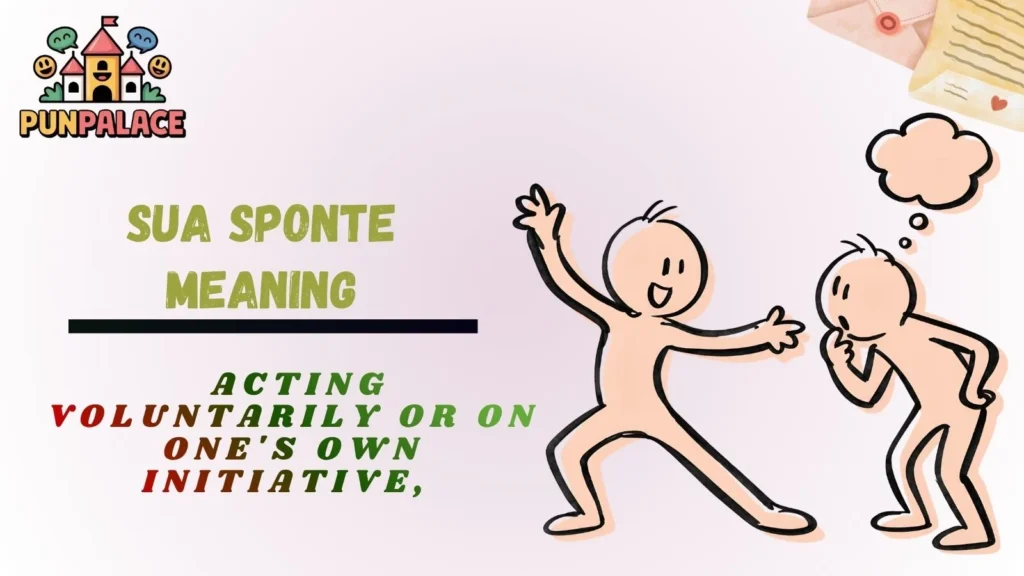
The sua sponte meaning is “on its own accord,” “of its own will,” or “on its own initiative.” In legal settings, it usually describes a situation where a judge or court takes action without being asked to do so by either party.
For example, if a judge notices an important legal issue and addresses it without either side filing a request, the court may be said to have acted sua sponte.
What Does Sua Sponte Mean? 🤔
Sua sponte is a Latin phrase that literally refers to acting by one’s own will or initiative.
Sua sponte = Acting voluntarily or on one’s own initiative, without being prompted by another person.
The phrase is particularly common in law, where it often describes an action taken by a court or judge without a motion, request, or suggestion from the parties involved.
In simple English, if a judge acts sua sponte, the judge has taken the action independently rather than waiting for one of the lawyers to ask for it.
Origin of Sua Sponte 📚
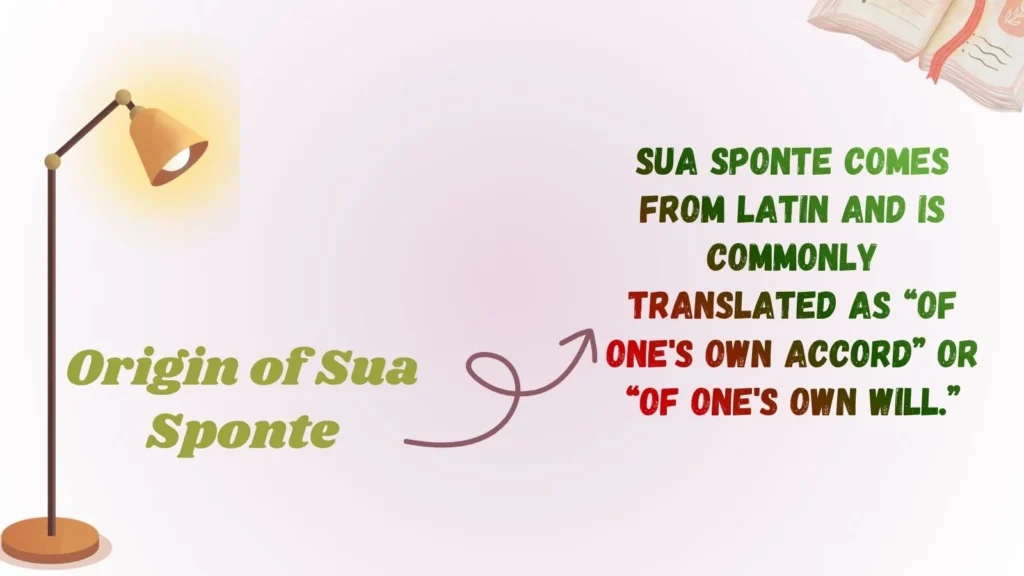
Sua sponte comes from Latin and is commonly translated as “of one’s own accord” or “of one’s own will.”
The phrase is made up of Latin words expressing the idea of something belonging to or originating from oneself and acting willingly or voluntarily.
Like many Latin expressions, it has remained part of formal legal vocabulary even though everyday English normally uses simpler phrases.
Legal writing contains many Latin expressions because Roman law and Latin historically influenced European legal traditions. Terms such as habeas corpus, bona fide, pro se, and de facto are other familiar examples.
Sua Sponte Meaning in Simple English 📖
The easiest way to understand sua sponte is:
“The person or authority decided to do it on their own.”
In everyday language, similar ideas include:
- On their own
- By their own choice
- On their own initiative
- Without being asked
- Voluntarily
- Without a request from someone else
However, sua sponte is much more formal than these everyday expressions and is especially associated with legal writing.
Sua Sponte Definition at a Glance 📊
| Term | Meaning |
|---|---|
| Sua Sponte | On one’s own initiative or by one’s own will |
| Language | Latin |
| Common Context | Legal and formal writing |
| Basic Idea | Taking action without being asked |
| Common Legal Use | A court or judge taking action independently |
| Similar Phrase | On its own motion |
What Does Sua Sponte Mean in Law? ⚖️
In legal terminology, sua sponte generally means that a court or judge takes action on its own initiative, rather than because one of the parties requested that action.
Courts may sometimes address an issue on their own when they believe it is necessary or appropriate under the applicable law and procedure.
For example:
“The court raised the jurisdictional issue sua sponte.”
This means the court considered or raised the jurisdiction issue on its own, rather than waiting for one of the parties to raise it.
Another example is:
“The judge dismissed the case sua sponte.”
This means the judge dismissed the case independently rather than doing so because a party specifically requested dismissal.
The exact authority of a court to act sua sponte depends on the applicable law and procedural rules.
Sua Sponte Examples in Legal Sentences 🏛️
Seeing the phrase in context makes its meaning much easier to understand.
Example 1: Court Raises an Issue
“The court raised the issue sua sponte.”
This means the court itself noticed and addressed the issue.
Example 2: Judge Orders a Hearing
“The judge scheduled a hearing sua sponte.”
Here, the judge initiated the action without waiting for a party to request the hearing.
Example 3: Sua Sponte Dismissal
“The court dismissed the action sua sponte.”
This means the court dismissed the action on its own initiative.
Example 4: Sua Sponte Review
“The appellate court reviewed the matter sua sponte.”
This means the court decided to consider the matter on its own initiative.
What Is a Sua Sponte Order? 📜
A sua sponte order is an order issued by a court on its own initiative.
Normally, lawyers or parties may file motions asking a judge to take a particular action. A court can sometimes act independently instead. When it does, the resulting order may be described as sua sponte.
For example, a judge might issue an order requiring the parties to provide additional information if the court believes that information is necessary for the case.
The important idea is that the court initiated the action rather than responding to a party’s request.
Sua Sponte Motion: Is That Correct? ⚠️
You may sometimes see the expression “sua sponte motion.” However, the phrase can be confusing because a motion is generally a formal request made by a party asking the court to take action.
Sua sponte, on the other hand, describes action taken by the court itself.
Therefore, legal terminology may more naturally refer to a sua sponte order, sua sponte ruling, sua sponte dismissal, or an issue the court raised sua sponte.
The exact terminology can depend on the jurisdiction and context.
Sua Sponte vs On Its Own Motion ⚖️
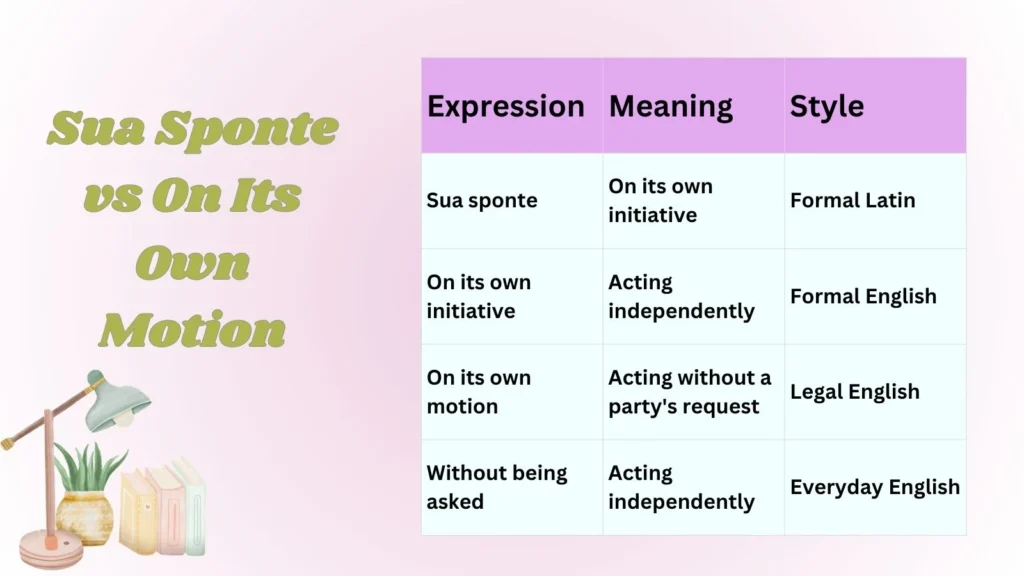
In legal writing, sua sponte is often used similarly to the phrase “on its own motion” or “on its own initiative.”
| Expression | Meaning | Style |
|---|---|---|
| Sua sponte | On its own initiative | Formal Latin |
| On its own initiative | Acting independently | Formal English |
| On its own motion | Acting without a party’s request | Legal English |
| Without being asked | Acting independently | Everyday English |
Although these expressions can overlap, legal meaning depends on the specific situation and jurisdiction.
How to Use Sua Sponte in a Sentence ✍️
Sua sponte is generally used as a formal adverbial phrase to describe an action taken independently.
Common sentence patterns include:
- “The court acted sua sponte.”
- “The judge raised the issue sua sponte.”
- “The court dismissed the case sua sponte.”
- “The appellate court considered the matter sua sponte.”
- “The judge issued a sua sponte order.”
Because the phrase is formal and legal, it may sound unusual in casual conversation.
Sua Sponte in Everyday English 💬
Although sua sponte is strongly associated with legal language, its underlying idea can be applied more broadly.
Imagine someone notices that a room is messy and decides to clean it without anyone asking.
You could describe the person as acting on their own initiative. In a highly formal context, the concept is similar to the meaning of sua sponte.
However, saying “I cleaned my room sua sponte” would sound unnecessarily formal in ordinary conversation. 😄
For everyday situations, “on my own,” “without being asked,” or “on my own initiative” would usually sound more natural.
Is Sua Sponte Only Used for Judges? 🏛️
No. The general meaning of sua sponte is broader than judges. It describes acting on one’s own initiative.
However, the phrase is especially common in legal contexts, where courts and judges may independently raise issues or take procedural actions.
That is why most people encounter the expression in:
- Court opinions
- Legal documents
- Judicial decisions
- Law textbooks
- Case summaries
- Legal research
Sua Sponte vs Voluntary: What’s the Difference? 🔍
Voluntary means something is done willingly rather than under force or obligation. Sua sponte emphasizes that an action was initiated independently by the person or authority taking it.
For example, a person may voluntarily agree to something because they are asked. That does not necessarily make the action sua sponte.
For an action to be described as sua sponte, the important idea is that it was taken without being prompted by another party.
Sua Sponte Synonyms and Similar Expressions 🔤
There is no single English word that perfectly replaces sua sponte in every legal context. However, several expressions convey a similar idea.
- On its own initiative
- On one’s own accord
- On its own motion
- Independently
- Voluntarily
- Without being prompted
- Without a request
In formal legal writing, “on its own initiative” is often a clear English alternative.
Why Do Lawyers Use Sua Sponte? ⚖️
Legal writing often uses specialized terminology because certain phrases communicate a specific procedural idea efficiently.
Sua sponte tells the reader that a court or authority took an action independently rather than in response to a party’s request.
This can be important when explaining how a court reached a decision or why a particular issue appeared in a case.
For someone unfamiliar with Latin legal terminology, however, the phrase can seem intimidating. Once translated into simple English, its basic concept is quite straightforward.
Common Mistakes About Sua Sponte ❌

1. Thinking Sua Sponte Means “By Request”
This is the opposite of the main idea. Sua sponte describes action taken independently rather than because someone else requested it.
2. Assuming It Only Means “Voluntary”
While voluntary action can overlap with the concept, sua sponte emphasizes acting on one’s own initiative, especially in legal contexts.
3. Using Sua Sponte in Every Casual Situation
The phrase is formal and is strongly associated with legal writing. In everyday conversation, expressions such as “on my own” or “without being asked” are usually more natural.
4. Confusing Sua Sponte With a Party’s Motion
A motion is generally a request made by a party to a court. Sua sponte describes an action initiated by the court itself, so the concepts should not automatically be treated as identical.
5. Assuming Every Court Action Is Sua Sponte
Not every judicial action is taken independently. Courts regularly act in response to motions, applications, objections, or other requests. The phrase applies when the relevant action is initiated by the court on its own.
FAQs:
What does sua sponte mean in simple English?
Sua sponte means on one’s own initiative or without being asked. It is especially common in legal contexts.
What does sua sponte mean in law?
In law, sua sponte generally describes an action taken by a court or judge on its own initiative rather than in response to a party’s request.
What is an example of sua sponte?
If a judge notices an issue and raises it without either lawyer asking the court to consider it, the judge may be described as acting sua sponte.
What is another word for sua sponte?
Similar expressions include “on its own initiative,” “on its own motion,” “independently,” and “on one’s own accord.”
Is sua sponte English or Latin?
Sua sponte is a Latin phrase that has become established in English, particularly in formal and legal writing.
Final Thoughts:
The sua sponte meaning is simply “on one’s own initiative” or “of one’s own accord.” The phrase is most commonly encountered in legal contexts, especially when a court or judge takes action without a request from the parties.
Remember the key idea: sua sponte means acting independently rather than waiting for someone else to ask.
Once you understand that concept, legal phrases such as sua sponte order, sua sponte dismissal, and sua sponte ruling become much easier to understand.
If you enjoy learning simple explanations of difficult English words, Latin phrases, slang, and expressions, explore more helpful vocabulary guides on punpalace.com.

I am Henry James and i am a passionate writer and language enthusiast behind PunPalace, a platform dedicated to exploring meanings, word origins, and simple explanations. My aims to make learning vocabulary easy, engaging, and accessible for everyone.