Have you ever heard a doctor use the word prognosis and wondered what it really means? Medical terms can sometimes sound complicated, especially when they concern a person’s health, recovery, or future. Understanding these words can make conversations with healthcare professionals easier and help you feel more informed.
The word prognosis refers to the expected outcome or likely course of a disease, medical condition, or health problem. In simple words, it describes what may happen in the future based on a person’s current condition, medical history, test results, and response to treatment.
For example, if a doctor says that a patient has a good prognosis, it generally means the patient is expected to have a favorable outcome. If the doctor describes the prognosis as poor, it means the expected outcome is less favorable or that the condition may be more difficult to treat.
However, a prognosis is not a guarantee. It is a medical prediction based on the information available at a particular time. Every patient is different, and outcomes can change as a condition develops or responds to treatment.
In this article, you will learn the prognosis meaning, its medical definition, common examples, different types, and how it differs from a diagnosis. You will also discover how the word is used in everyday English and what to ask when a healthcare professional discusses your prognosis.
What Is the Meaning of Prognosis?
Prognosis is a noun that means a prediction or estimate of the likely future outcome of a disease, medical condition, or situation.
The word is most commonly used in healthcare. Doctors use a prognosis to explain what they expect may happen to a patient, including the likelihood of recovery, the possible progression of an illness, and the expected effects of treatment.
Prognosis Meaning in Simple Words
In simple English, prognosis means what is likely to happen next.
For example:
- A patient with a mild infection may have a good prognosis.
- Someone recovering from an injury may have an excellent prognosis if the injury is expected to heal completely.
- A person with a serious, advanced illness may have a poor prognosis if treatment is unlikely to control the disease.
The exact meaning depends on the circumstances. A good prognosis does not necessarily mean a person will recover immediately, and a poor prognosis does not always mean recovery is impossible.
Prognosis Definition
A general definition of prognosis is:
Prognosis: An informed prediction about the probable development, duration, or outcome of a disease or condition.
In medicine, a prognosis may include several factors, such as:
- The likelihood of recovery.
- How long recovery might take.
- The possibility of complications.
- The chance that a disease will return.
- The likelihood of a condition progressing.
- The expected response to treatment.
- The possible impact on quality of life.
A doctor develops a prognosis by evaluating available medical evidence rather than simply guessing what will happen.
What Does Prognosis Mean in Medical Terms?
In medical terminology, prognosis describes the expected course and outcome of a patient’s condition.
When a healthcare professional evaluates someone, they consider the diagnosis, symptoms, physical examination, laboratory results, imaging studies, medical history, and other relevant information. These details help the professional estimate what may happen over time.
For instance, a doctor treating a patient with a broken bone may explain that the prognosis is good because the bone is expected to heal with appropriate treatment. The doctor may also provide an estimated recovery period and explain whether physical therapy could be necessary.
For another patient with a chronic condition, the prognosis may focus on whether the illness is likely to remain stable, improve with treatment, or gradually progress.
A medical prognosis can address different questions:
- Recovery: Is the patient likely to recover?
- Duration: How long might the condition last?
- Progression: Is the illness likely to worsen?
- Treatment: How likely is the patient to respond to a particular treatment?
- Recurrence: Could the condition return?
- Long-term outlook: What effects might the condition have on everyday life?
It is important to remember that a prognosis is an estimate, not a promise. Two people with the same diagnosis may have different prognoses because their overall health, age, medical history, treatment options, and individual responses may differ.
Good Prognosis Meaning
A good prognosis means that the expected outcome is favorable.
In medical situations, this often suggests that a patient is likely to improve, recover, respond well to treatment, or experience a manageable course of illness.
For example, a person with a minor infection that is expected to clear up after treatment may have a good prognosis.
A good prognosis can also apply to long-term conditions. A person may not be expected to recover completely, but the condition may be likely to remain stable with treatment and have a limited effect on daily activities.
Examples of Good Prognosis
Example 1: A patient has a mild infection, and the doctor expects a full recovery with the recommended treatment.
Example 2: A person breaks an arm, receives proper medical care, and is expected to regain normal function after healing.
Example 3: Someone with a manageable chronic condition is expected to control the symptoms through medication and lifestyle adjustments.
In each example, the outlook is favorable, although the exact recovery process may differ.
A good prognosis does not mean there is no risk. Complications can still occur, and the expected outcome may change as new information becomes available.
Poor Prognosis Meaning
A poor prognosis means that the expected outcome is unfavorable or less promising.
In healthcare, this may indicate that a condition is difficult to treat, has a significant risk of complications, is likely to progress, or has a lower chance of recovery.
For example, a patient with a serious illness that has not responded well to available treatments may be described as having a poor prognosis.
However, the phrase does not automatically mean that death is inevitable. Its meaning depends on the specific condition and the way the healthcare professional is using the term.
A poor prognosis might refer to a low likelihood of complete recovery, a high chance of recurrence, limited treatment options, or the expectation that symptoms may continue.
Examples of Poor Prognosis
Example 1: A severe infection has caused major complications, making recovery more difficult.
Example 2: A disease continues to progress despite several treatments, reducing the likelihood of controlling it.
Example 3: A serious injury has caused lasting damage that may limit the patient’s future mobility.
These examples illustrate why doctors consider multiple factors when discussing a prognosis. The phrase describes the expected outlook rather than determining exactly what will happen to an individual.
Prognosis Meaning With Examples
The easiest way to understand the word prognosis is to see how it appears in sentences.
Here are several examples from medical and everyday contexts.
| Sentence | Meaning |
|---|---|
| The doctor gave the patient a good prognosis. | The patient is expected to have a favorable outcome. |
| Her prognosis improved after treatment. | Her expected outlook became more positive. |
| The prognosis for a complete recovery is uncertain. | It is not yet clear whether full recovery is likely. |
| The patient has a poor prognosis. | The expected outcome is unfavorable. |
| Early treatment may improve the prognosis. | Treatment may increase the chance of a better outcome. |
| The long-term prognosis remains unclear. | The future course of the condition is not yet known. |
| The doctor discussed the prognosis with the family. | The doctor explained what may happen in the future. |
| His prognosis depends on how he responds to treatment. | His expected outcome may change according to his treatment response. |
Prognosis in Everyday English
Although prognosis is primarily a medical word, it can also be used more broadly to describe the expected future of a situation.
For example:
- Business: The economic prognosis for the company is encouraging.
- Weather: The prognosis for the storm’s development is uncertain.
- Sports: The team’s prognosis for the rest of the season looks positive.
- Projects: The prognosis for completing the project on time is poor.
In these examples, prognosis means an assessment of the likely future outcome.
However, in ordinary conversations, people often use words such as outlook, forecast, or prediction because they are more familiar and less formal.
Types of Prognosis
A prognosis can be classified in different ways depending on the condition, the medical question, and the expected outcome. There is no single classification that applies to every disease.
The following categories explain common ways healthcare professionals discuss prognosis.
1. Favorable Prognosis
A favorable prognosis means that the expected outcome is positive.
The patient may have a strong likelihood of recovery, a good response to treatment, or a relatively low risk of serious complications.
For example, a person with a treatable condition that is expected to resolve may have a favorable prognosis.
2. Unfavorable Prognosis
An unfavorable prognosis means that the expected outcome is less positive.
This may involve a lower likelihood of recovery, a greater chance of complications, or a condition that is difficult to manage.
The term does not necessarily mean treatment will fail. It describes the anticipated outcome based on current evidence.
3. Uncertain Prognosis
An uncertain prognosis means that there is not enough information to predict the outcome confidently.
This may happen when a disease has only recently been identified, additional tests are needed, or the patient’s response to treatment is not yet clear.
For example, a doctor may wait to see how a patient responds to initial treatment before providing a more specific outlook.
4. Short-Term Prognosis
A short-term prognosis focuses on what is likely to happen in the near future.
It may cover the next few days, weeks, or months, depending on the condition.
For example, a doctor may discuss whether a patient is likely to recover from an acute infection over the next several days.
5. Long-Term Prognosis
A long-term prognosis considers the expected course of a condition over an extended period.
It may address the likelihood of recurrence, future complications, lasting effects, or long-term disease management.
For instance, a person with a chronic condition may need to understand how the illness could affect their health over several years.
6. Functional Prognosis
A functional prognosis focuses on a person’s expected ability to perform activities after an illness or injury.
It may consider mobility, independence, communication, memory, or the ability to return to work.
For example, after a serious injury, a rehabilitation team may estimate how much movement or independence a patient is likely to regain.
7. Treatment Prognosis
A treatment prognosis concerns the expected response to a specific treatment or treatment plan.
It may address how likely a therapy is to improve symptoms, control a disease, or prevent complications.
The expected response may depend on the type of treatment, the stage of the condition, and the patient’s individual circumstances.
Prognosis vs. Diagnosis: What Is the Difference?
The words prognosis and diagnosis are closely related, but they have different meanings.
A diagnosis identifies or names a medical condition, while a prognosis estimates its likely future course and outcome.
For example, if a doctor identifies pneumonia in a patient, that is the diagnosis. The doctor’s estimate of how likely the patient is to recover, how long recovery may take, and whether complications are likely is the prognosis.
| Feature | Diagnosis | Prognosis |
|---|---|---|
| Meaning | Identifies a disease or condition | Predicts its likely course or outcome |
| Main question | What is the condition? | What is likely to happen? |
| Purpose | Helps identify the health problem | Helps estimate future outcomes |
| Based on | Symptoms, examinations, and tests | Diagnosis, test results, medical history, and other factors |
| Example | The patient has influenza. | The patient is expected to recover within a typical period. |
Easy Way to Remember the Difference
Think of the two terms this way:
- Diagnosis = What is happening now?
- Prognosis = What may happen next?
Both are important in medical care. A diagnosis helps healthcare professionals understand the condition, while a prognosis helps them discuss possible outcomes and plan treatment.
A prognosis may change even when the diagnosis stays the same. For example, a patient may initially have an uncertain outlook, but the prognosis may improve after a positive response to treatment.
Prognosis vs. Prediction vs. Forecast
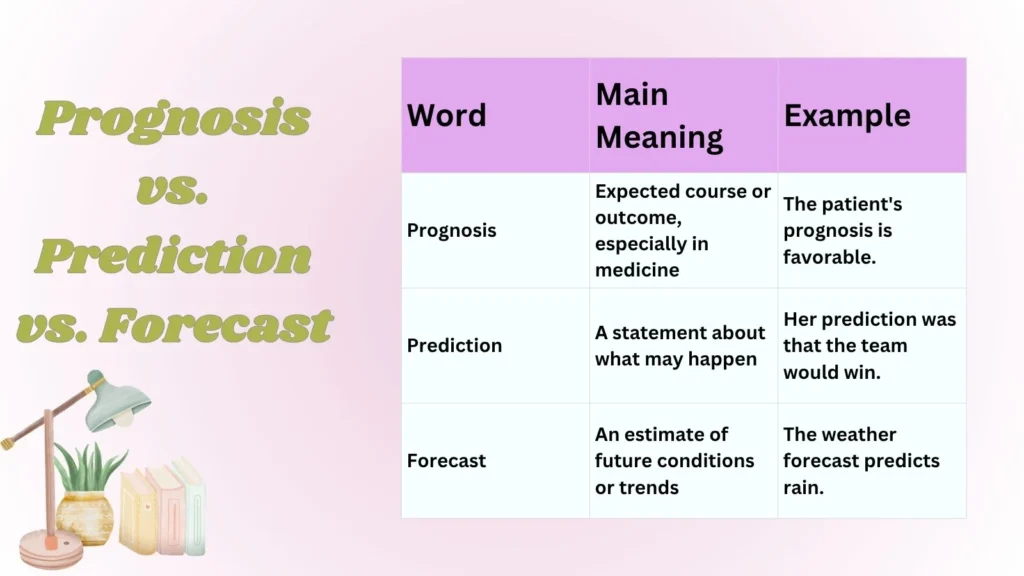
Prognosis, prediction, and forecast all relate to the future, but they are not always interchangeable.
| Word | Main Meaning | Example |
|---|---|---|
| Prognosis | Expected course or outcome, especially in medicine | The patient’s prognosis is favorable. |
| Prediction | A statement about what may happen | Her prediction was that the team would win. |
| Forecast | An estimate of future conditions or trends | The weather forecast predicts rain. |
For example, a doctor’s prognosis is based on clinical information about a patient’s condition. A weather forecast is based on meteorological observations and models. Both involve estimating the future, but they apply to different situations.
How Do Doctors Determine a Prognosis?
Doctors do not determine a prognosis from a single factor in every case. They consider the available evidence and how different factors may influence the patient’s expected outcome.
The exact assessment depends on the condition being treated.
1. The Type of Condition
Some conditions are usually temporary and respond well to treatment, while others may be complex, progressive, or difficult to manage.
The nature of the illness or injury helps establish the starting point for the prognosis.
2. The Severity of the Condition
The severity of a condition can influence the expected outcome.
A mild illness may have a different prognosis from the same illness when it causes serious complications.
3. The Stage or Extent of Disease
For some diseases, the extent to which the condition has progressed is an important factor.
Doctors may use examinations, scans, laboratory tests, and other investigations to understand how extensive a disease is and what that may mean for the future.
4. The Patient’s Overall Health
A person’s general health can affect recovery and treatment response.
Relevant considerations may include existing medical conditions, physical function, nutritional status, and other individual factors.
5. Response to Treatment
The way a patient responds to treatment can provide important information.
If the condition improves as expected, the prognosis may become more favorable. If treatment does not work or complications develop, the expected outlook may need to be reassessed.
6. Available Medical Evidence
Healthcare professionals may use research findings, clinical guidelines, diagnostic tests, and experience with similar cases to estimate possible outcomes.
However, statistics describe groups of people and cannot predict an individual’s future with complete certainty.
7. The Possibility of Complications
Doctors may consider whether the condition could cause additional health problems.
A higher risk of complications may affect the prognosis, while the ability to prevent or manage those complications may improve the expected outlook.
Because these factors differ from person to person, it is best to ask a healthcare professional how they apply to your specific situation.
What Does a Prognosis Tell a Patient?
A prognosis can help patients and their families understand what to expect and make informed decisions about care.
Depending on the situation, a healthcare professional may use a prognosis to discuss several important topics.
Expected Recovery
A prognosis may indicate whether recovery is likely, whether it may take time, or whether some effects of the condition could remain.
The expected recovery period is usually an estimate rather than a fixed deadline.
Treatment Choices
Understanding the likely outcome can help patients discuss available treatment options with their healthcare team.
The discussion may include potential benefits, risks, limitations, and the goals of treatment.
Follow-Up Care
Some conditions require additional appointments, rehabilitation, monitoring, or lifestyle adjustments.
A prognosis may help explain why follow-up care is important and what healthcare professionals hope to achieve.
Planning for the Future
For long-term or serious conditions, understanding the expected course of illness can help patients and families prepare for possible changes in daily life.
This information can also support conversations about personal goals, practical needs, and the kind of care a patient prefers.
A prognosis should be explained in language the patient understands. If a medical professional uses unfamiliar terminology, it is reasonable to ask for a simpler explanation.
Can a Prognosis Change Over Time?
Yes. A prognosis can change as a patient’s condition develops and new information becomes available.
A prognosis is based on the evidence available when it is made. It is not a permanent statement about what will happen.
For example, a patient may initially have an uncertain prognosis because the doctor is waiting for test results. After receiving the results and observing a positive response to treatment, the doctor may give a more favorable assessment.
The opposite can also happen. A patient’s condition may become more complicated, or a treatment may not work as expected. In that situation, the prognosis may become less favorable.
Factors that can lead to a change in prognosis include:
- New laboratory or imaging results.
- Improvement or worsening of symptoms.
- Response to medication or another treatment.
- The development of complications.
- Changes in overall health.
- Additional information about the condition.
A changing prognosis does not necessarily mean that the original assessment was wrong. It may reflect the fact that medicine involves uncertainty and that the patient’s situation has changed.
What Does Prognosis Mean in Cancer?
In cancer care, prognosis refers to the expected course and outcome of a person’s cancer.
It may include the likelihood of treatment success, the possibility of recurrence, expected survival, and the potential effects of cancer on a person’s health and quality of life.
A cancer prognosis can depend on several factors, including:
- The type of cancer.
- The stage of the cancer.
- Whether it has spread to other parts of the body.
- Certain features of the cancer cells.
- The patient’s overall health.
- Available treatment options.
- How the cancer responds to treatment.
Doctors may discuss survival statistics when explaining a cancer prognosis. These statistics are based on groups of people with particular characteristics and are not precise predictions for any one person.
For example, a statistic describing the percentage of people who are alive five years after a diagnosis does not tell an individual exactly how long they will live. Some people live much longer, and others have different outcomes.
It is also important to distinguish between prognosis and cancer stage. Cancer stage describes the extent of the cancer, while prognosis estimates the likely outcome based on the stage and other relevant factors.
Patients who have questions about a cancer prognosis can ask their oncology team to explain what the available evidence means for their specific case.
What Does Prognosis Mean Outside Medicine?
Although prognosis is strongly associated with healthcare, the word can also describe the likely future of a nonmedical situation.
In these contexts, it generally means an assessment of how a situation is expected to develop.
Business Prognosis
A business prognosis describes the expected future performance or condition of a company, industry, or market.
Example: The business has a positive prognosis because sales are increasing and customer demand remains strong.
This means the company is expected to perform well, although future results are not guaranteed.
Economic Prognosis
An economic prognosis refers to an assessment of likely economic conditions.
Example: The economic prognosis remains uncertain because inflation and employment trends are changing.
The sentence describes uncertainty about the economy’s future direction.
Prognosis for a Project
The word can also describe whether a project is likely to succeed.
Example: The prognosis for completing the project on time is poor because several important tasks are behind schedule.
Here, prognosis means the expected outcome of the project.
Prognosis in Everyday Conversation
The word may appear in formal conversations, reports, or analytical writing.
However, if you want to speak casually, words such as outlook, future, and likely outcome may sound more natural.
For example, instead of saying, “The prognosis for our weekend plans is uncertain,” you could simply say, “It is unclear whether our weekend plans will work out.”
Synonyms and Related Words for Prognosis
Synonyms for prognosis depend on the context. Some words are close in meaning, while others apply only in particular situations.
| Word | Meaning | Best Context |
|---|---|---|
| Outlook | The expected future condition or situation | Medical and general use |
| Prediction | A statement about what may happen | General use |
| Forecast | An estimate of future conditions | Weather, economics, business |
| Expectation | A belief about what is likely to happen | Everyday English |
| Projection | An estimate of a future result based on information | Finance, planning, research |
| Prospects | The chances of future success or improvement | General use |
| Anticipation | Expectation of a future event | General use |
The word outlook is often the easiest substitute for prognosis in ordinary English.
For example, “The patient’s prognosis is good” can be restated as “The patient’s outlook is favorable.”
However, in a medical report, prognosis may be more precise because it refers specifically to the expected course or outcome of a condition.
Antonyms of Prognosis
There is no single perfect antonym for prognosis because prognosis is a prediction or assessment rather than a quality that has one direct opposite.
However, several words express contrasting ideas depending on the sentence.
- Uncertainty: A lack of confidence about what will happen.
- Unknown: Something whose outcome is not known.
- Retrospection: Looking back at past events rather than considering future outcomes.
- Diagnosis: A related medical term that identifies a condition rather than predicting its future course.
Diagnosis is not a true antonym of prognosis, but it is sometimes confused with it because both words are used in healthcare.
The best contrasting word depends on what you want to communicate. For example, uncertainty may be appropriate when the future outcome cannot be predicted confidently.
Common Mistakes When Using the Word Prognosis

Understanding the meaning of prognosis is easier when you know the mistakes people commonly make with it.
1. Confusing Prognosis With Diagnosis
A diagnosis identifies a condition, while a prognosis describes its expected future course.
Incorrect understanding: “The prognosis tells the doctor which disease the patient has.”
Correct understanding: “The diagnosis identifies the disease, and the prognosis estimates what may happen next.”
2. Assuming a Good Prognosis Guarantees Recovery
A good prognosis suggests a favorable expected outcome, but it does not guarantee that everything will go as planned.
Medical conditions can develop unpredictably, and individual outcomes may differ.
3. Assuming a Poor Prognosis Means Recovery Is Impossible
A poor prognosis indicates that the expected outcome is unfavorable. It does not automatically mean that recovery cannot happen.
The precise meaning depends on the condition and the doctor’s assessment.
4. Using Prognosis When You Mean Forecast
Although both words refer to the future, forecast is generally more appropriate for weather and many economic predictions.
For example, “The weather forecast predicts rain” is more natural than “The weather prognosis predicts rain.”
FAQs:
1. What does prognosis mean in simple words?
Prognosis means the expected future outcome of a disease, medical condition, or situation. In simple words, it describes what is likely to happen next.
2. What does prognosis mean in medical terms?
In medicine, prognosis is an estimate of how a disease or condition is likely to develop. It may include the chances of recovery, the expected duration of illness, and the likelihood of complications.
3. What does a good prognosis mean?
A good prognosis means the expected outcome is favorable. A patient may be likely to recover, respond well to treatment, or manage a condition successfully.
4. What does a poor prognosis mean?
A poor prognosis means the expected outcome is unfavorable or less promising. It may indicate a lower chance of recovery or a greater likelihood of complications, depending on the condition.
5. What is the difference between prognosis and diagnosis?
A diagnosis identifies a disease or condition, while a prognosis predicts its likely future course. Diagnosis answers, “What is the problem?” Prognosis answers, “What may happen next?”
6. Can a prognosis change?
Yes. A prognosis can change when symptoms improve or worsen, test results become available, treatment has an unexpected effect, or new complications develop.
7. Does an uncertain prognosis mean a bad outcome?
No. An uncertain prognosis means the outcome cannot yet be predicted confidently. More tests, time, or information about the patient’s response to treatment may be needed.
8. What does prognosis mean in cancer?
In cancer care, prognosis describes the expected course and outcome of the disease. It may consider cancer type, stage, treatment response, and the patient’s overall health.
9. Is prognosis always a medical term?
No. Although prognosis is most commonly used in medicine, it can also describe the expected future of a business, project, economy, or other situation.
10. What is another word for prognosis?
Depending on the context, similar words include outlook, prediction, forecast, and expected outcome. In medical conversations, outlook is often a simple alternative.
Conclusion:
The word prognosis means an estimate of the likely future course or outcome of a disease, condition, or situation. It is most commonly used in medicine to explain whether a patient is expected to recover, how a condition may progress, and what outcomes might be possible.
A good prognosis generally means a favorable outlook, while a poor prognosis indicates a less favorable expected outcome. An uncertain prognosis means that there is not enough information to predict the future confidently.
The most important distinction to remember is that diagnosis identifies a condition, whereas prognosis estimates what may happen next. A prognosis is based on the available evidence, not a guarantee, and it can change as new information becomes available.
Now that you understand the prognosis meaning, you can recognize the term more confidently in medical conversations, health reports, and everyday English. If you hear a healthcare professional discuss your prognosis, ask what it means for your particular situation so you can better understand the possible outcomes and next steps.

I am Henry James and i am a passionate writer and language enthusiast behind PunPalace, a platform dedicated to exploring meanings, word origins, and simple explanations. My aims to make learning vocabulary easy, engaging, and accessible for everyone.