Have you ever sat in a classroom while a teacher explained a topic for an extended period? Or has someone told you that they were going to lecture you about something you did wrong? The word lecture can be used in both situations, but the meaning changes depending on the context.
The most common lecture meaning is a formal talk given to a group of people, especially students, to teach or explain a subject. However, lecture can also mean giving someone a long, serious talk because you think they have behaved incorrectly.
In this guide, you will learn the lecture definition, its different meanings, examples, synonyms, types of lectures, grammatical uses, and how to understand the word in everyday conversation.
What Is the Lecture Meaning?
Lecture generally means a formal talk given to an audience to teach, explain, or discuss a particular subject.
For example, a university professor may give a lecture about history, science, literature, economics, or another academic subject.
Simple definition: A lecture is a formal speech or lesson given to a group of people, usually for educational purposes.
The word can also be used as a verb. When someone says, “My teacher lectured us about the importance of studying,” it means the teacher gave the students a serious talk about studying.
Lecture Meaning in Simple English
In simple English, lecture means a talk that teaches people something.
Imagine a teacher standing in front of a classroom and explaining a topic while students listen and take notes. That is a lecture.
The word can also have a second meaning in everyday speech. If someone says, “Don’t lecture me,” they usually mean, “Don’t give me a long and serious speech about what I should or should not do.”
| Use | Simple Meaning | Example |
|---|---|---|
| Noun | A formal educational talk | The professor gave a lecture. |
| Verb | To give a formal or serious talk | She lectured the students. |
| Informal use | To criticize or advise someone at length | Don’t lecture me about my choices. |
What Does Lecture Mean?
What does lecture mean? It means a formal presentation or talk intended to teach, explain, or discuss a subject. It can also mean speaking to someone at length in a serious or critical way about their behavior.
The surrounding words usually tell you which meaning is intended.
For example:
- “I attended a lecture on biology.” — This means an educational talk.
- “My parents lectured me about being late.” — This means they gave me a serious talk about my behavior.
So, lecture can be educational, but it can also describe a long and sometimes unwanted piece of advice or criticism.
Lecture as a Noun
When lecture is used as a noun, it usually refers to a formal talk given to an audience.
Examples include:
- The professor delivered a lecture on psychology.
- We attended a lecture about climate science.
- The lecture lasted for two hours.
- She took notes during the lecture.
- The university organized a public lecture.
In educational settings, a lecture may be part of a course. Students listen to an instructor explain concepts, theories, facts, or arguments.
Lecture as a Verb
Lecture can also function as a verb. As a verb, it means to give a lecture or to speak to someone seriously for a long time, often about their behavior.
Educational Use
“The professor lectures on modern history.”
Here, lectures simply means teaches or gives formal talks about modern history.
Critical or Advisory Use
“My father lectured me about wasting money.”
Here, lectured means gave the speaker a serious talk because of their behavior.
This second use can sometimes have a negative tone because the person receiving the lecture may feel that they are being criticized or talked down to.
Types of Lectures
Lectures can take many forms depending on the audience, subject, and purpose.
Academic Lecture
An academic lecture is usually given by a teacher, professor, or researcher to explain a subject to students or other learners.
For example, a professor might give a lecture about ancient history or computer science.
Guest Lecture
A guest lecture is delivered by someone who is invited to speak to a class, organization, or audience.
A university might invite a professional to discuss their career experience with students.
Public Lecture
A public lecture is usually open to a wider audience. It may focus on science, history, culture, literature, technology, or another topic of public interest.
Online Lecture
An online lecture is delivered through a digital platform. Students may watch it live or access a recorded version later.
Guest Speaker Lecture
A guest speaker may give a lecture based on personal experience, professional knowledge, research, or specialized expertise.
University Lecture
A university lecture is a common part of higher education. Professors often use lectures to introduce important concepts before students complete readings, assignments, discussions, or practical work.
Lecture Meaning in Education
In education, a lecture is a method of teaching in which an instructor presents information to students.
Lectures are common in colleges and universities, although schools and training programs may also use them.
A typical lecture may include:
- An introduction to the topic
- Explanation of important concepts
- Examples and illustrations
- Supporting facts or evidence
- Questions or discussion
- A summary of the main points
Students may listen, take notes, ask questions, and later review the material.
Lecture Meaning in Everyday Conversation
Outside education, lecture often has a different emotional tone.
If someone says, “I don’t need a lecture,” they usually do not mean they do not want to attend a classroom lesson. They mean they do not want someone to give them a long speech about what they did wrong.
For example:
“I know I made a mistake. You don’t have to lecture me.”
In this sentence, lecture means to criticize, advise, or scold someone at length.
This use is common in conversations between parents and children, friends, couples, coworkers, and other people who are discussing someone’s behavior.
Lecture Examples in Sentences
Here are some simple examples that show how the word is used naturally.
- The professor gave a fascinating lecture about astronomy.
- I attended a lecture on modern art.
- The students listened carefully to the lecture.
- She took detailed notes during the lecture.
- The university invited a scientist to give a lecture.
- We watched an online lecture about economics.
- He has to lecture the class tomorrow.
- My parents lectured me about being responsible.
- She did not want another lecture about her grades.
- Don’t lecture me about something you also do.
Lecture Synonyms
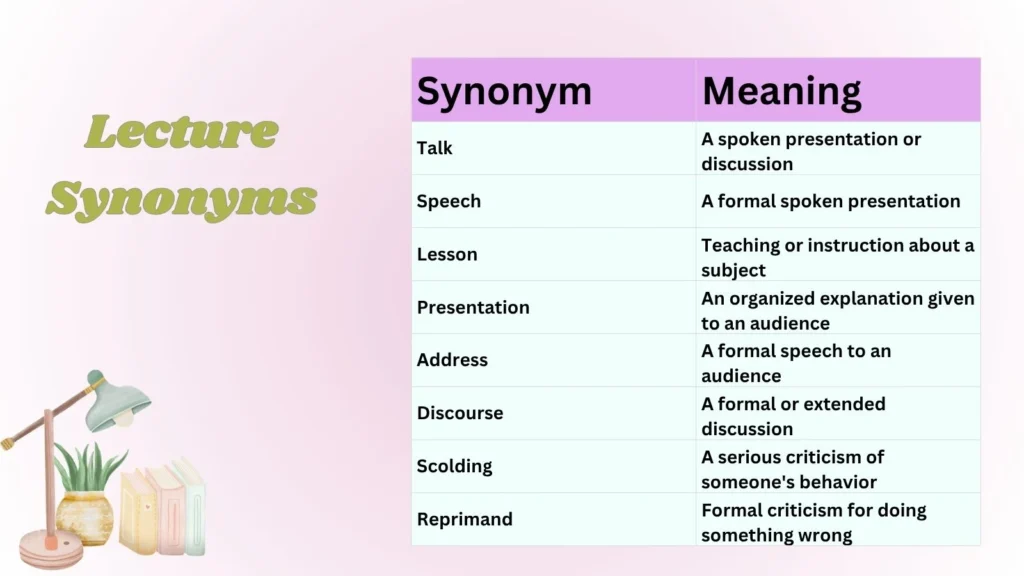
The best synonym for lecture depends on its context.
| Synonym | Meaning |
|---|---|
| Talk | A spoken presentation or discussion |
| Speech | A formal spoken presentation |
| Lesson | Teaching or instruction about a subject |
| Presentation | An organized explanation given to an audience |
| Address | A formal speech to an audience |
| Discourse | A formal or extended discussion |
| Scolding | A serious criticism of someone’s behavior |
| Reprimand | Formal criticism for doing something wrong |
Remember that these are not perfect replacements in every sentence. For example, a lesson may involve interaction and practice, while a lecture is usually more focused on the speaker explaining information to listeners.
Lecture vs Lesson
Lecture and lesson are closely related, but they are not exactly the same.
A lecture usually involves an instructor or speaker presenting information to a group. A lesson can be broader and may include activities, exercises, questions, demonstrations, and individual practice.
| Lecture | Lesson |
|---|---|
| Usually a formal talk | Can involve many teaching activities |
| Often delivered to a group | Can be individual or group-based |
| Common in universities | Common at all educational levels |
| Usually speaker-focused | Can be more interactive |
For example, a professor may give a 60-minute lecture and then hold a separate practical lesson where students work on exercises.
Lecture vs Speech
A speech is any organized spoken presentation, while a lecture normally has an educational or explanatory purpose.
A politician, award recipient, or wedding guest may give a speech. A professor or expert may give a lecture to explain a subject.
There can be overlap, but the purpose and context help distinguish them.
Lecture vs Seminar
A lecture generally involves one speaker presenting information to an audience. A seminar is often more interactive and may involve discussion, questions, presentations, and participation from attendees.
For example, students might attend a lecture to learn the basic theory of a subject and then join a seminar to discuss that theory.
Lecture in College and University
In higher education, lectures are one of the most familiar teaching formats.
A university course may include several lectures each week. The instructor introduces concepts, explains difficult material, discusses research, and provides examples.
Students may use lecture notes alongside textbooks, articles, assignments, and other course materials.
For example:
“Our psychology lecture covered memory, attention, and learning.”
Here, lecture refers to the teaching session rather than simply the physical classroom.
Lecture Meaning in a Negative Context
Although a lecture can be completely neutral or positive in an educational context, the word can have a negative tone when it describes personal advice or criticism.
For example:
“She gave me a lecture about being more careful.”
This may suggest that the speaker talked for a long time and sounded critical or overly serious.
That is why someone might say:
“Please don’t lecture me.”
They may be expressing frustration because they feel they already understand the situation and do not want a long explanation or criticism.
Common Phrases With Lecture
Several expressions containing lecture are common in English.
- Give a lecture — deliver a formal talk.
- Attend a lecture — go to a formal educational talk.
- Listen to a lecture — hear an educational presentation.
- Deliver a lecture — formally present a lecture.
- Attend a guest lecture — participate in a talk by an invited speaker.
- Give someone a lecture — speak to someone seriously, often critically.
- Get a lecture — receive a long or serious talk.
- Lecture someone about something — give someone extended advice or criticism about a subject.
How to Use Lecture Correctly
Use lecture as a noun when you are talking about the talk itself.
Example:
“The lecture starts at 10 a.m.”
Use lecture as a verb when describing the action of giving the talk.
Example:
“The professor will lecture on ancient philosophy.”
When it describes criticism or advice, it is often followed by a person and a topic.
Example:
“She lectured me about arriving late.”
This structure helps make the intended meaning clear.
How to Remember the Lecture Meaning
A simple way to remember lecture meaning is to connect it with the idea of someone speaking to an audience to explain something.
For the educational meaning:
Lecture = formal talk that teaches or explains.
For the informal meaning:
Lecture someone = give them a long, serious talk about their behavior.
Think of the context. If you hear “lecture hall,” “professor,” or “students,” the educational meaning is probably intended. If you hear “don’t lecture me,” the word probably refers to criticism or unwanted advice.
Common Mistakes With Lecture

Confusing a Lecture With Any Conversation
Not every conversation is a lecture. A lecture is generally a formal or extended presentation, especially one intended to teach or explain something.
Assuming Every Lecture Is Negative
A lecture can be completely neutral. University lectures, scientific lectures, and public educational lectures are not necessarily critical or unpleasant.
Forgetting the Verb Form
Lecture can be both a noun and a verb. “The lecture was interesting” uses it as a noun, while “The professor lectures on history” uses it as a verb.
Using Lecture When You Mean Lesson
A lecture is one type of teaching method. A lesson can involve much more interaction and practical activity.
Ignoring the Context
“I attended a lecture” and “My mother lectured me” have different meanings. Always look at the surrounding words before interpreting the term.
FAQs:
What is the simple meaning of lecture?
The simple lecture meaning is a formal talk given to teach or explain a subject to a group of people. It can also mean a long, serious talk criticizing or advising someone.
What does lecture mean in education?
In education, a lecture is a teaching session in which a professor, teacher, or expert presents information about a particular subject to students or an audience.
What does it mean to lecture someone?
To lecture someone means to give them a long, serious talk, often because you believe they have behaved incorrectly or made a mistake.
Is a lecture the same as a lesson?
Not exactly. A lecture is usually a formal presentation by a speaker, while a lesson is a broader teaching session that may include discussion, activities, practice, and interaction.
What are synonyms for lecture?
Depending on the context, synonyms include talk, speech, presentation, lesson, address, discourse, scolding, and reprimand.
Conclusion:
The lecture meaning is mainly a formal talk given to teach, explain, or discuss a subject. It is especially common in schools, colleges, universities, conferences, and professional settings.
However, lecture has another common meaning in everyday English. To lecture someone can mean to give them a long and serious speech about their behavior, often with a critical or advisory tone.
The easiest way to understand the word is to consider its context. A professor giving information to students is delivering a lecture, while a parent telling a child at length about their mistake may also be described as giving them a lecture.
Once you understand these two meanings, words and phrases such as lecture hall, guest lecture, public lecture, lecture notes, give a lecture, and don’t lecture me become much easier to understand and use correctly.

I am Henry James and i am a passionate writer and language enthusiast behind PunPalace, a platform dedicated to exploring meanings, word origins, and simple explanations. My aims to make learning vocabulary easy, engaging, and accessible for everyone.