Have you ever seen QCD in a message, document, technical discussion, or online conversation and wondered what it means? You are not alone. Like many abbreviations, QCD meaning depends heavily on the context in which you see it.
In science and physics, QCD commonly means Quantum Chromodynamics, a major theory that explains how quarks and gluons interact. However, QCD can also have other meanings in business, technology, medicine, finance, and everyday communication.
In this guide, we will explain what does QCD mean in simple English, explore its most common definition, look at examples, and explain how to understand QCD based on context.
What Does QCD Mean?
The most widely recognized QCD meaning in science is Quantum Chromodynamics.
Quantum Chromodynamics is the theory in particle physics that describes the strong interaction, one of the fundamental forces of nature. It explains how tiny particles called quarks interact through particles called gluons.
Simply put, QCD helps scientists understand what happens inside particles such as protons and neutrons.
| Term | Meaning | Common Context |
|---|---|---|
| QCD | Quantum Chromodynamics | Physics |
| Q | Quantum | Particle physics |
| C | Chromodynamics | Strong interaction theory |
| Quarks | Fundamental particles | Particle physics |
| Gluons | Particles that mediate the strong force | Particle physics |
QCD Meaning in Simple English
In simple English, QCD is a scientific theory about how quarks stick and interact with one another.
Quarks are extremely small particles found inside larger particles such as protons and neutrons. They interact through the strong nuclear force, which is described by Quantum Chromodynamics.
Think of QCD as a set of rules that helps physicists understand the behavior of quarks and gluons.
So, if someone asks, “What does QCD mean?” in a physics class, the answer is usually Quantum Chromodynamics.
What Is Quantum Chromodynamics?
Quantum Chromodynamics is a quantum field theory that describes the strong interaction between quarks and gluons.
The name may sound complicated, but each part gives us a clue:
- Quantum refers to the principles of quantum mechanics.
- Chromo relates to the special type of charge involved in the theory, called color charge.
- Dynamics refers to the study of forces and motion or interactions.
Unlike ordinary color such as red, blue, or green, color charge is a technical property used in particle physics.
QCD is an important part of the Standard Model of particle physics because it describes one of the four fundamental interactions of nature.
Why Is QCD Important?
QCD is important because the strong interaction plays a central role in the structure of ordinary matter.
Protons and neutrons are made from quarks. The interactions among these quarks and gluons are governed by QCD.
Without understanding the strong interaction, scientists would have an incomplete picture of how much of the visible universe is built.
QCD also helps researchers study high-energy particle collisions and conditions that existed shortly after the beginning of the universe.
QCD provides a framework for understanding the strong interaction between quarks and gluons.
QCD and Quarks
To understand the QCD definition, it helps to know what quarks are.
Quarks are elementary particles. There are six types, commonly called up, down, charm, strange, top, and bottom.
Quarks do not normally appear alone under ordinary conditions. They are generally found within composite particles called hadrons.
For example, protons and neutrons contain combinations of quarks. QCD describes the strong interactions that hold these components together.
QCD and Gluons
Another important part of QCD is the gluon.
Gluons are elementary particles associated with the strong interaction. They act as carriers of the strong force between quarks.
The name “gluon” is easy to remember because these particles are associated with the interaction that effectively binds quarks together.
However, QCD is more complicated than simply saying that gluons “glue” quarks together. Gluons themselves carry color charge, which makes the strong interaction particularly interesting.
What Does QCD Mean in Physics?
In physics, QCD means Quantum Chromodynamics.
It is used when discussing topics such as:
- Quarks
- Gluons
- Strong interactions
- Particle physics
- Hadrons
- Protons and neutrons
- High-energy collisions
- Quantum field theory
For example, a physics textbook might say, “The behavior of quarks is described by QCD.” Here, the abbreviation clearly refers to Quantum Chromodynamics.
QCD Meaning in a Sentence
Seeing QCD in a sentence can make its meaning much easier to understand.
- “The researcher specializes in QCD and particle physics.”
- “QCD explains the strong interaction between quarks and gluons.”
- “The students studied Quantum Chromodynamics in their advanced physics course.”
- “The experiment provided useful information for testing QCD predictions.”
- “QCD is an important part of the Standard Model.”
In each example, the surrounding words indicate that QCD has a physics-related meaning.
QCD Meaning in Text and Online Communication
If you see QCD in a text message or casual online conversation, you should not automatically assume that it means Quantum Chromodynamics.
Unlike common texting abbreviations such as LOL or BRB, QCD is not a universally recognized everyday texting abbreviation. Its meaning may depend on the group, workplace, subject, or conversation.
For example, someone discussing physics might naturally use QCD as shorthand for Quantum Chromodynamics. Someone working in another industry could use the same three letters for something completely different.
Context is the key. Look at the words around QCD before deciding what the abbreviation means.
Other Possible Meanings of QCD
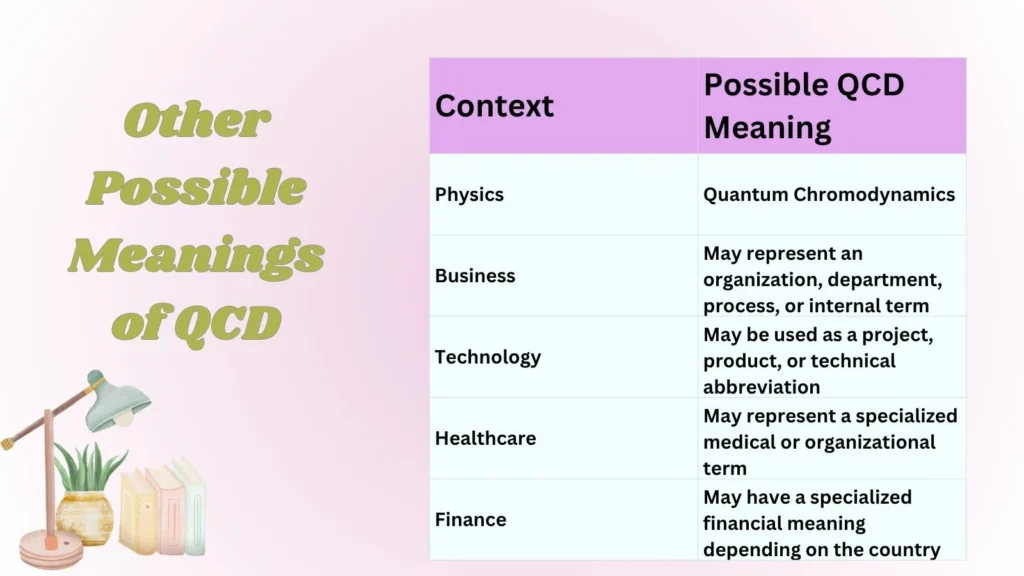
The abbreviation QCD can represent different terms in different fields.
| Context | Possible QCD Meaning |
|---|---|
| Physics | Quantum Chromodynamics |
| Business | May represent an organization, department, process, or internal term |
| Technology | May be used as a project, product, or technical abbreviation |
| Healthcare | May represent a specialized medical or organizational term |
| Finance | May have a specialized financial meaning depending on the country or institution |
This is why there is no single answer to QCD abbreviation meaning in every situation.
QCD vs Other Physics Abbreviations
Physics contains many abbreviations, and some can look confusing at first.
| Abbreviation | Meaning | Field |
|---|---|---|
| QCD | Quantum Chromodynamics | Particle physics |
| QED | Quantum Electrodynamics | Particle physics |
| SM | Standard Model | Particle physics |
| QM | Quantum Mechanics | Physics |
One common confusion is between QCD and QED. QCD focuses on the strong interaction involving quarks and gluons, while QED describes electromagnetic interactions involving electrically charged particles and photons.
QCD and the Strong Force
The strong interaction is one of the fundamental interactions described in modern physics.
QCD gives scientists the theoretical framework for understanding this interaction at the level of quarks and gluons.
An interesting feature of QCD is confinement. Under ordinary conditions, quarks are not observed as isolated particles. Instead, they are found within composite particles.
Another important feature is asymptotic freedom. At extremely high energies or very short distances, quarks can interact more weakly than they do at lower energies.
These unusual properties make QCD one of the most fascinating areas of modern particle physics.
How to Understand QCD From Context
If you encounter the abbreviation QCD and do not know its meaning, start by identifying the topic.
- If the conversation mentions quarks or gluons, QCD probably means Quantum Chromodynamics.
- If it mentions particle collisions, QCD may refer to the same physics theory.
- If it appears in a company document, check the organization’s terminology.
- If it appears in a text message, ask the sender if the meaning is unclear.
- If it appears in a research paper, check the abbreviation list or surrounding section.
This simple approach can prevent misunderstandings.
Synonyms and Related Terms for QCD
QCD does not have a perfect synonym because it is the abbreviation for a specific scientific theory. However, several related terms are commonly associated with it.
- Quantum Chromodynamics
- Strong interaction theory
- Strong-force theory
- Quark-gluon theory
- Quantum field theory of the strong interaction
These expressions may describe QCD or closely related concepts, although they are not always interchangeable in technical writing.
Common Mistakes When Understanding QCD

Even though QCD is only three letters, it can cause confusion. Here are some common mistakes to avoid.
Mistake 1: Assuming QCD Always Means One Thing
QCD has different possible meanings across industries. Always consider the context.
Mistake 2: Thinking QCD Is an Everyday Texting Slang
QCD is not a standard everyday texting abbreviation in the way that LOL, OMG, or BRB are. If you see it in casual communication, its meaning may be specific to the people involved.
Mistake 3: Confusing QCD With QED
QCD and QED are both important quantum theories, but they describe different fundamental interactions. QCD concerns the strong interaction, while QED concerns electromagnetism.
Mistake 4: Thinking “Color” Means Ordinary Color
The “chromo” in Quantum Chromodynamics refers to color charge, a technical concept in particle physics. It does not mean visual colors like those we see with our eyes.
Mistake 5: Treating QCD as a Complete Explanation of Every Force
QCD specifically describes the strong interaction. It is one component of the broader Standard Model rather than a theory describing every fundamental force.
FAQs:
What does QCD stand for?
QCD most commonly stands for Quantum Chromodynamics, the theory describing the strong interaction between quarks and gluons.
What does QCD mean in simple English?
In simple English, QCD is a theory that explains how quarks and gluons interact through the strong force.
What does QCD mean in physics?
In physics, QCD means Quantum Chromodynamics. It is a fundamental theory used to describe the strong interaction.
Is QCD a texting abbreviation?
QCD is not a widely standardized texting abbreviation. If you see it in a text, its meaning should be determined from the surrounding conversation.
What is the difference between QCD and QED?
QCD describes the strong interaction involving quarks and gluons, while QED describes electromagnetic interactions involving charged particles and photons.
Final Thoughts:
The most common QCD meaning is Quantum Chromodynamics, an important theory in particle physics that explains the strong interaction between quarks and gluons.
Although the abbreviation is strongly associated with physics, QCD can have other meanings depending on the industry or conversation. Therefore, context is always important when interpreting an abbreviation.
Whether you encountered QCD in a science class, research paper, technical discussion, or online message, understanding the surrounding context will usually reveal the intended meaning.

I am Henry James and i am a passionate writer and language enthusiast behind PunPalace, a platform dedicated to exploring meanings, word origins, and simple explanations. My aims to make learning vocabulary easy, engaging, and accessible for everyone.