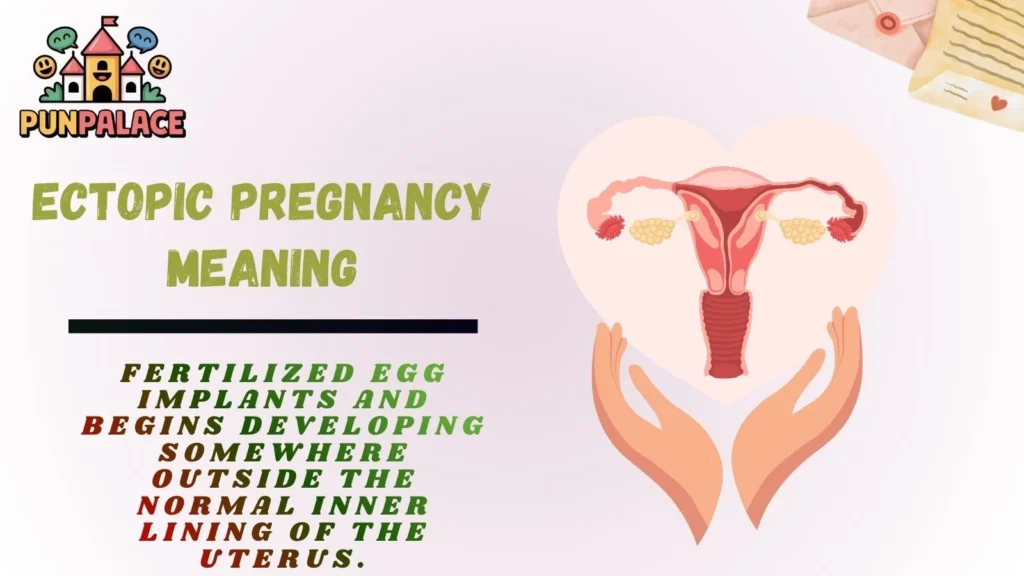
Understanding the ectopic pregnancy meaning can be important when learning about early pregnancy, especially if unusual pain or bleeding occurs. An ectopic pregnancy is a pregnancy that develops outside the main cavity of the uterus, rather than implanting in the normal location inside the uterus.
Most ectopic pregnancies occur in a fallopian tube. Because the fallopian tube cannot safely support a growing pregnancy, an ectopic pregnancy can become a serious medical emergency if it continues to grow and causes internal bleeding.
Not every person with an ectopic pregnancy has obvious symptoms at first. Some people may initially experience symptoms similar to a normal early pregnancy, such as a missed period, nausea, breast tenderness, or a positive pregnancy test. Later, symptoms such as one-sided abdominal or pelvic pain and vaginal bleeding may develop. 🚨
This guide explains what ectopic pregnancy means, where it occurs, possible symptoms and causes, how doctors diagnose it, available treatments, risk factors, and important warning signs.
What Does Ectopic Pregnancy Mean?
Ectopic pregnancy means that a fertilized egg implants and begins developing somewhere outside the normal inner lining of the uterus.
In a typical pregnancy, the fertilized egg travels through the fallopian tube and eventually implants inside the uterus. In an ectopic pregnancy, the fertilized egg implants somewhere else.
The most common location is a fallopian tube. This is why ectopic pregnancy is sometimes called a tubal pregnancy.
Simply put:
An ectopic pregnancy is a pregnancy that develops outside the normal location inside the uterus.
An ectopic pregnancy cannot normally develop safely to term because the tissue outside the uterus is not designed to support the growth of a pregnancy.
Where Does an Ectopic Pregnancy Occur?
Most ectopic pregnancies occur in the fallopian tube, but implantation can occasionally happen in other locations.
Possible locations include:
- Fallopian tube: The most common location.
- Ovary: An uncommon location where implantation occurs in or near the ovary.
- Cervix: A rare type in which implantation occurs in the cervix.
- Abdominal cavity: A very rare form in which implantation occurs within the abdomen.
- Cesarean-section scar: A rare type that develops in a previous surgical scar in the uterus.
The exact location matters because it can affect symptoms, diagnosis, and treatment.
Ectopic Pregnancy in the Fallopian Tube
The fallopian tube is the most common location for an ectopic pregnancy.
Normally, an egg is released from an ovary and travels into a fallopian tube. If fertilization occurs, the developing embryo normally continues traveling toward the uterus.
If the embryo becomes implanted inside the fallopian tube instead, the pregnancy is ectopic.
As the pregnancy develops, the tube may stretch and eventually rupture. A ruptured ectopic pregnancy can cause severe internal bleeding and requires emergency medical treatment.
What Are the Symptoms of an Ectopic Pregnancy?
Ectopic pregnancy symptoms can vary. Some people have no symptoms in the very early stages, while others develop symptoms relatively quickly.
Common symptoms may include:
- A missed menstrual period
- A positive pregnancy test
- Lower abdominal or pelvic pain
- Pain that is stronger on one side
- Vaginal bleeding or spotting
- Shoulder-tip pain
- Weakness or unusual dizziness
- Fainting or feeling close to fainting
These symptoms do not automatically mean that someone has an ectopic pregnancy. Several other conditions can cause similar symptoms. However, pregnancy combined with significant pain or bleeding should be medically evaluated.
Early Ectopic Pregnancy Symptoms
Early ectopic pregnancy can sometimes feel like an ordinary pregnancy.
A person may experience:
- Missed period
- Positive pregnancy test
- Nausea
- Breast tenderness
- Tiredness
- Mild abdominal discomfort
This can make an ectopic pregnancy difficult to recognize based on symptoms alone.
As the pregnancy progresses, more concerning symptoms may appear, particularly abdominal or pelvic pain and abnormal vaginal bleeding.
What Does Ectopic Pregnancy Pain Feel Like?
Ectopic pregnancy pain can vary from person to person. It may be felt in the lower abdomen or pelvis and can sometimes become more noticeable on one side.
The pain may be mild at first and become stronger over time. Some people describe it as sharp, cramping, aching, or persistent.
Severe or rapidly worsening abdominal or pelvic pain during pregnancy is a reason to seek urgent medical attention.
It is not possible to diagnose an ectopic pregnancy based on the type or location of pain alone.
Why Can Shoulder Pain Happen With an Ectopic Pregnancy?
Shoulder-tip pain can sometimes occur when an ectopic pregnancy has ruptured and caused internal bleeding.
Blood inside the abdominal cavity can irritate the diaphragm, and the resulting irritation may be perceived as pain around the shoulder.
Shoulder-tip pain during pregnancy is not automatically caused by an ectopic pregnancy. However, when it occurs together with abdominal pain, vaginal bleeding, dizziness, weakness, or fainting, it can be a serious warning sign.
Is an Ectopic Pregnancy Dangerous?
An ectopic pregnancy can be dangerous because the pregnancy may continue growing in a location that cannot safely accommodate it.
A fallopian tube, for example, has limited space. As the pregnancy grows, the tube can stretch and potentially rupture.
A rupture can cause internal bleeding, which can become life-threatening without emergency treatment.
This is why suspected ectopic pregnancy should be assessed by a healthcare professional rather than monitored at home without medical guidance.
What Causes an Ectopic Pregnancy?
There is not always one identifiable cause of an ectopic pregnancy.
Anything that affects the normal movement of a fertilized egg through the fallopian tube may increase the possibility of an ectopic implantation.
Potential contributing factors include:
- Previous ectopic pregnancy
- Damage or disease affecting the fallopian tubes
- Previous pelvic or fallopian tube surgery
- Pelvic infections that can affect reproductive organs
- Some fertility treatments
- Endometriosis
- Pregnancy occurring despite certain forms of contraception
- Smoking
However, an ectopic pregnancy can occur even when none of these risk factors are present.
Can You Have an Ectopic Pregnancy Without Symptoms?
Yes. An ectopic pregnancy can initially produce few or no obvious symptoms.
Some people may discover the pregnancy through a positive pregnancy test and then have an ultrasound or blood tests because of concerns about the pregnancy’s location or development.
This is one reason medical follow-up is important when an early pregnancy is associated with pain, bleeding, or other concerns.
Can an Ectopic Pregnancy Give a Positive Pregnancy Test?
Yes. An ectopic pregnancy can produce a positive pregnancy test because the developing pregnancy can produce human chorionic gonadotropin, or hCG.
A standard pregnancy test detects hCG in urine or blood. It does not normally determine where the pregnancy is located.
Therefore, a positive pregnancy test cannot by itself confirm that a pregnancy is developing inside the uterus.
How Is an Ectopic Pregnancy Diagnosed?
Doctors may use several pieces of information to determine whether an ectopic pregnancy is present.
Evaluation may include:
- Medical history
- Physical examination
- Pregnancy testing
- Quantitative blood hCG testing
- Repeat hCG measurements when needed
- Transvaginal ultrasound
- Other tests or procedures in selected situations
Doctors may sometimes need to monitor hCG levels and ultrasound findings over time because an early pregnancy may be too small to identify clearly on the first scan.
What Is a Transvaginal Ultrasound?
A transvaginal ultrasound uses an ultrasound probe inserted into the vagina to create detailed images of the reproductive organs.
It can help healthcare professionals examine the uterus, fallopian tubes, ovaries, and surrounding structures.
In an early pregnancy, ultrasound may help determine whether a pregnancy is visible inside the uterus and whether there are findings that raise concern for an ectopic pregnancy.
Sometimes the pregnancy is simply too early to be seen clearly. In such cases, doctors may recommend repeat testing and follow-up.
Ectopic Pregnancy Risk Factors
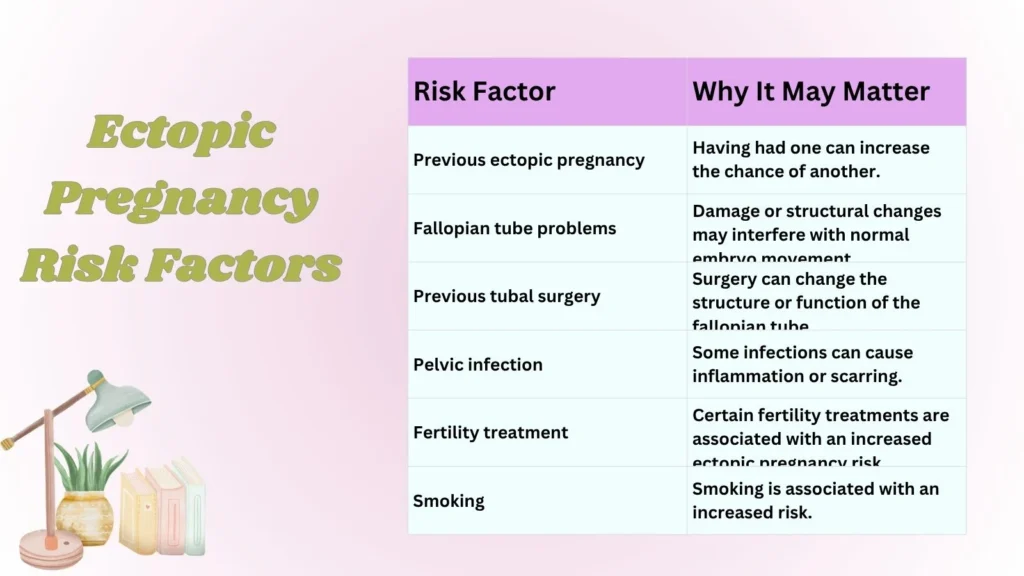
Certain circumstances can increase the likelihood of an ectopic pregnancy.
| Risk Factor | Why It May Matter |
|---|---|
| Previous ectopic pregnancy | Having had one can increase the chance of another. |
| Fallopian tube problems | Damage or structural changes may interfere with normal embryo movement. |
| Previous tubal surgery | Surgery can change the structure or function of the fallopian tube. |
| Pelvic infection | Some infections can cause inflammation or scarring. |
| Fertility treatment | Certain fertility treatments are associated with an increased ectopic pregnancy risk. |
| Smoking | Smoking is associated with an increased risk. |
Having a risk factor does not mean an ectopic pregnancy will definitely occur.
Ectopic Pregnancy and hCG Levels
hCG is a hormone produced during pregnancy. Blood testing can measure its level and, when repeated, show how the level changes over time.
In an ectopic pregnancy, hCG patterns may differ from those seen in a normally developing intrauterine pregnancy, but hCG alone cannot diagnose an ectopic pregnancy.
Healthcare professionals generally interpret hCG results together with symptoms, examination findings, ultrasound results, and the timing of the pregnancy.
Ectopic Pregnancy Treatment
The appropriate treatment depends on factors such as the pregnancy’s location, size, hCG level, symptoms, whether the fallopian tube has ruptured, and the person’s overall condition.
Common management approaches include:
- Medication: In selected early cases, medication such as methotrexate may be used to stop pregnancy tissue from continuing to grow.
- Surgery: Surgery may be required when medication is unsuitable, the pregnancy is more advanced, or there is significant bleeding or rupture.
- Close monitoring: In carefully selected situations, doctors may recommend observation with repeated testing because some ectopic pregnancies can resolve without active treatment.
The appropriate option must be determined by a qualified healthcare professional.
Methotrexate for Ectopic Pregnancy
Methotrexate is a medication that can be used to treat certain ectopic pregnancies before rupture occurs.
It works by stopping rapidly dividing pregnancy tissue from continuing to grow. The body can then gradually absorb the tissue.
Methotrexate is not appropriate for everyone. Doctors consider factors such as symptoms, pregnancy size and location, hCG level, medical history, laboratory results, and whether there are signs of rupture.
After treatment, follow-up blood tests are necessary to make sure the hCG level falls appropriately.
Surgery for Ectopic Pregnancy
Surgery may be necessary when an ectopic pregnancy has ruptured, when there is significant internal bleeding, or when medication is not appropriate or has not worked.
Depending on the circumstances, surgeons may remove the ectopic pregnancy while preserving the fallopian tube, or they may remove the affected tube.
The surgical approach depends on the location of the pregnancy, the extent of damage, bleeding, the condition of the other fallopian tube, and other individual factors.
Can an Ectopic Pregnancy Be Saved?
Unfortunately, an ectopic pregnancy generally cannot be moved into the uterus and continued safely as a normal pregnancy.
Treatment focuses on protecting the pregnant person’s health and preventing complications such as rupture and internal bleeding.
This can be emotionally difficult, especially when the pregnancy was wanted. Emotional support and appropriate medical follow-up can be an important part of recovery.
Can You Get Pregnant After an Ectopic Pregnancy?
Many people can become pregnant again after an ectopic pregnancy.
The possibility of a future pregnancy depends on factors such as the health of the remaining fallopian tube, fertility status, underlying conditions, age, and the treatment received.
Having one ectopic pregnancy does increase the risk of another, so a future pregnancy may require early medical follow-up.
Can an Ectopic Pregnancy Affect Fertility?
An ectopic pregnancy can sometimes affect fertility, particularly if a fallopian tube is damaged or removed or if an underlying condition affects the reproductive system.
However, an ectopic pregnancy does not automatically mean infertility.
Many people go on to have successful pregnancies afterward. Individual fertility outcomes vary, so discussing future pregnancy plans with a healthcare professional can be helpful.
Ectopic Pregnancy vs. Normal Pregnancy
| Normal Intrauterine Pregnancy | Ectopic Pregnancy |
|---|---|
| Implants inside the uterus | Implants outside the normal uterine cavity |
| Can normally continue developing in the uterus | Cannot normally develop safely outside the uterus |
| Usually progresses toward a viable pregnancy | Requires medical evaluation and management |
| Pregnancy hormone levels and ultrasound findings follow expected patterns | Findings may raise concern for abnormal implantation |
Symptoms alone cannot always distinguish the two. Medical testing is often needed.
Ectopic Pregnancy vs. Miscarriage
An ectopic pregnancy and miscarriage are different conditions, although both can cause pain and vaginal bleeding during early pregnancy.
A miscarriage generally refers to the loss of a pregnancy that was developing inside the uterus.
An ectopic pregnancy involves implantation outside the normal uterine cavity.
Because symptoms can overlap, it is important not to assume that bleeding in early pregnancy is simply a miscarriage without appropriate medical assessment.
Can Ectopic Pregnancy Cause Vaginal Bleeding?
Yes. Vaginal bleeding or spotting can occur with an ectopic pregnancy.
The bleeding may be lighter or different from a normal menstrual period, but there is no single bleeding pattern that proves an ectopic pregnancy.
Bleeding during pregnancy can have many causes. When bleeding occurs with pelvic or abdominal pain, dizziness, weakness, or other concerning symptoms, prompt medical evaluation is important.
Emergency Warning Signs of Ectopic Pregnancy
A suspected ectopic pregnancy can become an emergency if rupture or significant internal bleeding occurs.
Seek emergency medical care immediately if pregnancy is possible and there is:
- Severe or sudden abdominal or pelvic pain
- Severe pain that becomes worse quickly
- Fainting or loss of consciousness
- Severe dizziness or weakness
- Shoulder-tip pain together with other concerning symptoms
- Heavy vaginal bleeding
- Pale or clammy skin with severe pain or weakness
These symptoms can have causes other than ectopic pregnancy, but they should not be ignored.
Does an Ectopic Pregnancy Always Rupture?
No. An ectopic pregnancy does not always rupture.
Some are diagnosed before rupture and treated with medication or surgery, depending on the circumstances. Some may resolve naturally under carefully supervised medical monitoring.
However, an untreated ectopic pregnancy can rupture, which is why medical evaluation is important when an ectopic pregnancy is suspected.
How Long Does an Ectopic Pregnancy Last?
There is no single timeline that applies to every ectopic pregnancy.
The pregnancy may stop developing naturally, or it may continue growing until treatment becomes necessary. The risk of rupture varies depending on the location and development of the pregnancy.
Because of these differences, healthcare professionals may recommend blood tests, ultrasound examinations, medication, surgery, or close monitoring depending on the individual situation.
Common Misconceptions About Ectopic Pregnancy
An Ectopic Pregnancy Is the Same as a Normal Pregnancy in the Wrong Place
Although an ectopic pregnancy begins with the same basic process of fertilization, implantation occurs outside the normal uterine cavity. The location makes continued development unsafe.
A Positive Pregnancy Test Rules Out Ectopic Pregnancy
A positive pregnancy test does not show where the pregnancy is located. An ectopic pregnancy can also produce hCG and therefore a positive test.
No Pain Means There Is No Ectopic Pregnancy
Early ectopic pregnancy may cause few or no symptoms. The absence of pain does not completely rule it out.
All Vaginal Bleeding Means Miscarriage
Bleeding in early pregnancy has many possible causes. Ectopic pregnancy is one possibility and may require urgent assessment.
Ectopic Pregnancy Always Means Infertility
An ectopic pregnancy can affect fertility, but many people become pregnant successfully afterward.
Common Mistakes When Understanding Ectopic Pregnancy Meaning
Thinking It Means a Pregnancy Outside the Body
The term does not mean a pregnancy developing completely outside the body. It means implantation occurs outside the normal uterine cavity.
Assuming It Always Happens in the Fallopian Tube
Most ectopic pregnancies occur in a fallopian tube, but rare ectopic pregnancies can occur in other locations.
Waiting for Severe Symptoms Before Seeking Help
Early ectopic pregnancy may have mild or no symptoms. If pregnancy is confirmed or suspected and there is unusual pain or bleeding, medical advice should be sought promptly.
Trying to Diagnose It From Symptoms Alone
Symptoms such as abdominal pain and bleeding can occur with several conditions. Diagnosis usually requires medical assessment, pregnancy testing, hCG measurements, ultrasound, or other evaluation.
Assuming Treatment Is the Same for Everyone
Treatment depends on the individual’s medical situation. Medication, surgery, and monitoring are not interchangeable options for every ectopic pregnancy.
FAQs:
What is the simple meaning of ectopic pregnancy?
Ectopic pregnancy means a pregnancy that implants outside the normal inner cavity of the uterus. Most ectopic pregnancies occur in a fallopian tube.
Can an ectopic pregnancy be a normal pregnancy?
No. An ectopic pregnancy cannot normally develop safely outside the uterus and requires medical evaluation and appropriate management.
What are the first signs of an ectopic pregnancy?
Early signs can include a positive pregnancy test, abdominal or pelvic pain, and vaginal bleeding. Some people have few or no symptoms initially.
Can an ectopic pregnancy give a positive test?
Yes. An ectopic pregnancy can produce hCG, so a urine or blood pregnancy test can be positive. A pregnancy test alone cannot determine where the pregnancy is located.
Can you have a baby after an ectopic pregnancy?
Yes, many people can have a successful pregnancy after an ectopic pregnancy. Future fertility depends on individual factors, including the health of the reproductive organs and any underlying conditions.
Conclusion:
The ectopic pregnancy meaning is a pregnancy that implants outside the normal cavity of the uterus. Most ectopic pregnancies occur in a fallopian tube, where a growing pregnancy cannot safely continue.
Possible symptoms include one-sided pelvic or abdominal pain, vaginal bleeding, dizziness, weakness, and shoulder-tip pain, although some people have few symptoms in the early stages.
Diagnosis commonly involves pregnancy testing, blood hCG measurements, ultrasound, and medical assessment. Treatment may involve medication, surgery, or careful monitoring depending on the circumstances.

I am Henry James and i am a passionate writer and language enthusiast behind PunPalace, a platform dedicated to exploring meanings, word origins, and simple explanations. My aims to make learning vocabulary easy, engaging, and accessible for everyone.