
The word idempotent may look complicated when you first encounter it, especially in programming, mathematics, databases, or APIs. But its basic idea is surprisingly simple: doing the same operation again does not create an additional change after the desired result has already been reached.
Understanding the idempotent meaning is especially useful if you work with software, web development, HTTP requests, databases, distributed systems, or mathematical operations. You may see the term in technical documentation and wonder why developers care so much about it.
In simple English, an operation is called idempotent when repeating it produces the same final effect as performing it once. The operation may be performed one time or several times, but after the first successful application, repeating it does not keep changing the result.
For example, imagine an instruction that says, “Set the light to OFF.” If the light is already off, giving the same instruction again still leaves it off. That behavior illustrates the basic idea behind idempotence.
This article explains the idempotent meaning in English, its mathematical definition, programming examples, API usage, database applications, common misunderstandings, and practical examples in simple language.
What Does Idempotent Mean?
Idempotent describes an operation that can be applied repeatedly without changing the final result beyond what the first application achieved.
The easiest way to remember the idea is:
Repeat it, and the final result stays the same.
This does not necessarily mean that every execution does absolutely nothing. The important point is that repeating the operation does not produce a different final state after the first application.
For example, consider an operation that sets a user’s status to “active.”
- First request: User becomes active.
- Second request: User remains active.
- Third request: User remains active.
- Fourth request: User remains active.
The final state is the same whether the operation happens once or several times. Therefore, the operation can be described as idempotent with respect to that state.
Idempotent Meaning in Simple English

If you want a very simple definition, idempotent means repeating an operation gives the same final result.
Think about a button labeled “Set temperature to 20°C.”
If you press it once, the temperature setting becomes 20°C. If you press it again, the setting remains 20°C. Pressing it repeatedly does not change the final setting to 40°C, 60°C, or another value.
That is the basic concept of idempotence.
However, there is an important technical detail. An operation can still be idempotent even if repeated executions involve processing, logging, network activity, or other internal work. What matters is the effect of the operation on the relevant state.
Idempotent Meaning at a Glance
| Term | Simple Meaning |
|---|---|
| Idempotent | An operation that produces the same final result when repeated |
| Idempotence | The property of being idempotent |
| Idempotent operation | An operation whose repeated application does not change the final result |
| Idempotent API | An API operation designed so repeated requests have the same intended effect |
| Non-idempotent | An operation where repeating it can produce additional changes |
What Is Idempotence?
Idempotence is the property that makes an operation idempotent.
Suppose an operation is represented by f. In mathematics, an idempotent function satisfies the relationship:
f(f(x)) = f(x)
This means that applying the function twice gives the same result as applying it once.
The concept can be extended to more than two applications. If applying the operation once reaches a stable result, applying it again does not move that result somewhere else.
This idea appears in many areas, including:
- Mathematics
- Computer programming
- Web APIs
- Databases
- Distributed systems
- Network protocols
- Configuration management
- Data processing
Idempotent in Mathematics
The mathematical idempotent meaning is precise.
A function f is idempotent when applying it twice is equivalent to applying it once:
f(f(x)) = f(x)
A simple example is a function that converts a value into its absolute value.
If the value is already positive, applying the operation again does not change it. For example, taking the absolute value of a number twice gives the same result as taking it once.
Another useful example is rounding down to an integer. Once a number has been converted to an integer by the operation, applying the same operation again produces the same integer.
The mathematical idea is broader than programming. It describes a structural property of an operation.
Idempotent Example in Everyday Life
Although “idempotent” sounds technical, the basic concept can be understood through everyday instructions.
Imagine a sign that says:
“Make sure the door is closed.”
If the door is open, you close it. If it is already closed, performing the same instruction again leaves it closed.
Compare that with:
“Open the door.”
If the door is already open, the effect of repeating the action depends on what “open” means operationally. The key lesson is that an instruction that sets a desired state is often easier to make idempotent than one that represents an incremental action.
This is why software systems often prefer commands that describe a final state when safe repetition matters.
Idempotent Meaning in Programming
In programming, an idempotent operation is one that can safely be repeated without causing an additional change to the intended state.
This property becomes extremely valuable when software communicates across networks.
Imagine an application sends a request to a server. The server performs the operation, but the response never reaches the application because of a temporary network problem.
The application may not know whether the server completed the request.
If it sends the request again, an idempotent operation can prevent the retry from creating an unintended duplicate effect.
This is one of the most important practical reasons developers care about idempotence.
Why Is Idempotence Important in Software?
Modern applications often operate in environments where failures can happen.
Networks can disconnect. Servers can restart. Requests can time out. Users can click buttons more than once. Automated systems can retry operations.
Without careful design, these repeated actions can create duplicate or incorrect results.
Idempotent operations help make systems more resilient.
For example, suppose a system receives a request to set an account’s status to “verified.” If the request is accidentally sent twice, the second request should not create another verification record or otherwise produce an unintended duplicate effect.
The ability to retry safely can be extremely valuable in distributed systems.
Idempotent API Meaning
The phrase idempotent API usually refers to an API operation that can be repeated while maintaining the same intended final effect.
This matters because APIs communicate between different systems, and network communication is not always perfectly reliable.
Imagine a client sends a request to a server:
“Set order 123 to shipped.”
If the server processes the request but the client does not receive the response, the client may retry.
If the operation is designed to be idempotent, sending the same request again should not cause the order to become “shipped” twice in some harmful sense.
The important idea is that retries should not accidentally multiply the intended effect.
Idempotent HTTP Methods
Idempotence is an important concept in HTTP.
HTTP defines certain methods as idempotent in terms of their intended semantics. Commonly discussed idempotent methods include:
- GET
- HEAD
- PUT
- DELETE
- OPTIONS
- TRACE
However, understanding what this means is important. It does not mean that repeating a request produces absolutely no network activity or server-side processing. It means that the intended state-changing effect of repeated identical requests is defined to be equivalent to the effect of a single request.
By contrast, POST is generally considered non-idempotent because repeating the same POST request can create multiple resources or produce multiple effects.
For example, sending a POST request to create an order twice could potentially create two orders.
PUT vs POST and Idempotence
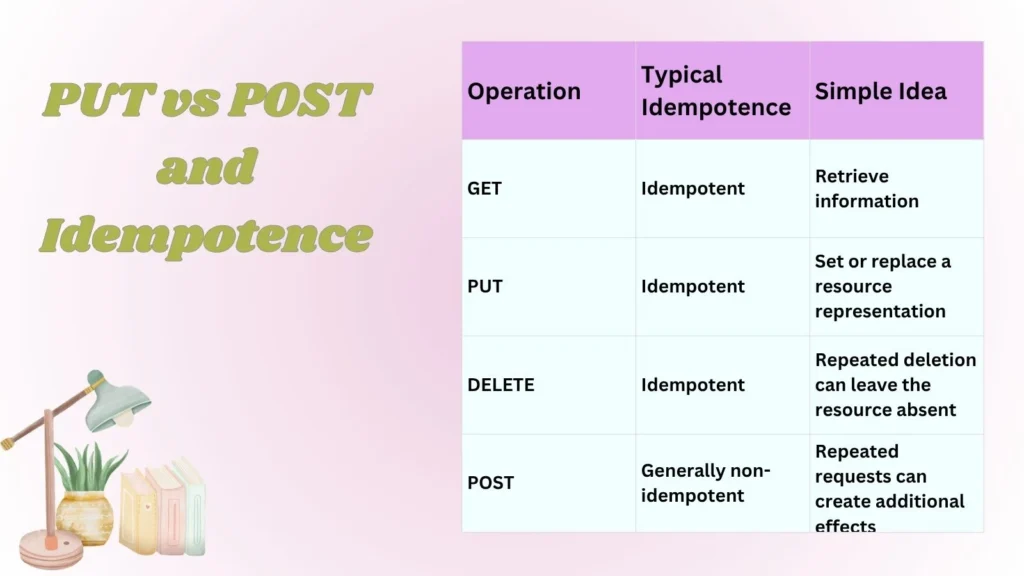
A common way to understand idempotence in APIs is to compare PUT and POST.
Suppose you have an API endpoint for a user profile.
A PUT request might mean:
“Set this user’s profile to these exact values.”
Sending that same request repeatedly can leave the profile in the same state.
A POST request might mean:
“Create a new resource based on this information.”
If you send it twice, you might create two separate resources.
| Operation | Typical Idempotence | Simple Idea |
|---|---|---|
| GET | Idempotent | Retrieve information |
| PUT | Idempotent | Set or replace a resource representation |
| DELETE | Idempotent | Repeated deletion can leave the resource absent |
| POST | Generally non-idempotent | Repeated requests can create additional effects |
The actual behavior of a specific API still depends on how it is implemented and what its operation means.
Idempotent vs Non-Idempotent
The easiest way to understand idempotence is to compare it with a non-idempotent operation.
An idempotent operation reaches a stable final result when repeated.
A non-idempotent operation can continue producing additional changes each time it is performed.
For example:
- Set balance to $100: Can be idempotent with respect to the balance.
- Add $100 to balance: Usually non-idempotent because repeating it keeps increasing the balance.
- Set status to active: Can be idempotent.
- Add one item to a list: Usually non-idempotent if each repetition adds another item.
The difference is often between setting a state and performing an incremental action.
Idempotent Database Operations
Databases are another area where the idempotent meaning becomes highly practical.
Suppose a database operation sets a user’s country to “Pakistan.” Running the same update repeatedly may leave the record in the same final state.
Compare that with an operation that increases a user’s account balance by a certain amount. Repeating the same command can repeatedly increase the balance.
| Database Action | Likely Behavior |
|---|---|
| Set status = active | Can be idempotent |
| Set country = Pakistan | Can be idempotent |
| Delete a specified record | Can be idempotent depending on the operation |
| Increment balance by 100 | Non-idempotent |
| Append a new row each time | Non-idempotent |
Database idempotence can make retry logic safer, especially in systems where a request may be processed more than once.
Idempotent Operations and Retry Logic
Retries are common in software systems.
Imagine a mobile application communicating with a server. The user presses a button, but the network connection becomes unstable.
The application may wait and then try again.
If the first request succeeded but its response was lost, the retry creates a potential duplicate operation.
With an idempotent design, the system can often repeat the request without producing an unwanted additional effect.
This is especially useful in:
- Payment systems
- Order processing
- Cloud services
- Database applications
- Distributed systems
- Background jobs
- Message processing
- Web applications
For sensitive operations such as payments, developers may also use idempotency keys or similar mechanisms to help ensure that retries do not accidentally create duplicate transactions.
What Is an Idempotency Key?
An idempotency key is a unique identifier supplied with a request so a server can recognize repeated attempts to perform the same logical operation.
Imagine a customer clicks “Pay” and the network becomes slow.
The application sends a request with a unique key. If the client retries because it did not receive a response, it sends the same key again.
The server can recognize that the request is a retry rather than a completely new operation.
This can help prevent accidental duplicate processing.
The exact implementation varies between systems, but the basic goal is simple:
“If this request is retried, recognize it as the same intended operation.”
Idempotent Meaning in Distributed Systems
Distributed systems are particularly interested in idempotence because multiple machines and services communicate over networks.
Messages can be delayed, duplicated, lost, or retried. A service may receive the same logical instruction more than once.
If processing a repeated message creates harmful duplicate effects, the system becomes harder to make reliable.
Idempotent processing can reduce this problem.
For example, a service might receive:
- Update customer status to verified.
- Update customer status to verified again.
- Update customer status to verified again.
If each message results in the same final state, the system can tolerate duplicate delivery more safely.
This does not solve every distributed-systems problem, but it is an important design principle.
Idempotent vs Repeatable
These words are related but not identical.
Repeatable simply means that something can happen again.
Idempotent means that repeating an operation does not change the final result beyond the first application.
For example, adding $10 to an account is repeatable because you can perform the operation multiple times.
But it is not idempotent because each repetition changes the balance again.
So remember:
Repeatable does not automatically mean idempotent.
Idempotent vs Deterministic
Another common confusion is between idempotence and determinism.
A deterministic function produces a predictable output for a given input.
An idempotent function has the special property that applying it again to its output produces the same result.
These are different properties.
A function can be deterministic without being idempotent.
For example, a function that adds 1 to a number is deterministic:
- Input 5 → output 6.
- Input 6 → output 7.
But applying it twice does not give the same result as applying it once.
Therefore, it is deterministic but not idempotent.
Idempotent Meaning in Functional Programming
Functional programming and mathematical programming concepts often use the term idempotent to describe functions or transformations.
A function is idempotent when feeding its result back into the same function does not change it.
For example, consider a function that converts text to lowercase.
If the input is:
“HELLO WORLD”
The first application produces:
“hello world”
Applying the same lowercase operation again still produces:
“hello world”
Therefore, lowercase conversion is an intuitive example of an idempotent transformation.
Real-World Examples of Idempotent Operations
Here are several examples that make the concept easier to remember.
- Set a switch to OFF: Repeating the instruction keeps it OFF.
- Set a user’s role to “admin”: Repeating the same state-setting operation can leave the role unchanged.
- Convert text to lowercase: Once the text is lowercase, converting it again produces the same text.
- Remove a specific resource: Once the resource is absent, repeating the deletion does not remove another copy of that same resource.
- Set a configuration value: Repeating the same configuration can leave the system in the same state.
These examples all illustrate the same basic idea: repetition does not keep changing the final state.
Examples of Non-Idempotent Operations
It is equally helpful to understand what is not idempotent.
- Increment a counter: Each repetition increases the value.
- Add money to an account: Each repetition can increase the balance again.
- Append an item to a list: Repeating the operation can add another item.
- Create a new order: Repeating the request may create another order.
- Send a message: Repeating the action can send another message.
These operations produce additional effects when repeated, so they are generally non-idempotent.
Why Developers Care About Idempotent Design
Idempotent design can make software systems more reliable and easier to recover from failures.
Consider a service that automatically retries failed network requests. If every request creates a new side effect, retries could cause duplicates.
With idempotent operations, repeating the same logical request can be much safer.
This is especially important in systems that handle:
- Customer orders
- Payments
- Account changes
- Inventory
- Cloud resources
- Database updates
- Automated workflows
Idempotence is therefore not merely a theoretical programming term. It can directly affect the reliability of real-world applications.
How to Remember the Idempotent Meaning
If the word seems difficult to remember, use this simple mental shortcut:
“Do it once or repeat it—the final state is the same.”
Think about setting rather than adding.
“Set the value to 10” can be idempotent.
“Add 10 to the value” is usually not idempotent.
That simple contrast makes the concept much easier to recognize in technical documentation.
Common Mistakes About Idempotent Meaning

1. Thinking Idempotent Means Nothing Happens
This is one of the most common mistakes. An idempotent operation can absolutely produce a change the first time it runs. The important part is that repeating it does not create another change to the final intended state.
2. Thinking Idempotent Means Every Execution Is Identical
Idempotence is mainly about the resulting effect or state. Internal processing, logging, timestamps, or network activity may still occur.
3. Confusing Idempotent With Deterministic
A deterministic operation gives predictable results for the same input. Idempotence specifically concerns what happens when an operation is applied repeatedly to its own result.
4. Assuming Every Retry Is Idempotent
Simply retrying an operation does not make it idempotent. The operation itself must be designed so repeated execution has the appropriate equivalent final effect.
5. Thinking POST Is Always Safe to Repeat
POST is generally considered non-idempotent under HTTP semantics. A specific API can implement protections such as idempotency keys, but that is an application-level design decision.
6. Confusing Idempotent With Repeatable
An operation can be performed repeatedly without being idempotent. Adding money to an account repeatedly is possible, but each repetition can create a new effect.
7. Assuming Idempotence Solves Every Reliability Problem
Idempotence is an important reliability technique, but it does not eliminate all problems involving concurrency, ordering, failures, or distributed systems.
FAQs:
What does idempotent mean in simple English?
Idempotent means that repeating an operation produces the same final result as performing it once. After the desired state is reached, repeating the operation does not create an additional intended change.
What is an idempotent operation?
An idempotent operation is an operation that can be applied multiple times while producing the same final state as applying it once. A common example is setting a value to a specific state.
What does idempotent mean in programming?
In programming, idempotent describes an operation that can safely be repeated without causing additional unintended changes. This is particularly useful when software retries network requests.
What does idempotent mean in API?
An idempotent API operation is designed so repeated identical requests have the same intended final effect as one request. This helps systems handle retries more safely.
What is an example of an idempotent function?
A lowercase conversion function is an intuitive example. Once text has been converted to lowercase, applying the same conversion again leaves the text unchanged.
Final Thoughts:
The idempotent meaning becomes much easier once you focus on one simple idea: repeating an operation does not keep changing the final result.
In mathematics, idempotence is expressed through the idea that applying a function to its own result gives the same result. In programming, the concept helps developers design operations that are safer to repeat. In APIs and distributed systems, idempotence is especially valuable because network failures and automatic retries can cause the same request to arrive more than once.
A useful comparison is “set” versus “add.” Setting a value to a specific state can often be idempotent, while adding or incrementing something usually creates another effect every time it runs.
Once you understand this distinction, terms such as idempotent API, idempotent operation, and idempotency key become much easier to understand.

I am Henry James and i am a passionate writer and language enthusiast behind PunPalace, a platform dedicated to exploring meanings, word origins, and simple explanations. My aims to make learning vocabulary easy, engaging, and accessible for everyone.