Have you ever seen the letters ISM in a word, text message, article, or online conversation and wondered what they mean? The meaning of ism depends on the context in which you see it.
In English, -ism is a suffix added to words to describe a belief, philosophy, movement, practice, system, or characteristic. Examples include capitalism, realism, racism, and optimism.
However, ISM can also appear as an abbreviation in specialized contexts. If you see it in a text message or on social media, its meaning may depend on the conversation.
In this guide, you’ll learn the ISM meaning in simple English, common examples, different types of -isms, and how to understand the term correctly. 📚
What Does ISM Mean in Simple English?
In simple English, -ism is a word ending that often describes a belief, idea, system, practice, or behavior.
For example:
- Optimism: The belief that good things are likely to happen.
- Pessimism: The tendency to expect negative outcomes.
- Capitalism: An economic system based largely on private ownership.
- Racism: Prejudice or discrimination based on race.
- Tourism: The activity of traveling for pleasure or other purposes.
Notice that -ism is not usually a complete word with one fixed meaning. Its meaning depends on the word it is attached to.
For example, optimism and capitalism both end in -ism, but they describe very different concepts.
ISM Meaning in Text Messages and Social Media 📱
If you see ISM written in capital letters in a text message, its meaning may depend on the sender and the conversation.
Unlike common texting abbreviations such as LOL or BRB, ISM does not have one universally accepted meaning in everyday texting.
It may be an abbreviation specific to a group, workplace, online community, or subject.
For example:
- In a conversation about philosophy, someone may be referring to an ideology or belief system.
- In a discussion about English vocabulary, ISM may refer to the suffix -ism.
- In a professional message, ISM may stand for a term specific to an industry or organization.
If you encounter ISM in a message, read the surrounding sentences before deciding what it means. Do not automatically assume it has a particular slang meaning.
Common Words That End in -ISM
Learning common -ism words can improve your vocabulary and help you understand what people mean in articles, books, and discussions.
1. Optimism
Optimism means having a hopeful or positive outlook.
Example: “Her optimism helped her stay motivated during a difficult year.”
2. Pessimism
Pessimism means expecting negative outcomes or focusing on the less hopeful side of a situation.
Example: “His pessimism made him doubt that the plan would succeed.”
3. Realism
Realism means dealing with situations according to the facts and practical possibilities.
Example: “We need realism when setting our financial goals.”
4. Capitalism
Capitalism is an economic system in which private individuals or businesses own much of the productive property and operate within markets.
Example: “The class discussed the advantages and disadvantages of capitalism.”
5. Racism
Racism involves prejudice, discrimination, or unequal treatment based on race.
Example: “The organization introduced policies to address racism in the workplace.”
6. Feminism
Feminism refers to ideas and movements that advocate women’s equality and address gender-based inequalities.
Example: “She studied the history of feminism at university.”
7. Idealism
Idealism can refer to a tendency to pursue high principles or ideals, sometimes without fully considering practical limitations.
Example: “His idealism inspired him to work for social change.”
8. Heroism
Heroism refers to courage, bravery, or selfless action, particularly in difficult or dangerous circumstances.
Example: “The firefighter was praised for his heroism.”
Types of ISMs in English
Words ending in -ism can be grouped by the concepts they describe.
Political and Economic ISMs
These terms describe political ideologies, economic systems, or ways of organizing society.
Examples include:
- Capitalism
- Socialism
- Communism
- Liberalism
- Conservatism
- Nationalism
Each term has its own definition, history, and variations. They should not be treated as interchangeable.
Philosophical ISMs
These words describe philosophical approaches, theories, or schools of thought.
Examples include:
- Realism
- Idealism
- Existentialism
- Humanism
- Skepticism
They address questions about reality, knowledge, human existence, and how people should live.
Social and Cultural ISMs
These terms describe social attitudes, movements, or patterns of behavior.
Examples include:
- Feminism
- Racism
- Sexism
- Ageism
- Multiculturalism
Some refer to movements or approaches, while others describe prejudice or discriminatory behavior.
Personal Characteristics and Attitudes
Some -ism words describe a person’s outlook or behavior.
Examples include:
- Optimism
- Pessimism
- Perfectionism
- Altruism
- Heroism
These terms can help explain how people think, act, or respond to different situations.
What Does the Suffix -ISM Mean?
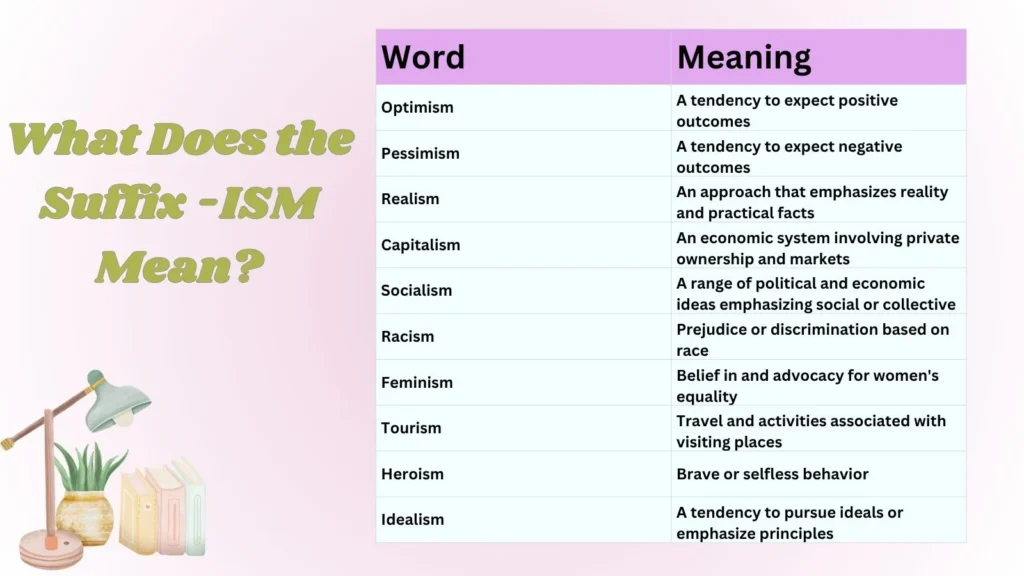
The suffix -ism is used to form nouns. It often identifies a particular belief, system, movement, practice, condition, or characteristic.
Here are some common examples:
| Word | Meaning |
|---|---|
| Optimism | A tendency to expect positive outcomes |
| Pessimism | A tendency to expect negative outcomes |
| Realism | An approach that emphasizes reality and practical facts |
| Capitalism | An economic system involving private ownership and markets |
| Socialism | A range of political and economic ideas emphasizing social or collective ownership |
| Racism | Prejudice or discrimination based on race |
| Feminism | Belief in and advocacy for women’s equality |
| Tourism | Travel and activities associated with visiting places |
| Heroism | Brave or selfless behavior |
| Idealism | A tendency to pursue ideals or emphasize principles |
The suffix appears in many areas of life, including politics, economics, philosophy, psychology, culture, and everyday conversation.
Is ISM an Acronym or a Suffix?
ISM can be an acronym in certain contexts, but -ism is most commonly recognized in English as a suffix.
A suffix is a group of letters added to the end of a word to create a new word or change its meaning.
For example:
- Happy → Happiness
- Real → Realism
- Optimistic → Optimism
- Hero → Heroism
An acronym, on the other hand, is formed from the initial letters of a phrase or name.
In business, technology, education, and other specialized fields, ISM may stand for different organizations, systems, or technical terms. Its exact meaning depends on the subject.
Therefore, when you see ISM in capital letters, check whether it is being used as a specific abbreviation or whether the discussion is about words ending in -ism.
How to Use -ISM Words in Sentences
You can use -ism words in conversations, essays, academic writing, and everyday English.
Here are ten examples:
- “Optimism can help people stay hopeful during challenging times.”
- The teacher explained the meaning of realism.
- “We studied capitalism and socialism in economics class.”
- “Her idealism encouraged her to help the community.”
- “The campaign raised awareness about racism.”
- “The book discusses the history of feminism.”
- “His perfectionism sometimes makes simple tasks take longer.”
- “The rescue worker showed remarkable heroism.”
- “Tourism provides jobs in many destinations.”
- “The philosopher wrote about existentialism.”
These examples show how the suffix appears in words with different meanings.
Common Mistakes About ISM Meaning
1. Assuming ISM Is Always a Texting Abbreviation
ISM does not have one universal slang meaning. It may refer to a suffix, an abbreviation, or a specialized term.
2. Thinking Every -ISM Word Describes a Belief
Many -ism words refer to beliefs or ideologies, but others describe behaviors, characteristics, systems, or activities.
For example, tourism describes travel-related activity, while optimism describes a positive outlook.
3. Confusing ISM With a Complete English Word
In most common English uses, -ism is a suffix rather than an independent word with a single definition.
4. Assuming All ISMs Have the Same Meaning
Words such as feminism, capitalism, racism, and realism describe different concepts. Their meanings must be learned individually.
5. Ignoring Context When Reading ISM
If ISM appears in a professional document or online message, the subject and surrounding words usually help identify its intended meaning.
FAQs:
1. What Does ISM Mean in English?
In English, -ism is a suffix used to form nouns that often describe beliefs, systems, movements, practices, or characteristics. Examples include optimism, capitalism, and realism.
2. What Does ISM Mean in Texting?
ISM does not have one universally recognized meaning in texting. It may be a context-specific abbreviation, so the surrounding conversation is important.
3. Is ISM a Word or a Suffix?
The ending -ism is primarily a suffix in English. ISM in capital letters can also be an abbreviation in certain professional or specialized contexts.
4. What Are Five Examples of -ISM Words?
Five common examples are optimism, pessimism, capitalism, realism, and feminism. Each describes a different idea, system, attitude, or movement.
5. What Does -ISM Mean at the End of a Word?
The suffix -ism often indicates a belief, ideology, system, practice, characteristic, or movement. Its precise meaning depends on the word in which it appears.
6. Is ISM the Same as an Ideology?
No. An ideology is a system of ideas or beliefs. Some -ism words name ideologies, but other words ending in -ism describe activities or personal characteristics.
7. What Is the Difference Between ISM and an Acronym?
The suffix -ism is a word-forming element added to the end of a word. An acronym is formed from the initial letters of a phrase or name. ISM may be used as an abbreviation in certain contexts.
Conclusion:
The ISM meaning depends on how the term is used. In English vocabulary, -ism is a suffix that commonly forms words describing beliefs, ideologies, systems, movements, practices, and characteristics.
Common examples include optimism, pessimism, capitalism, feminism, and realism. In text messages or professional settings, ISM may also be an abbreviation with a context-specific meaning.
The best way to understand ISM is to examine the word or sentence in which it appears. Once you recognize the context, you can identify the intended meaning more accurately and expand your English vocabulary with confidence.

I am Henry James and i am a passionate writer and language enthusiast behind PunPalace, a platform dedicated to exploring meanings, word origins, and simple explanations. My aims to make learning vocabulary easy, engaging, and accessible for everyone.