Have you ever tried to remember something important, keep a valuable possession, or hold on to a relationship? The English word retain is often used to describe these situations.
The word retain means to keep, preserve, hold, or continue to have something rather than losing it, giving it away, or allowing it to disappear.
For example, when a student retains information, they remember what they have learned. When a company retains employees, it manages to keep them working for the organization. Similarly, when someone retains ownership of a property, they continue to own it.
Although retain is a simple word, it has several uses in everyday English, business, education, law, and personal communication.
Understanding the retain meaning can help you improve your vocabulary, write more professionally, and understand conversations more clearly.
In this guide, we will explore the definition, origin, pronunciation, synonyms, examples, common expressions, and different contexts in which the word retain is used.
1. Retain Meaning in Simple Words
Retain means to keep something or continue to possess it over time.
In simple words, it means not letting go of something or keeping it instead of losing it.
For example:
- You retain information when you remember what you have learned.
- A business retains customers when people continue buying its products.
- A person retains ownership when they continue to own something.
- A container retains heat when it keeps warmth inside.
- An employee retains their position when they continue working in the same job.
Simple Definition
Retain is a verb that means to keep, hold, preserve, or continue to have something.
Quick Meaning Table
| Word | Meaning |
|---|---|
| Retain | To keep or continue to have something |
| Retention | The act or ability of keeping something |
| Retained | Kept or continued to possess something |
| Retaining | The action of keeping something |
| Retentive | Having the ability to retain or remember information |
The word is especially useful when you want to describe keeping something over a period of time.
2. Retain Definition and Pronunciation
According to its standard English usage, retain is a transitive verb. This means it usually takes an object: something that is being kept or preserved.
Pronunciation: ri-TAYN
Phonetic spelling: /rɪˈteɪn/
Part of speech: Verb
Word forms:
- Base form: Retain
- Past tense: Retained
- Past participle: Retained
- Present participle: Retaining
- Noun: Retention
Examples of the Definition
- “The company wants to retain its talented employees.”
- “She can retain information very quickly.”
- “The bottle helps retain the temperature of the drink.”
- “He decided to retain ownership of the property.”
In each sentence, retain describes something that continues to be kept or possessed.
3. Origin and History of the Word Retain
The word retain comes from the Old French word retenir, meaning to hold back, keep, or preserve.
It ultimately traces back to the Latin verb retinere, which combines two elements:
- Re-: Back.
- Tenere: To hold.
Together, these elements convey the idea of holding something back or keeping it.
The word entered English through French and gradually developed its modern meaning of keeping, preserving, or continuing to possess something.
Today, retain is commonly used in several areas, including education, business, law, science, and everyday conversation.
Its central idea remains the same: keeping something rather than losing or releasing it.
4. Retain Meaning in Different Contexts
The word retain can have slightly different applications depending on the situation. However, its basic meaning of keeping or preserving something remains consistent.
A. Retain Meaning in Education
In education, retain often means remembering or keeping information in your memory.
For example, a student may understand a lesson during class but struggle to retain the information afterward.
Example:
“Regular revision helps students retain important concepts.”
Here, retain means to remember information over time.
B. Retain Meaning in Business
In business, retain means keeping customers, employees, clients, or existing resources.
For example:
“The company introduced better benefits to retain experienced employees.”
This means the company wants its workers to continue working there rather than leave for another job.
C. Retain Meaning in Law
In legal contexts, retain can mean hiring or engaging a professional, especially a lawyer, for legal services.
For example:
“They decided to retain an experienced attorney.”
This means they hired or engaged the attorney to represent or advise them.
A related expression is retain legal counsel, which means arranging for a lawyer’s professional services.
D. Retain Meaning in Science
In science, retain often describes the ability of a material, object, or system to keep something.
For example:
“Some materials retain heat better than others.”
This means those materials hold warmth for a longer period.
Other examples include retaining moisture, retaining water, and retaining energy.
E. Retain Meaning in Everyday Conversation
In ordinary conversations, retain simply means keeping something.
For example:
“I decided to retain the original copy of the document.”
This means the speaker chose to keep the original document instead of giving it away or discarding it.
5. Retain Examples in Sentences
The best way to understand a word is to see how people use it in real situations.
Here are 20 examples of retain in sentences.
- “It is important to retain important documents in a safe place.”
- “She has an excellent ability to retain new information.”
- “The company works hard to retain its loyal customers.”
- “You should retain a copy of your payment receipt.”
- “Some plants retain water in their leaves.”
- “The organization wants to retain its most experienced employees.”
- “He managed to retain his confidence during the difficult situation.”
- “This material can retain heat for several hours.”
- “Students need regular practice to retain what they learn.”
- “The business hopes to retain its position in the market.”
- “Please retain this ticket until the end of the event.”
- “The athlete worked hard to retain his championship title.”
- “The company decided to retain ownership of the building.”
- “She can retain detailed information after reading it once.”
- “The soil needs enough organic matter to retain moisture.”
- “The manager wants to retain skilled workers.”
- You may retain your original name after marriage, depending on the applicable rules.
- “The school introduced new methods to help children retain knowledge.”
- “The container is designed to retain cold temperatures.”
- “He chose to retain the services of a professional consultant.”
These examples demonstrate how retain can describe keeping physical objects, remembering information, maintaining relationships, and preserving positions.
6. Synonyms of Retain
Synonyms are words that have similar meanings. Learning synonyms can help you improve your vocabulary and avoid repeating the same word.
Here are some common synonyms of retain.
| Synonym | Meaning |
|---|---|
| Keep | To continue having something |
| Preserve | To protect something from damage or loss |
| Maintain | To keep something in a particular condition |
| Hold | To keep or carry something |
| Save | To keep something for future use |
| Store | To keep something in a particular place |
| Conserve | To protect or use something carefully |
| Retain | To keep or continue to possess something |
| Reserve | To keep something available for later |
| Remember | To keep information in your memory |
Which Synonym Is Best for Retain?
The best synonym depends on the context.
- Use keep for everyday situations.
- Use preserve when protecting something from damage or change.
- Use maintain when keeping a condition or standard.
- Use remember when talking about information.
- Use store when keeping something for future use.
- Use conserve when protecting limited resources.
For example, “retain information” can often be expressed as “remember information,” but “retain ownership” is better expressed as “continue to own.”
7. Antonyms of Retain
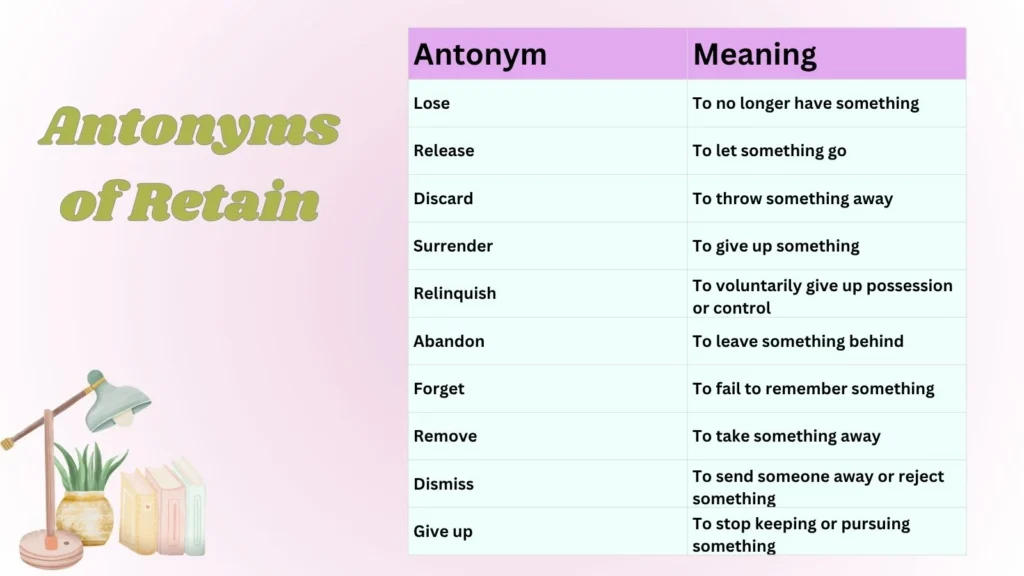
Antonyms are words with opposite meanings.
Since retain means to keep something, its antonyms generally describe losing, releasing, removing, or giving something away.
| Antonym | Meaning |
|---|---|
| Lose | To no longer have something |
| Release | To let something go |
| Discard | To throw something away |
| Surrender | To give up something |
| Relinquish | To voluntarily give up possession or control |
| Abandon | To leave something behind |
| Forget | To fail to remember something |
| Remove | To take something away |
| Dismiss | To send someone away or reject something |
| Give up | To stop keeping or pursuing something |
Example:
- Retain: “She decided to retain her position.”
- Antonym: “She decided to relinquish her position.”
These words communicate opposite actions.
8. Retain vs. Maintain: What’s the Difference?
Retain and maintain are similar words, but they are not always interchangeable.
Retain means to keep or continue possessing something.
Maintain means to keep something in a particular condition, state, or level.
Comparison Table
| Retain | Maintain |
|---|---|
| Means to keep something | Means to keep something in good condition or at a certain level |
| Focuses on possession or preservation | Focuses on continuation or upkeep |
| Retain information | Maintain a routine |
| Retain ownership | Maintain a building |
| Retain customers | Maintain customer relationships |
| Retain control | Maintain order |
Examples of Retain
- “The company wants to retain its employees.”
- “She can retain information easily.”
- “He decided to retain ownership of the house.”
Examples of Maintain
- “You should maintain a healthy lifestyle.”
- “The workers maintain the equipment.”
- “The teacher maintains discipline in the classroom.”
Easy trick: Retain means keep something. Maintain means keep something working, stable, or in a particular condition.
9. Retain vs. Preserve: What’s the Difference?
Retain and preserve can sometimes be used similarly, but they have different shades of meaning.
Retain focuses on continuing to have or hold something.
Preserve focuses on protecting something from damage, loss, or unwanted change.
| Retain | Preserve |
|---|---|
| Keep something | Protect something |
| Retain ownership | Preserve historical buildings |
| Retain information | Preserve cultural traditions |
| Retain moisture | Preserve food |
| Retain control | Preserve natural resources |
For example:
- “The student retained the information.” This means the student remembered it.
- The student preserved the original notes.” This means the student kept them safe.
The two words are related, but the context determines which one is more appropriate.
10. Common Expressions and Phrases With Retain
Retain appears in several common English expressions, especially in professional, educational, and formal writing.
1. Retain Information
Means to remember or keep knowledge in your memory.
Example: “Reading regularly helps you retain information.”
2. Retain Employees
Means to keep workers within an organization.
Example: “The company offers competitive salaries to retain employees.”
3. Retain Ownership
Means to continue owning something.
Example: “The family decided to retain ownership of the property.”
4. Retain Control
Means to continue having authority or power over something.
Example: “The manager wants to retain control of the project.”
5. Retain Customers
Means to keep existing customers rather than losing them to competitors.
Example: “Good customer service helps businesses retain customers.”
6. Retain Moisture
Means to keep water or dampness instead of allowing it to disappear quickly.
Example: “This type of soil can retain moisture.”
7. Retain the Services
Means to hire or continue using the services of a professional.
Example: “The organization decided to retain the services of a consultant.”
8. Retain Its Value
Means to continue being worth a particular amount.
Example: “Some classic cars retain their value over time.”
11. Retain Meaning in Business and Professional English
In professional communication, retain is a particularly useful word because it sounds clear, formal, and precise.
Businesses use it when discussing employees, customers, clients, profits, and resources.
Employee Retention
Employee retention refers to an organization’s ability to keep its employees over time.
For example:
“The company introduced flexible working hours to improve employee retention.”
Customer Retention
Customer retention means keeping existing customers interested in a business and encouraging them to continue purchasing its products or services.
For example:
“Excellent customer support can improve customer retention.”
Retain a Client
This means continuing a professional relationship with a customer or client.
For example:
“The agency offered additional services to retain its largest client.”
Why Is Retain Useful in Professional Writing?
The word can make business communication more precise.
Instead of writing:
“We want to keep our best workers.”
You can write:
“We aim to retain our most talented employees.”
Both sentences are correct, but the second sounds more formal and professional.
12. Retain Meaning in Learning and Memory
Retain is frequently used when discussing learning, studying, and memory.
When people learn something, they do not always remember it permanently. Retaining information means keeping that knowledge available in the mind so it can be recalled later.
For example:
“Students who review their lessons regularly may retain information more effectively.”
Ways to Improve Information Retention
Here are some practical learning techniques:
- Active recall: Test yourself instead of only rereading notes.
- Spaced repetition: Review information at increasing intervals.
- Practice: Apply what you have learned through exercises.
- Teach others: Explain concepts in your own words.
- Take breaks: Give yourself time to process information.
- Get enough sleep: Healthy sleep supports learning and memory.
These methods can help make learning more effective and improve your ability to retain knowledge.
13. Common Mistakes When Using the Word Retain

Although retain is not a difficult word, learners sometimes use it incorrectly.
Here are some common mistakes and their corrections.
Mistake 1: Using Retain When You Mean Obtain
Incorrect: “I want to retain a new job.”
Correct: “I want to obtain a new job.”
Explanation: Obtain means to get something, while retain means to keep something you already have.
Mistake 2: Confusing Retain With Maintain
Incorrect: “I need to retain my car in good condition.”
Better: “I need to maintain my car in good condition.”
Explanation: Maintain is more appropriate when talking about keeping something in good working condition.
Mistake 3: Using the Wrong Verb Form
Incorrect: “She retain the information yesterday.”
Correct: “She retained the information yesterday.”
Explanation: Retained is the past-tense form of retain.
Mistake 4: Thinking Retain Only Refers to Physical Objects
Incorrect understanding: “Retain can only mean keeping physical things.”
Correct understanding: Retain can refer to physical objects, knowledge, ownership, customers, employees, control, and other abstract things.
Mistake 5: Confusing Retain With Remember in Every Situation
Incorrect: “The company wants to remember its employees.”
Correct: “The company wants to retain its employees.”
Explanation: Remember is usually related to memory, while retain can mean continuing to employ or keep someone.
14. Related Words and Forms of Retain
Understanding the different forms of retain can help you use the word correctly in writing and conversation.
| Word Form | Meaning | Example |
|---|---|---|
| Retain | To keep something | “We retain our records.” |
| Retained | Kept something | “She retained her position.” |
| Retaining | The act of keeping | “The material is retaining heat.” |
| Retention | The act or ability of keeping something | “Information retention is important.” |
| Retentive | Having the ability to remember or hold something | “He has a retentive memory.” |
What Does Retention Mean?
Retention is the noun form of retain.
It refers to the act, process, or ability of keeping something.
Examples:
- Customer retention means keeping customers.
- Employee retention means keeping employees.
- Memory retention means remembering information.
- Water retention means the holding or accumulation of water in a material or system.
What Does Retained Mean?
Retained is the past tense and past participle of retain.
For example:
“The company retained its original employees.”
This means the company continued to employ those workers.
FAQs:
1. What does retain mean in simple words?
Retain means to keep, hold, or continue to have something instead of losing or giving it away. For example, retaining information means remembering what you have learned.
2. What is another word for retain?
Common synonyms of retain include keep, preserve, maintain, hold, save, store, and conserve. The best alternative depends on the sentence.
3. What does retain mean in a sentence?
In the sentence “She can retain information easily,” retain means to remember or keep information in her memory.
4. Is retain a positive or negative word?
Retain is generally a neutral word. Its meaning depends on the context. Retaining valuable knowledge is positive, while retaining an unwanted problem may be negative.
5. What is the opposite of retain?
Common antonyms of retain include lose, release, discard, surrender, relinquish, abandon, and give up.
6. What is the difference between retain and maintain?
Retain means to keep or continue possessing something. Maintain means to keep something in a particular condition or at a certain level. For example, you retain ownership but maintain a building.
7. What does retain information mean?
To retain information means to remember knowledge or facts after learning or reading them. It means the information stays available in your memory.
8. What does retain mean in business?
In business, retain usually means keeping employees, customers, clients, or resources. For example, customer retention refers to a company’s ability to keep its existing customers.
9. What is the noun form of retain?
The noun form of retain is retention. It refers to the act or ability of keeping something, such as information, customers, or employees.
10. Is retained the past tense of retain?
Yes. Retained is both the simple past tense and the past participle of retain. For example, “She retained her position.”
Conclusion:
The retain meaning is simple but useful: it means to keep, hold, preserve, or continue to have something rather than losing or giving it away.
You can use retain when talking about remembering information, keeping employees, maintaining ownership, preserving resources, or continuing to hold a particular position.
Although it is similar to words such as keep, maintain, and preserve, retain has its own specific uses depending on the context.

I am Henry James and i am a passionate writer and language enthusiast behind PunPalace, a platform dedicated to exploring meanings, word origins, and simple explanations. My aims to make learning vocabulary easy, engaging, and accessible for everyone.