Have you ever heard someone say, “She knows how to weave fabric,” or “The car began to weave through traffic”? The word weave can have several meanings, and its meaning changes depending on the situation. Understanding the weave meaning can help you recognize the word in everyday conversations, books, articles, and descriptions.
In simple English, weave can mean to make cloth by crossing threads over and under one another. It can also mean to move from side to side while traveling through a space. In writing, people may even use “weave” figuratively when talking about combining ideas, stories, or details.
In this guide, we will explain the weave meaning in simple terms, explore its different uses, provide sentence examples, discuss its origin, and explain common mistakes.
What Does Weave Mean?
The word weave has two major everyday meanings.
First, it can mean to make fabric by interlacing threads. The threads are arranged in a particular pattern to create cloth or another material.
Second, weave can mean to move from one side to another while traveling, often while avoiding obstacles.
For example:
“The artist learned to weave beautiful baskets.”
Here, weave refers to creating something by interlacing materials.
Now consider:
“The cyclist had to weave through the crowded street.”
In this sentence, weave means moving from side to side to get through a crowded area.
Weave Meaning in Simple English
In simple English, weave means to cross or mix things together in a pattern, especially threads or materials.
When used for movement, it means to move from side to side while going around people or objects.
| Meaning | Simple Explanation | Example |
|---|---|---|
| Make fabric | Cross threads together | She learned to weave cloth. |
| Move around | Move from side to side around obstacles | The cyclist weaved through traffic. |
| Combine ideas | Mix different elements together | The author weaved history into the story. |
Weave Meaning in English
In English, weave is both a verb and a noun.
As a verb, it can describe the action of interlacing materials or moving in a winding or side-to-side path.
As a noun, weave can refer to the way threads are arranged in fabric or to a weaving pattern.
For example:
“The fabric has a tight weave.”
Here, weave describes the structure or pattern created by threads in the material.
Weave Meaning in Text
When you see weave in a text message, article, book, or conversation, look at the words around it.
If the sentence mentions fabric, thread, wool, cloth, baskets, or textiles, weave probably means to create something by interlacing materials.
If the sentence mentions traffic, people, cars, roads, or obstacles, it may describe movement from side to side.
For example:
“He weaved between the tables to reach the door.”
This means he moved around the tables rather than walking in a straight line.
Weave Meaning in a Sentence
Here are several examples that show how weave can be used naturally.
- “My grandmother taught me how to weave baskets.”
- “The workers weave colorful patterns into the fabric.”
- “The cyclist began to weave through traffic.”
- “She had to weave between the people in the crowd.”
- “The author managed to weave humor into the story.”
- “The designer used a traditional weave for the fabric.”
- “The horse weaved around the obstacles.”
- “The story weaves several different characters together.”
- “They weave the threads carefully to create the final design.”
- “The dancer weaved through the performers on stage.”
These examples show why the surrounding context is important when interpreting the word.
Weave as a Verb
As a verb, weave describes an action.
The most traditional use is the process of making fabric or another object by crossing threads, fibers, strips, or other materials together.
For example:
“The craftsperson weaves cotton into a beautiful textile.”
Weave can also describe movement:
“The runner weaved through the crowd.”
It can also be used figuratively:
“The filmmaker weaved several personal stories into the documentary.”
In the last example, no physical threads are involved. Instead, different stories are being combined into one larger work.
Weave as a Noun
Weave can also be used as a noun, particularly when discussing textiles.
In this sense, it refers to the pattern or structure created when threads are interlaced.
For example:
“This fabric has a loose weave.”
A loose weave means the threads are arranged less tightly. A tight weave means the threads are closely arranged.
The noun form is especially common in discussions about clothing, fabrics, textiles, and manufacturing.
Weave Meaning in Fabric and Textiles
The word weave has a particularly important meaning in the textile industry.
Weaving involves crossing two basic sets of threads. These threads are traditionally called the warp and weft.
The warp threads generally run lengthwise, while the weft threads are passed across them. By crossing these threads in different patterns, manufacturers can create different types of fabric.
Common textile weaves include:
- Plain weave – a simple over-and-under pattern
- Twill weave – creates a diagonal pattern
- Satin weave – produces a smoother surface
Different weaving techniques can affect the appearance, texture, strength, and feel of fabric.
Weave Meaning in Writing
One of the most interesting uses of weave is figurative language.
Writers often say they weave ideas, details, themes, or stories into their work. This does not involve physical threads. Instead, it means combining different elements so they become part of a larger whole.
For example:
“The novelist weaves several family stories into one powerful narrative.”
This means the novelist combines the different stories in a connected way.
This figurative use is common in literature, journalism, speeches, essays, and everyday descriptions.
Weave Meaning for Movement
Another common use of weave describes movement that is not straight.
Someone may weave through a crowd, meaning they move from side to side to get around people.
A vehicle can also weave through traffic, although this expression can suggest unsafe or unpredictable driving depending on the context.
Examples include:
- “She weaved through the busy market.”
- “The dog weaved between the chairs.”
- “The runner weaved around the other athletes.”
- “The car was weaving between lanes.”
The central idea is movement that changes direction repeatedly.
Weave vs Wave
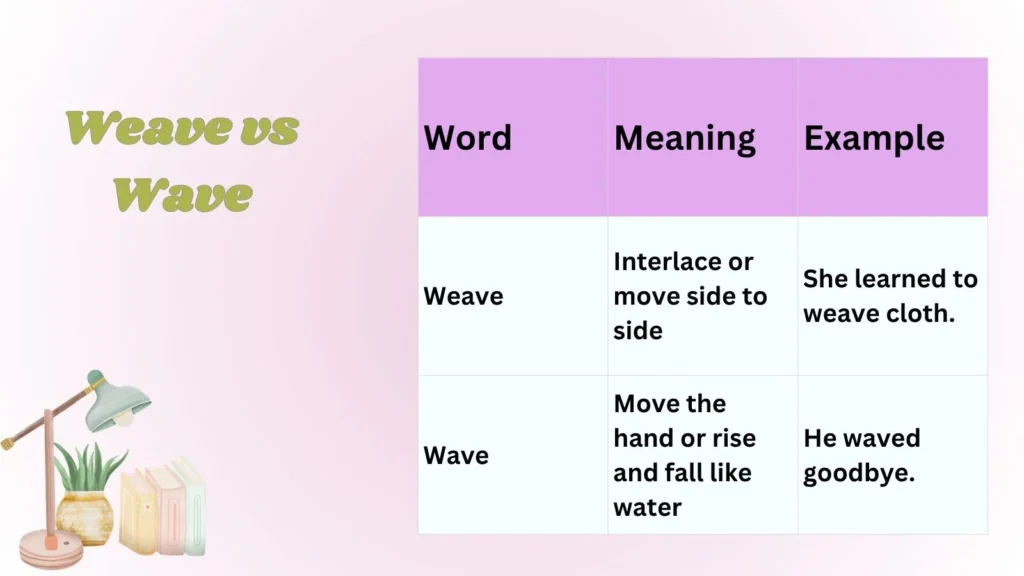
Weave and wave can sometimes be confused because they sound somewhat similar, but they have completely different meanings.
Weave means to interlace materials or move from side to side.
Wave can mean to move your hand as a greeting or to describe the movement of water.
| Word | Meaning | Example |
|---|---|---|
| Weave | Interlace or move side to side | She learned to weave cloth. |
| Wave | Move the hand or rise and fall like water | He waved goodbye. |
Remembering this difference can prevent spelling and usage mistakes.
Weave vs Intertwine
Weave and intertwine are closely related, especially when talking about things being combined.
To weave something often means to combine or interlace it with something else in an organized pattern.
To intertwine means to twist or connect things together so they become closely linked.
For example:
“The author weaves historical facts into the novel.”
Meanwhile:
“Their lives became intertwined over the years.”
Both words can describe connection, but their emphasis is slightly different.
Weave Synonyms
The best synonym for weave depends on how the word is being used.
For making fabric, possible related words include:
- Interlace
- Braid
- Plait
- Combine
- Thread
For movement, related words can include:
- Wind
- Wander
- Swerve
- Twist
- Meander
For figurative writing, related words include:
- Combine
- Integrate
- Blend
- Incorporate
- Intertwine
These are related words rather than perfect replacements because weave has several meanings.
Weave Antonyms
There is no single antonym for every meaning of weave.
When referring to combining or interlacing, possible contrasting ideas include:
- Separate
- Disconnect
- Untangle
- Divide
- Disassemble
When describing movement, an opposite idea might be traveling straight or moving directly without changing direction.
The correct opposite therefore depends on the context.
Different Forms of Weave
The word weave has several grammatical forms.
| Form | Example |
|---|---|
| Weave | They weave the fabric by hand. |
| Weaves | She weaves colorful baskets. |
| Weaving | Weaving is an ancient craft. |
| Wove | She wove the cloth herself. |
| Woven | The fabric was carefully woven. |
One important point is that the past forms can be confusing. The simple past is commonly wove, while woven is generally used as a past participle.
Why Is the Word Weave Useful?
The word weave is useful because it can describe both physical actions and abstract ideas.
You can use it to talk about traditional crafts, textiles, movement, storytelling, writing, relationships, and the way different ideas connect.
For example, saying that a writer weaves humor into a story creates a vivid image. It suggests that humor is carefully integrated into the larger piece rather than simply added randomly.
This makes weave a powerful word for both everyday and creative English.
Common Mistakes With Weave
Here are some common mistakes to avoid when using weave.
Confusing Weave With Wave
These words have different meanings and spellings. Weave relates to interlacing or winding movement, while wave can refer to a hand gesture or moving water.
Using the Wrong Past Tense
For the textile-related verb, the simple past is commonly wove. For example, “She wove the fabric.” The past participle is woven, as in “The fabric was woven by hand.”
Thinking Weave Only Refers to Fabric
Although weaving fabric is an important meaning, weave can also describe movement and the combination of ideas or stories.
Ignoring Context
The sentence “He weaved through traffic” and “She weaved a basket” use the same basic word differently. Always examine the surrounding words.
Assuming Figurative Weave Is About Physical Threads
When someone says an author weaves ideas into a story, they are using the word metaphorically. It means combining ideas naturally and effectively.
FAQs:
What is the simple meaning of weave?
Weave means to interlace threads or materials to make something, or to move from side to side around obstacles.
What does weave mean in a sentence?
The meaning depends on context. For example, “She weaves fabric” means she crosses threads together, while “He weaves through traffic” means he moves from side to side around vehicles.
What is the past tense of weave?
The common simple past form is wove, while woven is commonly used as the past participle.
What is a synonym for weave?
Depending on the context, synonyms or related words include interlace, intertwine, blend, incorporate, wind, and meander.
Can weave be used figuratively?
Yes. Writers often use weave figuratively to describe combining ideas, themes, details, emotions, or stories into a larger whole.
Final Thoughts:
The weave meaning is broader than simply making cloth. The word can describe interlacing materials, moving from side to side, or combining ideas and stories.
When talking about textiles, weave refers to the process of crossing threads or the pattern created by those threads. When talking about movement, it describes changing direction while moving through or around obstacles. In writing and storytelling, it can describe carefully combining different elements into one connected work.

I am Henry James and i am a passionate writer and language enthusiast behind PunPalace, a platform dedicated to exploring meanings, word origins, and simple explanations. My aims to make learning vocabulary easy, engaging, and accessible for everyone.