If someone sends you “Feliz Cumpleaños” on your birthday, they are giving you a warm and friendly birthday wish in Spanish. You may have seen this phrase in texts, social media posts, birthday cards, songs, or messages from Spanish-speaking friends and wondered exactly what it means.
Feliz Cumpleaños meaning is simply “Happy Birthday” in English. It is one of the most common Spanish phrases used to wish someone happiness on their birthday. 🎂
The phrase is short, positive, and suitable for many situations. You can use it with friends, family members, classmates, coworkers, or other people you want to congratulate on their special day.
In this guide, we will explain the meaning of Feliz Cumpleaños, break down each word, explore its pronunciation and origin, show how people use it in texts and social media, and give you natural examples and replies.
What Does Feliz Cumpleaños Mean?
Feliz Cumpleaños translates directly into English as “Happy Birthday.”
It is a Spanish birthday greeting used to celebrate someone’s birthday and express good wishes for their special day.
| Spanish Phrase | English Meaning | Common Use |
|---|---|---|
| Feliz Cumpleaños | Happy Birthday | Birthday greeting |
| Muy Feliz Cumpleaños | Very Happy Birthday | Warm birthday wish |
| Feliz Cumpleaños a ti | Happy Birthday to you | Birthday song or greeting |
| Que tengas un feliz cumpleaños | Have a happy birthday | Full birthday message |
So, if you are searching for what does Feliz Cumpleaños mean, the easiest answer is: it means “Happy Birthday” in Spanish.
Feliz Cumpleaños Meaning in Simple English

In simple English, Feliz Cumpleaños means:
“I hope you have a happy birthday.”
You do not need to interpret it as a complicated sentence. It is simply a traditional birthday greeting.
When someone says Feliz Cumpleaños, they are acknowledging your birthday and wishing you happiness. The phrase can sound warm, cheerful, affectionate, or respectful depending on the relationship between the people using it.
For example:
- A friend might text you “¡Feliz Cumpleaños!”
- A family member might write “¡Feliz Cumpleaños, querida!”
- A coworker might say “¡Feliz Cumpleaños!” at work.
- A romantic partner might send a longer and more affectionate birthday message.
The basic phrase stays the same, but the surrounding words can change the emotional tone.
What Does Feliz Mean in Spanish?
The Spanish word feliz means “happy” or “joyful.”
It describes a positive emotional state or something associated with happiness.
For example:
- Estoy feliz. = I am happy.
- Un día feliz. = A happy day.
- Feliz Navidad. = Merry Christmas.
- Feliz cumpleaños. = Happy birthday.
Therefore, the word feliz provides the positive feeling in the birthday greeting.
It is not specifically a birthday word. You will find feliz in many Spanish expressions involving happiness, celebration, and good wishes.
What Does Cumpleaños Mean?
Cumpleaños means “birthday.”
The word is formed from two Spanish elements:
- cumple — related to the verb cumplir, meaning “to complete,” “to fulfill,” or, in the context of age, “to turn” a certain age.
- años — means “years.”
In everyday Spanish, cumpleaños refers to the anniversary of the day a person was born.
For example:
- Hoy es mi cumpleaños. = Today is my birthday.
- ¿Cuándo es tu cumpleaños? = When is your birthday?
- Mañana es su cumpleaños. = Tomorrow is his/her birthday.
The letter ñ is important because años means “years.” Without the tilde, anos can have a completely different and potentially embarrassing meaning in Spanish. This is one reason correct spelling matters when writing the phrase.
Feliz Cumpleaños Word-by-Word Translation
Understanding each part can make the phrase easier to remember.
| Word | Meaning | Role |
|---|---|---|
| Feliz | Happy | Expresses a positive wish |
| Cumpleaños | Birthday | Identifies the occasion |
Together:
Feliz + Cumpleaños = Happy Birthday
The phrase is therefore very close in meaning and function to the English expression.
How Do You Pronounce Feliz Cumpleaños?
For English speakers, the pronunciation can seem unfamiliar because Spanish has sounds that may not exist in English.
A helpful approximate pronunciation is:
feh-LEES koom-pleh-AH-nyos
The exact pronunciation varies slightly depending on the Spanish-speaking region and accent.
Pay special attention to the ñ in cumpleaños. The “ñ” sound is similar to the ny sound in the English word “canyon.”
So the final part of cumpleaños should not simply sound like an English “nos.” The ñ creates the characteristic Spanish sound.
Why Does Cumpleaños Have an Ñ?
The ñ is a distinct letter in Spanish and represents a specific sound.
In cumpleaños, the ñ appears in the word años, which means “years.”
This distinction is important when writing Spanish.
For example:
años = years
The tilde over the ñ is not decorative. It changes the pronunciation and meaning of the word.
Therefore, when writing Feliz Cumpleaños, keeping the ñ is the correct Spanish spelling.
Feliz Cumpleaños in Texting
In texting, Feliz Cumpleaños has the same basic meaning as it does in spoken Spanish: Happy Birthday.
People often shorten the surrounding message rather than changing the phrase itself.
For example:
- ¡Feliz Cumpleaños! 🎂
- Feliz cumple! 🥳
- ¡Feliz cumple, amiga!
- Feliz cumple, bro!
- ¡Feliz cumpleaños! Espero que tengas un día increíble.
Feliz cumple is a casual shortened form that you may see in everyday messages. It is especially common when friends are chatting online.
However, Feliz Cumpleaños remains the standard full expression.
Feliz Cumpleaños Meaning on Social Media
On social media, Feliz Cumpleaños is commonly used in comments, captions, stories, and direct messages.
Someone might post a birthday photo and receive comments such as:
- ¡Feliz cumpleaños! 🎂
- ¡Feliz cumple, hermosa!
- Feliz cumpleaños, amiga. Que disfrutes mucho tu día.
- ¡Muchísimas felicidades!
- Espero que tengas un día maravilloso. ¡Feliz cumpleaños!
The phrase can be used by Spanish speakers and by people who simply want to include a Spanish birthday greeting in their post.
Because the phrase is widely recognized, it can also add a festive or multicultural touch to a birthday caption.
Is Feliz Cumpleaños Formal or Casual?
Feliz Cumpleaños is neither strictly formal nor strictly casual. It is a general birthday greeting that can work in many situations.
You can use it with:
- Close friends
- Family members
- Classmates
- Coworkers
- Teachers
- Neighbors
- Acquaintances
- Romantic partners
The level of formality usually comes from the rest of the message.
For example, simply saying “¡Feliz Cumpleaños!” is neutral and friendly.
A more formal message might say:
“Le deseo un muy feliz cumpleaños.”
That means approximately, “I wish you a very happy birthday.”
A close friend might receive something much more casual, such as:
“¡Feliz cumple! Espero que la pases genial.”
Feliz Cumpleaños vs Happy Birthday
Feliz Cumpleaños and Happy Birthday have essentially the same function. The main difference is language.
| English | Spanish |
|---|---|
| Happy Birthday | Feliz Cumpleaños |
| Happy birthday to you | Feliz cumpleaños a ti |
| Have a happy birthday | Que tengas un feliz cumpleaños |
| Many happy returns | No exact direct equivalent |
Although the phrases perform the same social function, Spanish speakers may use several other birthday expressions that do not translate word-for-word into English.
How to Say Happy Birthday to a Friend in Spanish
If you want to wish a Spanish-speaking friend a happy birthday, ¡Feliz Cumpleaños! is already perfectly appropriate.
You can make it warmer by adding their name or another friendly sentence.
Examples include:
- ¡Feliz Cumpleaños, amiga! — Happy Birthday, friend!
- ¡Feliz Cumpleaños, amigo! — Happy Birthday, friend!
- ¡Feliz Cumpleaños! Espero que disfrutes mucho tu día. — Happy Birthday! I hope you really enjoy your day.
- ¡Feliz Cumpleaños! Que todos tus deseos se hagan realidad. — Happy Birthday! May all your wishes come true.
The exact wording can depend on the relationship and the region where the Spanish speaker lives.
How to Say Happy Birthday to Someone You Love
When speaking to someone you love, you can make Feliz Cumpleaños more affectionate by adding terms of endearment and a personal message.
For example:
- Feliz Cumpleaños, mi amor. — Happy Birthday, my love.
- Feliz Cumpleaños, cariño. — Happy Birthday, darling.
- Feliz Cumpleaños, mi vida. — Happy Birthday, my love/my life.
- Feliz Cumpleaños, corazón. — Happy Birthday, sweetheart.
These expressions can sound romantic or deeply affectionate depending on the relationship.
It is important to remember that words of affection can vary by country and personal preference. A phrase that sounds natural in one Spanish-speaking community may sound more intimate or less common in another.
What Does Feliz Cumple Mean?
Feliz cumple is a casual shortened version of Feliz Cumpleaños.
It also means “Happy Birthday.”
You are more likely to see Feliz cumple in casual conversations, texts, social media comments, and messages between friends.
For example:
“¡Feliz cumple! Espero que tengas un día increíble.”
This means:
“Happy birthday! I hope you have an amazing day.”
The shortened version sounds more relaxed, while the complete form works in both casual and more formal settings.
How to Reply to Feliz Cumpleaños
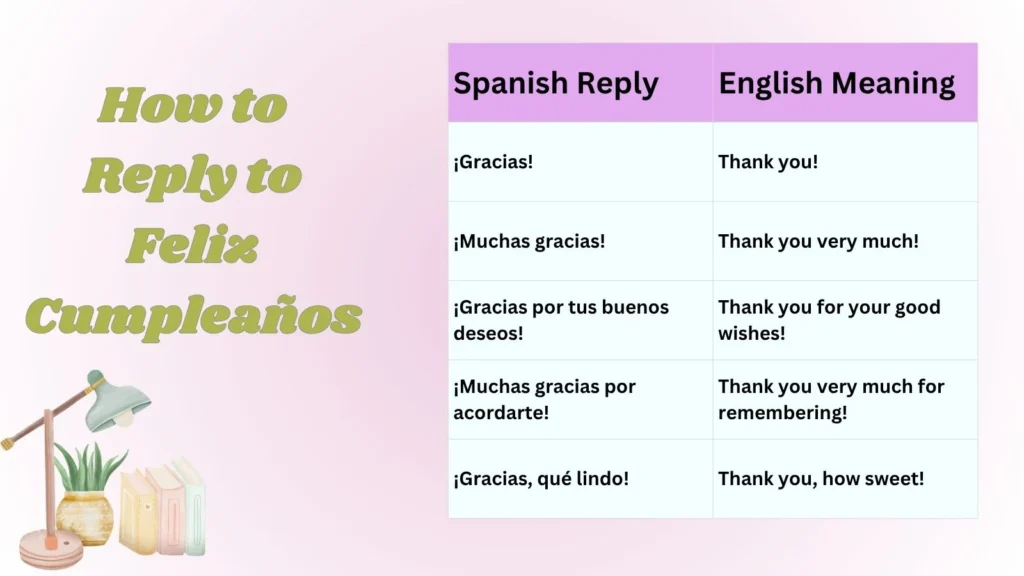
If someone tells you “Feliz Cumpleaños!”, the easiest response is “¡Gracias!”, meaning “Thank you!”
You can also respond with a slightly warmer message.
| Spanish Reply | English Meaning |
|---|---|
| ¡Gracias! | Thank you! |
| ¡Muchas gracias! | Thank you very much! |
| ¡Gracias por tus buenos deseos! | Thank you for your good wishes! |
| ¡Muchas gracias por acordarte! | Thank you very much for remembering! |
| ¡Gracias, qué lindo! | Thank you, how sweet! |
For a quick text reply, “¡Gracias!” is completely natural.
Feliz Cumpleaños and Birthday Songs
Feliz Cumpleaños is also strongly associated with Spanish-language birthday celebrations and birthday songs.
Spanish-speaking communities have different versions and regional traditions surrounding birthday songs. One well-known birthday song uses the phrase “Cumpleaños feliz”.
This expression also means “Happy Birthday.”
The exact lyrics and traditions can differ depending on the country and community, so it is better to think of Feliz Cumpleaños as the standard birthday greeting rather than assuming every Spanish-speaking country celebrates birthdays in exactly the same way.
Feliz Cumpleaños in Different Spanish-Speaking Countries
Spanish is spoken across many countries, and everyday expressions can vary from place to place.
However, Feliz Cumpleaños is broadly understood as a birthday greeting throughout Spanish-speaking communities.
You may notice variations in:
- Birthday songs
- Terms of affection
- Casual abbreviations
- Ways of saying congratulations
- Birthday traditions
- Regional vocabulary
For instance, some speakers may use feliz cumple casually, while others may prefer the complete feliz cumpleaños.
The core meaning remains the same.
Feliz Cumpleaños vs Feliz Cumple
These two expressions are closely related.
| Expression | Meaning | Tone |
|---|---|---|
| Feliz Cumpleaños | Happy Birthday | Standard and universal |
| Feliz Cumple | Happy Birthday | Casual and friendly |
If you are learning Spanish, Feliz Cumpleaños is the safest expression to learn first because it is the complete standard phrase.
Once you become familiar with casual Spanish, you will likely encounter feliz cumple in everyday communication.
Feliz Cumpleaños in a Birthday Card
You can use Feliz Cumpleaños at the beginning of a birthday card and then add a longer message.
For example:
¡Feliz Cumpleaños! Espero que este nuevo año de tu vida esté lleno de alegría, amor y momentos inolvidables.
The English meaning is approximately:
“Happy Birthday! I hope this new year of your life is filled with joy, love, and unforgettable moments.”
This type of message works well for someone close to you because it combines the traditional greeting with a more personal wish.
Feliz Cumpleaños Examples in Sentences
Here are several examples showing how the phrase can appear naturally.
- ¡Feliz Cumpleaños! — Happy Birthday!
- Te deseo un feliz cumpleaños. — I wish you a happy birthday.
- Espero que tengas un feliz cumpleaños. — I hope you have a happy birthday.
- ¡Feliz cumpleaños, mamá! — Happy Birthday, Mom!
- ¡Feliz cumpleaños, papá! — Happy Birthday, Dad!
- ¡Feliz cumpleaños, amiga! — Happy Birthday, friend!
- ¡Feliz cumpleaños, mi amor! — Happy Birthday, my love!
- Hoy es su cumpleaños. ¡Feliz cumpleaños! — Today is their birthday. Happy Birthday!
- Le envié un mensaje de feliz cumpleaños. — I sent them a happy birthday message.
- Todos le dijeron feliz cumpleaños. — Everyone wished them a happy birthday.
These examples show that the phrase can stand alone or become part of a longer sentence.
Is Feliz Cumpleaños Romantic?
By itself, Feliz Cumpleaños is not inherently romantic.
It simply means Happy Birthday.
However, the phrase can become romantic when it is directed toward a romantic partner and accompanied by affectionate language.
For example:
“Feliz Cumpleaños, mi amor. Espero que hoy sea tan especial como tú.”
Here, the romantic feeling comes from mi amor and the rest of the message, not from the words Feliz Cumpleaños themselves.
Therefore, if someone sends you only “Feliz Cumpleaños”, you should not automatically assume they are flirting or expressing romantic feelings.
Is Feliz Cumpleaños Used for Men and Women?
Yes. Feliz Cumpleaños can be used for people of any gender.
The phrase itself does not change based on whether the birthday person is a man or a woman.
You can say:
- Feliz cumpleaños, amigo.
- Feliz cumpleaños, amiga.
- Feliz cumpleaños, hermano.
- Feliz cumpleaños, hermana.
The additional word may change according to the person, but Feliz Cumpleaños remains the same.
What Is the Origin of Feliz Cumpleaños?
The phrase comes from ordinary Spanish vocabulary rather than being a modern internet expression.
Feliz is the Spanish adjective meaning “happy,” while cumpleaños is the Spanish noun for “birthday.”
The word cumpleaños combines the idea of fulfilling or completing years with años, meaning years. In the context of age, cumplir años refers to reaching or completing another year of life.
Therefore, the birthday expression developed naturally from the language used to describe the occasion of someone’s birthday.
Unlike internet slang, Feliz Cumpleaños is a traditional expression that has been used across generations of Spanish speakers.
Why Is Feliz Cumpleaños So Common?
The phrase is common because birthdays are celebrated across cultures, and Spanish-speaking communities use this simple expression to communicate good wishes.
Its popularity also comes from its flexibility.
You can say it:
- In person
- Over the phone
- In a text
- In an email
- On social media
- In a birthday card
- During a birthday party
- As part of a birthday song
You do not need a complicated sentence to make the greeting meaningful. Sometimes a simple ¡Feliz Cumpleaños! is enough. 🎉
How to Make a Feliz Cumpleaños Message More Special
If you want to send more than a basic birthday greeting, you can add a personal wish.
For example:
- ¡Feliz Cumpleaños! Espero que todos tus sueños se hagan realidad.
- ¡Feliz Cumpleaños! Que tengas un día lleno de alegría.
- ¡Feliz Cumpleaños! Disfruta mucho de tu día especial.
- ¡Feliz Cumpleaños! Te deseo salud, felicidad y muchos momentos maravillosos.
- ¡Feliz Cumpleaños! Espero que este nuevo año de vida sea increíble.
These messages add warmth without changing the core meaning of the phrase.
Common Mistakes With Feliz Cumpleaños

1. Forgetting the Ñ
One of the most common spelling mistakes is writing cumpleanos instead of cumpleaños.
The correct Spanish spelling is cumpleaños, with the ñ.
2. Thinking Feliz Means Birthday
Feliz means “happy.” It does not mean “birthday.” The word for birthday is cumpleaños.
3. Assuming It Is Romantic
Feliz Cumpleaños is a general birthday greeting. Its use does not automatically indicate romantic interest.
4. Confusing Feliz Cumple With a Different Meaning
Feliz cumple is simply a shortened, casual version of Feliz Cumpleaños.
5. Translating Every Word Too Literally
Although understanding the individual words is helpful, the natural English translation of the whole expression is simply “Happy Birthday.”
FAQs:
What does Feliz Cumpleaños mean in English?
Feliz Cumpleaños means “Happy Birthday” in English. It is a common Spanish expression used to wish someone happiness on their birthday.
What does Feliz mean?
Feliz means “happy” or “joyful” in Spanish. It appears in several expressions, including Feliz Cumpleaños and Feliz Navidad.
What does Cumpleaños mean?
Cumpleaños means “birthday.” The word is associated with completing another year of life.
How do you reply to Feliz Cumpleaños?
The simplest reply is “¡Gracias!”, meaning “Thank you!” You can also say “¡Muchas gracias!” for “Thank you very much!”
Is Feliz Cumpleaños formal or casual?
Feliz Cumpleaños is a general greeting that works in both casual and many formal situations. The surrounding message determines how formal or affectionate it sounds.
Final Thoughts:
Feliz Cumpleaños meaning is simple: it means “Happy Birthday” in Spanish. The phrase combines feliz, meaning “happy,” with cumpleaños, meaning “birthday.”
You can use it with friends, family, coworkers, classmates, romantic partners, or almost anyone celebrating a birthday. The full expression is standard and widely understood, while feliz cumple is a more casual shortened form commonly seen in everyday communication.
If you are replying to someone who says “¡Feliz Cumpleaños!”, a simple “¡Gracias!” is all you need. If you want to make your own greeting warmer, add a personal wish, a name, or an affectionate expression.
Most importantly, remember the spelling: Feliz Cumpleaños, with the Spanish ñ. 🎂
Whether you are learning Spanish, chatting with a Spanish-speaking friend, writing a birthday caption, or simply curious about the phrase, Feliz Cumpleaños is one of the easiest and most useful Spanish expressions to know.

I am Henry James and i am a passionate writer and language enthusiast behind PunPalace, a platform dedicated to exploring meanings, word origins, and simple explanations. My aims to make learning vocabulary easy, engaging, and accessible for everyone.