
Have you ever wondered why some people can quickly turn their savings or investments into cash while others struggle to access their money when they need it most? The answer often comes down to liquidity.
Understanding the liquidity meaning is important in finance, business, banking, investing, and everyday money management. It explains how easily an asset can be converted into cash without losing much of its value. For example, money in your wallet is highly liquid because you can spend it immediately. A house, however, is less liquid because selling it can take weeks or even months.
Liquidity is not just a financial term used by economists or investors. It is a practical concept that affects how individuals manage their savings, how businesses pay their bills, and how financial markets operate.
In this guide, you will learn what liquidity means, where the term comes from, its different types, practical examples, common financial ratios, and why it matters in everyday life.
What Is the Meaning of Liquidity?
Liquidity refers to the ease and speed with which an asset can be converted into cash without significantly reducing its market value.
In simple words, liquidity means how quickly you can access money from something you own.
Cash is considered the most liquid asset because it is already available for immediate use. Other assets, such as stocks, bonds, vehicles, and real estate, have different levels of liquidity depending on how easily they can be sold.
For example:
- Cash: You can use it immediately, making it highly liquid.
- Bank savings: You can usually withdraw money quickly.
- Stocks: You can generally sell them through a stock market, although the price may change.
- A car: You may need time to find a buyer and agree on a price.
- Real estate: Selling a property can take considerable time and involve additional costs.
Liquidity is important because having valuable assets does not always mean having money available when you need it.
A person may own an expensive house but still struggle to pay an unexpected bill if they do not have enough cash or accessible savings.
Simple Definition of Liquidity

The simplest definition of liquidity is:
Liquidity is the ability to convert an asset into cash quickly and easily without losing a significant amount of its value.
In financial terms, liquidity measures how readily available money or cash equivalents are.
The concept can also describe a company’s ability to meet its short-term financial obligations using its available assets.
For example, if a business has enough cash to pay employee salaries, suppliers, rent, and other upcoming expenses, it generally has a stronger liquidity position.
Origin and History of the Word Liquidity
The word liquidity comes from the word liquid, which describes something that can flow easily.
The term has roots in the Latin word liquidus, meaning fluid or flowing.
Over time, the word developed a financial meaning. Economists and financial professionals began using liquidity to describe how easily money or assets could move into cash.
Today, liquidity is widely used in banking, investment management, accounting, economics, and financial markets.
Although its meaning is connected to the idea of flow, financial liquidity is specifically about the availability and convertibility of money.
How Does Liquidity Work?
Liquidity works by measuring how easily an asset can be sold or exchanged for cash.
The easier it is to convert an asset into money, the more liquid that asset is. If selling something takes a long time or requires a significant price reduction, it is considered less liquid.
Several factors affect liquidity:
1. Demand: Assets that many buyers want are usually easier to sell.
2. Market availability: Assets traded in active markets can often be sold faster.
3. Transaction costs: High selling fees can make an asset less attractive to convert into cash.
4. Price stability: Assets that can be sold without a major price reduction generally have better liquidity.
5. Time: The longer an asset takes to sell, the less liquid it is considered.
For example, selling shares in a popular publicly traded company may take only seconds during normal market conditions. Selling a large commercial property could take several months.
This difference demonstrates why liquidity matters when making financial decisions.
Types of Liquidity
Liquidity can be understood in several ways depending on the financial situation. The most common categories include asset liquidity, market liquidity, accounting liquidity, and funding liquidity.
1. Asset Liquidity
Asset liquidity refers to how easily an individual asset can be converted into cash without losing much of its value.
Cash is the most liquid asset, while property, collectibles, and specialized equipment are generally less liquid.
For example, a person can immediately spend cash but may need to advertise a vehicle, negotiate with buyers, and complete paperwork before receiving money from a sale.
2. Market Liquidity
Market liquidity describes how easily buyers and sellers can trade an asset in a financial market.
A market is considered highly liquid when many buyers and sellers are available and transactions can happen quickly without significantly affecting the asset’s price.
For example, major stock exchanges usually offer greater liquidity for actively traded shares than markets for rare collectibles.
High market liquidity generally makes buying and selling more convenient.
3. Accounting Liquidity
Accounting liquidity refers to a company’s ability to pay its short-term debts using assets that can be converted into cash within a relatively short period.
Businesses use financial ratios to evaluate their liquidity position.
These ratios help investors, lenders, and managers understand whether a company has enough accessible resources to cover upcoming expenses.
4. Funding Liquidity
Funding liquidity refers to the ability of an individual, business, or financial institution to obtain enough cash or financing to meet its financial obligations when they become due.
For example, a bank needs sufficient available funds to handle customer withdrawals and other payment requirements.
A company may also need funding liquidity to pay suppliers while waiting for customers to settle their invoices.
Examples of Liquidity in Everyday Life
Liquidity becomes easier to understand when you look at practical situations.
Here are some common examples:
Example 1: Cash in Your Wallet
Suppose you have $100 in your wallet. You can immediately use it to buy groceries, pay for transportation, or cover a small emergency.
This money has very high liquidity because it is already cash.
Example 2: Money in a Savings Account
Imagine you have $2,000 in a regular savings account. If you can withdraw it whenever needed, your savings are also highly liquid.
However, withdrawal restrictions or processing delays can affect how quickly you access the funds.
Example 3: Selling a Car
Suppose you own a car worth $15,000. Although it has considerable value, you cannot always turn it into cash immediately.
You must find a buyer, negotiate a price, and complete the sale. Therefore, a car is generally less liquid than cash.
Example 4: Owning a House
Imagine you own a house worth $250,000. It may be a valuable investment, but selling it can take weeks or months.
You might also need to pay taxes, agent commissions, and other transaction costs. This makes real estate less liquid than cash or publicly traded stocks.
Example 5: Business Inventory
A clothing store may have thousands of dollars worth of products. However, the owner cannot necessarily use those products to pay electricity bills directly.
The inventory must first be sold and converted into cash. Its liquidity depends on customer demand and how quickly the products sell.
Liquidity vs. Solvency: What Is the Difference?
Liquidity and solvency are related financial concepts, but they do not mean the same thing.
Liquidity measures whether someone can meet short-term financial obligations using readily available assets.
Solvency measures whether an individual or business can meet its overall financial obligations over the long term.
A company may have valuable assets and manageable long-term debt but still experience a temporary cash shortage. This means it could be solvent but have poor liquidity.
Similarly, a business with plenty of cash today might still be insolvent if its total debts are greater than its assets.
| Feature | Liquidity | Solvency |
|---|---|---|
| Meaning | Ability to access cash quickly | Ability to meet total financial obligations |
| Main focus | Short-term financial health | Long-term financial health |
| Time period | Usually short-term | Usually long-term |
| Measurement | Current ratio and quick ratio | Debt-to-equity and other financial measures |
| Main concern | Paying upcoming bills | Managing overall debt |
| Example | Paying monthly rent | Repaying long-term loans |
Both concepts are essential for evaluating financial stability.
What Is a Liquidity Ratio?
A liquidity ratio is a financial measurement used to determine whether a company has enough short-term assets to pay its short-term liabilities.
Investors, accountants, business owners, and lenders use liquidity ratios to evaluate a company’s financial health.
The most common liquidity ratios include the current ratio, quick ratio, and cash ratio.
1. Current Ratio
The current ratio measures whether a company can cover its short-term liabilities using its current assets.
Formula:
Current Ratio = Current Assets ÷ Current Liabilities
For example, imagine a company has:
- Current assets: $100,000
- Current liabilities: $50,000
Its current ratio is:
$100,000 ÷ $50,000 = 2
This means the company has $2 in current assets for every $1 of current liabilities.
A ratio above 1 generally indicates that current assets exceed current liabilities. However, what counts as a healthy ratio depends on the industry and the quality of those assets.
2. Quick Ratio
The quick ratio measures a company’s ability to pay short-term obligations using its most liquid current assets.
It generally excludes inventory because inventory may take time to sell.
Formula:
Quick Ratio = (Current Assets − Inventory − Prepaid Expenses) ÷ Current Liabilities
For example:
- Current assets: $100,000
- Inventory: $30,000
- Prepaid expenses: $10,000
- Current liabilities: $40,000
Quick ratio:
($100,000 − $30,000 − $10,000) ÷ $40,000 = 1.5
The company has $1.50 in quick assets for every $1 of short-term liabilities.
3. Cash Ratio
The cash ratio is a more conservative liquidity measurement. It focuses on cash and cash equivalents that are immediately available to cover short-term liabilities.
Formula:
Cash Ratio = (Cash + Cash Equivalents) ÷ Current Liabilities
For example:
- Cash and cash equivalents: $20,000
- Current liabilities: $50,000
Cash ratio:
$20,000 ÷ $50,000 = 0.4
This means the company has $0.40 in cash and cash equivalents for every $1 of current liabilities.
| Liquidity Ratio | What It Measures | Main Formula |
|---|---|---|
| Current Ratio | Ability to pay short-term debts using current assets | Current Assets ÷ Current Liabilities |
| Quick Ratio | Ability to pay debts using more liquid current assets | Quick Assets ÷ Current Liabilities |
| Cash Ratio | Ability to pay debts using cash and equivalents | Cash and Cash Equivalents ÷ Current Liabilities |
No single ratio tells the entire financial story. It is best to compare several ratios, examine previous performance, and consider industry standards.
Why Is Liquidity Important?
Liquidity plays a major role in financial stability. Whether you are managing personal savings or running a large organization, access to cash can make a significant difference.
Here are some important reasons why liquidity matters.
1. Helps Manage Unexpected Expenses
Life can be unpredictable. Medical bills, car repairs, household emergencies, and sudden expenses can happen without warning.
Having liquid assets, such as cash and accessible savings, allows you to handle these situations without immediately selling valuable possessions.
2. Supports Business Operations
Businesses need cash to pay employees, purchase supplies, cover rent, and manage everyday operating costs.
Even a profitable company can experience financial difficulties if it cannot access enough cash to meet its immediate obligations.
3. Reduces Financial Stress
Having readily available money provides greater financial flexibility.
Instead of worrying about how to pay an urgent bill, people with sufficient liquid savings can respond more confidently to unexpected situations.
4. Creates Investment Opportunities
Investors often keep some money in liquid assets so they can take advantage of new opportunities.
For example, someone with available cash may be able to purchase an investment when an attractive opportunity appears.
5. Builds Financial Stability
Liquidity helps individuals and businesses maintain financial stability during uncertain periods.
When income decreases or expenses increase, accessible funds can provide a temporary financial cushion.
6. Improves Creditworthiness
Lenders often examine a business’s liquidity before approving loans or extending credit.
A company that demonstrates the ability to meet its short-term obligations may appear less risky to potential lenders.
What Are Liquid and Illiquid Assets?
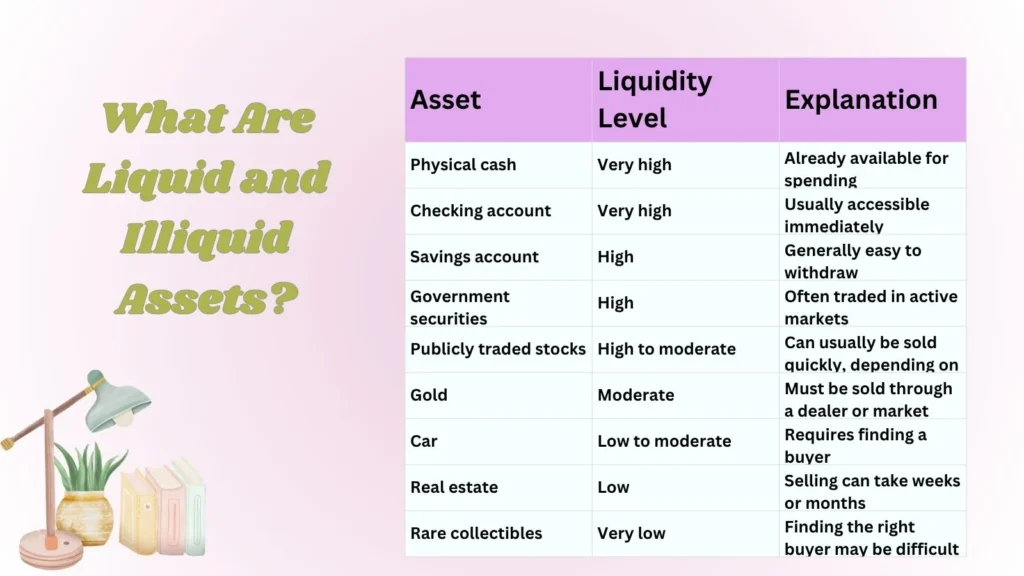
Assets are commonly classified according to how easily they can be converted into cash.
Liquid assets can generally be converted into cash quickly with little loss of value.
Illiquid assets take longer to sell or may require a substantial discount to find a buyer.
| Asset | Liquidity Level | Explanation |
|---|---|---|
| Physical cash | Very high | Already available for spending |
| Checking account | Very high | Usually accessible immediately |
| Savings account | High | Generally easy to withdraw |
| Government securities | High | Often traded in active markets |
| Publicly traded stocks | High to moderate | Can usually be sold quickly, depending on trading activity |
| Gold | Moderate | Must be sold through a dealer or market |
| Car | Low to moderate | Requires finding a buyer |
| Real estate | Low | Selling can take weeks or months |
| Rare collectibles | Very low | Finding the right buyer may be difficult |
Liquidity levels can change depending on market conditions, withdrawal restrictions, demand, and transaction costs.
For example, a stock that is normally easy to sell may become less liquid during a market crisis.
What Is the Difference Between High Liquidity and Low Liquidity?
High liquidity means an asset can be converted into cash quickly and easily.
Low liquidity means an asset takes more time, effort, or price reduction to convert into cash.
High liquidity example: Money in a checking account can usually be accessed quickly for everyday expenses.
Low liquidity example: A piece of land may have significant market value, but finding a buyer and completing the sale can take months.
| High Liquidity | Low Liquidity |
|---|---|
| Easy to convert into cash | Difficult or slow to convert into cash |
| Usually has lower selling delays | Often requires more time to sell |
| Generally has lower transaction barriers | May involve higher transaction costs |
| Useful for immediate expenses | Better suited to longer-term ownership |
| Example: Cash | Example: Real estate |
Neither type is automatically good or bad. Liquid assets offer flexibility, while less liquid assets may serve long-term investment or ownership goals.
What Is Liquidity in Banking?
In banking, liquidity refers to a financial institution’s ability to meet its payment obligations when they become due.
Banks receive deposits, provide loans, and manage financial transactions. They must maintain access to sufficient funds to handle withdrawals and other cash requirements.
For example, if many customers withdraw money at the same time, a bank needs enough available liquidity to process those withdrawals.
Banks manage liquidity through cash reserves, liquid investments, borrowing arrangements, and other financial strategies.
A shortage of liquidity can create serious problems, even for a financial institution that owns valuable long-term assets.
What Is Liquidity in the Stock Market?
In the stock market, liquidity describes how easily investors can buy or sell shares without significantly affecting their prices.
A highly liquid stock usually has many buyers and sellers, along with frequent trading activity.
For example, shares of a large, widely traded company may be easier to sell than shares of a small company with very limited trading volume.
Two important concepts help explain stock market liquidity:
Trading Volume: The number of shares bought and sold during a specific period.
Bid-Ask Spread: The difference between the highest price a buyer is willing to pay and the lowest price a seller is willing to accept.
A smaller bid-ask spread often indicates better liquidity, although trading volume and market depth also matter.
High liquidity can make investing more convenient because investors may be able to enter or exit positions more easily.
Advantages and Disadvantages of Liquidity
Liquidity offers several financial benefits, but holding too much or too little liquidity can create challenges.
Advantages of Liquidity
- Financial flexibility: Liquid assets allow you to access money when needed.
- Emergency protection: Available savings can help cover unexpected expenses.
- Business stability: Companies can pay bills and manage operating costs more easily.
- Investment opportunities: Cash availability makes it easier to respond to market opportunities.
- Lower financial pressure: Having accessible funds can reduce dependence on borrowing.
Disadvantages of Excessive Liquidity
- Lower potential returns: Keeping too much money in low-interest accounts may limit investment growth.
- Inflation risk: Cash can lose purchasing power over time as prices increase.
- Missed opportunities: Excessive cash holdings may prevent investors from benefiting from suitable long-term investments.
- Idle resources: Businesses holding too much unused cash may not be using their resources efficiently.
The goal is not to keep every asset in cash. It is to maintain an appropriate balance between accessibility, safety, and long-term financial growth.
How Can You Improve Your Liquidity?
Improving liquidity means making sure you have enough accessible money to handle your financial responsibilities.
Here are some practical ways to improve your liquidity:
- Build an emergency fund: Keep money in an accessible savings account for unexpected expenses.
- Track your spending: Understand where your money goes and identify unnecessary expenses.
- Reduce short-term debt: Paying down expensive short-term obligations can improve your financial position.
- Avoid locking away all your savings: Consider how easily you can access money before choosing long-term financial products.
- Maintain a cash reserve: Businesses should plan for payroll, supplier payments, and other upcoming expenses.
- Monitor financial ratios: Business owners can regularly review current, quick, and cash ratios.
- Plan for upcoming expenses: Set aside funds for bills and payments before they become due.
A good liquidity strategy depends on your income, expenses, financial goals, and personal circumstances.
Common Mistakes People Make When Understanding Liquidity

Liquidity is a straightforward concept, but people sometimes misunderstand how it works in real financial situations.
1. Confusing Liquidity With Profitability
Profitability and liquidity are not the same thing. A company can earn a profit but still lack enough cash to pay its immediate bills. Liquidity focuses on available funds, while profitability measures whether a business earns more than it spends.
2. Assuming All Valuable Assets Are Liquid
An asset’s value does not determine how quickly it can be converted into cash. A house, rare painting, or expensive vehicle may be valuable but difficult to sell immediately. Always consider how long an asset might take to convert into money.
3. Believing High Liquidity Is Always Better
Having accessible cash is useful, but keeping too much money unused may reduce potential investment returns. Financial planning requires a balance between immediate access and long-term growth.
4. Ignoring Market Conditions
An asset that is normally easy to sell may become difficult to trade during a financial crisis. Liquidity can change depending on demand, market confidence, and economic conditions.
5. Treating Liquidity and Solvency as the Same Thing
Liquidity focuses mainly on short-term financial obligations, whereas solvency concerns long-term financial stability. Understanding the difference helps people evaluate financial health more accurately.
FAQs:
1. What Does Liquidity Mean in Simple Words?
Liquidity means how easily and quickly something can be converted into cash without losing much of its value. Cash is the most liquid asset because it is already available to spend.
2. What Is an Example of Liquidity?
Money in a checking account is a simple example of liquidity. You can generally access it quickly to pay bills, purchase groceries, or cover everyday expenses.
3. What Is the Opposite of Liquidity?
The opposite of liquidity is illiquidity. It describes an asset that cannot be easily or quickly converted into cash without a significant reduction in value.
4. Is Cash a Liquid Asset?
Yes, cash is considered the most liquid asset because it can be used immediately without needing to be sold or exchanged.
5. What Does Liquidity Mean in Business?
In business, liquidity refers to a company’s ability to pay its short-term financial obligations using available cash and other assets that can be converted into cash relatively quickly.
6. What Is a Good Liquidity Ratio?
A current ratio of around 1.5 to 2 is sometimes considered a useful benchmark, but the ideal ratio varies by industry. A company’s operating model, asset quality, and cash flow should also be considered.
7. What Is the Difference Between Liquidity and Solvency?
Liquidity measures the ability to meet short-term financial obligations, while solvency measures the ability to meet overall financial obligations over the long term.
8. Why Is Liquidity Important for Investors?
Liquidity allows investors to buy and sell investments more easily. It can reduce transaction difficulties and help investors access their money when they need it.
9. Are Stocks Considered Liquid Assets?
Many publicly traded stocks are relatively liquid because they can be bought and sold through stock exchanges. However, liquidity varies depending on trading volume, market demand, and market conditions.
10. Is Real Estate a Liquid Asset?
Real estate is generally considered an illiquid asset because selling property can take considerable time and involve legal procedures, negotiations, and transaction costs.
Conclusion:
Understanding the liquidity meaning is essential for making informed financial decisions. Liquidity describes how easily an asset can be converted into cash without losing a significant amount of its value.
Cash and accessible bank deposits are highly liquid, while assets such as vehicles, property, and collectibles are generally less liquid. In business, liquidity determines how effectively a company can meet its short-term financial obligations. In investing, it affects how easily people can buy and sell financial assets.
The most important lesson is that having valuable assets is not always enough. You also need access to money when financial responsibilities arise.
By understanding liquidity, maintaining appropriate cash reserves, and managing your assets carefully, you can make smarter financial decisions and build a more stable financial future.

I am Henry James and i am a passionate writer and language enthusiast behind PunPalace, a platform dedicated to exploring meanings, word origins, and simple explanations. My aims to make learning vocabulary easy, engaging, and accessible for everyone.