Have you ever heard someone being called a Millennial and wondered what the word actually means? You might have seen it in social media discussions, news articles, workplace conversations, or debates about technology and modern lifestyles. The term is commonly used to describe a generation of people who grew up during a period of major technological, cultural, and social changes.
Understanding the Millennial meaning helps you recognize an important generation that experienced the transition from traditional communication to the digital world. Millennials witnessed the rise of the internet, mobile phones, social media, and online entertainment. Their childhood experiences were often different from those of Generation X and Generation Z.
In this guide, we’ll explore what Millennial means, its origin, age range, characteristics, lifestyle, examples, and differences between millennials and other generations.
What Does Millennial Mean?
Millennial refers to a person belonging to the generation born approximately between 1981 and 1996. This generation is also known as Generation Y, because it comes after Generation X and before Generation Z.
The name comes from the word millennium, which refers to a period of 1,000 years. Millennials received this name because many members of the generation reached adulthood around the beginning of the new millennium in 2000.
For example:
- Someone born in 1985 is generally considered a Millennial.
- Someone born in 1990 belongs to the Millennial generation.
- Someone born in 1995 is generally classified as a Millennial.
- Someone born in 2002 is usually considered Generation Z.
The exact boundaries can vary slightly between researchers, but 1981–1996 is a widely used definition.
Millennial Meaning In Simple Words
In simple words, a Millennial is someone who belongs to the generation that grew up around the beginning of the 21st century.
Millennials experienced both traditional and modern lifestyles. Many remember using landline phones, CDs, DVDs, and early computers before smartphones and social media became part of everyday life.
For example:
- A person who remembers life before smartphones but now uses technology daily may be a Millennial.
- Someone who experienced the early days of Facebook and YouTube during their teenage years may belong to this generation.
- A person born in 1992 is generally considered a Millennial.
The Origin And History Of The Word Millennial
The word Millennial comes from the Latin word millennium, meaning a thousand years.
The term became popular as researchers and writers began describing the generation approaching adulthood around the year 2000.
American authors William Strauss and Neil Howe helped popularize the term through their discussions of generational history and the book Millennials Rising: The Next Great Generation, published in 2000.
Over time, Millennial became a widely recognized term used in education, business, marketing, journalism, and everyday conversations.
What Is The Millennial Age Range In 2026?
People born between 1981 and 1996 are generally classified as Millennials.
In 2026, members of this generation are approximately 29 to 45 years old, depending on their birthdays.
| Birth Year | Approximate Age in 2026 | Generation |
|---|---|---|
| 1981 | 44–45 | Millennial |
| 1985 | 40–41 | Millennial |
| 1990 | 35–36 | Millennial |
| 1995 | 30–31 | Millennial |
| 1996 | 29–30 | Millennial |
| 2000 | 25–26 | Generation Z |
| 2005 | 20–21 | Generation Z |
Age ranges are approximate and depend on whether someone has celebrated their birthday in 2026.
Common Characteristics Of Millennials
Millennials are often associated with certain cultural and lifestyle characteristics. However, not every person in this generation has the same personality or preferences.
1. Technology-Friendly
Millennials experienced the growth of personal computers, mobile phones, and the internet. Many adapted to digital technology as it became increasingly important.
2. Social Media Users
Many Millennials were among the early users of platforms such as Facebook, YouTube, and Instagram.
3. Career-Focused
Millennials often place importance on career development, professional growth, and finding meaningful work.
4. Financially Conscious
Economic changes, rising living costs, and financial uncertainty have influenced how many Millennials approach saving, spending, and homeownership.
5. Interested In Experiences
Travel, entertainment, personal development, and memorable experiences are important to many Millennials.
6. Adaptable
Growing up during major technological changes helped many Millennials become comfortable with learning new digital tools.
Millennial Lifestyle And Culture
Millennial culture reflects the transition from traditional lifestyles to modern digital communication.
Some popular elements associated with this generation include:
- Early internet culture
- Facebook and Instagram
- Online shopping
- Smartphone technology
- Streaming entertainment
- Coffee shop culture
- Digital photography
- Online gaming
- Fitness and wellness trends
- Remote working
These experiences helped shape the cultural identity commonly associated with Millennials.
Millennial Meaning In Social Media
On social media, the word Millennial is frequently used to describe people, habits, trends, and cultural references associated with Generation Y.
You might see expressions such as:
- Millennial humor
- Millennial lifestyle
- Millennial problems
- Millennial fashion
- Millennial parents
- Millennial nostalgia
For example:
“That is such a Millennial thing to do!”
This statement might refer to someone’s preference for nostalgic music, older internet trends, or a particular cultural habit.
Sometimes the term is used humorously, but it can also be used neutrally to describe someone’s generation.
Millennial Vs Generation Z: What’s The Difference?
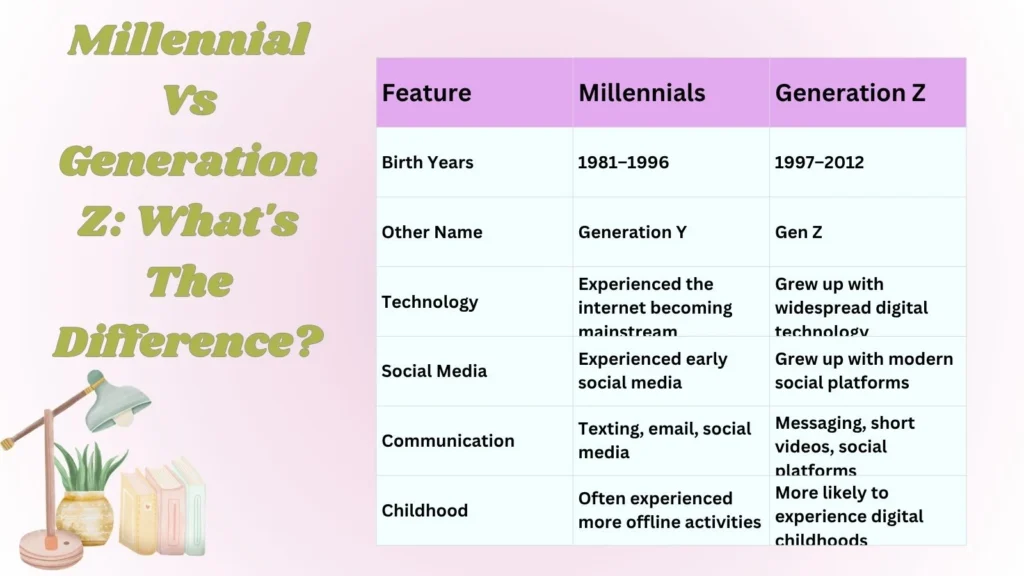
Millennials and Generation Z are two different generations that grew up with different technological and cultural experiences.
| Feature | Millennials | Generation Z |
|---|---|---|
| Birth Years | 1981–1996 | 1997–2012 |
| Other Name | Generation Y | Gen Z |
| Technology | Experienced the internet becoming mainstream | Grew up with widespread digital technology |
| Social Media | Experienced early social media | Grew up with modern social platforms |
| Communication | Texting, email, social media | Messaging, short videos, social platforms |
| Childhood | Often experienced more offline activities | More likely to experience digital childhoods |
The biggest difference is that Millennials experienced the transition into the digital age, while Generation Z generally grew up with digital technology already established.
Millennials Vs Generation X
Generation X comes before Millennials.
People born approximately between 1965 and 1980 are generally classified as Generation X.
Some common differences include:
- Generation X experienced childhood before widespread internet access.
- Millennials grew up during the expansion of computers and online communication.
- Generation X generally experienced more traditional forms of entertainment.
- Millennials witnessed the growth of social media and smartphones.
Both generations have influenced modern culture, technology, and workplace environments.
Examples Of Millennial In Everyday Sentences
Understanding the word becomes easier when you see how it appears in everyday conversations.
Example 1: My older sister is a Millennial because she was born in 1990.
Example 2: Many Millennials remember using CDs before music streaming became popular.
Example 3: That fashion trend reminds me of Millennial culture.
Example 4: Millennials experienced the transition from traditional phones to smartphones.
Example 5: The article discusses Millennial spending habits and lifestyle choices.
Example 6: My manager belongs to the Millennial generation.
Example 7: Millennial humor often includes references to childhood memories and early internet culture.
Example 8: Many Millennials started using social media during their teenage years.
Common Mistakes When Using Millennial
Although Millennial is a familiar word, people sometimes misunderstand its meaning or use it incorrectly.
- Calling everyone under 40 a Millennial without considering their birth year.
- Confusing Millennials with Generation Z.
- Assuming Millennials are all technologically advanced.
- Believing that Millennial refers only to young adults.
- Using Millennial as a synonym for teenager.
- Assuming everyone born in the 1990s belongs to Generation Z.
- Thinking Millennial describes a personality rather than a generation.
- Confusing the word with the term millennium.
- Assuming all Millennials have identical lifestyles.
- Using Millennial to describe anyone who enjoys modern technology.
Common Mistakes About Millennial Meaning

Some misunderstandings about Millennials come from stereotypes and incorrect assumptions.
- Thinking Millennials were all born after 2000.
- Believing Millennials and Gen Z are the same generation.
- Assuming Millennials never experienced life without the internet.
- Thinking Millennial is an insulting word.
- Believing every Millennial uses social media regularly.
- Assuming Millennials are always young adults.
- Thinking the term only applies to people in America.
- Believing Millennial refers to a specific personality type.
- Assuming all Millennials have the same financial situation.
- Confusing Millennial culture with modern youth culture.
FAQs:
What does Millennial mean?
Millennial refers to a person born approximately between 1981 and 1996. This generation is also known as Generation Y.
What age is a Millennial in 2026?
In 2026, Millennials are approximately 29 to 45 years old, depending on their birthdays.
Why are they called Millennials?
They are called Millennials because many members of this generation reached adulthood around the beginning of the new millennium in 2000.
Is Millennial the same as Generation Y?
Yes. Millennial and Generation Y are two names for the same generation.
Is someone born in 1995 a Millennial?
Yes. Someone born in 1995 is generally classified as a Millennial.
Is someone born in 2000 a Millennial?
No. Someone born in 2000 is generally considered part of Generation Z.
What is the difference between Millennials and Gen Z?
Millennials experienced the transition into the digital age, while Generation Z grew up with widespread internet access and modern digital technology.
What are common Millennial characteristics?
Millennials are often associated with technology adaptability, social media use, career development, and an interest in personal experiences.
Is Millennial a positive or negative term?
Millennial is a neutral generational term. However, its meaning can depend on the context and tone in which someone uses it.
Where can I learn more word meanings and internet slang?
You can explore more definitions, texting abbreviations, and interesting word explanations on punpalace.com.
Conclusion:
Understanding the Millennial meaning helps you recognize one of the most influential generations of the modern era. Millennials, also known as Generation Y, are generally people born between 1981 and 1996. They experienced significant changes in technology, communication, entertainment, and everyday lifestyles.
From using traditional phones and early computers to adopting smartphones and social media, this generation witnessed the development of the digital world. Although Millennials are often associated with certain cultural trends and characteristics, every individual has their own experiences and personality.

I am Henry James and i am a passionate writer and language enthusiast behind PunPalace, a platform dedicated to exploring meanings, word origins, and simple explanations. My aims to make learning vocabulary easy, engaging, and accessible for everyone.