
The word state is commonly used in everyday conversations, school lessons, government discussions, and written communication. However, its meaning can change depending on the situation in which it appears.
In simple English, state means a condition or situation that someone or something is in, or a politically organized region within a country. It can also mean to say or express something clearly.
For example, when someone says, “The house is in a terrible state,” the word state refers to the house’s condition. When someone says, “California is a state in the United States,” it refers to a political region. In the sentence “Please state your name,” the word means to say or provide information clearly.
These different meanings make state a versatile word in the English language.
Understanding the state meaning can help you interpret conversations, improve your vocabulary, and use the word correctly in different contexts.
In this guide, you will learn the definition of state, its different meanings, examples, synonyms, common expressions, and the difference between a state, a condition, and a country.
What Is the Meaning of State in Simple English?
In simple English, state means the way something is, a particular condition, or a region with its own government within a larger country.
The word can also be used as a verb meaning to say something clearly or formally.
Here are three simple examples:
- Condition: “My phone is in a poor state.” This means the phone is in bad condition.
- Political region: “Texas is a state in the United States.” This means Texas is one of the country’s political divisions.
- To express something: “Please state your opinion.” This means you should clearly express what you think.
The correct meaning depends on the surrounding words and the topic being discussed.
For example, in a conversation about politics, state may refer to a government or territory. In a conversation about health, it may describe someone’s physical or emotional condition.
State Definition and Dictionary Meaning
The word state can function as both a noun and a verb.
As a noun, it commonly refers to a condition, situation, political territory, or organized political entity.
As a verb, it means to express, declare, or present information clearly.
The main definitions include:
- Condition: The way a person, object, or situation exists at a particular time.
- Political region: A territory that forms part of a country and has its own government or administrative authority.
- Country or nation: In political terminology, a state can refer to an independent political entity with territory, population, government, and sovereignty.
- To express: To say or write something clearly and formally.
- Government authority: The institutions and powers responsible for governing a territory or society.
For example, “The machine is in a damaged state” uses state to describe a condition, while “The report states that sales increased” uses it as a verb.
What Does State Mean as a Noun?
As a noun, state often describes a condition, situation, or stage that a person or thing is experiencing.
For example:
- “The garden is in a beautiful state.”
- “She was in a state of shock after hearing the news.”
- “The car is in excellent state after the repairs.”
- “The country entered a state of emergency.”
In these sentences, the word describes a particular situation or condition.
A state can be temporary or long-lasting. A person may be in a state of confusion for a few minutes, while a building may remain in a poor state for years.
Examples of State as a Noun
| Sentence | Meaning of State |
|---|---|
| The room was in a messy state. | The room’s condition |
| He was in a state of excitement. | His emotional condition |
| The machine is in working state. | The machine’s operational condition |
| Florida is a state in the United States. | A political region |
| The state introduced a new policy. | The government or political authority |
These examples show why context is important when interpreting the word.
What Does State Mean as a Verb?
As a verb, state means to express, declare, or communicate something clearly.
It is often used in formal writing, official documents, instructions, reports, and academic work.
For example:
- “Please state your full name.”
- “The teacher stated the rules before the examination.”
- “The report states that the project is complete.”
- “She stated her reasons for leaving.”
- “The application states that all information must be accurate.”
In each sentence, state means to provide information directly.
The verb often sounds more formal than words such as say or tell.
For example, “He stated his opinion” sounds more formal than “He said what he thought.”
What Does State Mean in Government?
In government and politics, the word state can refer to a political territory or an organized political entity.
Its precise meaning depends on the country’s political system and the context in which the word is used.
State as a Political Region
In countries such as the United States, a state is a major political division within the country.
For example, California, Texas, Florida, and New York are states within the United States. Each has its own state government and certain powers under the country’s constitutional system.
A state may have its own laws, legislature, executive branch, and courts, while remaining part of the larger country.
State as an Independent Country
In international relations, state can also mean an independent political entity with a population, territory, government, and capacity to conduct relations with other states.
For example, Pakistan is a sovereign state.
In this context, state is closely related to the word country, although the two words can have different meanings depending on the discussion.
What Does the State Government Do?
A state government may be responsible for areas such as:
- Education and public schools.
- Local transportation and infrastructure.
- Public health services.
- Law enforcement and public safety.
- Environmental regulation.
- Certain taxes and public services.
The exact responsibilities vary by country and constitutional arrangement.
What Is the Difference Between a State and a Country?
Although the words state and country are sometimes used interchangeably, they do not always mean the same thing.
A country generally refers to a geographical and political area associated with a population and government. A state may refer either to an independent sovereign political entity or to a subdivision within a country.
For example, Pakistan is a country and a sovereign state. California is a state within the United States but is not an independent sovereign country.
| Feature | State | Country |
|---|---|---|
| General meaning | A political entity or a subdivision of a country | A geographical and political area |
| Can be independent? | Yes, when referring to a sovereign state | Generally refers to an area understood as a country |
| Can be part of a larger country? | Yes, as in the United States | Usually refers to the larger political area itself |
| Example | Texas as a U.S. state | Pakistan as a country |
The meaning of state must be understood from the context. In international politics, it often refers to a sovereign entity rather than a regional division.
What Does State of Being Mean?
The phrase state of being refers to the condition or situation in which a person, object, or thing exists at a particular time.
It can describe physical, emotional, mental, or general circumstances.
Examples include:
- State of happiness: A condition of feeling happy.
- State of confusion: A condition in which someone does not understand something clearly.
- State of rest: A condition of being relaxed or inactive.
- State of health: A person’s current physical or medical condition.
- State of awareness: The condition of being conscious of something.
For example, “Meditation helped her achieve a calmer state of being” means that meditation helped her feel calmer.
The phrase is also used in philosophy and discussions about existence, identity, and consciousness.
What Does State of Mind Mean?
A state of mind is a person’s current mental or emotional condition.
It describes how someone feels, thinks, or perceives a situation at a particular time.
For example:
- “She was in a positive state of mind before the interview.”
- “Stress can affect your state of mind.”
- “He was not in the right state of mind to make an important decision.”
A person’s state of mind may be influenced by sleep, stress, personal experiences, surroundings, and emotions.
This expression is common in everyday conversation, psychology, literature, and discussions about decision-making.
What Does State of Emergency Mean?
A state of emergency is an official declaration that a serious situation requires special government measures or emergency powers.
It may be declared in response to events such as natural disasters, major public emergencies, or serious threats to public safety.
The exact legal meaning and consequences depend on the laws of the country or region involved.
For example:
“The government declared a state of emergency after the severe flooding.”
This means that officials formally recognized an emergency and may have activated special procedures or powers to respond to it.
A state of emergency is different from an ordinary difficult situation because it usually has a specific official or legal meaning.
What Does State Mean in Science?
In science, state often describes the form, condition, or arrangement of a substance or system.
One common example is the states of matter.
The three familiar states of matter are:
- Solid: Has a relatively fixed shape and volume.
- Liquid: Has a fixed volume but takes the shape of its container.
- Gas: Has no fixed shape or volume and expands to fill its container.
Plasma is another state of matter found in conditions such as those inside stars.
The word also appears in physics, chemistry, and computing.
For example, a system may be described as being in a particular state depending on its measurable properties. In computing, the state of a program or device refers to the information or condition that describes its current status.
What Does State Mean in Health?
In healthcare, state refers to a person’s physical, mental, or medical condition at a particular time.
Examples include:
- “The patient is in a stable state.”
- “The doctor assessed the patient’s state of health.”
- “The medication may affect the patient’s physical state.”
- “The patient regained a normal state of consciousness.”
The word does not identify a particular disease by itself. Instead, it describes the condition or status of a person.
For example, saying that someone is in a stable state generally means that their condition is not changing significantly at that moment. The precise medical meaning depends on the circumstances.
State Synonyms and Related Words
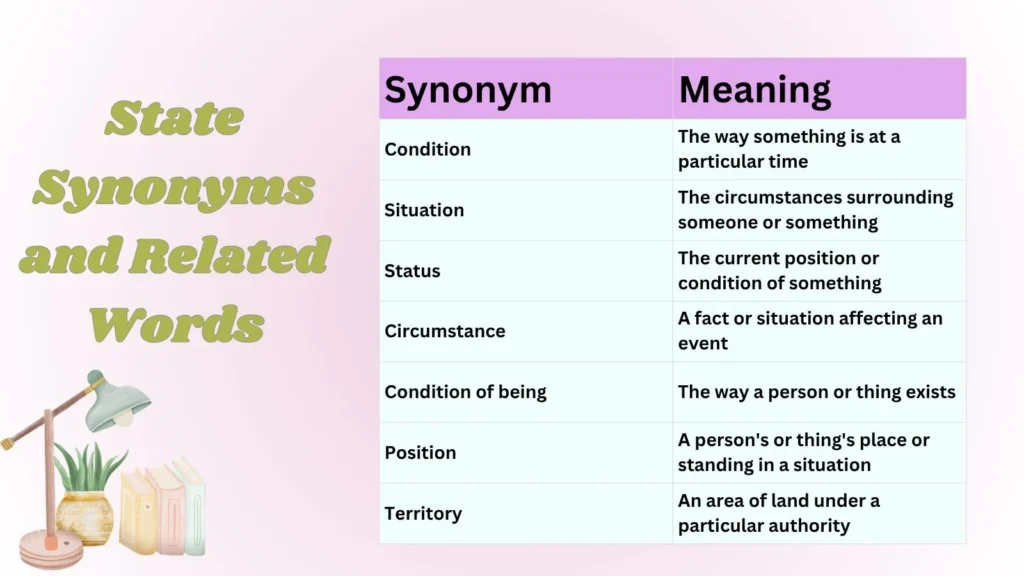
The synonyms for state depend on whether it is used as a noun or a verb.
Synonyms for State as a Noun
| Synonym | Meaning |
|---|---|
| Condition | The way something is at a particular time |
| Situation | The circumstances surrounding someone or something |
| Status | The current position or condition of something |
| Circumstance | A fact or situation affecting an event |
| Condition of being | The way a person or thing exists |
| Position | A person’s or thing’s place or standing in a situation |
| Territory | An area of land under a particular authority |
These words are not interchangeable in every sentence. For example, territory may fit a political context, while condition is more suitable when discussing the state of a damaged object.
Synonyms for State as a Verb
When state means to express information, related words include:
- Say
- Declare
- Express
- Specify
- Report
- Mention
- Assert
For example, “Please state your reason” can be rewritten as “Please explain your reason,” depending on the intended meaning and level of formality.
What Does State Mean in Computer Science?
In computer science, state describes the current condition of a system, application, device, or process.
It may include information about what the system is doing, which settings are active, or what data it currently holds.
For example:
- A login system may be in a logged-in or logged-out state.
- A game character may have a particular health or movement state.
- A website may store a user’s selected language as part of its state.
- A machine may be in an active, idle, or error state.
Understanding state is important in programming because a system’s behavior may depend on its current condition.
For example, a shopping website may display a different page depending on whether the user is signed in or has items in their cart.
How to Use State in a Sentence
The best way to learn the state meaning is to see how it works in different sentences.
Here are ten examples:
- “The old building is in a dangerous state.”
- “Please state your reason for applying.”
- “California is a state in the United States.”
- “She was in a state of complete surprise.”
- “The report states that the results were accurate.”
- “The government declared a state of emergency.”
- “Exercise can improve your physical state.”
- “The machine returned to its normal state.”
- “He was in a calm state of mind.”
- “The scientist studied the state of the material.”
In the first sentence, state means condition. In the second, it means to express something. In the third, it refers to a political region.
These examples demonstrate that the same word can have different meanings while remaining grammatically correct.
Common Expressions With the Word State
English includes several common expressions that use the word state.
In a State of Shock
This expression describes a condition of intense surprise or distress.
Example: “She was in a state of shock after hearing the unexpected news.”
In a State of Confusion
This means being unable to understand something clearly.
Example: “The complicated instructions left everyone in a state of confusion.”
State of the Art
This phrase means using the most advanced methods, technology, or design currently available.
Example: “The hospital uses state-of-the-art medical equipment.”
State Your Case
This means to explain your position, reasons, or arguments clearly.
Example: “You will have an opportunity to state your case during the meeting.”
State of Affairs
This expression refers to the current situation or condition of a particular matter.
Example: “The manager was concerned about the current state of affairs.”
In a State
In informal English, saying that someone or something is “in a state” can mean being upset, confused, disorganized, or in poor condition.
Example: “The children left the living room in a state.”
Here, the expression means that the room was messy.
State vs. Status vs. Condition
The words state, status, and condition have related meanings, but each has a slightly different emphasis.
| Word | Main Meaning | Example |
|---|---|---|
| State | The way something exists or is at a particular time | The room was in a messy state. |
| Status | A person’s or thing’s current position or standing | The application status is pending. |
| Condition | The quality or physical state of something | The car is in good condition. |
State is broad and can refer to physical, emotional, political, or technical situations.
Status often refers to progress, rank, or an official position.
Condition commonly describes quality, health, or the way something is functioning.
Although the words sometimes overlap, choosing the most suitable one makes your writing clearer.
Why Is Understanding the Word State Important?
Learning the different meanings of state improves reading comprehension, vocabulary, and communication.
The word appears in several important areas:
- Education: Students encounter it in science, geography, and English lessons.
- Government: It appears in discussions about political systems, laws, and public services.
- Everyday conversation: People use it to describe feelings, situations, and the condition of objects.
- Business: Reports may describe the state of the economy or a company’s operations.
- Technology: Programmers use it to describe the current condition of a system.
- Formal writing: The verb state is commonly used to introduce facts, findings, and instructions.
Recognizing the context helps you understand which meaning is intended instead of assuming that the word always refers to a political region.
Common Mistakes About State
Mistake 1: Assuming State Always Means a Political Region
Many people associate state with places such as Texas or California. However, it can also describe a condition or mean to express information.
Mistake 2: Confusing State With Country
A state can be a subdivision within a country or an independent sovereign political entity. The meaning depends on the context.
Mistake 3: Using State and Status as Exact Synonyms
Both words can describe a current situation, but status often emphasizes progress or official standing, while state has a broader meaning.
Mistake 4: Forgetting That State Can Be a Verb
In the sentence “The document states the rules,” state is a verb meaning to express or present information clearly.
Mistake 5: Ignoring the Words Around State
Expressions such as state of mind, state of emergency, and state of the art have specific meanings. Understanding the complete phrase is often more useful than interpreting the word alone.
FAQs:
What does state mean in simple words?
State means the condition or situation of a person or thing, a political region within a country, or the act of expressing information clearly.
What is the basic definition of state?
As a noun, state refers to a condition, situation, or political entity. As a verb, it means to say or express something clearly.
What does state mean in a sentence?
The meaning depends on the sentence. In “The car is in a poor state,” it means condition. In “Please state your name,” it means to provide information.
What is the difference between a state and a country?
A state may be a region within a country, such as Texas in the United States, or an independent sovereign political entity. A country generally refers to the larger geographical and political area.
What does state of mind mean?
State of mind means a person’s current mental or emotional condition, including how they feel, think, or approach a situation.
What does state mean in government?
In government, state can refer to a political region with its own government or to an independent sovereign political entity.
What is another word for state?
Depending on the context, synonyms include condition, situation, status, circumstance, declare, express, and specify.
Is state a noun or a verb?
State can be both. As a noun, it can mean a condition or political region. As a verb, it means to express or declare information.
What does state of emergency mean?
A state of emergency is an official declaration that a serious situation requires special measures or emergency powers under applicable laws.
What does state mean in science?
In science, state often describes the condition or form of a substance or system, such as a solid, liquid, or gas.
What does state mean in formal writing?
In formal writing, the verb state means to present information clearly and directly. For example, “The report states that the experiment was successful.”
Conclusion:
The state meaning depends on the context in which the word is used. Most commonly, it refers to the condition or situation of a person or thing, a political region within a country, or an independent political entity. As a verb, it means to express or declare information clearly.
For example, a person may be in a happy state of mind, a machine may be in a damaged state, and California may be described as a state within the United States.
The easiest way to understand the word is to look at the surrounding sentence. Once you recognize the context, you can identify the intended meaning and use state more confidently in everyday conversations, academic writing, and formal communication.

I am Henry James and i am a passionate writer and language enthusiast behind PunPalace, a platform dedicated to exploring meanings, word origins, and simple explanations. My aims to make learning vocabulary easy, engaging, and accessible for everyone.