Have you ever heard someone call another person an “idiot” and wondered what the word really means? You may have seen it in a conversation, movie, social media post, or text message. The word is common in everyday English, but its tone can range from playful teasing to a genuinely harsh insult.
The idiot meaning generally describes a person who is considered very foolish, unintelligent, or someone who has made a seriously poor decision. However, the exact meaning depends on the speaker, situation, and tone of voice.
In this guide, we will explain what does idiot mean in simple English, explore its history, examples, synonyms, different uses, and how to recognize when the word may sound offensive.
What Does Idiot Mean?
Idiot is a noun commonly used to describe someone who is behaving in a very foolish, careless, or unintelligent way.
For example, if someone makes an obviously bad decision, another person might say:
“You idiot! Why did you leave the door open?”
Here, the speaker is criticizing the person’s action. Depending on the relationship and tone, the statement could be a serious insult or playful teasing.
| Word | Meaning | Tone |
|---|---|---|
| Idiot | A foolish or unintelligent person | Usually negative |
| Idiot | Someone who has acted very foolishly | Negative or teasing |
| Idiot | An insult directed at someone’s behavior or judgment | Can be offensive |
Idiot Meaning in Simple English
In simple English, an idiot is someone who is acting very foolishly.
The word is usually used as an insult. It can criticize someone’s intelligence, judgment, or behavior.
For example:
“I was an idiot for forgetting my keys.”
In this sentence, the speaker is using the word about themselves. It does not necessarily mean they believe they are unintelligent. Instead, they are admitting that they made a foolish mistake.
This shows an important feature of the word: idiot can sometimes describe an action rather than a person’s overall intelligence.
Idiot Meaning in English
In standard English, idiot is a derogatory word for someone regarded as foolish or lacking good judgment.
It can be directed toward another person:
“That idiot ignored the warning.”
It can also be used reflexively:
“I felt like an idiot after making that mistake.”
The second example is generally less aggressive because the speaker is criticizing themselves rather than insulting someone else.
Is Idiot a Bad Word?
Idiot is considered an insulting or offensive word in many situations.
It is not usually considered one of the strongest swear words, but it can still hurt someone’s feelings, especially when used directly and seriously.
The impact depends on several factors:
- Tone: A joking tone may make it sound less serious.
- Relationship: Close friends may use it playfully.
- Situation: Saying it during an argument can make it much harsher.
- Target: Calling a stranger an idiot may be perceived as disrespectful.
- Intent: A serious insult is different from friendly teasing.
For professional, academic, or formal communication, it is usually better to choose a more respectful expression.
Idiot Meaning in Text
If someone calls you an “idiot” in a text message, they are generally saying that they think you have acted foolishly or made a stupid mistake.
However, texting removes many clues that are available in face-to-face communication, such as facial expressions and tone of voice.
For example:
“You idiot 😂”
Between close friends, this may be playful teasing.
On the other hand:
“You’re an idiot. Don’t talk to me again.”
is clearly more hostile.
Therefore, when interpreting idiot meaning in text, look at the entire conversation rather than focusing only on the word.
Idiot Meaning in a Sentence
Here are some examples showing how the word can be used in different situations:
- “He called me an idiot after I made the mistake.”
- “I felt like an idiot when I realized I had the wrong address.”
- “Don’t be an idiot; check the instructions first.”
- “You forgot your phone again, you idiot!”
- “I was an idiot to believe that story.”
- “The character in the movie is portrayed as an idiot.”
These examples show that idiot can express anger, frustration, self-criticism, humor, or playful teasing.
Is Idiot Always About Intelligence?
No. Calling someone an idiot does not always mean the speaker literally believes that person has low intelligence.
In everyday speech, the word is often used to criticize a particular decision or action.
For example:
“I was an idiot for leaving my wallet on the table.”
The speaker probably does not mean that they are generally unintelligent. They are saying that leaving the wallet there was foolish or careless.
Similarly, when someone says, “Don’t be an idiot,” they may simply mean “Don’t do something foolish.”
Idiot as a Playful Expression
Among friends and family, idiot can sometimes be used affectionately or jokingly.
For example:
“You idiot! You scared me!”
If said with laughter or affection, this may not be intended as a serious insult.
However, playful use depends heavily on the relationship. What sounds funny between close friends may sound rude or hurtful when said to a stranger, coworker, or someone you do not know well.
When you are unsure, using a kinder expression is the safer choice.
Idiot Synonyms
There are many words that can have a similar meaning to idiot, although their strength and tone can differ.
- Fool — someone who acts unwisely.
- Foolish person — a softer description of poor judgment.
- Simpleton — someone portrayed as lacking sophistication or good sense.
- Blockhead — an informal word for a foolish person.
- Dimwit — an informal insult suggesting limited intelligence.
- Moron — a strong insulting term that should be used carefully.
- Clown — can describe someone behaving foolishly, often in a mocking way.
These words are not always interchangeable. Their meaning and emotional strength depend on context.
Idiot vs Fool
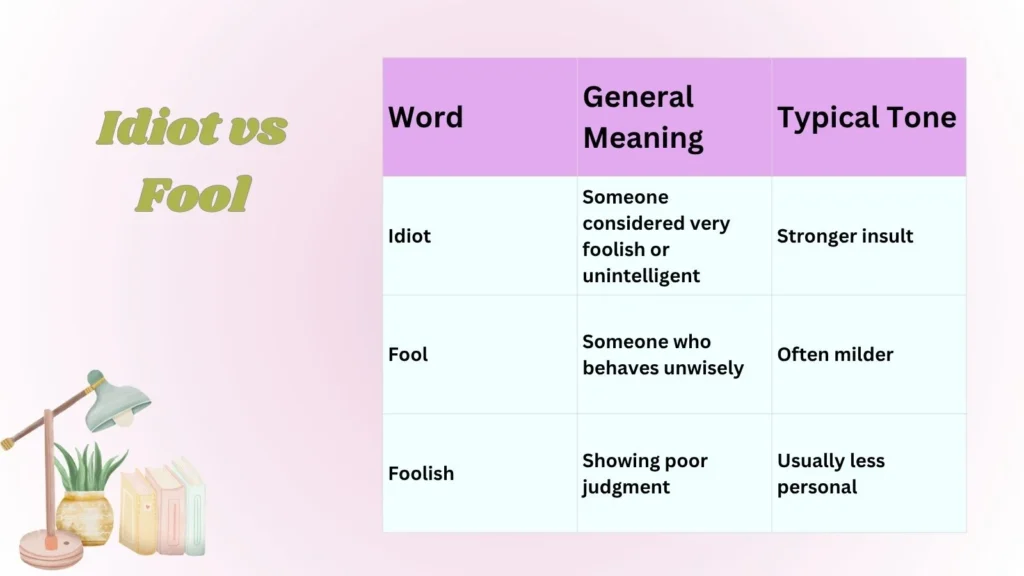
Idiot and fool are sometimes used similarly, but they can have slightly different tones.
| Word | General Meaning | Typical Tone |
|---|---|---|
| Idiot | Someone considered very foolish or unintelligent | Stronger insult |
| Fool | Someone who behaves unwisely | Often milder |
| Foolish | Showing poor judgment | Usually less personal |
For example, saying “That was a foolish decision” focuses on the decision rather than directly attacking the person.
Idiot vs Stupid
Another common comparison is idiot vs stupid.
Stupid is usually an adjective, while idiot is normally a noun.
For example:
- “That was a stupid mistake.”
- “He acted like an idiot.”
Both can express criticism, but they are used grammatically in different ways.
You can also use stupid to describe an action, idea, or situation, whereas idiot generally refers to a person.
History and Origin of the Word Idiot
The history of idiot is interesting because its meaning has changed over time.
The word ultimately comes from an ancient Greek term associated with a private person or someone without specialized knowledge or public office. It later passed through Latin and French before developing into the English word used today.
Over the centuries, its meaning shifted toward describing someone as ignorant, foolish, or unintelligent.
It is important to note that historical uses of the word do not necessarily match its modern everyday meaning.
Idiot Meaning in Literature and Media
The word idiot appears frequently in books, films, television shows, and other forms of entertainment.
Writers may use it to show:
- Anger between characters
- Friendly teasing
- Frustration
- Self-criticism
- A character’s lack of judgment
- Comic situations
Because fictional dialogue often reflects informal speech, the word can appear in many different emotional contexts.
When reading or watching a story, consider the relationship between the characters before deciding how seriously the word is being used.
Polite Alternatives to Idiot
If you want to express criticism without directly insulting someone, there are more respectful alternatives.
- “That was a poor decision.”
- “That wasn’t very sensible.”
- “You made a mistake.”
- “That was careless.”
- “I don’t think that was a good idea.”
- “Please think about it again.”
These alternatives focus on the behavior or decision instead of attacking the person’s intelligence.
How to Use Idiot Correctly
Idiot is generally used as a noun.
Common structures include:
- “He is an idiot.”
- “Don’t be an idiot.”
- “I felt like an idiot.”
- “She called him an idiot.”
- “What an idiot!”
The word can be used seriously or humorously, but it is important to understand that it is still an insult in many contexts.
When communicating professionally or with someone you do not know well, choosing a neutral alternative is usually better.
Common Mistakes About the Word Idiot
Mistake 1: Thinking Idiot Always Means Unintelligent
The word can describe someone who has made a foolish decision without suggesting that they are generally unintelligent.
Mistake 2: Assuming Idiot Is Always a Joke
Friends may use the word playfully, but it can also be a genuine insult. The tone and context determine the intended meaning.
Mistake 3: Using Idiot in Professional Communication
Calling a coworker, customer, student, or employee an idiot can sound disrespectful and unprofessional. More neutral language is usually better.
Mistake 4: Confusing Idiot With Stupid
Although the meanings overlap, idiot is generally a noun referring to a person, while stupid is usually an adjective.
Mistake 5: Ignoring Tone in Text Messages
A message such as “You idiot” can be playful or aggressive. Look at the surrounding conversation, relationship, and punctuation before interpreting the speaker’s intention.
FAQs:
What does idiot mean in simple English?
Idiot means a person who is considered foolish, unintelligent, careless, or someone who has behaved very unwisely. It is usually an insulting word.
Is idiot a bad word?
Idiot is an insulting word, although it is generally less severe than many profanity terms. Friends may sometimes use it jokingly, but it can still be offensive in serious situations.
What does idiot mean in text?
In a text message, idiot usually means that the sender thinks someone has behaved foolishly or made a poor decision. The exact tone depends on the conversation.
What are some synonyms for idiot?
Common synonyms include fool, blockhead, dimwit, simpleton, moron, and clown. Their strength and tone can vary.
Can idiot be used for yourself?
Yes. People often use it for self-criticism, such as “I was an idiot for forgetting my passport.” This can express frustration with one’s own mistake rather than a serious judgment about intelligence.
Final Thoughts:
The idiot meaning generally refers to a person who is acting foolishly, making a poor decision, or behaving in a way that the speaker considers unintelligent. It is normally an insulting word, but close friends may sometimes use it playfully.
Context is especially important when interpreting idiot meaning in text. A short message can be difficult to understand without knowing the relationship between the people and the tone of the conversation.
If you want to communicate politely, expressions that criticize the action rather than the person are usually a better choice. Understanding the word’s meaning, tone, and context will help you recognize it and use it appropriately.

I am Henry James and i am a passionate writer and language enthusiast behind PunPalace, a platform dedicated to exploring meanings, word origins, and simple explanations. My aims to make learning vocabulary easy, engaging, and accessible for everyone.