Have you ever felt tired, unmotivated, or stuck in a difficult situation? Or perhaps you have heard someone say that a business is experiencing a slump. The word slump can describe all these situations, depending on the context.
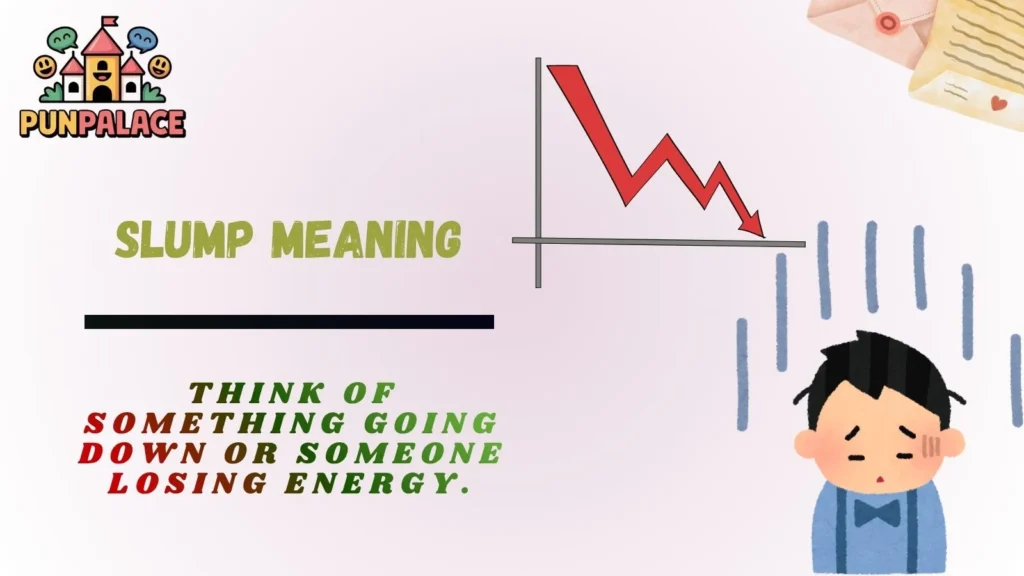
The slump meaning is generally a sudden or noticeable decline in performance, activity, value, or energy. It can also describe a person dropping into a sitting position heavily or with poor posture.
For example, if someone says, “I’m going through a slump,” they usually mean that they are experiencing a period when things are not going well. This could relate to their mood, work, studies, sports performance, or daily routine.
In this guide, you will learn what slump means in simple English, how people use it in conversations and text messages, its synonyms, common mistakes, and examples that make the word easy to understand. 😊
What Is the Slump Meaning in English?
The word slump has several related meanings in English. Its most common meaning is a decline or decrease in something that was previously doing well or performing at a higher level.
It can refer to a temporary period of low motivation, poor performance, reduced sales, falling prices, or decreased activity.
For example:
- Personal life: She is going through a slump and feels unmotivated.
- Business: The company experienced a slump in sales.
- Sports: The player is in a scoring slump.
- Economics: The industry is facing an economic slump.
- Physical movement: He slumped into his chair after a long day.
As a verb, slump means to decline or to drop heavily into a relaxed or tired position.
As a noun, a slump means a period of decline or the act of dropping into a heavy, relaxed position.
In simple words, slump means a downturn, a drop in performance, or a heavy and tired-looking movement.
Slump Meaning in Simple Words
The easiest way to understand slump is to think of something going down or someone losing energy.
Imagine that you usually get excellent grades, but suddenly you begin receiving lower marks. You are struggling to concentrate and your performance is not as good as before. You could describe this situation as an academic slump.
Similarly, if a shop normally makes many sales but customers stop buying as much, the shop may experience a sales slump.
Here are a few simple examples:
| Situation | Meaning of slump |
|---|---|
| You feel unmotivated for several days | A personal or emotional slump |
| A student receives lower grades | An academic slump |
| A company sells fewer products | A sales slump |
| A football player stops scoring regularly | A performance slump |
| Someone drops heavily into a chair | A physical slump |
| Prices fall noticeably | A price slump |
The main idea is that something has dropped, weakened, or lost its previous level of energy or success.
Slump Meaning in Text and Chat
In texting and online conversations, slump often describes feeling unmotivated, emotionally low, unproductive, or stuck in a routine.
It is not a formal texting abbreviation. Instead, it is a regular English word that people use casually to explain how they are feeling or how something is going.
For example:
Friend 1: Why haven’t you been studying lately?
Friend 2: I’m in a slump. I just can’t focus.
Here, the person means they are struggling with motivation and concentration.
More examples include:
- “I’ve been in a slump all week.” This means the person has been feeling unmotivated or less productive.
- “Need to get out of this slump.” This means the person wants to feel better or become productive again.
- “My gym routine is in a slump.” This means the person’s exercise routine or progress has declined.
- “Business is in a slump right now.” This means business activity or sales have decreased.
The exact meaning depends on the conversation. A slump can involve emotions, productivity, money, performance, or physical movement.
What Does It Mean to Be in a Slump?
To be in a slump means to experience a period when your performance, energy, motivation, or results are lower than usual.
People commonly use this expression when things are not going as expected.
For example, a student who normally studies well but suddenly struggles to complete assignments may say, “I’m in a slump.”
A writer who cannot come up with new ideas might also describe their situation as a creative slump.
Being in a slump does not necessarily mean that someone has failed. It often describes a temporary difficult period.
Common signs of a personal or productivity slump may include:
- Feeling less motivated than usual.
- Struggling to concentrate on tasks.
- Putting off important work.
- Losing interest in a regular activity.
- Making slower progress toward goals.
- Feeling frustrated because results are not improving.
These experiences can have many causes, including stress, tiredness, changes in routine, or challenging circumstances. The word itself does not identify the cause.
Examples of Being in a Slump
- “I’m in a reading slump, so I haven’t finished a book in weeks.”
- “She was in a slump after receiving disappointing exam results.”
- “Our team is in a slump because we haven’t won a game recently.”
- “He’s trying to get out of his creative slump.”
- “I’ve been in a productivity slump since changing my schedule.”
In each example, the expression describes a period of reduced activity, progress, or success.
Different Types of Slumps
The word slump appears in many areas of everyday life. Understanding the context helps you identify the intended meaning.
1. Emotional Slump
An emotional slump refers to a period when someone feels discouraged, less enthusiastic, or emotionally low.
For example, a person might experience an emotional slump after a stressful week or a disappointing event.
Example: “After a difficult month, she found herself in an emotional slump.”
This expression describes how the person feels without necessarily identifying a specific mental health condition.
2. Academic Slump
An academic slump happens when a student’s grades, concentration, or study performance decline.
For example, a student who previously earned high marks may begin struggling with assignments and exams.
Example: “He experienced an academic slump during his final semester.”
The phrase is useful when discussing education, studying, exams, and school performance.
3. Sales Slump
A sales slump occurs when a business sells fewer products or services than usual.
For example, a clothing store may experience a sales slump when fewer customers visit or purchase items.
Example: “The store introduced a new promotion to recover from its sales slump.”
Businesses often use this expression when discussing revenue, customer demand, and marketing performance.
4. Sports Slump
A sports slump refers to a period when an athlete or team performs below their usual level.
A basketball player may struggle to score, while a baseball player may have difficulty getting hits.
Example: “The player finally ended his scoring slump with two goals.”
This meaning is common in sports commentary and conversations among fans.
5. Economic Slump
An economic slump is a period of weaker economic activity.
It may involve reduced consumer spending, lower production, declining business confidence, or other signs of economic weakness.
Example: “The company reduced its expenses during the economic slump.”
An economic slump can affect businesses, workers, consumers, and investment. The term does not automatically mean that an official recession has occurred.
6. Creative Slump
A creative slump happens when someone struggles to produce new ideas or creative work.
Writers, artists, musicians, designers, and content creators may use this expression.
Example: “I’m experiencing a creative slump and can’t think of a good topic for my next article.”
A creative slump can describe a temporary lack of inspiration or difficulty completing creative projects.
Slump Meaning in a Sentence
The best way to learn a new word is to see how it works in different sentences.
Here are examples of slump in everyday English.
| Sentence | Meaning |
|---|---|
| I am going through a slump. | I am experiencing a difficult or unproductive period. |
| Sales slumped last month. | Sales decreased noticeably. |
| He slumped into his chair. | He dropped heavily into his chair. |
| The team is in a scoring slump. | The team is scoring less than usual. |
| The economy experienced a slump. | Economic activity weakened. |
| She wants to break out of her slump. | She wants to overcome her difficult period. |
| The company’s profits slumped. | The company’s profits fell. |
| I hit a reading slump this summer. | I lost momentum or interest in reading. |
| His shoulders slumped with disappointment. | His shoulders dropped, showing sadness or discouragement. |
| The market slumped after the announcement. | The market declined after the announcement. |
Notice that the meaning changes slightly according to the subject and sentence. However, the central idea usually involves a decline or a heavy downward movement.
How to Use Slump Correctly
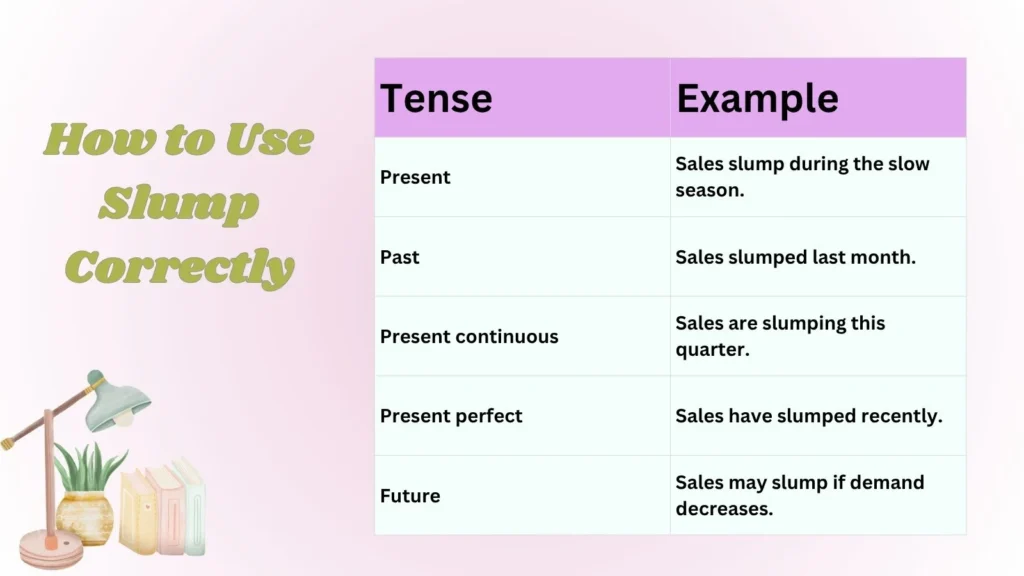
The verb can be used in different tenses:
| Tense | Example |
|---|---|
| Present | Sales slump during the slow season. |
| Past | Sales slumped last month. |
| Present continuous | Sales are slumping this quarter. |
| Present perfect | Sales have slumped recently. |
| Future | Sales may slump if demand decreases. |
Using the right tense makes your sentence clearer and more natural.
Slump Synonyms and Similar Words
Synonyms are words with similar meanings. The best synonym for slump depends on whether you are describing a decline, low motivation, or physical movement.
| Synonym | Meaning | Example |
|---|---|---|
| Decline | A reduction or decrease | Sales declined in June. |
| Drop | A fall in level or amount | Prices dropped overnight. |
| Downturn | A period of reduced activity | The industry faced a downturn. |
| Dip | A small or temporary decrease | Attendance took a dip. |
| Deterioration | A worsening condition | Performance showed deterioration. |
| Recession | A significant period of economic decline, as defined by relevant economic analysis | The recession affected many businesses. |
| Setback | A problem that delays progress | The injury was a setback for the player. |
| Lull | A temporary period of reduced activity | There was a lull in business. |
| Rut | A situation that feels repetitive or difficult to escape | She felt stuck in a rut. |
| Sag | To droop or sink downward | His shoulders began to sag. |
Not all these words are interchangeable. For example, recession has a more specific economic meaning, while rut often describes feeling stuck in an unchanging routine.
Slump Antonyms
Antonyms are words that express opposite meanings.
Since slump can mean a decline or a downward movement, its opposite depends on the context.
| Antonym | Meaning | Example |
|---|---|---|
| Rise | To move upward or increase | Sales began to rise. |
| Increase | To become greater in amount | Profits increased this year. |
| Improvement | A positive change | Her performance showed improvement. |
| Recovery | A return toward a better condition | The team began its recovery. |
| Boom | A period of rapid growth or activity | The business experienced a boom. |
| Growth | An increase or development | The company achieved steady growth. |
| Progress | Movement toward a goal | He made progress with his studies. |
| Surge | A sudden, strong increase | Demand surged overnight. |
For example, a sales slump may be followed by a recovery, while a player’s performance slump may end with an improvement in results.
Slump Meaning in Business and Economics
In business and economics, a slump usually refers to a noticeable decline in sales, prices, profits, demand, or general economic activity.
The expression can describe a single company or a wider industry.
For example, a restaurant may experience a slump when fewer customers visit during a particular season. A technology company may report a slump in sales if demand for its products decreases.
A stock market slump occurs when market prices fall significantly over a period. The word does not, by itself, explain why prices declined or how long the decline will last.
Businesses may respond to a slump by reviewing costs, adjusting prices, improving customer service, or developing new products.
Examples in Business
- “The retailer experienced a slump in holiday sales.”
- “The company is trying to recover from a slump in demand.”
- “A decline in consumer spending contributed to the industry’s slump.”
- “The market slumped after investors reacted to the announcement.”
In economic discussions, a slump should not automatically be treated as another word for recession. The terms overlap in everyday usage, but an official recession assessment involves broader economic considerations.
Slump Meaning in Sports
In sports, a slump is a period when an athlete or team performs worse than expected.
For example, a basketball player may miss more shots than usual, a baseball player may struggle to get hits, or a football team may go several matches without a win.
Sports fans often describe such a period as a performance slump.
Examples include:
- “The striker is trying to end his scoring slump.”
- “The team has been in a slump for several games.”
- “She broke out of her slump by winning the next match.”
- “The coach believes the player’s slump is temporary.”
A sports slump does not necessarily mean that the athlete has lost their ability. Performance can fluctuate for many reasons, including pressure, fatigue, changes in technique, or the strength of the competition.
Slump Meaning in Body Language
When used to describe body language, slump means to sit, stand, or bend with a drooping or collapsed posture.
It often suggests tiredness, sadness, disappointment, or relaxation, depending on the situation.
For example:
- “He slumped in his chair after working all day.”
- “Her shoulders slumped when she heard the result.”
- “The exhausted student slumped over the desk.”
- “She slumped onto the sofa and closed her eyes.”
In these sentences, the word describes a physical movement rather than a decline in performance or activity.
The expression shoulders slumped is especially common. It often indicates disappointment or discouragement, although body language alone cannot tell you exactly what someone is feeling.
Common Expressions With Slump
Some phrases using slump appear frequently in conversation, news articles, and online content.
1. In a Slump
This means experiencing a period of reduced performance, motivation, or success.
Example: “I’m in a slump and need a fresh start.”
2. Go Through a Slump
This means experiencing a temporary difficult period.
Example: “The company went through a slump last year.”
3. Break Out of a Slump
This means ending a period of poor performance or low motivation.
Example: “She broke out of her writing slump by starting a new project.”
4. Slump in Sales
This refers to a decline in the number or value of sales.
Example: “The business is working to overcome its slump in sales.”
5. Slump Into a Chair
This describes dropping heavily into a chair, often because of tiredness or disappointment.
Example: “He slumped into a chair after the long meeting.”
6. End a Slump
This means bringing a period of decline or poor performance to an end.
Example: “The team ended its slump with a convincing win.”
Common Mistakes When Using Slump

Although slump is easy to understand, people sometimes confuse it with other words or use it in ways that do not match the intended meaning.
Mistake 1: Using Slump and Recession as Exact Synonyms
A slump can refer to a decline in one company, industry, market, or person’s performance. A recession refers to a broader economic contraction assessed using economic indicators.
Correct usage: “The company experienced a sales slump.”
This does not automatically mean the entire economy is in a recession.
Mistake 2: Assuming a Slump Always Describes Sadness
A slump can describe someone’s mood, but it can also refer to falling prices, reduced sales, weaker sports performance, or physical posture.
Correct usage: “The stock market slumped after the announcement.”
Here, slumped describes a market decline rather than a person’s emotions.
FAQs:
1. What Does Slump Mean in Simple English?
Slump means a decline in performance, activity, value, or energy. It can also mean dropping heavily into a sitting or bent position. For example, a person may experience a slump in motivation, while a business may experience a slump in sales.
2. What Does It Mean When Someone Says They Are in a Slump?
It usually means they are experiencing a period when they feel less motivated, productive, or successful than usual. The phrase can refer to studies, work, sports, creativity, or personal life.
3. Is Slump a Positive or Negative Word?
Slump usually has a negative meaning because it describes a decline or a difficult period. However, it is a neutral descriptive word in terms of grammar, and it does not necessarily mean the situation will continue.
4. What Is Another Word for Slump?
Common alternatives include decline, downturn, drop, dip, and decrease. For emotional or productivity-related situations, words such as rut may sometimes fit better. The correct choice depends on the context.
5. What Does Slump Mean in a Relationship?
In a relationship, a slump may refer to a period when communication, excitement, closeness, or shared activities have decreased. For example, “We’re going through a relationship slump” suggests that the relationship feels less connected or exciting than usual.
Conclusion:
The slump meaning is a decline in performance, activity, value, or energy. It can also describe someone dropping heavily into a chair or adopting a drooping posture.
The word is commonly used in everyday conversations, texting, sports, business, economics, and personal life. Expressions such as in a slump, sales slump, and break out of a slump help explain different situations in which something has slowed down or become less successful.
Once you understand the context, using slump becomes much easier. Remember that it does not always refer to sadness or a major failure. Sometimes, it simply describes a temporary decline that may improve over time.
Want to improve your English vocabulary? Keep learning everyday words, explore their meanings in real sentences, and practice using them in your own conversations. 📚
Tighten repetitive slump explanationsAdd pronunciation and word forms

I am Henry James and i am a passionate writer and language enthusiast behind PunPalace, a platform dedicated to exploring meanings, word origins, and simple explanations. My aims to make learning vocabulary easy, engaging, and accessible for everyone.