Have you ever heard someone say that a problem, condition, or situation has been “exacerbated” and wondered what they really meant? The word exacerbation sounds formal, but its basic idea is quite simple: it refers to a situation becoming worse, more severe, or more intense.
The exacerbation meaning can be useful in many situations. You may see it in medical articles, news reports, academic writing, workplace discussions, or everyday descriptions of difficult situations. For example, a doctor may talk about an exacerbation of symptoms, while a writer may describe an exacerbation of a conflict.
In this guide, you will learn the exact exacerbation definition, how to pronounce and use the word, its synonyms and antonyms, medical meaning, examples, common phrases, and the differences between exacerbation and similar words.
What Is the Exacerbation Meaning?
Exacerbation means an increase in the severity or intensity of something that is already present. In simple English, it means a worsening of a problem, condition, symptom, or situation.
The word is often used when something was already difficult or unpleasant and then becomes even worse.
Simple definition: Exacerbation means the act or process of making something worse or more severe.
For example:
- The cold weather caused an exacerbation of his symptoms.
- The argument led to an exacerbation of the conflict.
- Stress can contribute to an exacerbation of an existing problem.
So, if something becomes more serious than it was before, you can often describe that change as an exacerbation.
Exacerbation Meaning in Simple English

If you want to understand the word without complicated vocabulary, think of exacerbation = worsening.
Imagine that you already have a small problem. Then another factor causes the problem to become bigger or more severe. That increase in severity is an exacerbation.
| Word | Simple Meaning | Example |
|---|---|---|
| Exacerbation | Worsening | The situation showed an exacerbation. |
| Exacerbate | Make worse | The delay exacerbated the problem. |
| Exacerbated | Made worse | The problem was exacerbated by stress. |
This makes the relationship between these words easier to remember. Exacerbate is the verb, while exacerbation is the noun.
What Does Exacerbation Mean?
What does exacerbation mean? It means a worsening or intensification of something, especially a problem, condition, symptom, disagreement, or difficult circumstance.
The word usually suggests that the thing being discussed was already present. It is not normally about creating a completely new problem. Instead, it describes an existing issue becoming more severe.
For example, if someone already has a difficult cough and their symptoms become much worse, a doctor might describe this as an exacerbation of symptoms.
Likewise, if two groups are already disagreeing and a new event makes their disagreement stronger, someone might describe the event as causing an exacerbation of the conflict.
Exacerbation Definition and Word Origin
The noun exacerbation comes from the verb exacerbate. The word traces back to Latin exacerbare, meaning to make something harsh, bitter, or more severe.
Over time, the English word developed the meaning of making an existing problem or condition worse.
Today, exacerbation is particularly common in formal writing. It appears frequently in medical, scientific, academic, and professional contexts.
The related words are:
- Exacerbate: to make something worse.
- Exacerbated: made worse.
- Exacerbating: making something worse.
- Exacerbation: the process or result of something becoming worse.
Exacerbation Meaning in Medical Contexts
One of the most common places you will encounter the word exacerbation is medicine.
In a medical context, exacerbation generally means that an existing disease, condition, or group of symptoms has become more severe than usual.
For example, a healthcare professional might refer to an exacerbation of asthma symptoms. This means the person’s existing symptoms have become worse.
You may also see phrases such as:
- Exacerbation of symptoms
- Exacerbation of asthma
- Exacerbation of chronic disease
- Acute exacerbation
- Severe exacerbation
- Repeated exacerbations
The exact medical significance depends on the disease or condition being discussed. In medical writing, the word does not automatically describe a particular cause or treatment. It simply indicates that the condition or symptoms have worsened.
Medical meaning in simple terms: An exacerbation is a period when an existing medical condition or its symptoms become worse or more intense.
Exacerbation vs Worsening
Worsening is the simpler and more common word, while exacerbation sounds more formal and specific.
Both can describe something becoming worse, but exacerbation is especially useful when discussing an existing problem or condition that has increased in severity.
| Exacerbation | Worsening |
|---|---|
| More formal | More common |
| Frequent in medical and academic writing | Common in everyday speech |
| Often describes increased severity | Broadly describes becoming worse |
For everyday conversation, you might say, “His symptoms are getting worse.” In formal medical writing, you may encounter, “The patient experienced an exacerbation of symptoms.”
Exacerbation Synonyms
Several words can have a similar meaning to exacerbation, although the best choice depends on the sentence.
- Worsening — becoming worse.
- Aggravation — making a problem more serious or troublesome.
- Intensification — becoming stronger or more intense.
- Escalation — an increase in severity, size, or intensity.
- Increase — a general rise in amount or degree.
- Deterioration — a decline in condition or quality.
- Complication — an additional problem that makes a situation more difficult.
These words are not always interchangeable. For example, deterioration can describe a gradual decline, while exacerbation often focuses on an increase in severity of an existing issue.
Antonyms of Exacerbation
The opposite of exacerbation is generally an improvement or reduction in severity.
Possible antonyms include:
- Improvement
- Relief
- Recovery
- Reduction
- Alleviation
- Remission
- Easing
- Stabilization
For example, if an exacerbation means that symptoms have become worse, improvement means the symptoms have become less severe or more manageable.
Exacerbation vs Exacerbate
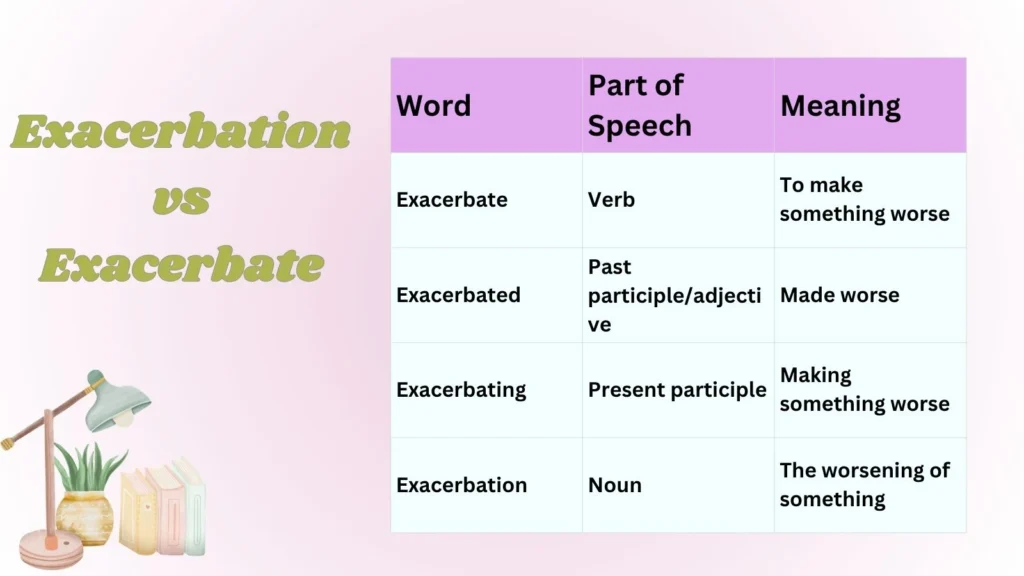
These two words are closely related, so it is easy to confuse them. The main difference is grammatical.
| Word | Part of Speech | Meaning |
|---|---|---|
| Exacerbate | Verb | To make something worse |
| Exacerbated | Past participle/adjective | Made worse |
| Exacerbating | Present participle | Making something worse |
| Exacerbation | Noun | The worsening of something |
Compare these examples:
- The noise exacerbated the situation.
- The noise caused an exacerbation of the situation.
The first sentence uses exacerbate as a verb. The second uses exacerbation as a noun.
Exacerbation Examples in Everyday Sentences
Understanding examples is one of the easiest ways to learn the exacerbation meaning.
- The heavy rain caused an exacerbation of the flooding.
- The argument resulted in an exacerbation of tensions.
- Lack of sleep contributed to an exacerbation of his fatigue.
- The delay caused an exacerbation of the existing problem.
- The new information led to an exacerbation of public concern.
- Cold temperatures can cause an exacerbation of certain symptoms.
- The financial setback created an exacerbation of the company’s difficulties.
- The disagreement resulted in an exacerbation of the conflict.
- Additional pressure led to an exacerbation of the situation.
- The policy change was followed by an exacerbation of existing tensions.
Exacerbation in a Sentence
Here are several sentence patterns that show how the word naturally works.
Formal Example
“The unexpected delay caused an exacerbation of the existing difficulties.”
Medical Example
“The patient experienced an exacerbation of symptoms.”
Workplace Example
“Poor communication contributed to an exacerbation of the disagreement.”
News Example
“The shortage led to an exacerbation of economic pressures.”
Academic Example
“Researchers examined factors associated with the exacerbation of the problem.”
Notice that the word often appears after an and is followed by of plus the problem or condition that became worse.
Common Phrases With Exacerbation
Some combinations appear more frequently than others. Learning these phrases can help you recognize the word quickly when reading.
| Phrase | Meaning |
|---|---|
| Exacerbation of symptoms | Symptoms becoming more severe |
| Exacerbation of a condition | An existing condition becoming worse |
| Exacerbation of the problem | An existing problem becoming more serious |
| Exacerbation of conflict | Conflict becoming more intense |
| Exacerbation of tensions | Tensions becoming stronger |
| Acute exacerbation | A sudden or significant worsening |
Exacerbation in Different Contexts
The word is not limited to medicine. It can describe the worsening of many different things.
In Health
An exacerbation can describe an increase in the severity of symptoms or an existing condition.
In Relationships
If an existing disagreement becomes more serious, someone might describe it as an exacerbation of the conflict.
In Business
A financial problem, supply issue, or management dispute can experience an exacerbation when additional difficulties make it worse.
In Society
News articles may use the word when describing an exacerbation of social tensions, shortages, or other ongoing problems.
In the Environment
Writers may describe an exacerbation of environmental problems when existing conditions become more severe.
In Academic Writing
The word is useful when researchers need a precise, formal noun for the worsening of an existing issue.
How to Pronounce Exacerbation
Exacerbation is commonly pronounced approximately as ig-ZAS-er-BAY-shun.
The related verb exacerbate is commonly pronounced approximately as ig-ZAS-er-bayt.
Because these words are often encountered in formal writing rather than casual conversation, pronunciation can initially feel unfamiliar. Once you connect exacerbate with “make worse” and exacerbation with “worsening,” the vocabulary becomes much easier to remember.
How to Remember the Meaning of Exacerbation
A simple memory trick can make the word easier to recall.
Exacerbation = an existing problem becoming more severe.
Think of a problem as a volume knob. If the problem is already there and something turns the volume higher, the increase is an exacerbation.
For example:
Existing problem + something makes it worse = exacerbation.
This simple formula works for health symptoms, conflicts, financial problems, environmental issues, and many other situations.
Exacerbation vs Aggravation
Exacerbation and aggravation can both refer to making something worse, but they have slightly different common uses.
Aggravation can mean increased seriousness or irritation. It can also refer to annoyance or frustration.
Exacerbation is more specifically associated with the worsening or intensification of an existing problem or condition.
For example:
- “The delay caused an exacerbation of the problem.”
- “The constant noise was a source of aggravation.”
In the second sentence, aggravation can mean annoyance, which is not necessarily the meaning of exacerbation.
Exacerbation vs Escalation
These words are also related but should not always be treated as exact synonyms.
Escalation means an increase in intensity, scale, seriousness, or level. It is commonly used for conflicts, prices, risks, and other changing situations.
Exacerbation emphasizes the worsening of an existing problem or condition.
For example, an argument may escalate, while the factors that make an existing disagreement worse may cause an exacerbation of the conflict.
Is Exacerbation a Negative Word?
Yes, exacerbation usually has a negative meaning because it describes something becoming worse, more severe, or more difficult.
It is generally used for problems, symptoms, conflicts, risks, difficulties, or unpleasant circumstances.
You would not normally use exacerbation to describe something positive becoming better. Words such as improvement, enhancement, development, or growth may be more appropriate for positive changes.
Can Exacerbation Be Used in Everyday Conversation?
Yes, but it is a relatively formal word. In casual conversation, people are more likely to say “getting worse,” “making it worse,” or “worsening.”
For example, instead of saying:
“The delay caused an exacerbation of the problem.”
A person might casually say:
“The delay made the problem worse.”
However, exacerbation is perfectly natural in professional, academic, scientific, and medical writing.
Common Mistakes With Exacerbation

Because exacerbation is a formal word, learners sometimes use it incorrectly. Here are some common mistakes to avoid.
Using It to Mean Any Change
An exacerbation specifically suggests worsening or increased severity. A neutral change is not necessarily an exacerbation.
Confusing Exacerbation With Exacerbate
Remember that exacerbate is a verb, while exacerbation is a noun.
Using It for Improvement
Exacerbation normally describes a negative change. If something becomes better, use words such as improvement or recovery instead.
Assuming It Always Means a Medical Emergency
The word is common in medicine, but it is not exclusively medical. It can describe worsening conflict, financial difficulties, social problems, environmental issues, and many other situations.
Thinking It Means a Completely New Problem
An exacerbation generally concerns something that already exists and has become worse. It does not simply mean that a new problem appeared.
FAQs:
What is the simplest meaning of exacerbation?
The simplest exacerbation meaning is worsening. It describes a situation, problem, symptom, or condition becoming more severe or intense.
What does exacerbation mean in medical terms?
In medical language, exacerbation usually means that an existing condition or its symptoms have become worse than they were previously.
What is the difference between exacerbation and exacerbation of symptoms?
Exacerbation is the general noun meaning a worsening. Exacerbation of symptoms specifically means that existing symptoms have become more severe or intense.
Is exacerbation the same as worsening?
They are closely related. Worsening is the simpler everyday term, while exacerbation is a more formal word often used for an increase in the severity of an existing problem or condition.
What is the verb form of exacerbation?
The related verb is exacerbate, which means “to make something worse.” For example, “The delay exacerbated the problem.”
Conclusion:
The exacerbation meaning is straightforward once you break it down: it refers to the worsening or increased severity of something that already exists.
You will often see the word in medical and professional writing, especially in phrases such as “exacerbation of symptoms,” “exacerbation of a condition,” and “exacerbation of conflict.” However, its use is much broader than medicine.
The easiest way to remember it is: exacerbation means something becomes worse or more intense. The related verb, exacerbate, means to make something worse.
Once you understand this basic idea, phrases containing the word become much easier to recognize and use correctly.

I am Henry James and i am a passionate writer and language enthusiast behind PunPalace, a platform dedicated to exploring meanings, word origins, and simple explanations. My aims to make learning vocabulary easy, engaging, and accessible for everyone.