
Have you seen the abbreviation TPA in a medical document, insurance policy, workplace message, or online conversation and wondered what it means? TPA is a short abbreviation with several possible meanings, so its definition depends heavily on the context in which it appears.
The most common TPA meaning in healthcare and insurance is Third-Party Administrator. A third-party administrator is an organization that performs administrative services for an insurance plan or employer, such as processing claims or helping manage healthcare benefits.
However, TPA can also stand for other terms. In medicine, for example, tPA commonly refers to tissue plasminogen activator, a protein involved in the body’s process of breaking down blood clots. Certain medicines that act as thrombolytics are also called tPA.
In this guide, we will explain what TPA means, its major full forms, how the abbreviation is used in healthcare and insurance, examples, and how to identify the correct meaning from context. 🔎
What Does TPA Mean?
TPA can have several meanings, but two of the most important are:
- Third-Party Administrator — commonly used in insurance, healthcare administration, and employee benefits.
- Tissue Plasminogen Activator — a medical term related to the breakdown of blood clots.
Other industries may use TPA for completely different terms.
| TPA Meaning | Common Context |
|---|---|
| Third-Party Administrator | Insurance and healthcare administration |
| Tissue Plasminogen Activator | Medicine and biology |
| Travel and Tourism-related abbreviations | Travel and aviation contexts |
| Other organization-specific terms | Business, education, technology, and other fields |
Because abbreviations are context-dependent, the surrounding words are important when determining exactly what TPA means.
TPA Full Form in Insurance

In insurance, TPA commonly stands for Third-Party Administrator.
A third-party administrator is a company or organization hired to perform certain administrative functions for an insurance plan, employer-sponsored health plan, or other benefit arrangement.
Depending on the arrangement, a TPA may help with:
- Processing insurance claims
- Managing healthcare benefit administration
- Maintaining member information
- Coordinating with healthcare providers
- Providing customer support
- Managing documentation
- Communicating claim decisions or requirements
The exact responsibilities vary according to the contract and the type of insurance or benefit plan.
What Is a Third-Party Administrator?
A Third-Party Administrator is essentially an organization that handles administrative work on behalf of another organization.
For example, an employer may provide health benefits to employees but use a separate company to handle certain administrative tasks.
In that situation, the TPA may serve as a link between:
- The employer or plan sponsor
- The insurance or benefit arrangement
- Healthcare providers
- Employees or plan members
The TPA does not necessarily provide the insurance itself. Its role may primarily involve administration and claims-related services.
TPA Meaning in Health Insurance
In health insurance, TPA often refers to an organization that helps manage administrative aspects of healthcare claims and benefits.
A policyholder or employee may interact with a TPA when:
- Submitting a claim
- Checking claim status
- Providing required documents
- Finding information about healthcare benefits
- Resolving an administrative issue
- Receiving information about claim processing
The TPA’s exact role depends on the health plan and the agreement between the relevant organizations.
How Does a TPA Work in Insurance?
The process can vary, but a simplified example may look like this:
- An individual receives healthcare services.
- The relevant claim information is submitted.
- The TPA receives or processes the claim according to the applicable arrangement.
- Documents and eligibility information may be reviewed.
- The claim is processed according to the plan’s rules.
- The member or provider receives relevant information about the claim.
A TPA can therefore help organize the administrative side of a healthcare benefits system.
It is important to remember that a TPA’s role does not necessarily mean it is the insurer or the organization ultimately responsible for funding the benefit.
TPA vs. Insurance Company
A TPA and an insurance company are not necessarily the same thing.
| TPA | Insurance Company |
|---|---|
| May provide administrative services | Provides insurance coverage under an insurance policy |
| May process or manage claims | May be responsible for the insurance contract and covered benefits |
| Can work on behalf of an employer or insurer | Provides or underwrites insurance products |
| Role depends on the agreement | Role is defined by the insurance arrangement |
A TPA can work with insurers, employers, self-funded plans, or other benefit structures. The specific relationship depends on the plan.
TPA Meaning in Medical Terms
In medicine, tPA commonly stands for tissue plasminogen activator.
Tissue plasminogen activator is a protein involved in the body’s natural system for breaking down blood clots.
Medications that act as tissue plasminogen activators can be used as thrombolytic drugs in certain emergency medical situations to help dissolve blood clots.
The lowercase form tPA is often used in medical writing to distinguish the biological term from unrelated uses of TPA.
What Is Tissue Plasminogen Activator?
Tissue plasminogen activator is a protein involved in fibrinolysis, the process through which the body breaks down blood clots.
It helps convert a protein called plasminogen into plasmin. Plasmin can then break down fibrin, an important structural component of blood clots.
Because blood clots can sometimes block blood flow to important organs, medications that promote clot breakdown can have important medical uses.
However, thrombolytic medicines can also cause serious bleeding. Their use is based on specific medical criteria and requires professional evaluation.
TPA and Stroke Treatment
People often encounter the abbreviation tPA when reading about stroke treatment.
Certain thrombolytic medicines that act like tissue plasminogen activator may be used in eligible patients with an acute ischemic stroke.
An ischemic stroke occurs when a blood clot blocks blood flow to part of the brain.
In appropriate circumstances, a clot-dissolving medicine may help restore blood flow. However, treatment depends on factors such as the type of stroke, timing, medical history, imaging results, and eligibility criteria.
Not every stroke patient can receive thrombolytic medication. A suspected stroke is a medical emergency requiring immediate professional assessment.
TPA and Blood Clots
The medical meaning of TPA is closely connected with fibrin and blood-clot breakdown.
The body naturally uses tissue plasminogen activator as part of its clot-dissolving system. Pharmaceutical thrombolytics can mimic or enhance this process in carefully selected medical situations.
This is why the abbreviation may appear in discussions about:
- Blood clots
- Fibrinolysis
- Ischemic stroke
- Certain heart attacks
- Pulmonary embolism in selected circumstances
- Other clot-related emergencies
Clinical use depends on the specific medication, condition, timing, risks, and medical guidelines.
TPA Meaning in Biology
In biology, tissue plasminogen activator is a naturally occurring protein associated with the regulation and breakdown of blood clots.
It is part of the body’s fibrinolytic system.
The basic sequence can be simplified as:
- Blood clot contains fibrin.
- Plasminogen is present in the blood and clot.
- tPA helps convert plasminogen into plasmin.
- Plasmin breaks down fibrin.
- The clot can then be degraded as part of the body’s clot-removal process.
This biological pathway is important for maintaining a balance between clot formation and clot breakdown.
TPA Meaning in Healthcare Administration
When TPA appears on a health insurance document, benefits card, or claims-related communication, it often refers to a Third-Party Administrator rather than tissue plasminogen activator.
The surrounding vocabulary can help you determine which meaning applies.
For example:
- “TPA claim status” → likely Third-Party Administrator.
- “TPA processed the medical claim” → likely Third-Party Administrator.
- “tPA therapy” → likely tissue plasminogen activator.
- “tPA and plasminogen” → tissue plasminogen activator.
Context is the key to understanding the abbreviation.
TPA Meaning in Business
In business, TPA may refer to Third-Party Administrator, especially in employee benefits, insurance, healthcare, and claims management.
Businesses may use external administrators because managing every administrative process internally can require significant resources.
A third-party administrator can provide specialized services while allowing the employer, insurer, or plan sponsor to focus on other responsibilities.
However, the exact services provided by a TPA depend on the business arrangement.
TPA Meaning in Employee Benefits
TPAs are also used in the administration of employee benefit programs.
An employer may work with a third-party administrator to help manage aspects of a benefits program, including:
- Employee enrollment information
- Claims administration
- Eligibility records
- Benefits communication
- Administrative reporting
- Provider coordination
The TPA may interact with employees and healthcare providers while performing tasks assigned under its agreement.
TPA Claim Meaning
If you see the phrase TPA claim on an insurance document, it often means a claim being handled or administered by a Third-Party Administrator.
Depending on the insurance arrangement, the TPA may receive documents, process information, communicate with healthcare providers, and provide updates.
However, the TPA may not necessarily be the organization that ultimately bears the insurance risk or pays the claim.
The specific responsibilities should be confirmed from the relevant insurance or benefits documentation.
TPA Card Meaning in Health Insurance
Some health insurance systems provide members with cards containing information about the insurer, plan, administrator, member identification, or provider network.
If a card identifies a TPA, it may indicate the third-party organization responsible for certain administrative functions.
The exact information displayed varies by insurance provider and plan.
If you are unsure which organization to contact about a claim, eligibility question, or benefit issue, use the contact information provided on the card or insurance documentation.
TPA Meaning in Different Contexts
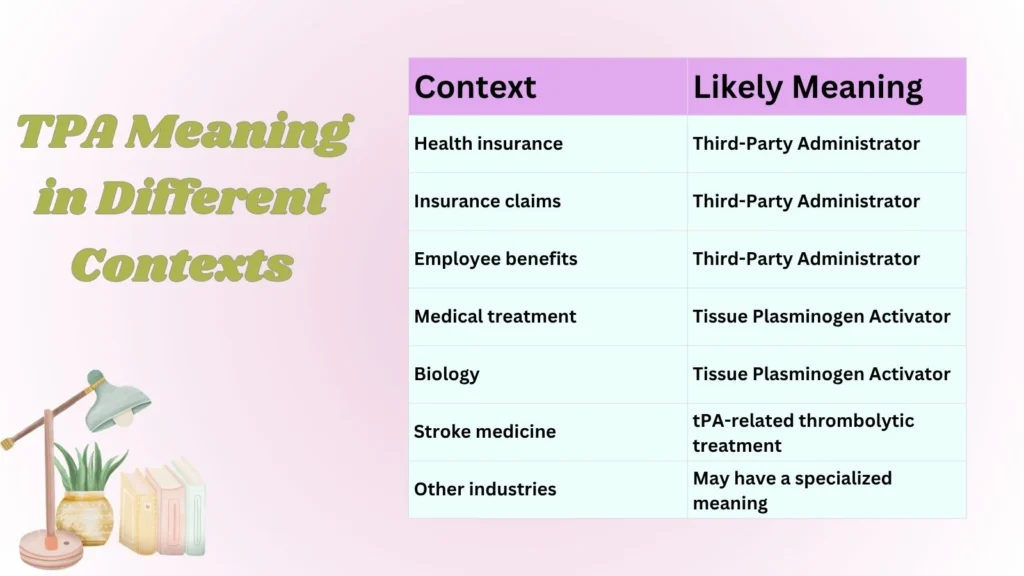
Because TPA is an abbreviation rather than a single word, the meaning can change dramatically depending on the subject.
| Context | Likely Meaning |
|---|---|
| Health insurance | Third-Party Administrator |
| Insurance claims | Third-Party Administrator |
| Employee benefits | Third-Party Administrator |
| Medical treatment | Tissue Plasminogen Activator |
| Biology | Tissue Plasminogen Activator |
| Stroke medicine | tPA-related thrombolytic treatment |
| Other industries | May have a specialized meaning |
How to Know Which TPA Meaning Is Correct
The easiest way to identify the correct TPA meaning is to look at the words surrounding the abbreviation.
Look at the Subject
If the document is about insurance, claims, employee benefits, or healthcare administration, TPA probably means Third-Party Administrator.
If the document is about blood clots, stroke treatment, fibrinolysis, or pharmacology, tPA probably means tissue plasminogen activator.
Look at the Other Terms
Words such as claim, policy, provider, benefits, administrator, network, and member suggest the insurance meaning.
Words such as plasminogen, plasmin, fibrin, clot, thrombolytic, and stroke suggest the medical biology meaning.
Check the Source
If the abbreviation appears on an insurance card, the insurance-related meaning is likely. If it appears in a medical research paper, the biological meaning may be more likely.
Examples of TPA in Sentences
Here are examples showing how the abbreviation can be used in different contexts.
- Insurance: “The TPA is reviewing the healthcare claim.”
- Insurance: “Contact the TPA for information about claim processing.”
- Benefits: “The employer uses a TPA to administer certain health benefits.”
- Medicine: “The researchers studied the role of tPA in fibrinolysis.”
- Medicine: “The physician considered thrombolytic treatment for the eligible patient.”
- Biology: “tPA helps convert plasminogen into plasmin.”
The same three letters can therefore represent completely different concepts.
TPA vs. TPA Full Form Confusion
It is common to search for “TPA full form” and find multiple answers.
That happens because abbreviations are not unique identifiers. Different industries can independently use the same letters for different terms.
For TPA, the two meanings most relevant to healthcare are:
- Third-Party Administrator
- Tissue Plasminogen Activator
Using the surrounding context is therefore more reliable than assuming there is only one universal full form.
Is TPA a Medical Term?
TPA can be a medical term, but it is not exclusively medical.
In medicine and biology, tPA usually refers to tissue plasminogen activator. In healthcare administration and insurance, TPA commonly means Third-Party Administrator.
So, the capitalization and context can both provide useful clues.
TPA and Healthcare Claims
When a TPA handles healthcare claims, its administrative work can include receiving and processing claim information according to the rules of the applicable plan.
Claims may involve:
- Patient information
- Healthcare provider information
- Dates of service
- Medical bills
- Eligibility information
- Coverage details
- Required supporting documents
The exact process depends on the insurance or benefit plan.
TPA Meaning in a Hospital Context
If you see TPA in a hospital or healthcare setting, the meaning depends on where it appears.
On an insurance or billing document, it may mean Third-Party Administrator.
In an emergency medicine or pharmacology discussion, tPA may mean tissue plasminogen activator.
For example, a hospital billing department might communicate with a TPA about claim administration, while a medical team might discuss tPA in the context of clot-related treatment.
TPA Pronunciation
As an abbreviation, TPA is generally pronounced by saying its individual letters:
“T-P-A”
When referring to tissue plasminogen activator, healthcare professionals may also say “T-P-A.”
The full term tissue plasminogen activator is usually pronounced as a normal phrase.
Related Terms to TPA
Depending on which meaning you are researching, several related terms may appear.
Insurance-Related Terms
- Insurance claim
- Health benefits
- Third-party administrator
- Plan administrator
- Healthcare provider
- Claims processing
- Member benefits
Medical-Related Terms
- Plasminogen
- Plasmin
- Fibrin
- Fibrinolysis
- Thrombolytic
- Blood clot
- Ischemic stroke
Important Note About Medical tPA
Medical tPA and related thrombolytic medications are specialized treatments. They are not appropriate for every person with a blood clot or stroke.
These medications can have serious risks, including potentially dangerous bleeding. Whether they are appropriate depends on the diagnosis, timing, medical history, imaging, contraindications, and other clinical factors.
If you think someone may be having a stroke, seek emergency medical care immediately rather than trying to determine whether tPA is appropriate yourself.
Common Mistakes About TPA Meaning

Assuming TPA Has Only One Meaning
TPA can refer to several different terms. In healthcare, the two major meanings are Third-Party Administrator and tissue plasminogen activator.
Confusing a TPA With an Insurance Company
A Third-Party Administrator may handle administrative tasks, but it is not necessarily the insurance company providing or underwriting the insurance coverage.
Thinking tPA Is Always a Medication
Tissue plasminogen activator is a naturally occurring protein. The term is also used when discussing medicines that act as thrombolytic agents.
Ignoring the Context
The surrounding words usually make the intended meaning clear. “TPA claim” and “tPA fibrinolysis” are pointing to very different concepts.
Assuming Every Stroke Can Be Treated With tPA
Thrombolytic treatment is only appropriate for certain eligible patients and specific clinical situations. Stroke treatment must be determined by qualified medical professionals.
Thinking the Capitalization Always Solves the Question
Capitalization can provide a clue, but context remains important. Different organizations and publications may use abbreviations differently.
FAQs:
What does TPA mean?
TPA most commonly means Third-Party Administrator in insurance and healthcare administration. In medicine, tPA commonly means tissue plasminogen activator.
What is the TPA full form in insurance?
In insurance, TPA commonly stands for Third-Party Administrator, an organization that may handle administrative services such as claims processing and benefit management.
What is the TPA full form in medical terms?
In medical terminology, tPA stands for tissue plasminogen activator, a protein involved in the body’s process of breaking down blood clots.
What does TPA mean on a health insurance document?
On a health insurance document, TPA usually means Third-Party Administrator. The organization may handle certain administrative or claims-related services for the health plan.
What does tPA mean in stroke treatment?
In stroke medicine, tPA refers to tissue plasminogen activator or thrombolytic medicines that act through the body’s clot-dissolving pathway. Such treatment is used only for eligible patients under medical supervision.
Conclusion:
The TPA meaning depends on context. In insurance and healthcare administration, TPA most commonly stands for Third-Party Administrator, an organization that may handle claims and other administrative services.
In medicine and biology, tPA commonly stands for tissue plasminogen activator, a protein involved in fibrinolysis and the breakdown of blood clots.
The easiest way to identify the correct meaning is to examine the surrounding words and the type of document or conversation where TPA appears. Terms such as claims, benefits, policy, and administrator point toward the insurance meaning, while terms such as fibrin, plasminogen, clot, and stroke point toward the medical meaning.

I am Henry James and i am a passionate writer and language enthusiast behind PunPalace, a platform dedicated to exploring meanings, word origins, and simple explanations. My aims to make learning vocabulary easy, engaging, and accessible for everyone.