Hyperpigmentation means that certain areas of the skin become darker than the surrounding skin. This happens when the skin produces or stores more pigment, especially melanin, than usual.
In simple English, the hyperpigmentation meaning is darkening of the skin in specific areas. It can appear as small dark spots, larger patches, or areas of uneven skin tone.
Hyperpigmentation can affect people of any skin tone. It may appear on the face, hands, arms, legs, neck, or other areas of the body. Sometimes it develops after a pimple, cut, burn, rash, or other type of skin inflammation. In other cases, hormones, sun exposure, medications, or certain medical conditions can contribute to it.
Simple definition: Hyperpigmentation is the darkening of an area of skin because of increased or uneven pigmentation.
Importantly, hyperpigmentation is a description of a skin change rather than one single disease. The reason behind the discoloration can vary from person to person.
Hyperpigmentation Meaning in Simple English

If you are searching for the hyperpigmentation meaning in simple English, think of it as “skin that has become darker in certain areas.”
| Term | Simple Meaning | Example |
|---|---|---|
| Hyperpigmentation | Darker areas of skin | Dark spots after acne |
| Melanin | Pigment that gives skin its color | More melanin can make skin look darker |
| Hypopigmentation | Reduced skin pigmentation | A lighter patch of skin |
| Uneven skin tone | Different areas have different shades | Dark spots mixed with normal skin |
The word itself can be understood by breaking it into parts. “Hyper” means excessive or more than normal, while “pigmentation” refers to the coloring of the skin. Together, the term describes increased or excessive pigmentation in an area.
What Is Skin Pigmentation?
Before understanding hyperpigmentation, it helps to understand pigmentation.
Skin pigmentation refers to the natural color of your skin. A major factor responsible for this color is melanin, a pigment produced by specialized cells called melanocytes.
Melanin contributes to the color of the skin, hair, and eyes. Everyone produces melanin, but the amount and type can vary between individuals.
When pigment production or distribution changes, the skin can become lighter or darker in certain areas.
- Hyperpigmentation: An area becomes darker.
- Hypopigmentation: An area becomes lighter.
- Depigmentation: Pigment is greatly reduced or absent in an area.
Therefore, hyperpigmentation is essentially a change in the normal pattern or amount of skin pigment.
What Causes Hyperpigmentation?
There are many possible hyperpigmentation causes. Some are temporary, while others may continue for a long time.
Common contributors include:
- Sun exposure
- Acne and skin inflammation
- Injuries or wounds
- Hormonal changes
- Certain medications
- Skin conditions
- Some medical conditions
- Aging and cumulative sun exposure
One of the most common mechanisms is post-inflammatory hyperpigmentation. When skin becomes inflamed or injured, pigment production can increase as part of the skin’s response. After the original problem settles, a darker mark may remain.
This is why some people notice dark marks after pimples, eczema flares, cuts, burns, or other irritation.
Hyperpigmentation From the Sun
Sun exposure can contribute significantly to uneven pigmentation. Ultraviolet radiation can stimulate melanocytes to produce more melanin.
This increased pigment is part of the skin’s natural protective response to UV exposure. However, repeated exposure can contribute to persistent dark spots and uneven skin tone.
Sun-related pigmentation may appear as:
- Dark spots on the face
- Freckles
- Sun spots
- Uneven pigmentation on the hands
- Darker areas on other frequently exposed skin
Sun protection is therefore an important part of managing many types of hyperpigmentation. Broad-spectrum sunscreen, protective clothing, shade, and limiting intense sun exposure can help reduce additional UV-related pigmentation.
Post-Inflammatory Hyperpigmentation Meaning
Post-inflammatory hyperpigmentation, often abbreviated as PIH, refers to darkened skin that remains after inflammation or injury has healed.
It can occur after many common skin problems, including:
- Acne
- Pimples
- Eczema
- Dermatitis
- Minor burns
- Scratches
- Insect bites
- Other skin irritation
For example, imagine someone develops a pimple on the cheek. The pimple eventually disappears, but a brown or darker mark remains in the same place. That leftover mark may be post-inflammatory hyperpigmentation.
PIH can be especially noticeable in people with medium to dark skin tones, although it can occur in anyone.
Melasma Meaning and Its Connection to Hyperpigmentation
Melasma is a common pigmentation disorder that causes darker patches, often on the face.
It commonly affects areas such as:
- Cheeks
- Forehead
- Upper lip
- Nose
- Chin
Melasma can be associated with hormonal influences and sun exposure. It is particularly common during pregnancy, when it is sometimes called the “mask of pregnancy.”
Although melasma is a form of hyperpigmentation, not every case of hyperpigmentation is melasma.
This distinction matters because different pigmentation problems can have different triggers and treatment approaches.
Types of Hyperpigmentation
Hyperpigmentation is a broad term, and several different conditions or patterns can cause darker skin.
1. Post-Inflammatory Hyperpigmentation
This develops after inflammation or injury. Acne is a very common trigger.
2. Melasma
Melasma usually produces larger, irregular patches of pigmentation, particularly on the face.
3. Sun-Related Pigmentation
Long-term UV exposure can contribute to freckles, sun spots, and other forms of increased pigmentation.
4. Medication-Related Pigmentation
Some medications can cause skin discoloration as a side effect. Anyone who notices new pigmentation after starting a medication should discuss it with a healthcare professional rather than stopping prescribed treatment independently.
5. Pigmentation Associated With Medical Conditions
Some underlying health conditions can cause generalized or localized skin darkening. When pigmentation appears suddenly, spreads significantly, or occurs alongside other symptoms, professional medical evaluation can help identify the cause.
Where Can Hyperpigmentation Appear?
Hyperpigmentation can appear almost anywhere on the skin. The location sometimes provides clues about possible triggers, although appearance alone cannot establish a diagnosis.
Common areas include:
- Face: Often associated with acne marks, sun exposure, or melasma.
- Forehead: May show sun-related or hormonal pigmentation.
- Cheeks: A common location for melasma and post-acne marks.
- Upper lip: Can be affected by melasma.
- Hands: May develop sun-related dark spots.
- Neck: Darkening can have several possible causes and may require evaluation depending on its appearance.
- Arms and legs: Marks can develop after injuries, inflammation, or sun exposure.
The pattern, texture, duration, and associated symptoms are often more useful than location alone when determining what a skin change may represent.
Hyperpigmentation From Acne
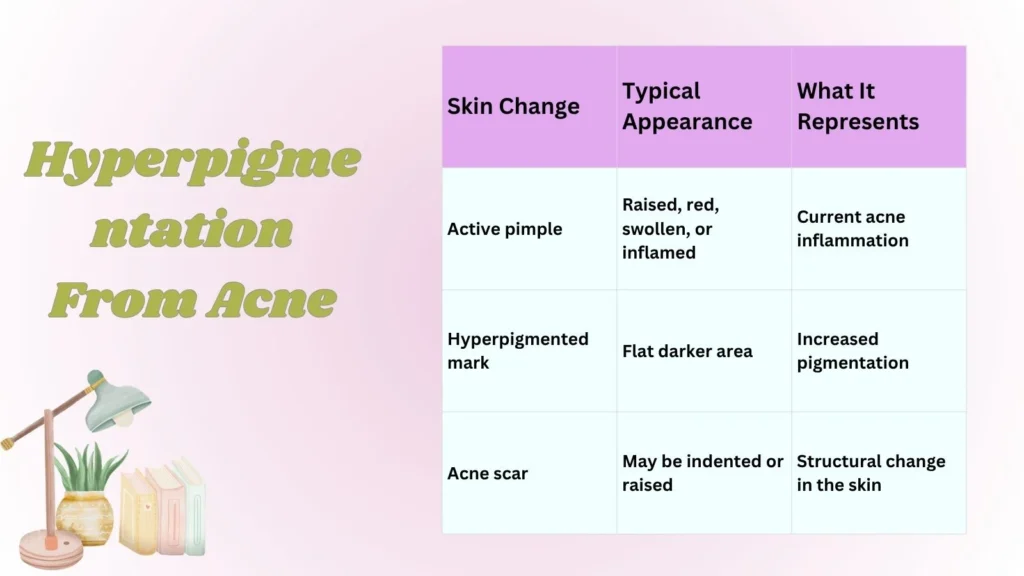
Acne is a common reason people notice dark spots after their skin has healed.
When a pimple becomes inflamed, the surrounding skin can respond with increased pigmentation. After the inflammation disappears, a flat dark mark may remain.
This is different from an active acne lesion.
| Skin Change | Typical Appearance | What It Represents |
|---|---|---|
| Active pimple | Raised, red, swollen, or inflamed | Current acne inflammation |
| Hyperpigmented mark | Flat darker area | Increased pigmentation |
| Acne scar | May be indented or raised | Structural change in the skin |
Not every dark mark left after acne is technically a scar. A flat change in color can be pigmentation rather than a structural scar.
Hyperpigmentation on the Face
Facial hyperpigmentation is one of the most noticeable forms because the face is frequently exposed to sunlight and commonly experiences acne, irritation, and cosmetic-product use.
Common reasons for facial dark spots include:
- Acne-related marks
- Sun exposure
- Melasma
- Skin irritation
- Inflammation
- Some medications
- Normal changes associated with aging
A skincare routine should focus on identifying and reducing the trigger rather than simply trying to bleach the darker area.
Gentle skincare and consistent sun protection are often important. Strong or irritating products can sometimes worsen inflammation and pigmentation, particularly when used incorrectly.
Hyperpigmentation on the Neck
Darkened skin on the neck can have many possible explanations. Sometimes it is related to friction, irritation, or pigmentation changes. In other situations, a darker, thicker, or velvety appearance can be associated with a condition called acanthosis nigricans.
Acanthosis nigricans can appear on areas such as the neck, armpits, and groin. It may be associated with insulin resistance and other underlying conditions.
Because several different causes can produce a darker neck, persistent or unexplained darkening should not automatically be assumed to be ordinary hyperpigmentation.
If the skin becomes noticeably thicker, velvety, rapidly changes, or appears together with other symptoms, a healthcare professional can help determine the cause.
Does Hyperpigmentation Go Away?
Whether hyperpigmentation fades depends on its cause, depth, location, duration, and individual skin characteristics.
Some dark marks gradually become lighter over time after the original trigger has stopped. Others can persist for months or longer.
For example, a dark mark left after a minor pimple may gradually fade. However, repeated sun exposure or ongoing inflammation can make pigmentation persist or become more noticeable.
It is also important to remember that improvement is usually gradual. Expecting a dark mark to disappear immediately can lead people to overuse aggressive products, which may cause irritation and potentially worsen discoloration.
Hyperpigmentation Treatment Options
The appropriate treatment depends on the type and cause of the pigmentation. There is no single treatment that works for every form of hyperpigmentation.
Depending on the situation, dermatologists may recommend approaches such as:
- Sun protection
- Topical skin-care ingredients
- Prescription treatments
- Chemical peels
- Laser or light-based procedures
- Other dermatologist-guided treatments
Some topical ingredients used for pigmentation include azelaic acid, retinoids, vitamin C, niacinamide, and hydroxy acids. However, the suitability of an ingredient depends on the person’s skin, the cause of the pigmentation, other products being used, and the possibility of irritation.
Prescription treatments may also be appropriate in selected cases. A dermatologist can determine which approach is suitable.
Why Sunscreen Matters for Hyperpigmentation
Sun protection is one of the most important parts of managing many pigmentation problems.
UV exposure can stimulate pigmentation and make existing dark spots more persistent or noticeable.
Helpful habits can include:
- Using a broad-spectrum sunscreen regularly
- Reapplying sunscreen as appropriate
- Wearing protective clothing
- Using hats or other physical protection
- Seeking shade when sunlight is intense
- Avoiding unnecessary tanning
Sun protection is useful not only for prevention but also when trying to improve existing pigmentation.
Hyperpigmentation vs Hypopigmentation
The terms hyperpigmentation and hypopigmentation sound similar, but they describe opposite changes.
| Feature | Hyperpigmentation | Hypopigmentation |
|---|---|---|
| Basic meaning | Increased or darker pigmentation | Reduced or lighter pigmentation |
| Appearance | Darker than surrounding skin | Lighter than surrounding skin |
| Possible causes | Sun, inflammation, hormones, medications, other conditions | Inflammation, injury, certain skin conditions, other causes |
A useful memory trick is simple: “hyper” suggests more, while “hypo” suggests less.
Hyperpigmentation vs Acne Scars
People sometimes call every dark mark an acne scar, but pigmentation and scarring are different.
Hyperpigmentation changes the color of the skin. It is usually flat.
Acne scars can involve changes in the skin’s structure. They may appear as depressions, pits, raised areas, or other textural changes.
For example, a flat brown spot left after a pimple may represent post-inflammatory hyperpigmentation, while a permanent indentation left behind by severe acne is a type of scar.
Both can occur after acne, but they are not the same thing.
Is Hyperpigmentation Dangerous?
Hyperpigmentation itself is a description of pigmentation, not automatically a sign of something dangerous. Many cases are related to common issues such as sun exposure, acne, inflammation, or hormonal changes.
However, not every dark spot should automatically be labeled hyperpigmentation.
A new, changing, unusual, or persistent dark spot may require professional evaluation, especially if it has concerning features such as:
- Rapid change in size
- Significant change in color
- Irregular or unusual borders
- Bleeding
- Crusting
- Persistent itching or pain
- A sore that does not heal
These signs do not automatically mean something serious is present, but they are reasons to seek medical advice rather than assuming the mark is harmless pigmentation.
Hyperpigmentation in Different Skin Tones
Hyperpigmentation can occur in all skin tones. However, darker skin tones may be more prone to noticeable pigmentation following inflammation or injury.
This is particularly relevant after acne, irritation, burns, or other inflammatory skin conditions.
Because skin responds differently to various treatments, people with deeper skin tones may need especially careful guidance when considering procedures such as chemical peels or lasers. Some treatments can cause additional irritation or pigmentation if they are not selected and performed appropriately.
A qualified dermatologist can take skin tone and pigmentation history into account when developing a treatment plan.
Hyperpigmentation and Hormones
Hormonal changes can influence certain forms of pigmentation, particularly melasma.
Hormonal changes associated with pregnancy can contribute to melasma, which is why facial pigmentation may become more noticeable during pregnancy.
Hormonal medications and other factors can also influence pigmentation in some individuals.
If pigmentation begins around a major hormonal change, it is useful to mention that timing to a healthcare professional.
Hyperpigmentation and Skincare
A gentle skincare routine can help reduce unnecessary irritation, which is important because inflammation itself can contribute to pigmentation.
A basic routine may focus on:
- Gentle cleansing
- Moisturizing
- Sun protection
- Carefully selected pigmentation-focused ingredients when appropriate
Avoid aggressively scrubbing dark areas. Scrubbing harder does not necessarily remove pigmentation and can irritate the skin.
Likewise, using many strong active ingredients at once can cause irritation. A slower, consistent approach is often more sensible than constantly changing products.
Common Mistakes About Hyperpigmentation

1. Thinking Hyperpigmentation Is One Specific Disease
Hyperpigmentation is a broad description of darker skin pigmentation. Different causes can produce similar-looking dark areas.
2. Assuming Every Dark Spot Is Hyperpigmentation
Not every dark spot is simply pigmentation. Moles, infections, inflammatory conditions, medication reactions, and other skin changes can look different. A changing or unusual lesion deserves professional evaluation.
3. Scrubbing Dark Areas Aggressively
Harsh scrubbing can irritate the skin and may make inflammation-related pigmentation worse.
4. Skipping Sunscreen
Continuing significant UV exposure can make some pigmentation harder to manage.
5. Expecting Instant Results
Hyperpigmentation often fades gradually. Quick-fix expectations can encourage excessive product use and irritation.
6. Using Unverified Bleaching Products
Products with unknown ingredients or unsafe concentrations can damage the skin. It is better to use reputable products and seek professional advice for persistent pigmentation.
7. Stopping Prescribed Medicine Without Advice
If a medication appears to be associated with pigmentation, speak with the prescribing healthcare professional rather than stopping it independently.
FAQs:
What does hyperpigmentation mean?
Hyperpigmentation means that an area of skin becomes darker than the surrounding skin, usually because of increased or uneven pigmentation. Sun exposure, inflammation, hormones, medications, and other factors can contribute to it.
What is the main cause of hyperpigmentation?
There is no single cause. Common contributors include sun exposure, inflammation or injury, acne, hormonal changes, medications, and certain skin or medical conditions.
Can hyperpigmentation go away naturally?
Some types of hyperpigmentation gradually fade after the underlying trigger stops. However, the time required varies, and some pigmentation can persist. Sun protection and appropriate treatment may help.
Is hyperpigmentation the same as acne scars?
No. Hyperpigmentation changes skin color, while acne scars involve structural changes in the skin, such as indentations or raised areas. A flat dark mark after acne may be pigmentation rather than a scar.
When should I see a dermatologist about a dark spot?
Consider professional evaluation if a spot is new, rapidly changing, unusual, bleeding, crusting, painful, persistently itchy, or not healing. A clinician can determine whether it is ordinary pigmentation or something else.
Final Thoughts:
The hyperpigmentation meaning is straightforward: it refers to darker areas of skin caused by increased or uneven pigmentation. It is a broad term rather than the name of one single condition.
Sun exposure, acne, inflammation, hormonal changes, medications, and various skin or medical conditions can all be associated with pigmentation changes. Common examples include post-inflammatory hyperpigmentation, melasma, freckles, and sun-related spots.
Understanding the cause is important because treatment depends on what is creating the discoloration. Gentle skincare, appropriate sun protection, and professional guidance can be useful, while aggressive or unverified treatments may cause further irritation.
Most importantly, don’t assume every dark spot is harmless pigmentation. If a spot changes quickly or has unusual features, getting it checked by a healthcare professional is the safer approach. 🌿

I am Henry James and i am a passionate writer and language enthusiast behind PunPalace, a platform dedicated to exploring meanings, word origins, and simple explanations. My aims to make learning vocabulary easy, engaging, and accessible for everyone.