Have you ever noticed how a song makes you tap your foot without even thinking about it? Or how some people speak in a smooth, flowing pattern while others sound more rushed or uneven? That natural pattern is closely connected to rhythm.
The rhythm meaning can change slightly depending on the context, but the basic idea is simple: rhythm is a pattern of beats, sounds, movements, or events that happen in a particular order or timing.
You can find rhythm in music, poetry, dance, speech, exercise, nature, and everyday activities. Understanding this word can help you appreciate how timing and patterns create flow and structure.
What Does Rhythm Mean?
Rhythm means a repeated pattern of sounds, beats, movements, or events that creates a sense of timing and flow.
In simple English, rhythm is the way things happen in a pattern over time.
For example, when you clap your hands repeatedly at a steady pace, you are creating a rhythm. A drummer creates rhythm through beats, while a dancer follows rhythm through body movements.
Rhythm is the pattern that gives movement, sound, or activity a sense of timing and flow.
The word is especially common when talking about music and dance, but it can also describe speech, writing, daily routines, and natural patterns.
Rhythm Meaning in Simple English
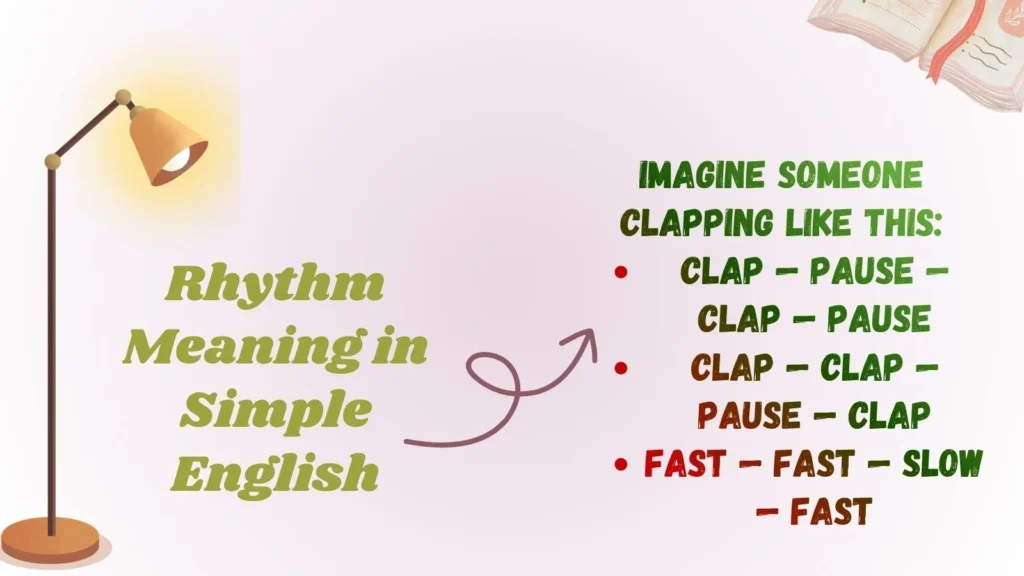
If you want the easiest possible definition, think of rhythm as a repeating pattern of timing.
Imagine someone clapping like this:
- Clap — pause — clap — pause
- Clap — clap — pause — clap
- Fast — fast — slow — fast
These patterns have rhythm because the sounds happen according to a particular timing.
Rhythm does not always have to be perfectly regular. A rhythm can be steady, changing, fast, slow, strong, soft, simple, or complex.
Rhythm Definition
The dictionary-style definition of rhythm is a regular or patterned movement or arrangement of sounds, beats, or events.
Depending on the subject, rhythm can refer to:
- A pattern of beats in music
- A pattern of stressed and unstressed sounds in speech
- A pattern of movement in dance
- A pattern of syllables in poetry
- A repeated pattern in nature
- A regular pattern in someone’s daily life
So, although rhythm is often associated with music, its meaning is much broader.
Rhythm Meaning in Music
In music, rhythm refers to the arrangement of sounds and silences over time. It determines when notes, beats, and rests occur.
For example, a song may have a steady beat that makes you naturally move your head or tap your foot. The instruments may play different patterns over that beat, creating the song’s rhythm.
Rhythm helps give music its:
- Movement
- Energy
- Structure
- Timing
- Feel
A song can have a fast rhythm that feels energetic or a slow rhythm that feels calm and emotional.
| Music Term | Simple Meaning |
|---|---|
| Beat | A regular pulse you can count or feel |
| Rhythm | The pattern of sounds and silences over the beat |
| Tempo | How fast or slow the music moves |
| Melody | A sequence of musical notes that forms a tune |
These terms are related, but they do not mean exactly the same thing.
Rhythm vs Beat: What Is the Difference?
Beat and rhythm are often confused because they work together in music.
A beat is like the steady pulse of a song. Rhythm is the pattern created by placing sounds and pauses around that pulse.
Think about walking. Your regular footsteps can represent the beat. If you change the way you step, pause, or move faster and slower, you are creating different rhythmic patterns.
In simple terms:
- Beat: The steady pulse.
- Rhythm: The pattern played or performed around that pulse.
Therefore, a song can have a steady beat while its rhythm changes throughout the song.
Rhythm Meaning in Poetry
Rhythm is also extremely important in poetry. In poems, rhythm refers to the pattern created by stressed and unstressed syllables, word choices, pauses, and sentence structure.
A poet may carefully arrange words so that a poem feels smooth, dramatic, playful, calm, or powerful when read aloud.
For example, short words and repeated patterns can create a quick rhythm, while longer phrases and pauses can create a slower rhythm.
Poetic rhythm can make writing more memorable because readers can almost hear a pattern as they read.
Rhythm Meaning in Speech
People also use rhythm when they speak. Speech rhythm is the pattern of stressed words, unstressed words, pauses, and changes in timing during conversation.
For example, someone telling an exciting story may speak quickly and use short pauses. Someone explaining a serious topic may speak more slowly and deliberately.
Good speech rhythm can make communication sound:
- Natural
- Engaging
- Clear
- Expressive
- Confident
That is why rhythm can matter when learning a new language. Knowing individual words is useful, but understanding the timing and stress of spoken language can make speech sound more natural.
Rhythm Meaning in Dance
In dance, rhythm refers to the timing and pattern of movements in relation to music or another beat.
A dancer may move their feet, arms, body, or entire body according to a particular rhythmic pattern.
For example, a dance routine may include:
- Quick steps
- Slow movements
- Pauses
- Repeated movements
- Changes in timing
All of these elements can contribute to the overall rhythm of a performance.
When someone says a dancer has a good sense of rhythm, they usually mean the person can recognize timing and coordinate their movements with it effectively.
Rhythm Meaning in Everyday Life
Rhythm is not limited to artistic activities. Everyday life also contains many rhythms.
Your daily routine may follow a particular rhythm. You wake up, eat breakfast, work or study, take breaks, eat dinner, and eventually sleep.
Nature has rhythms too. Day and night, changing seasons, ocean tides, and other recurring patterns can all be described as rhythms.
For example:
- Daily rhythm: Your regular pattern of activities each day.
- Work rhythm: The pace and pattern of your work.
- Sleep rhythm: Your recurring sleep and wake pattern.
- Natural rhythm: A recurring pattern found in nature.
In this context, rhythm means a repeated or recognizable pattern over time.
Examples of Rhythm in Sentences
Seeing the word in real sentences makes its meaning easier to understand.
- The drummer kept a steady rhythm throughout the song.
- She has a natural sense of rhythm when she dances.
- The poem has a beautiful rhythm when read aloud.
- I love the rhythm of this song.
- The speech had a slow and calming rhythm.
- The dancers moved perfectly with the rhythm of the music.
- After a few weeks, I found my rhythm at work.
- The rhythm of the waves was relaxing.
- His writing has a smooth rhythm.
- The band changed the rhythm during the final section.
What Does “Find Your Rhythm” Mean?
The phrase “find your rhythm” usually means to become comfortable with a routine, activity, or situation and discover a pace that works well for you.
For example, someone starting a new job might initially feel uncomfortable. After several weeks, they may understand their responsibilities and develop a comfortable routine.
They could say:
“I’m finally finding my rhythm at my new job.”
Here, rhythm does not refer to music. It means a comfortable and effective pattern or routine.
What Does “Get Into the Rhythm” Mean?
“Get into the rhythm” means to become accustomed to the pace or pattern of an activity.
For example:
- “It took me a few days to get into the rhythm of my new schedule.”
- “Once the class started, everyone got into the rhythm.”
- “After warming up, I got into the rhythm of the workout.”
The expression suggests that something becomes easier or more natural after you adjust to its pace.
Rhythm in Writing
Good writing has rhythm too. Writers create rhythm through sentence length, punctuation, word choice, repetition, and paragraph structure.
Imagine reading a paragraph where every sentence has exactly the same length and structure. It may feel mechanical.
Now imagine writing that mixes short sentences with longer ones. The variation can make the text feel more natural and engaging.
For example:
The room was quiet. Too quiet. Then the door opened, and everything changed.
The short sentences create a dramatic rhythm. The pacing makes the reader pause and pay attention.
That is why rhythm is useful in storytelling, advertising, speeches, poetry, and online content.
Rhythm vs Tempo

Rhythm and tempo are closely connected in music, but they are not identical.
Rhythm describes the pattern of beats, sounds, and pauses. Tempo describes how fast or slow the music is performed.
| Term | Meaning | Example |
|---|---|---|
| Rhythm | Pattern of beats and sounds | A repeating drum pattern |
| Tempo | Speed of the music | Fast or slow performance |
| Beat | Underlying pulse | Regular counting pattern |
A song can keep the same rhythm while being performed at a different tempo. Likewise, two songs can have a similar tempo while using very different rhythms.
Types of Rhythm
There are different ways to describe rhythm depending on the field or activity.
Steady Rhythm
A steady rhythm follows a consistent pattern. A metronome ticking at an even pace is a simple example.
Irregular Rhythm
An irregular rhythm does not follow a perfectly predictable pattern. It may change unexpectedly in timing or emphasis.
Fast Rhythm
A fast rhythm contains quick movements or closely spaced beats. It often creates energy and excitement.
Slow Rhythm
A slow rhythm uses more relaxed timing. It can create feelings of calmness, seriousness, or reflection.
Natural Rhythm
Natural rhythm describes recurring patterns in the natural world, such as day and night or seasonal changes.
The exact terminology can vary by subject, but these descriptions help explain the different ways rhythm can appear.
Rhythm Synonyms
There is no single synonym that perfectly replaces rhythm in every sentence. The best alternative depends on the context.
- Pattern
- Beat
- Flow
- Cadence
- Tempo
- Pace
- Timing
- Meter
- Pulse
For example, “pattern” may work when discussing repeated events, while “cadence” may be more appropriate for speech or poetry. “Beat” is commonly used in music but does not always mean exactly the same thing as rhythm.
Rhythm Antonyms
Rhythm does not have one perfect opposite either, but words describing a lack of pattern or regular timing can work as opposites in certain contexts.
- Disorder
- Irregularity
- Randomness
- Chaos
- Inconsistency
The correct opposite depends on what kind of rhythm you are describing.
Why Is Rhythm Important?
Rhythm gives structure and movement to many forms of communication and expression.
In music, it helps organize sounds. In dance, it guides movement. In poetry, it shapes how words flow. In speech, it contributes to natural communication.
Rhythm can also affect emotion.
- A fast rhythm can feel exciting.
- A slow rhythm can feel peaceful.
- A strong rhythm can feel powerful.
- A changing rhythm can create suspense.
- A repetitive rhythm can feel familiar or hypnotic.
This makes rhythm an important tool for musicians, writers, dancers, speakers, filmmakers, and performers.
Rhythm Meaning in Texting and Social Media
Unlike many modern slang terms, rhythm is not primarily a texting abbreviation. If someone writes “rhythm” in a message, they usually mean the ordinary word.
For example:
- “This song has such a good rhythm.”
- “I can’t find my rhythm today.”
- “Once I get into the rhythm, I’ll finish it quickly.”
- “You have great rhythm!”
In casual texting, “find my rhythm” can describe getting comfortable with a routine, while “you have rhythm” may refer to someone’s ability to dance or move naturally with music.
Rhythm Meaning in Different Contexts
The easiest way to understand rhythm is to look at how the word changes slightly across different situations.
| Context | Rhythm Meaning |
|---|---|
| Music | Pattern of beats, sounds, and rests |
| Dance | Timing and pattern of body movements |
| Poetry | Pattern of stressed and unstressed sounds |
| Speech | Pattern of stress, timing, and pauses |
| Writing | Flow created by sentences, words, and punctuation |
| Daily life | Repeated routine or comfortable pace |
| Nature | Recurring pattern or cycle |
Although the applications are different, the central idea remains the same: rhythm involves pattern and timing.
Common Phrases With Rhythm
Here are some common expressions that use the word rhythm:
- Find your rhythm: Discover a comfortable pace or routine.
- Get into a rhythm: Become comfortable with a repeated pattern.
- Keep the rhythm: Continue following the established timing or pattern.
- Lose the rhythm: Stop following the expected pace or pattern.
- Change the rhythm: Introduce a different timing or pattern.
- Sense of rhythm: Natural ability to recognize and follow timing.
- Natural rhythm: A recurring pattern that occurs naturally.
- Rhythm of life: The recurring pace and pattern of everyday living.
How to Use Rhythm Correctly in a Sentence
Use rhythm when you are talking about a pattern involving timing, movement, sound, or repeated events.
For music:
“The drummer created a powerful rhythm.”
For daily routines:
“I’m slowly getting back into my normal rhythm.”
For writing:
“The short sentences give the story a fast rhythm.”
For dance:
“She moved perfectly to the rhythm of the music.”
Using the word this way makes the intended meaning clear from context.
Common Mistakes With Rhythm
Confusing Rhythm With Rhyme
Rhythm and rhyme are different. Rhyme involves similar or matching sounds, especially at the ends of words. Rhythm involves timing and patterns of stress, beats, or movement.
Thinking Rhythm Only Means Music
Music is one of the most common contexts, but rhythm can also describe speech, poetry, writing, dance, routines, and natural patterns.
Using Rhythm and Tempo as the Same Word
Tempo refers to speed, while rhythm refers to the pattern of beats, sounds, and pauses. They work together but have different meanings.
Confusing Rhythm With Beat
A beat is generally the underlying pulse, while rhythm is the pattern arranged around or across that pulse.
Spelling Rhythm Incorrectly
Rhythm is a commonly misspelled English word because it contains an unusual arrangement of vowels. Remember the spelling carefully when using it in formal writing.
FAQs:
What is the simple meaning of rhythm?
Rhythm means a pattern of sounds, beats, movements, or events that happens over time. It creates a sense of timing and flow.
What does rhythm mean in music?
In music, rhythm is the arrangement of sounds and silences over time. It helps create the movement and feel of a song.
What is an example of rhythm?
A repeated clapping pattern, a drumbeat, a dance routine, or a regular daily routine can all be examples of rhythm.
What is the difference between rhythm and beat?
A beat is the steady pulse, while rhythm is the pattern of sounds and pauses that occurs around or across that pulse.
What does “find your rhythm” mean?
“Find your rhythm” means to become comfortable with a routine, activity, or pace that works well for you.
What is the difference between rhythm and rhyme?
Rhythm concerns timing and pattern, while rhyme concerns matching or similar sounds between words.
Can rhythm be used outside music?
Yes. Rhythm can describe patterns in poetry, speech, writing, dance, exercise, daily routines, and nature.
Is rhythm the same as tempo?
No. Tempo describes how fast or slow something happens, especially in music, while rhythm describes the pattern of timing, beats, and sounds.
Final Thoughts:
The rhythm meaning is centered on pattern, timing, repetition, and flow. Whether you are listening to music, reading poetry, watching a dance, speaking, writing, or following a daily routine, rhythm helps organize experiences over time.
Once you understand this simple idea, phrases such as “find your rhythm,” “get into a rhythm,” and “sense of rhythm” become much easier to understand.
Rhythm is everywhere. It can make a song memorable, a poem enjoyable, a speech engaging, and even an ordinary routine feel natural. Understanding the word also gives you a better appreciation of how timing and patterns shape communication and everyday life.

I am Henry James and i am a passionate writer and language enthusiast behind PunPalace, a platform dedicated to exploring meanings, word origins, and simple explanations. My aims to make learning vocabulary easy, engaging, and accessible for everyone.