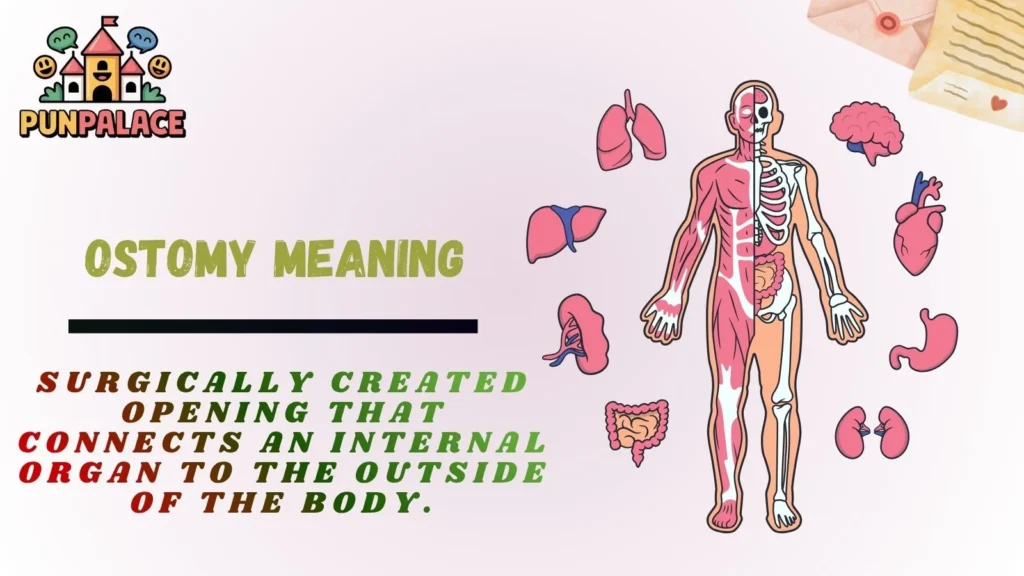
If you have come across the word ostomy in a medical report, hospital conversation, or health-related article, you may wonder what it actually means. The term can sound complicated, but the basic idea is easier to understand once you break it down.
Ostomy meaning refers to a surgically created opening in the body that allows waste or other bodily contents to leave the body through a different route. This opening is called a stoma.
An ostomy may be created when part of the digestive or urinary system cannot work normally or needs to be bypassed. Depending on the body system involved, an ostomy can help remove stool or urine from the body.
In this guide, we will explain what ostomy means, why an ostomy may be needed, the major types of ostomy, what a stoma is, and how related medical terms are different. 🩺
What Does Ostomy Mean?
Ostomy means a surgical procedure that creates an opening from an internal organ to the outside of the body.
The opening provides an alternative pathway for bodily waste or other contents. The resulting opening is known as a stoma.
For example, if a person’s normal pathway for passing stool cannot be used, a surgeon may create an opening from the intestine through the abdominal wall. Stool can then leave the body through that opening and collect in an ostomy pouch.
In simple English, you can think of an ostomy as a surgically created new route for something to leave or access the body.
Simple definition: An ostomy is a surgically created opening that connects an internal organ to the outside of the body.
Ostomy Meaning in Medical Terms
In medical terminology, ostomy describes the creation of an opening between an organ and the body’s surface or, in some cases, between internal structures.
The exact meaning depends on the organ involved. Medical words ending in -ostomy often identify the organ or structure involved in creating the opening.
| Term | Basic Meaning |
|---|---|
| Colostomy | An opening created from the colon to the abdominal surface |
| Ileostomy | An opening created from the ileum to the abdominal surface |
| Urostomy | An opening that provides a new route for urine to leave the body |
| Stoma | The visible opening created during an ostomy procedure |
| Ostomy pouch | A pouch used to collect bodily waste from a stoma |
Therefore, ostomy is a broad term, while words such as colostomy and ileostomy describe more specific procedures.
What Is a Stoma?
A stoma is the opening created during an ostomy procedure. It allows material such as stool or urine to leave the body through a new pathway.
A stoma is usually located on the abdomen when it is associated with a digestive or urinary ostomy.
Unlike normal skin, a stoma is made from tissue lining an internal organ. It may appear pink or red and can have a moist appearance.
The stoma itself does not have the same type of control mechanism as a normal bowel or bladder. Because of this, an ostomy pouch or another collection system may be used depending on the type of ostomy.
Ostomy vs. Stoma
These two words are related but do not mean exactly the same thing.
- Ostomy: The surgical procedure or the resulting surgical diversion.
- Stoma: The actual opening created on the body.
A simple way to remember the difference is: ostomy is the procedure, while stoma is the opening.
Why Is an Ostomy Needed?
An ostomy may be necessary when the normal route for eliminating waste cannot safely or effectively be used.
There are many possible medical reasons. The need for an ostomy depends on a person’s condition, anatomy, treatment plan, and surgical circumstances.
Some situations that may lead to an ostomy include:
- Part of the intestine needs to be removed.
- The bowel needs time to heal after surgery.
- A section of the digestive tract is blocked.
- A disease has seriously affected the intestine.
- The bladder or urinary system needs an alternative pathway.
- An injury has damaged part of the digestive or urinary system.
- A temporary diversion is needed during treatment.
An ostomy can therefore be temporary or permanent, depending on the underlying medical situation.
What Is a Colostomy?
A colostomy is a type of ostomy involving the colon, which is part of the large intestine.
During a colostomy, a surgeon brings part of the colon through an opening in the abdominal wall to create a stoma.
Stool then passes through the stoma rather than following the usual route through the lower digestive tract.
A colostomy can be created for different medical reasons, including conditions that affect the colon or rectum or situations where part of the bowel needs to be bypassed or removed.
Colostomy in Simple Words
Think of a colostomy as creating a new exit for stool from the colon.
The person may use an ostomy pouch attached around the stoma to collect stool. The exact type of pouching system depends on individual needs.
What Is an Ileostomy?
An ileostomy is another type of ostomy. It involves the ileum, which is the final part of the small intestine.
In an ileostomy, the end or a portion of the ileum is brought through the abdominal wall to form a stoma.
Digestive contents then leave the body through this opening and are collected using an ostomy pouch.
Because the colon normally absorbs water from intestinal contents, stool from an ileostomy can often be softer or more liquid than stool that has passed through the entire colon.
The output can vary from person to person and can also change depending on diet, fluids, medications, and other factors.
What Is a Urostomy?
A urostomy is an ostomy that creates a new pathway for urine to leave the body.
It may be needed when the bladder or another part of the urinary system cannot function normally or needs to be bypassed.
One common type of urinary diversion uses a small section of intestine to create a passage for urine. The urine then drains through a stoma into an external pouch.
Unlike a digestive ostomy, a urostomy is primarily associated with urine rather than stool.
| Type | Main System | What Leaves the Body? |
|---|---|---|
| Colostomy | Large intestine | Stool |
| Ileostomy | Small intestine | Digestive contents |
| Urostomy | Urinary system | Urine |
Temporary vs. Permanent Ostomy
Not every ostomy is permanent. Some are created temporarily to give an injured or surgically repaired part of the body time to heal.
Temporary Ostomy
A temporary ostomy may be reversed later if the person’s medical condition and anatomy allow it.
For example, a surgeon may temporarily divert stool away from a section of bowel while it heals. Later, another operation may reconnect the digestive tract.
Permanent Ostomy
A permanent ostomy may be necessary when the normal route cannot be restored or when restoring it would not be medically appropriate.
Whether an ostomy is temporary or permanent depends on the individual surgical situation. It should not be assumed from the type of ostomy alone.
How Does an Ostomy Work?
The basic process depends on the type of ostomy, but the general concept is straightforward.
- A surgeon creates an opening through the abdominal wall.
- A suitable section of an organ is brought to the surface.
- The tissue is formed into a stoma.
- Body contents pass through the stoma.
- An appropriate collection system may be attached around the stoma.
For a digestive ostomy, stool or intestinal contents are collected in an ostomy pouch. For a urostomy, urine is collected in a pouch designed for urinary output.
The pouching system is designed to protect the skin around the stoma and safely collect the output.
Common Ostomy Terms You Should Know
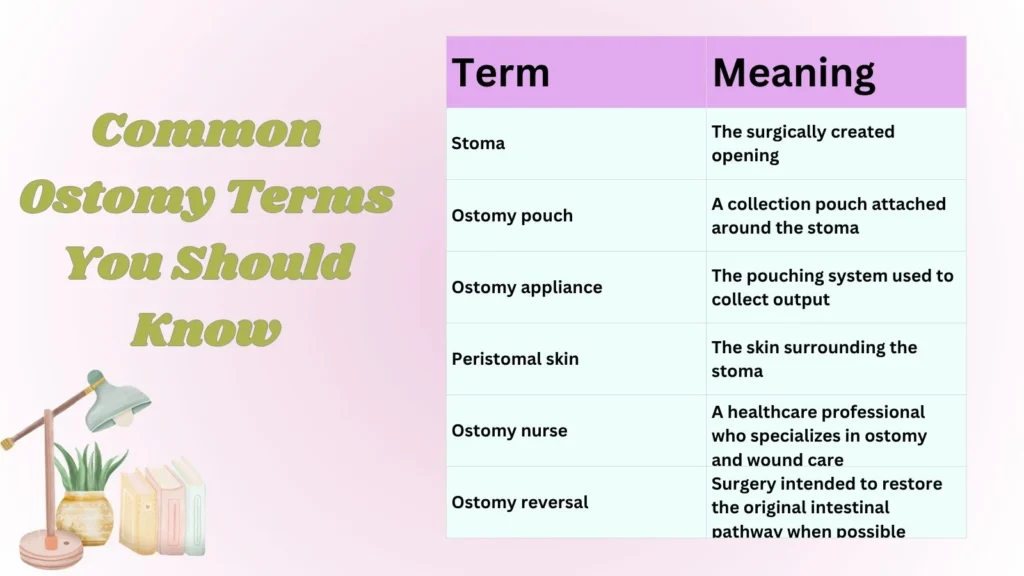
If you are reading about ostomies for the first time, several terms may seem unfamiliar. Understanding these words makes medical information much easier to follow.
| Term | Meaning |
|---|---|
| Stoma | The surgically created opening |
| Ostomy pouch | A collection pouch attached around the stoma |
| Ostomy appliance | The pouching system used to collect output |
| Peristomal skin | The skin surrounding the stoma |
| Ostomy nurse | A healthcare professional who specializes in ostomy and wound care |
| Ostomy reversal | Surgery intended to restore the original intestinal pathway when possible |
Ostomy Examples in Sentences
Seeing the word in context can make the ostomy meaning easier to understand.
- Example 1: The patient needed an ostomy after bowel surgery.
- Example 2: The nurse taught her how to care for her stoma.
- Example 3: His colostomy was created as part of his treatment.
- Example 4: The doctor explained that the ostomy might be temporary.
- Example 5: She learned how to change her ostomy pouch.
- Example 6: The surgeon discussed the possible benefits and risks of an ileostomy.
- Example 7: A urostomy can provide an alternative route for urine.
In these examples, ostomy refers to a surgical opening or diversion, while more specific words identify the organ or system involved.
Ostomy Meaning vs. Ostomy Pouch
People sometimes use these terms as though they mean the same thing, but they do not.
An ostomy is the surgical opening or diversion. An ostomy pouch is a device used to collect the material that exits through the stoma.
For example, someone can have a colostomy and use an ostomy pouch to collect stool.
The pouch is therefore part of the management system, not the definition of an ostomy itself.
Ostomy Meaning in Everyday Conversation
Outside medical conversations, the word ostomy usually appears when someone is discussing surgery, digestive health, urinary health, recovery, or living with a stoma.
You may see phrases such as:
- Living with an ostomy
- Ostomy surgery
- Ostomy care
- Ostomy supplies
- Ostomy pouch
- Ostomy support
- Ostomy reversal
- Ostomy patient
These expressions generally relate to medical care, daily management, surgery, recovery, or support for people who have an ostomy.
Is Ostomy the Same as Surgery?
Ostomy is related to surgery, but the two words are not interchangeable.
Surgery is a broad term for an operation performed on the body. An ostomy specifically refers to creating an opening or diversion.
In other words, an ostomy can be created during surgery, but not every surgery involves an ostomy.
Ostomy vs. Stoma: What’s the Difference?
This is one of the most common questions people have when learning the terminology.
| Ostomy | Stoma |
|---|---|
| Refers to the surgical procedure or diversion | Refers to the physical opening |
| Describes the creation of an alternative pathway | Is the visible site where the pathway reaches the body surface |
| Can be temporary or permanent | Is the opening created by the procedure |
A helpful memory trick is: the ostomy creates the stoma.
Ostomy Care and Daily Life
Having an ostomy can require changes to everyday routines. People may need to learn how to care for the stoma, use a pouching system, protect the surrounding skin, and recognize changes that should be discussed with a healthcare professional.
Many people with ostomies continue to work, travel, exercise, socialize, and participate in normal daily activities.
The adjustment process can be physical and emotional. Learning practical skills and receiving appropriate medical and emotional support can make the transition easier.
Individual care instructions vary, so a person with an ostomy should follow the advice of their healthcare team rather than relying on general information alone.
What Does an Ostomy Stoma Look Like?
A healthy-looking stoma is commonly described as pink or red, moist, and similar in appearance to the inside lining of the mouth.
Its appearance can vary depending on the person, the type of ostomy, and the stage of recovery.
Because the stoma contains tissue with a blood supply, it can sometimes bleed slightly when touched during routine care. However, significant bleeding, major color changes, severe pain, or other concerning symptoms should be discussed promptly with a healthcare professional.
Do not use a general online description to diagnose a stoma problem. Medical assessment is important when something appears abnormal or changes unexpectedly.
Who May Have an Ostomy?
An ostomy can be used in people with many different medical conditions and surgical circumstances. The presence of an ostomy does not identify one specific disease.
Depending on the situation, an ostomy may be associated with:
- Intestinal diseases
- Certain cancers
- Bowel obstruction
- Severe intestinal injury
- Complications requiring bowel diversion
- Congenital conditions
- Serious problems affecting the urinary system
- Major abdominal or pelvic surgery
The reason for an ostomy is always individual. Two people can have the same type of ostomy for completely different medical reasons.
Ostomy Meaning in Simple English
If you need the shortest possible explanation, remember this:
Ostomy means a surgically created opening that gives waste or other bodily contents a new pathway out of the body.
The opening is called a stoma. Depending on the type, the ostomy may allow stool, intestinal contents, or urine to leave the body through the stoma.
Synonyms and Related Terms for Ostomy
There is not always a perfect everyday synonym for ostomy, because it is a specific medical term. However, several related expressions can help explain the concept.
- Surgical opening: A general descriptive phrase.
- Surgical diversion: Describes redirecting the normal pathway.
- Stoma: The opening created by the procedure.
- Ostomy procedure: The surgical creation of the opening.
- Body diversion: A broad descriptive phrase sometimes used when explaining the concept.
It is important not to treat all these expressions as exact medical synonyms. Stoma, for example, specifically identifies the opening rather than the entire procedure.
Common Phrases With Ostomy
You may encounter the word ostomy in several common medical phrases.
- Ostomy surgery — surgery involving the creation of an ostomy.
- Ostomy care — care and management of an ostomy and surrounding skin.
- Ostomy supplies — products used to manage an ostomy.
- Ostomy pouch — a pouch that collects output from a stoma.
- Ostomy reversal — surgery intended to reconnect the original pathway when medically possible.
- Ostomy nurse — a healthcare professional specializing in ostomy-related care.
- Permanent ostomy — an ostomy intended to remain long term.
- Temporary ostomy — an ostomy that may potentially be reversed.
Can an Ostomy Be Reversed?
Sometimes, but not always.
An ostomy may be reversible when it was created as a temporary diversion and the person’s anatomy, healing, and overall medical situation allow reconnection.
Reversal is another surgical procedure, and it is not appropriate for everyone. A surgeon considers several factors before recommending it.
Therefore, having a temporary ostomy does not automatically mean that reversal will occur.
Does an Ostomy Change How the Body Works?
An ostomy changes the normal route through which stool or urine leaves the body. The effects depend heavily on the type of ostomy and which parts of the digestive or urinary system remain functional.
For example, a person with an ileostomy may have different stool consistency and fluid-management needs from someone with a colostomy.
Similarly, a person with a urostomy manages urine rather than intestinal output.
This is why ostomy care is individualized. Healthcare professionals can provide instructions based on the person’s specific surgery and needs.
Ostomy and Quality of Life
The word ostomy can sometimes create fear because people associate it with major surgery or dramatic lifestyle changes. However, an ostomy does not automatically prevent someone from living an active life.
People with ostomies may return to many ordinary activities after recovery, including work, school, travel, social events, and physical activity that their healthcare team considers appropriate.
Emotional adjustment can also be important. Body-image concerns, uncertainty, and learning new routines can take time.
Support from healthcare professionals, family, friends, and ostomy communities can help people adapt to their new routine.
Why Is the Word Ostomy Sometimes Confusing?
The term can be confusing because ostomy is a broad category rather than one single operation.
When someone says, “I have an ostomy,” that statement does not necessarily tell you whether they have a colostomy, ileostomy, or urostomy.
Similarly, the word does not automatically tell you whether the ostomy is temporary or permanent.
To understand the exact situation, you need the specific medical term and context.
How to Remember the Ostomy Meaning
Here is a simple memory trick:
- Ostomy = created opening or diversion.
- Stoma = the opening you can see.
- Colostomy = colon-related ostomy.
- Ileostomy = ileum-related ostomy.
- Urostomy = urinary diversion.
Once you understand these five ideas, most basic discussions about ostomies become much easier to follow.
Common Mistakes When Understanding Ostomy Meaning

Confusing Ostomy With Stoma
One of the most common mistakes is assuming that ostomy and stoma are identical terms. They are closely related, but an ostomy refers to the surgical opening or diversion, while a stoma is the actual opening.
Assuming Every Ostomy Is Permanent
Some ostomies are temporary. Others are permanent. The outcome depends on the individual medical and surgical situation.
Thinking Every Ostomy Is for Stool
Not all ostomies involve stool. A urostomy, for example, creates a route for urine to leave the body.
Assuming a Colostomy and Ileostomy Are the Same
Both are digestive ostomies, but they involve different parts of the intestine. A colostomy involves the colon, while an ileostomy involves the ileum.
Thinking an Ostomy Means Someone Cannot Live Normally
An ostomy can require lifestyle adjustments, but many people with ostomies participate in everyday activities after recovery and with appropriate care.
Using General Information as Personal Medical Advice
General explanations of ostomy meaning cannot replace individualized medical advice. Questions about surgery, stoma appearance, complications, diet, activity, or pouching should be discussed with the appropriate healthcare professional.
FAQs:
What does ostomy mean?
Ostomy means a surgically created opening or diversion that provides a new pathway between an internal organ and the outside of the body. It may allow stool, intestinal contents, or urine to leave the body.
What is the difference between an ostomy and a stoma?
An ostomy refers to the surgical opening or diversion, while a stoma is the actual opening created on the body.
What are the main types of ostomy?
The major types include colostomy, ileostomy, and urostomy. Colostomy involves the colon, ileostomy involves the ileum, and urostomy provides a urinary pathway.
Is an ostomy permanent?
An ostomy can be temporary or permanent. Some are created to allow the body to heal and may later be reversed, while others are intended to remain permanently.
Can people live a normal life with an ostomy?
Many people with ostomies return to everyday activities after recovery. However, the experience varies by person and depends on the type of ostomy, overall health, and medical circumstances.
Conclusion:
The ostomy meaning is easier to understand when you remember that it refers to a surgically created opening or diversion that gives bodily contents a new pathway out of the body.
The opening itself is called a stoma. Depending on the type, an ostomy may involve the colon, small intestine, or urinary system. Colostomies, ileostomies, and urostomies are different procedures designed for different medical needs.
An ostomy can be temporary or permanent, and having one does not automatically mean that a person cannot enjoy everyday activities. The right care and individualized medical guidance are important for adapting to life with an ostomy.
If you encountered the word ostomy in a medical document, understanding the specific type and context can give you a much clearer picture of what it means.

I am Henry James and i am a passionate writer and language enthusiast behind PunPalace, a platform dedicated to exploring meanings, word origins, and simple explanations. My aims to make learning vocabulary easy, engaging, and accessible for everyone.