Have you ever come across the word misandrist online, in a book, or during a serious conversation and wondered what it actually means? 🤔 It is a relatively uncommon word, but it appears more often in discussions about gender, relationships, culture, and social attitudes.
The misandrist meaning refers to a person who has strong hatred, contempt, or prejudice toward men or boys. The word describes an attitude or belief that negatively targets males as a group.
Understanding this term is useful because it can sometimes be confused with words such as misogynist, sexist, feminist, or simply someone who criticizes certain men’s behavior. These terms do not all mean the same thing.
What Does Misandrist Mean? 🤔
A misandrist is a person who expresses or holds hatred, contempt, or strong prejudice against men or boys because they are male.
In simple English, you can think of it this way:
Misandrist = A person who dislikes, hates, or shows strong prejudice against men as a group.
The word is generally used to describe a person’s attitude toward males rather than a single disagreement with an individual man.
For example, if someone dislikes one particular man because of something he did, that does not automatically make the person a misandrist. The term usually involves a broader negative attitude toward men or boys.
Misandrist Meaning in Simple English 📖
If you want the easiest possible definition, misandrist means a person who has hatred, contempt, or prejudice toward men.
Here are some simple ways to understand it:
- A person who strongly dislikes men as a group.
- Someone who expresses prejudice against males.
- A person who holds negative beliefs about men simply because they are men.
- Someone whose attitude toward men is based on hostility or contempt.
The adjective related to this concept is misandristic, while the noun describing the attitude itself is misandry.
Misandrist Definition at a Glance 📊
| Term | Meaning | Word Type |
|---|---|---|
| Misandrist | A person who hates or strongly prejudices against men | Noun |
| Misandry | Hatred, contempt, or prejudice against men | Noun |
| Misandristic | Showing or relating to misandry | Adjective |
| Misogynist | A person who hates or strongly prejudices against women | Noun |
| Misogyny | Hatred, contempt, or prejudice against women | Noun |
What Is Misandry? 🧠
Misandry is the broader concept behind the word misandrist. It means hatred, contempt, or prejudice against men or boys.
For example, if someone believes that men are naturally inferior, untrustworthy, or deserving of negative treatment simply because they are male, that belief may be described as misandry.
A person who holds such views may be called a misandrist.
This distinction is easy to remember:
- Misandry = the attitude or belief.
- Misandrist = the person holding or expressing that attitude.
Origin of the Word Misandrist 📚
The word misandrist comes from the Greek roots associated with hatred or dislike and the word for man. It belongs to the same linguistic family as misandry.
The prefix mis- is commonly associated with hatred, dislike, or aversion. The element related to andr- comes from Greek anēr, meaning man.
This same root can appear in other English words connected with men. For example, androgen and andrology contain the same Greek-derived root associated with males or men.
Misandrist vs Misogynist ⚖️
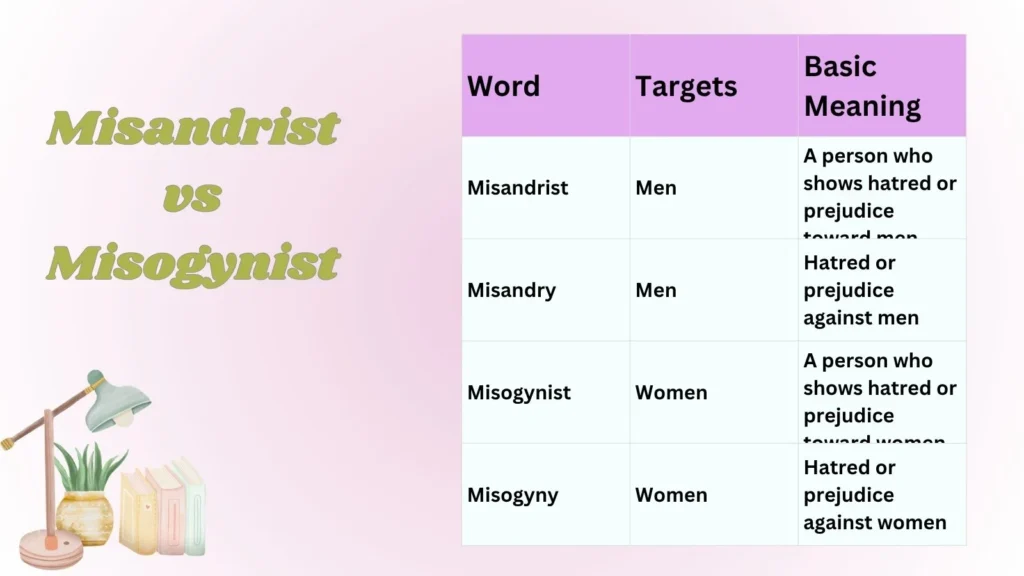
One of the most common points of confusion is the difference between misandrist and misogynist.
They describe opposite targets of gender-based hatred or prejudice.
| Word | Targets | Basic Meaning |
|---|---|---|
| Misandrist | Men | A person who shows hatred or prejudice toward men |
| Misandry | Men | Hatred or prejudice against men |
| Misogynist | Women | A person who shows hatred or prejudice toward women |
| Misogyny | Women | Hatred or prejudice against women |
A simple memory trick is to associate misandry with men and misogyny with women.
Misandrist Examples in Everyday Language 💬
Seeing the word in context makes its meaning much easier to understand.
Example 1: General Hostility
“His comments about all men were extremely hostile, and some people described them as misandrist.”
Here, the word suggests that the comments expressed prejudice or hostility toward men as a group.
Example 2: Negative Generalization
“Calling every man dishonest simply because he is male can be viewed as a misandrist attitude.”
The important part is the broad generalization about men.
Example 3: Online Discussion
“The post received criticism because readers considered its message misandrist.”
In this example, the term describes content that is perceived as expressing prejudice against men.
Example 4: Academic Discussion
“The researchers examined representations of misandry in popular culture.”
Here, the related noun misandry describes the broader idea rather than a specific person.
How to Use Misandrist in a Sentence ✍️
Misandrist is usually used as a noun when referring to a person.
- “Some readers considered the writer a misandrist.”
- “She was accused of being a misandrist after making hostile comments about men.”
- “A misandrist may hold deeply negative beliefs about males.”
- “The article discusses whether the character is genuinely misandrist.”
It can also appear in discussions where people are evaluating whether a statement or attitude demonstrates prejudice against men.
Misandrist in Social Media and Online Conversations 📱
The term misandrist sometimes appears on social media, forums, comment sections, and relationship discussions.
Online, people may use the word when someone makes broad negative statements about men. However, social media users do not always use labels precisely.
For this reason, it is important to look at the actual statement and context before deciding whether the term accurately applies.
A sarcastic joke, criticism of a particular person, or disagreement with certain male behavior does not automatically demonstrate misandry.
Is Misandrist a Negative Word? ⚠️
Yes. Misandrist is generally a negative or critical term because it describes hatred, contempt, or prejudice toward men.
Calling someone a misandrist can therefore be a serious accusation. It is better to use the word carefully rather than applying it to anyone who simply disagrees with men or criticizes a particular man’s actions.
Criticism is not automatically misandry. The distinction usually depends on whether the negative attitude is directed toward men generally because of their gender.
Misandrist vs Criticism of Men 🔍
Not every negative statement about men is necessarily misandrist.
For example, criticizing a man’s dishonesty, irresponsible behavior, or harmful actions focuses on what that individual did.
On the other hand, saying that all men are inherently bad simply because they are men expresses a much broader gender-based generalization.
| Statement Type | Likely Meaning |
|---|---|
| “I dislike that man’s behavior.” | Personal criticism |
| “That person treated me badly.” | Experience or complaint |
| “All men are terrible.” | Broad gender-based generalization |
| “Men should be treated badly because they are men.” | Gender-based hostility or prejudice |
Context always matters, especially when a strong label is being applied to someone’s words or behavior.
Is Misandrist the Same as Feminist? 🌱
No. Misandrist and feminist do not mean the same thing.
Feminism broadly refers to movements and ideas focused on gender equality and addressing disadvantages experienced by women. A feminist can support equality while also criticizing harmful behavior or social systems.
A misandrist, by definition, holds hostility, contempt, or prejudice toward men.
Therefore, simply identifying with feminism does not make someone a misandrist.
Common Synonyms and Related Words 🔤
There is no perfect everyday synonym for misandrist, but several words can help explain the concept.
- Man-hater — an informal expression for someone who strongly dislikes men.
- Anti-male — describing an attitude opposed to or hostile toward males.
- Prejudiced against men — a straightforward descriptive phrase.
- Misandristic — an adjective meaning related to or showing misandry.
Among these, misandrist is the more specific term when referring to a person.
Antonym of Misandrist 🔄
There is not one universally used everyday antonym that perfectly matches misandrist.
Depending on context, words such as egalitarian may describe someone who supports equality rather than gender-based prejudice.
It is important not to assume that the opposite of misandrist is simply “misogynist.” A misogynist is prejudiced against women, so that word describes a different form of gender-based hostility.
Why Understanding the Word Matters 🎯
Words such as misandrist, misandry, misogynist, and misogyny are often used during discussions about gender. Knowing their precise meanings can prevent misunderstandings.
Using the correct term helps people distinguish between:
- Personal disagreements
- Criticism of individual behavior
- Gender stereotypes
- Gender-based prejudice
- Hatred or contempt toward a gender
That distinction is especially important in online conversations, where short statements can easily lose their original context.
Common Mistakes About Misandrist ❌
1. Thinking Every Woman Who Criticizes Men Is a Misandrist
This is incorrect. A woman can criticize individual men, social behavior, or specific issues without hating men as a group.
2. Confusing Misandrist With Misogynist
These words have different targets. Misandrist refers to hostility or prejudice toward men, while misogynist refers to hostility or prejudice toward women.
3. Thinking Misandrist Means Feminist
These terms are not interchangeable. Feminism and misandry describe different concepts, and supporting gender equality does not mean hating men.
4. Using Misandrist for Every Negative Comment
A negative comment about a particular man is not automatically misandrist. The broader context and target of the statement matter.
5. Confusing Misandry With Misandrist
Misandry is the attitude or prejudice, while a misandrist is the person who holds or expresses that attitude.
FAQs:
What does misandrist mean in simple words?
Misandrist means a person who has hatred, contempt, or strong prejudice against men or boys.
What is the difference between misandrist and misandry?
Misandrist refers to the person, while misandry refers to the attitude, belief, or prejudice itself.
What is the opposite of misandrist?
There is no single perfect everyday opposite. In some contexts, egalitarian can describe someone who supports equality rather than gender-based prejudice.
Is misandrist the opposite of misogynist?
They describe prejudice toward different genders. A misandrist is hostile toward men, while a misogynist is hostile toward women.
Does criticizing men make someone a misandrist?
No. Criticizing an individual man or criticizing specific behavior does not automatically mean someone is misandrist. The term generally involves broader hostility or prejudice toward men as a group.
Final Thoughts:
The misandrist meaning is straightforward: it describes a person who expresses hatred, contempt, or prejudice toward men or boys. The related word misandry describes the attitude itself.
The most important thing to remember is that not every criticism of men is misandry. Context, intent, and whether the statement targets men as a group all matter.
Once you understand the difference between misandrist, misandry, misogynist, misogyny, and feminism, it becomes much easier to understand conversations where these terms appear.
If you enjoy learning simple meanings, slang, abbreviations, and interesting English vocabulary, explore more helpful language guides on punpalace.com.

I am Henry James and i am a passionate writer and language enthusiast behind PunPalace, a platform dedicated to exploring meanings, word origins, and simple explanations. My aims to make learning vocabulary easy, engaging, and accessible for everyone.