
Have you ever come across the phrase “carpe diem” or seen the term “per diem” in a workplace, travel, or business context? If so, you may have wondered what diem actually means on its own.
The diem meaning is quite simple once you know where the word comes from. Diem is a Latin word meaning “day.” It is commonly seen in well-known Latin expressions, especially carpe diem, meaning “seize the day,” and per diem, meaning “per day” or “for each day.”
Although diem is not normally used as an independent English word in everyday conversation, it appears in several established phrases. In this guide, you will learn the diem definition, its Latin origin, pronunciation, common expressions, examples, and the difference between phrases such as carpe diem and per diem.
What Is the Diem Meaning?
Diem is a Latin word that means “day.” It is the accusative form of the Latin noun dies, which means “day.”
Simple definition: Diem means “day” in Latin and is most commonly encountered in English expressions such as “carpe diem” and “per diem.”
For example, in carpe diem, the word diem means “the day.” The phrase is commonly translated as “seize the day.”
In per diem, the word refers to each individual day, giving the phrase the meaning “per day” or “for each day.”
| Expression | Meaning | Common Context |
|---|---|---|
| Diem | Day | Latin |
| Carpe diem | Seize the day | Life, motivation, philosophy |
| Per diem | Per day | Work, travel, business |
Diem Meaning in Simple English

In simple English, diem means “day.”
However, you will rarely see diem used by itself in normal English sentences. Instead, it is usually part of a Latin phrase that has become established in English.
The two expressions you are most likely to encounter are:
- Carpe diem — seize the day.
- Per diem — per day or for each day.
So, when you see diem, think of the basic idea of a day. Then look at the words around it to understand the complete expression.
What Does Diem Mean?
What does diem mean? In Latin, diem means “day.” It is an inflected form of the Latin word dies.
Its meaning in English depends heavily on the phrase in which it appears.
For example:
- Carpe diem means “seize the day.”
- Per diem means “per day.”
This is why understanding the entire phrase is often more useful than translating diem alone.
Diem Definition and Latin Origin
The English word diem comes directly from Latin. The Latin noun dies means “day,” while diem is a grammatical form used in certain sentence constructions.
This distinction explains why the word appears as diem rather than simply dies in expressions such as carpe diem.
The phrase carpe diem comes from the Roman poet Horace, who used the expression in his poem Odes. The phrase later became one of the most recognizable Latin expressions in the English language.
Over time, Latin expressions containing diem became common in literature, education, business, law, philosophy, and popular culture.
Carpe Diem Meaning
Carpe diem is probably the most famous phrase containing diem.
It is commonly translated as “seize the day.” The expression encourages people to make use of the present moment rather than constantly waiting for an uncertain future.
In simple terms, the idea is:
Make the most of today instead of always putting life off until tomorrow.
For example:
“I decided to travel while I had the opportunity. Carpe diem!”
Here, carpe diem expresses the idea of taking advantage of the present opportunity.
Per Diem Meaning
Another extremely common expression is per diem.
Per diem is a Latin phrase that literally means “per day” or “by the day.”
In modern English, it is frequently used in employment, business, travel, accounting, and legal contexts.
For example, a company may provide an employee with a per diem allowance to cover eligible daily expenses during a business trip.
| Term | Simple Meaning |
|---|---|
| Per diem | Per day |
| Per diem rate | Amount provided or charged for each day |
| Per diem allowance | Daily allowance for specified expenses |
| Per diem employee | An employee who may be paid or scheduled on a daily basis, depending on the context |
The exact meaning of per diem can vary by workplace, contract, or legal context, so the surrounding information matters.
Per Diem Examples in Sentences
Here are some examples that show how per diem is used in modern English.
- The company provides a per diem for employees traveling for work.
- She receives a daily per diem allowance during business trips.
- The employee submitted the required documents for his per diem.
- The contract specifies a fixed per diem rate.
- The organization established a maximum per diem for travel expenses.
In these examples, per diem has a practical financial meaning rather than the philosophical meaning associated with carpe diem.
Diem vs Dies
If you look up the Latin word for “day,” you may encounter both dies and diem. They are related forms of the same Latin noun.
Dies is the basic dictionary form of the Latin word meaning “day.” Diem is an inflected form used in particular grammatical situations.
This is why you should not assume that one is simply an alternative spelling of the other.
In the famous expression carpe diem, diem is the appropriate grammatical form.
Diem Meaning in Modern English
Although diem is a Latin word, it remains familiar to English speakers because of its use in established expressions.
You may see it in:
- Books and literature
- Motivational writing
- School and university discussions
- Business documents
- Travel policies
- Employment contracts
- Legal writing
- Speeches
- Art and tattoos
- Social media captions
Its meaning can therefore range from a simple reference to a day to a broader idea about making the most of life.
Is Diem an English Word?
Diem is originally a Latin word, not a regular standalone English word in the way that “day” is.
However, English has adopted many Latin expressions, and diem is commonly understood as part of phrases such as carpe diem and per diem.
It is therefore better to understand diem as a Latin term that has become established within English vocabulary and expressions.
Diem Meaning in Philosophy and Motivation
When people use carpe diem in philosophical or motivational contexts, the word diem represents the present day or present opportunity.
The broader message is about recognizing that time is limited and that the present moment has value.
For example, someone might say:
“You have always wanted to learn guitar. Why keep waiting? Carpe diem.”
The speaker is encouraging the person to act now instead of continually postponing the goal.
Importantly, carpe diem does not necessarily mean acting recklessly or ignoring the future. In modern usage, it often simply means appreciating the present and making meaningful use of current opportunities.
Diem Meaning in Literature
Diem is especially important in discussions of classical and English literature because of the carpe diem tradition.
The expression became influential in poetry and other forms of writing that explore themes such as time, mortality, youth, love, opportunity, and the passing of life.
Writers may use the idea of seizing the day to encourage characters or readers to appreciate the present instead of assuming that every opportunity will remain available forever.
Because of this literary history, carpe diem is often associated with the broader theme of making the most of life.
Diem Meaning in Carpe Diem Explained Word by Word
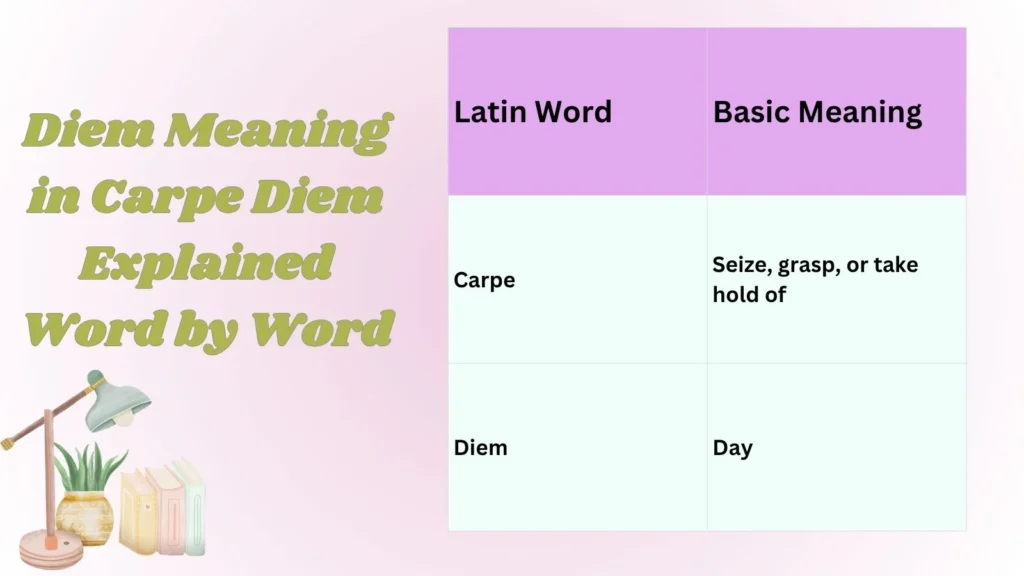
Breaking down carpe diem can make the phrase easier to understand.
| Latin Word | Basic Meaning |
|---|---|
| Carpe | Seize, grasp, or take hold of |
| Diem | Day |
Together, carpe diem is commonly translated as “seize the day.”
The expression is often used to encourage someone to take advantage of an opportunity, appreciate the present, or stop endlessly postponing meaningful experiences.
Diem Meaning in Business
In business, the word is most often encountered through per diem.
A business may establish a daily amount for certain travel-related expenses. For example, an employee traveling for work may receive a per diem according to the organization’s rules.
However, a per diem does not necessarily mean the same thing at every company. Some organizations use it for expense allowances, while other employment contexts may use the phrase when referring to daily work arrangements or rates.
Always check the specific policy, contract, or workplace definition when the term has financial or employment consequences.
Diem Meaning in Travel
Travel is another context where per diem appears frequently.
When an employee travels for work, an organization may provide a daily allowance for eligible expenses such as meals or other approved costs, depending on its policy.
For example:
“Employees receive a per diem while traveling for approved business activities.”
In this sentence, per diem means a daily allowance or rate rather than “seize the day.”
Diem Meaning in Social Media
On social media, you are much more likely to encounter carpe diem than the word diem by itself.
People often use carpe diem in captions about:
- Travel
- New experiences
- Personal goals
- Celebrations
- Adventure
- Friendship
- Life milestones
- Taking opportunities
For example, someone posting pictures from a spontaneous trip might caption them with “Carpe diem.” The phrase communicates the idea of enjoying the opportunity and living in the present.
Common Phrases With Diem
Learning the common phrases containing diem is the easiest way to understand how the word appears in English.
Carpe Diem
Carpe diem means “seize the day” and encourages making the most of the present.
Per Diem
Per diem means “per day” and is commonly used for daily rates or allowances.
Carpe Diem Quote
A carpe diem quote generally expresses the idea of appreciating the present and making use of current opportunities.
Per Diem Rate
A per diem rate is an amount calculated on a daily basis.
How to Pronounce Diem
Diem is commonly pronounced approximately as DEE-em in English.
In the phrase carpe diem, English speakers generally pronounce it as KAR-pay DEE-em, although pronunciation can vary depending on whether someone is using an English or reconstructed Latin pronunciation.
For everyday English, the pronunciation you hear most often is more important than trying to reproduce a particular historical Latin accent.
Is Carpe Diem Positive or Negative?
Carpe diem is generally used in a positive or encouraging way.
It encourages people to appreciate the present and take advantage of meaningful opportunities.
For example:
“Don’t keep waiting for the perfect moment. Carpe diem.”
Here, the phrase has an encouraging tone.
However, its interpretation can vary depending on the context. Some people may use it humorously or casually, while others use it in a serious philosophical sense.
How to Remember the Diem Meaning
A simple memory trick can help you remember diem.
Diem = Day
Then connect it to the two major phrases:
- Carpe diem = seize the day.
- Per diem = per day.
If you remember those two phrases, you will recognize most common uses of diem in English.
Diem Synonyms and Related Words
Because diem is a Latin term, its direct English equivalent is simple: day.
Depending on the phrase, related English concepts include:
- Day
- Today
- Daily
- Present
- Moment
- Opportunity
- Daily rate
- Daily allowance
These are not all direct synonyms. Their usefulness depends on whether you are translating diem itself or explaining an expression such as carpe diem or per diem.
Common Mistakes With Diem

Thinking Diem Means Seize
Diem means “day.” In carpe diem, the word associated with “seize” is carpe.
Confusing Carpe Diem With Per Diem
These expressions contain the same Latin word but have completely different meanings. Carpe diem is about making the most of the present, while per diem means “per day.”
Using Diem as a Regular English Noun
In normal English, you generally would not replace the word “day” with “diem” in an ordinary sentence. The term is most natural in established Latin expressions.
Assuming Per Diem Always Means Salary
A per diem may refer to a daily allowance, rate, or arrangement, depending on the context. It does not automatically mean a person’s regular salary.
Assuming Carpe Diem Means Being Reckless
Although some modern uses may suggest spontaneity, carpe diem more broadly means making good use of the present and recognizing current opportunities.
FAQs:
What is the simple meaning of diem?
The simple diem meaning is “day.” It is a Latin word commonly found in English expressions such as carpe diem and per diem.
What does carpe diem mean?
Carpe diem is commonly translated as “seize the day.” It expresses the idea of making the most of the present moment or current opportunities.
What does per diem mean?
Per diem means “per day” or “for each day.” In modern English, it is often used for daily rates or allowances, especially in work and travel contexts.
Is diem a Latin word?
Yes. Diem is a Latin form of the noun dies, meaning “day.” It has become familiar in English through established Latin phrases.
What is the difference between diem and carpe diem?
Diem is the Latin word meaning “day,” while carpe diem is a complete Latin expression commonly translated as “seize the day.”
Conclusion:
The diem meaning is simple: diem means “day” in Latin. Although it is not normally used alone in everyday English, it remains familiar because of phrases that have become part of modern vocabulary.
The two most important expressions to remember are carpe diem and per diem. Carpe diem means “seize the day” and is associated with making the most of the present. Per diem means “per day” and is commonly used in business, employment, and travel contexts.
So, whenever you see diem, remember its basic meaning of day, then examine the complete phrase to understand the intended meaning. This simple connection makes the word much easier to recognize in literature, conversations, workplace documents, and everyday English.

I am Henry James and i am a passionate writer and language enthusiast behind PunPalace, a platform dedicated to exploring meanings, word origins, and simple explanations. My aims to make learning vocabulary easy, engaging, and accessible for everyone.