
The degree meaning can change depending on the context. The word degree is commonly used to describe an academic qualification, a unit of temperature, a unit for measuring angles, or the extent or level of something.
For example, you can earn a degree from a university, say that the temperature is 30 degrees, or describe an angle as 90 degrees. The same word is used in all three situations, but its meaning changes according to the context. 🎓
Simple definition: A degree can mean an academic qualification, a measurement of temperature or angle, or a particular level or amount of something.
Degree Meaning in Simple English

In simple English, degree has several important meanings.
- Education: A qualification awarded by a college or university.
- Temperature: A unit used to measure how hot or cold something is.
- Angle: A unit used to measure the size of an angle.
- Level or extent: The amount or intensity of something.
- Academic level: A particular stage or type of university education.
Because degree has multiple meanings, you need to look at the surrounding words to understand exactly what it means in a sentence.
What Does Degree Mean in Education?
In education, a degree is a formal qualification awarded after completing a particular course of study, usually at a college or university.
For example, someone might say:
- “I have a bachelor’s degree in English.”
- “She is studying for a master’s degree.”
- “He earned a degree in computer science.”
- “My degree helped me qualify for the position.”
In these examples, degree refers to an academic qualification.
The exact structure of degrees varies by country and educational system, but common university degrees include bachelor’s, master’s, and doctoral degrees. 🎓
Types of Academic Degrees
When people use the word degree in an educational context, they may be referring to different levels of academic study.
Bachelor’s Degree
A bachelor’s degree is generally an undergraduate university qualification. Students usually complete a structured program of study before receiving the degree.
Examples include:
- Bachelor of Arts
- Bachelor of Science
- Bachelor of Business Administration
- Bachelor of Engineering
Master’s Degree
A master’s degree is a postgraduate qualification that generally involves more advanced study in a particular subject.
Examples include:
- Master of Arts
- Master of Science
- Master of Business Administration
- Master of Education
Doctoral Degree
A doctoral degree, such as a PhD, is an advanced academic qualification. Doctoral study often involves original research and a substantial contribution to a field of knowledge.
Degree Meaning in Temperature
Degree is also used as a unit for measuring temperature. You may see it written with the symbol °.
For example:
- 20°C means 20 degrees Celsius.
- 90°F means 90 degrees Fahrenheit.
- 0°C means zero degrees Celsius.
When someone says, “It is 35 degrees outside,” they are usually talking about temperature. The exact scale depends on the context.
For example, 35°C and 35°F represent very different temperatures.
Temperature is commonly expressed using scales such as Celsius and Fahrenheit.
Degree Meaning in Mathematics
In mathematics, a degree is commonly used to measure angles. A full circle contains 360 degrees.
Some common angle measurements are:
| Angle | Measurement |
|---|---|
| Right angle | 90° |
| Straight angle | 180° |
| Full rotation | 360° |
| Acute angle | Less than 90° |
| Obtuse angle | More than 90° but less than 180° |
For example, if you turn halfway around, you have rotated 180 degrees.
Degree Meaning in Algebra
In algebra, the word degree can have another technical meaning. The degree of a polynomial is determined by the highest power of the variable that has a nonzero coefficient.
For example, consider a polynomial such as:
x³ + 4x² + 2x + 7
The highest power of x is 3, so the polynomial has a degree of 3.
Some common examples include:
- 5x + 2: degree 1
- x² + 3x + 1: degree 2
- x³ + x – 4: degree 3
- 2x⁴ + 5x² + 1: degree 4
This is a specialized mathematical use of the word and is different from an academic degree or temperature measurement.
Degree Meaning as a Level or Extent
Degree can also mean the amount, level, intensity, or extent of something.
For example:
- “To some degree, I agree with you.”
- “The degree of difficulty was high.”
- “The disease varies in degree of severity.”
- “He showed a high degree of confidence.”
In these examples, degree does not refer to education, temperature, or an angle. Instead, it refers to how much or how strongly something exists.
What Does “To Some Degree” Mean?
The phrase “to some degree” means to some extent or partly.
For example:
“I agree with your argument to some degree.”
This means the person agrees with part of the argument but perhaps not everything.
Similar expressions include:
- To some extent
- To a certain extent
- Partly
- In some measure
What Does “To a Degree” Mean?
“To a degree” can also mean to some extent or partly.
For example:
“The decision was understandable to a degree.”
This suggests that the decision can be understood to some extent, although the speaker may not completely agree with or support it.
The phrase is often used when someone wants to express a limited or qualified opinion.
Degree Meaning in Everyday Sentences
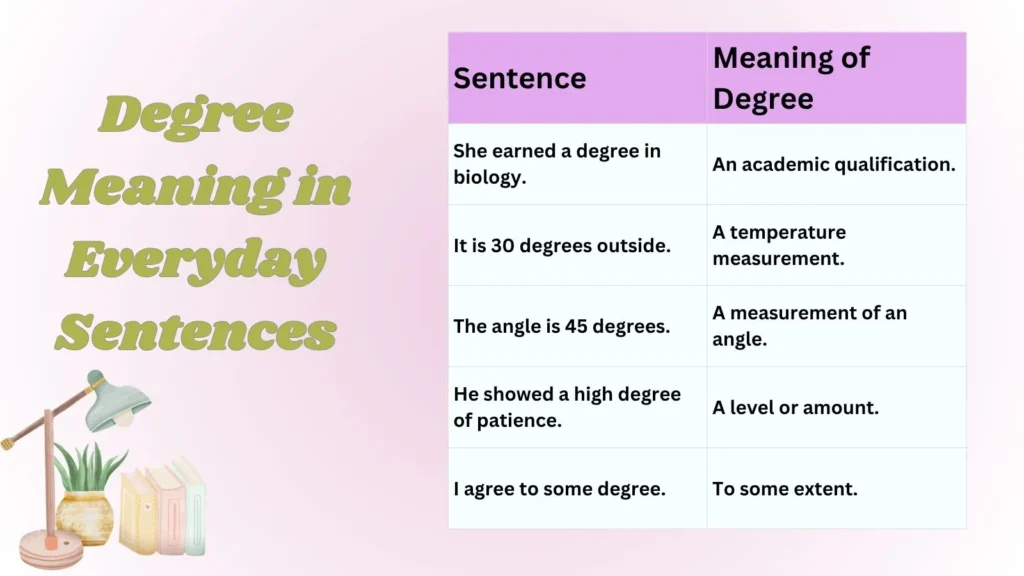
The word degree can appear in many ordinary conversations.
| Sentence | Meaning of Degree |
|---|---|
| She earned a degree in biology. | An academic qualification. |
| It is 30 degrees outside. | A temperature measurement. |
| The angle is 45 degrees. | A measurement of an angle. |
| He showed a high degree of patience. | A level or amount. |
| I agree to some degree. | To some extent. |
This demonstrates why context is important when understanding the degree meaning.
Degree vs Diploma
Degree and diploma are sometimes used as if they mean the same thing, but they are not necessarily identical.
A degree is generally an academic qualification awarded after completing a degree program at a college or university. A diploma is a different type of educational credential and can be awarded by various educational institutions depending on the country and program.
The exact distinction depends on the educational system.
For example, a student might complete a diploma program in a particular field without earning a university bachelor’s degree.
Therefore, it is useful to check the specific educational institution and country when comparing qualifications.
Degree vs Certificate
A certificate usually recognizes completion of a specific course, training program, or set of requirements. A degree generally represents a broader academic program and is often awarded by a university or college.
However, the exact requirements and terminology vary between institutions and countries.
In simple terms:
- Degree: Usually a broader academic qualification.
- Certificate: Usually recognition of completing a specific course or training.
- Diploma: A separate educational credential whose level and meaning depend on the education system.
Degree Meaning in Jobs and Careers
In career conversations, degree often refers to a person’s educational qualification.
For example:
- “What degree do you have?”
- “The position requires a bachelor’s degree.”
- “She has a master’s degree in finance.”
- “His degree is related to computer science.”
Employers may specify particular educational qualifications for certain positions. Whether a degree is required depends on the job, employer, profession, and local regulations.
People also discuss degrees when talking about career paths, postgraduate study, professional qualifications, and further education.
Degree Meaning in Weather Conversations
In weather conversations, degree usually refers to temperature.
For example:
“It will reach 40 degrees this afternoon.”
The scale matters because 40°C is very different from 40°F.
When the unit is not stated, the intended scale may be understood from the country, conversation, or surrounding information.
Degree Meaning in Science
In science, degree can appear in several technical contexts.
It can be used for temperature, angles, and other measurements or classifications. Scientists may also use degree-related terminology in mathematics, physics, engineering, and other technical fields.
The exact meaning should always be determined from the subject being discussed.
Synonyms of Degree
Because degree has multiple meanings, its synonyms depend heavily on context.
When Degree Means Level or Extent
- Extent
- Level
- Amount
- Intensity
- Magnitude
- Measure
When Degree Means Academic Qualification
There is not always a perfect synonym for an academic degree, but related terms can include:
- Qualification
- Academic credential
- Academic qualification
- University qualification
When Degree Means an Angle Measurement
In mathematics, degree is a specific unit rather than a word that can always be replaced by a general synonym.
Antonyms of Degree
There is no single direct antonym for degree because the word has several unrelated meanings.
For the meaning of extent or level, words such as absence, lack, or zero may sometimes express an opposite idea, depending on the sentence.
For an academic degree, there is no straightforward antonym. The same is true when degree refers to temperature or an angle.
Common Phrases With Degree
Here are some common expressions containing the word:
- University degree: An academic qualification.
- Bachelor’s degree: An undergraduate academic qualification.
- Master’s degree: A postgraduate academic qualification.
- Degree program: A structured course of university or college study.
- To some degree: To some extent.
- To a certain degree: To a certain extent.
- High degree: A high level or amount.
- Degree of difficulty: The level of difficulty.
- Degrees Celsius: A temperature measurement using the Celsius scale.
- Degrees Fahrenheit: A temperature measurement using the Fahrenheit scale.
How to Understand the Meaning of Degree in Context
When you see the word degree, look at the words around it.
If you see words such as university, college, bachelor’s, master’s, study, major, or graduation, degree probably refers to education.
If you see Celsius, Fahrenheit, weather, hot, cold, temperature, or outside, it probably refers to temperature.
If you see angle, circle, rotation, triangle, geometry, or 90°, it probably refers to an angular measurement.
If you see extent, level, amount, difficulty, confidence, or severity, it may refer to the degree or intensity of something.
| Context | Likely Meaning |
|---|---|
| University | Academic qualification |
| Weather | Temperature |
| Geometry | Angle measurement |
| General description | Level or extent |
Common Mistakes About the Word Degree

1. Assuming Degree Always Means Education
The word degree has several meanings. It can refer to temperature, angles, levels, and academic qualifications.
2. Confusing a Degree With a Major
A major is an area of academic specialization within a degree program. The terms are related, but they are not necessarily interchangeable.
3. Forgetting the Temperature Scale
Saying “30 degrees” without specifying Celsius or Fahrenheit can be unclear in international contexts. The scale can significantly change the meaning.
4. Thinking Degree Always Means a University Qualification
When someone says “90 degrees,” they are almost certainly talking about an angle, not an academic qualification.
5. Confusing Degree With Diploma
A degree and diploma are different types of educational credentials. Their exact distinctions depend on the education system and institution.
FAQs:
What does degree mean in simple English?
Degree can mean an academic qualification, a unit of temperature, a unit for measuring angles, or a level or extent of something.
What does degree mean in education?
In education, a degree is a formal academic qualification awarded after completing a specific program of study, commonly at a college or university.
What does degree mean in temperature?
In temperature, a degree is a unit used with scales such as Celsius and Fahrenheit to describe how hot or cold something is.
What does degree mean in mathematics?
In mathematics, degree can refer to the measurement of an angle. It can also describe the highest power of a variable in a polynomial.
What does “to some degree” mean?
“To some degree” means to some extent or partly. It indicates that something is true or applies to a limited extent rather than completely.
Conclusion:
The degree meaning depends on the context in which the word is used. In education, a degree is an academic qualification. In weather, it is a unit used to describe temperature. In geometry, it measures angles, while in general English, it can describe the level or extent of something.
Understanding the surrounding words makes the intended meaning much easier to identify. Whether you are reading about a university qualification, checking the temperature, studying mathematics, or describing the intensity of something, degree is a flexible word with several important meanings.
In short, the meaning of degree is best understood by looking at the context. 🎓🌡️📐

I am Henry James and i am a passionate writer and language enthusiast behind PunPalace, a platform dedicated to exploring meanings, word origins, and simple explanations. My aims to make learning vocabulary easy, engaging, and accessible for everyone.