Creativity means the ability to think of new ideas, make something original, or find fresh ways to solve problems. It involves using imagination, curiosity, knowledge, and flexible thinking to produce ideas or results that are different, useful, expressive, or meaningful.
In simple English, the creativity meaning is the ability to come up with new and interesting ideas.
Creativity can appear in art, music, writing, business, science, technology, cooking, fashion, education, relationships, and everyday problem-solving. You do not have to be an artist to be creative.
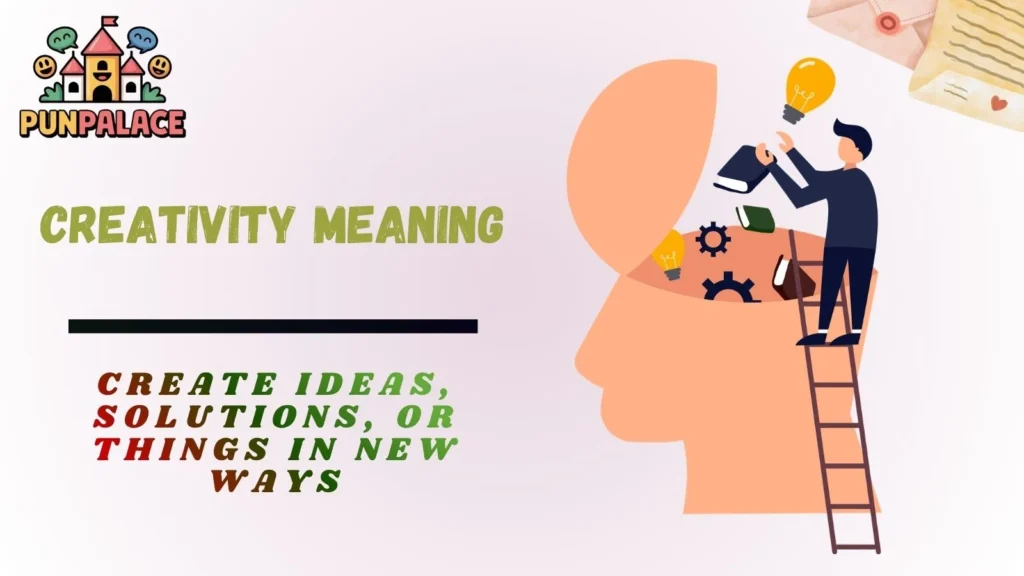
Simple definition: Creativity is the ability to use imagination and original thinking to create ideas, solutions, or things in new ways.
For example, a painter may use creativity to create a unique picture. A scientist may use creativity to develop a new approach to a problem. A student may use creativity to present a school project in an unusual way.
Creativity Meaning in Simple English

If you are looking for the creativity meaning in simple English, you can understand it as “thinking in new ways.”
| Term | Simple Meaning | Example |
|---|---|---|
| Creativity | Ability to produce new ideas | Creating an original design |
| Creative | Having or showing creativity | She is a creative writer |
| Imagination | Ability to form ideas or pictures in your mind | Imagining a new story |
| Innovation | Introducing a new idea or method | Developing a new product |
| Originality | Being new or different | An original concept |
Creativity is not simply about making something beautiful. It can also mean finding a clever solution, connecting unrelated ideas, or looking at an ordinary situation from a different perspective.
What Is Creativity?
Creativity is a mental and practical ability that allows people to move beyond familiar patterns and explore possibilities.
When you use creativity, you may:
- Generate new ideas
- Imagine different possibilities
- Solve problems in unusual ways
- Combine existing ideas into something new
- Express emotions or experiences
- Experiment with different approaches
- Find alternative solutions
- Create art, stories, music, or designs
Interestingly, creativity does not always require inventing something that has never existed before. A person can be creative by combining familiar ideas in an unexpected way.
For example, a chef might combine traditional ingredients using a new cooking method. The ingredients may be familiar, but the final result can still demonstrate creativity.
Creativity Examples in Everyday Life
Creativity is present in everyday activities, even when people do not label them as creative.
Consider these examples:
- A parent inventing a fun game to teach a child.
- A student creating an unusual presentation for a project.
- A cook modifying a recipe based on available ingredients.
- A designer developing a fresh logo concept.
- A writer creating an original character.
- A business owner finding a new way to serve customers.
- A teacher explaining a difficult concept through a story.
- A photographer finding an unusual angle for a familiar subject.
- A programmer developing an alternative solution to a technical problem.
- A person rearranging furniture to make a small room more functional.
These examples show that creativity is not limited to traditional artistic activities.
Why Is Creativity Important?
Creativity is important because it helps people adapt, solve problems, communicate ideas, and create new possibilities.
In personal life, creativity can make ordinary activities more enjoyable. At work, it can help teams discover better approaches to challenges.
Creativity is particularly useful when there is no obvious answer to a problem.
For example, if a business has fewer resources than expected, simply repeating an old strategy may not solve the problem. Creative thinking can encourage people to consider alternative methods.
Creativity can also support:
- Problem-solving
- Communication
- Innovation
- Learning
- Adaptability
- Self-expression
- Decision-making
- Collaboration
Types of Creativity
Creativity can take many forms. Different fields require different kinds of creative thinking.
Artistic Creativity
Artistic creativity involves expressing ideas, emotions, or experiences through visual art, music, dance, photography, sculpture, and other creative forms.
Writing Creativity
Writers use creativity to develop stories, characters, descriptions, poems, articles, and original ways of communicating ideas.
Scientific Creativity
Scientists also need creativity. Developing a hypothesis, designing an experiment, or interpreting an unexpected result can require original thinking.
Business Creativity
Businesses use creativity when developing products, marketing campaigns, customer experiences, branding strategies, or new ways of working.
Technical Creativity
Engineers and programmers can use creativity to solve technical problems and develop new systems, tools, or methods.
Social Creativity
Social creativity involves finding new ways to communicate, cooperate, organize activities, or build relationships.
Creative Thinking Meaning
Creative thinking means approaching a question, task, or problem from different angles instead of automatically relying on the most familiar solution.
Creative thinking may involve asking:
- What else could work?
- Can these two ideas be combined?
- What happens if I change the usual process?
- Is there another way to look at this?
- What would happen if the normal limitation disappeared?
- Can a simple solution work better?
This type of thinking is useful in both professional and personal situations.
For example, if a student finds a textbook explanation difficult, creative thinking might lead them to turn the concept into a diagram, story, analogy, or practical example.
Creativity in Education
Creativity plays an important role in learning. Students can use creative thinking to understand difficult concepts, remember information, and communicate what they have learned.
Teachers can encourage creativity through activities such as:
- Open-ended questions
- Storytelling
- Creative writing
- Art projects
- Experiments
- Problem-solving activities
- Group brainstorming
- Role-playing
- Project-based learning
Creativity does not mean that students should ignore facts or rules. Instead, it can help them use knowledge in flexible and meaningful ways.
Creativity vs Imagination
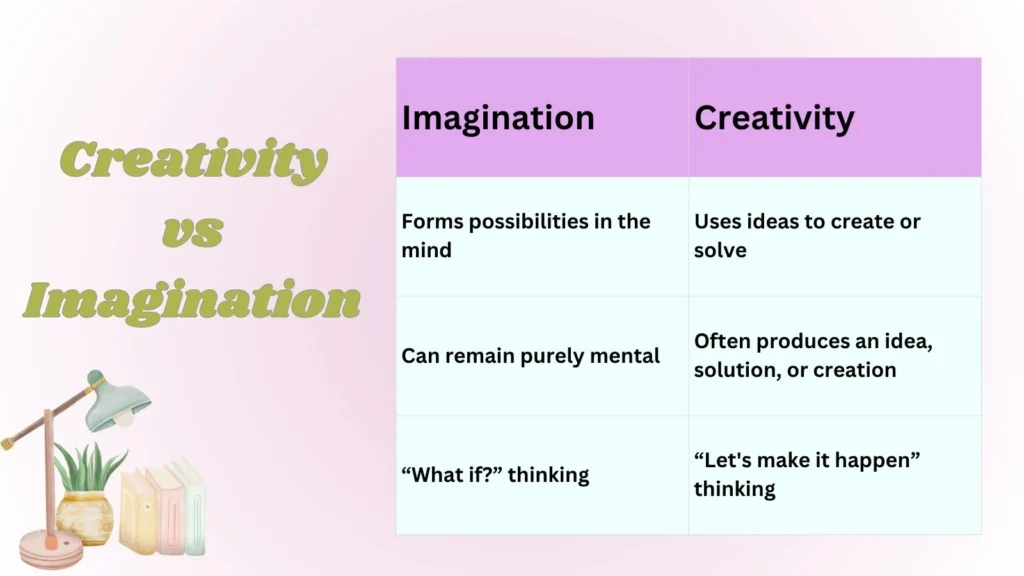
Creativity and imagination are closely connected, but they are not exactly the same.
Imagination is the ability to form ideas, images, or possibilities in your mind. Creativity involves using those ideas to produce something new, useful, expressive, or meaningful.
| Imagination | Creativity |
|---|---|
| Forms possibilities in the mind | Uses ideas to create or solve |
| Can remain purely mental | Often produces an idea, solution, or creation |
| “What if?” thinking | “Let’s make it happen” thinking |
For example, imagining a flying car is imagination. Designing a concept for how that car might work combines imagination with creative thinking.
Creativity vs Innovation
People often use creativity and innovation as if they mean the same thing, but there is a useful distinction.
Creativity is mainly about generating original ideas. Innovation often involves applying new ideas in a practical way to create value or improvement.
For example, someone may creatively imagine a new type of educational app. Turning that idea into a working product and introducing it to users involves innovation.
A simple way to remember the difference is:
Creativity generates possibilities; innovation puts useful possibilities into practice.
Creativity in the Workplace
Modern workplaces often rely on creativity to improve products, services, processes, and communication.
A creative employee might:
- Suggest a faster workflow.
- Develop a new marketing concept.
- Find a simpler way to explain a complicated process.
- Create a better customer experience.
- Identify an overlooked solution.
- Combine existing tools in a new way.
Creative workplaces often encourage employees to suggest ideas, test possibilities, and learn from unsuccessful attempts.
However, creativity does not mean that every idea will work. Creative thinking naturally involves experimentation and revision.
Can Creativity Be Learned?
Many people assume that creativity is something you either have or do not have. In reality, creative abilities can be developed and practiced.
People can encourage creative thinking by regularly exposing themselves to new experiences, asking questions, experimenting, and practicing activities that require flexible thinking.
Helpful habits can include:
- Reading widely
- Learning new skills
- Trying unfamiliar activities
- Writing down ideas
- Brainstorming without immediate judgment
- Asking open-ended questions
- Studying how other people solve problems
- Taking breaks when stuck
- Experimenting with different approaches
- Reflecting on what worked and what did not
Creativity can grow when people give themselves room to explore rather than expecting every idea to be perfect immediately.
What Is a Creative Person?
A creative person is someone who frequently uses original or flexible thinking to create, communicate, experiment, or solve problems.
Creative people may show qualities such as:
- Curiosity
- Open-mindedness
- Imagination
- Flexibility
- Persistence
- Willingness to experiment
- Observation
- Questioning
However, there is no single personality type that defines creativity. Someone can be quiet, outgoing, highly organized, spontaneous, analytical, or artistic and still be creative.
Creativity in Art and Design
Art and design are among the most obvious places to see creativity.
Artists use creativity to explore color, shape, composition, texture, sound, movement, and emotion. Designers use it to make products, websites, buildings, clothing, packaging, and visual identities functional as well as appealing.
A designer does not necessarily need to invent a completely new visual element. Creativity can also involve combining familiar elements in a fresh and effective way.
For example, a website may use familiar navigation principles but present them in a particularly clear and engaging layout.
Creativity in Problem-Solving
One of the most practical forms of creativity is creative problem-solving.
Suppose a small business needs to reach more customers but has a limited advertising budget. A conventional approach might involve spending more money on traditional advertising. A creative approach might explore partnerships, educational content, referral systems, community events, or other low-cost possibilities.
The creative process often involves:
- Understanding the problem
- Generating multiple ideas
- Exploring different perspectives
- Evaluating possible solutions
- Testing an idea
- Improving the solution
The goal is not simply to be unusual. The goal is to find a solution that is original and useful for the situation.
Creativity Synonyms
Several words are related to the creativity meaning, although they are not perfect synonyms in every context.
- Originality
- Imagination
- Inventiveness
- Ingenuity
- Innovation
- Resourcefulness
- Inspiration
- Artistry
- Vision
- Expressiveness
Inventiveness emphasizes the ability to create new things or ideas. Ingenuity often emphasizes clever problem-solving. Originality focuses on being new or different.
Creativity Antonyms
There is no single perfect opposite of creativity, but several words can describe a lack of creative or flexible thinking.
- Imaginationlessness
- Unoriginality
- Conformity
- Rigidity
- Repetition
- Inflexibility
- Conventionality
The correct opposite depends on the context. For example, rigidity describes an unwillingness to consider alternatives, while unoriginality describes a lack of originality.
Creativity Meaning in Relationships and Everyday Life
Creativity is not restricted to school or work. People can use it in relationships and ordinary daily situations.
For example, someone might creatively plan a birthday celebration, find a thoughtful way to apologize, create a personalized gift, or invent a fun family activity.
Creative communication can also help people express feelings that are difficult to explain directly.
A handwritten note, drawing, song, thoughtful message, or personalized gesture can communicate something in a way that ordinary words may not.
This shows that creativity can be both practical and emotional.
Creativity and Curiosity
Curiosity and creativity often work together. When people are curious, they ask questions and explore possibilities instead of accepting everything as obvious.
Questions such as “Why does this work this way?” or “Could there be another way?” can lead to creative ideas.
Curiosity encourages exploration, while creativity helps transform exploration into ideas, solutions, or creations.
Creativity and Failure
Creative work does not always produce successful results on the first attempt.
An idea may need several revisions before it becomes useful. A painting may change during the process. A business concept may need testing. A story may require multiple drafts.
Therefore, failure or an unsuccessful attempt does not necessarily mean creativity has failed. Experimentation can provide information that helps improve the next version.
This is why creative processes often involve testing, feedback, revision, and persistence.
Creativity Meaning in Texting and Social Media
If you see creativity in a text, caption, comment, or social media post, it normally has its standard English meaning: the ability to produce original ideas or express something in an imaginative way.
For example:
“I love your creativity!”
This means:
“I like the originality and imagination you used.”
Someone might compliment another person by saying:
- “Your creativity is amazing.”
- “I love your creative ideas.”
- “That took a lot of creativity.”
- “She has so much creativity.”
In social media conversations, creativity may refer to art, editing, photography, fashion, writing, videos, business ideas, or simply an unusual way of presenting something.
Creativity in a Sentence
Here are several natural examples showing how to use creativity correctly:
- Her creativity makes every project unique.
- The teacher encouraged students to use their creativity.
- This job requires both technical skills and creativity.
- His creativity helped solve the problem.
- The designer is known for her creativity.
- Children often express creativity through play.
- The campaign was praised for its creativity.
- Music gives him a way to express his creativity.
- The team used creativity to overcome limited resources.
- Travel can inspire creativity by exposing people to new experiences.
Common Mistakes About Creativity

1. Thinking Creativity Only Means Art
Creativity is much broader than painting, music, or writing. It can also involve science, business, technology, teaching, cooking, and everyday problem-solving.
2. Assuming Creative People Are Born Creative
People may have different natural interests and abilities, but creative thinking can also be practiced and developed.
3. Confusing Creativity With Imagination
Imagination involves forming possibilities in the mind. Creativity often involves using those possibilities to produce ideas, solutions, or creations.
4. Assuming Every Creative Idea Must Be Completely New
Creativity can involve combining existing ideas in a new way. Originality does not always mean creating something from nothing.
5. Thinking Creativity Must Always Be Useful
Some forms of creativity are primarily expressive or artistic. Other forms focus on practical problem-solving. Creativity can serve different purposes.
6. Believing Creativity Requires Expensive Tools
Creativity does not depend on expensive equipment. A notebook, pencil, conversation, simple materials, or even a new way of thinking can be enough to begin.
FAQs:
What does creativity mean in simple words?
Creativity means the ability to think of new ideas, create original things, or find different solutions to problems. It involves imagination, flexibility, and original thinking.
What is an example of creativity?
Creating an original painting, developing a new recipe, finding a clever solution to a problem, writing a unique story, or designing a new product can all be examples of creativity.
What is the difference between creativity and imagination?
Imagination involves forming ideas or possibilities in your mind, while creativity often involves using those ideas to create, communicate, or solve something.
Is creativity a skill?
Creativity can be considered an ability that people can practice and develop. Activities such as brainstorming, experimenting, learning, and exploring new perspectives can encourage creative thinking.
What is the opposite of creativity?
There is no single exact opposite, but words such as unoriginality, rigidity, inflexibility, and conformity can describe qualities that contrast with creative thinking.
Final Thoughts:
The creativity meaning is the ability to generate new ideas, express yourself in original ways, and find fresh solutions to problems. It is not limited to artists or naturally talented people.
Creativity can appear in classrooms, workplaces, laboratories, kitchens, businesses, relationships, and everyday decisions. Sometimes it produces a beautiful painting or an entertaining story. Other times, it produces something much simpler, such as a clever way to solve an ordinary problem.
The most important idea to remember is that creativity is about possibilities. It encourages people to ask questions, explore alternatives, connect ideas, experiment, and improve what already exists. 🌟

I am Henry James and i am a passionate writer and language enthusiast behind PunPalace, a platform dedicated to exploring meanings, word origins, and simple explanations. My aims to make learning vocabulary easy, engaging, and accessible for everyone.