
Have you ever noticed someone who performs far better than everyone else, a business that earns unusually high profits, or a number that looks completely different from the rest of a dataset? These unusual people, events, or values are often described as outliers.
The word outliers can appear in statistics, business, education, science, psychology, and everyday conversations. Although its exact meaning depends on the context, it generally refers to people or things that differ significantly from the usual pattern or from the majority of a group.
For example, imagine that five students receive test scores of 72, 75, 78, 80, and 98. The score of 98 is noticeably higher than the others. Depending on the context and the distribution of scores, it might be considered an outlier.
Similarly, a person who achieves extraordinary success in a highly competitive field may be described as an outlier because their results are unusual compared with those of their peers.
Understanding the outliers meaning can help you interpret data, recognize unusual patterns, and understand how people use the word in everyday English.
In this guide, you will learn the definition of outliers, their meaning in statistics, different types, real-life examples, synonyms, common mistakes, and the difference between outliers and anomalies.
What Is the Meaning of Outliers?
Outliers are people, objects, observations, or values that differ noticeably from the rest of a group or dataset.
The word is the plural form of outlier. An outlier stands apart from the typical pattern because it is unusually high, unusually low, or different in another important way.
In statistics, outliers are observations that are unusually distant from the other values in a dataset. In everyday English, the term can describe someone or something that does not fit the usual pattern.
Outliers Meaning in Simple Words
In simple English, outliers are things that stand out because they are different from the rest.
For example:
- A student who scores much higher than the rest of the class may be an outlier.
- A house that sells for far more than similar houses in the neighborhood may be an outlier.
- A company that grows much faster than other companies in its industry may be an outlier.
- A number that is much larger or smaller than the other numbers in a dataset may be an outlier.
However, being different does not automatically make something an outlier. The difference must be meaningful in the particular context.
For example, if most students score between 85 and 100 and one student scores 82, that score may not be unusual enough to qualify as an outlier.
Outlier Definition
A simple definition of outlier is:
Outlier: A person, observation, or value that differs significantly from what is typical or expected in a group.
The plural form, outliers, refers to two or more such people, observations, or values.
Outliers can occur for many reasons. They may represent genuine unusual events, exceptional performance, natural variation, measurement errors, or mistakes in data collection.
Their meaning therefore depends on the information being examined.
What Does Outliers Mean in Statistics?
In statistics, outliers are data points that lie unusually far from the other observations in a dataset.
They are important because they can affect calculations, influence statistical models, and reveal information that might otherwise be overlooked.
Consider the following test scores:
72, 74, 75, 77, 78, 99
Most scores fall between 72 and 78, while 99 is considerably higher. The score of 99 may be an outlier, although the conclusion depends on the size and distribution of the full dataset and the method used to identify unusual values.
Why Are Outliers Important in Statistics?
Outliers can affect several common statistical measures.
1. Mean
The mean is the average of all values. An unusually high or low observation can pull the mean toward itself.
For example, the numbers 10, 12, 13, 15, and 50 have a mean of 20. The value 50 raises the average above most of the individual observations.
2. Median
The median is the middle value when the data is arranged in order. It is generally less affected by extreme values than the mean.
For the numbers 10, 12, 13, 15, and 50, the median is 13.
3. Range
The range is the difference between the highest and lowest values. A single extreme value can make the range much larger.
4. Statistical models
Some statistical methods are sensitive to extreme observations. An outlier can influence the estimated relationship between variables or reduce a model’s predictive accuracy.
5. Data interpretation
Outliers can reveal errors, unusual behavior, rare events, or important discoveries. Investigating them may lead to a better understanding of the data.
It is important not to remove outliers automatically. First, determine whether they are errors or valid observations that provide useful information.
Examples of Outliers in Real Life
Outliers are not limited to mathematics or scientific research. They can occur anywhere people compare observations, results, or behavior.
Here are several examples that make the meaning easier to understand.
1. Outliers in Education
Imagine a class where most students score between 60 and 80 on a test. One student scores 100.
That score may be an outlier because it is noticeably higher than the other results.
However, the student may have studied more effectively, understood the material exceptionally well, or benefited from prior knowledge. The unusual score does not necessarily indicate an error.
2. Outliers in Business
Suppose five small businesses earn approximately $20,000 to $30,000 in monthly revenue, while one earns $250,000.
The higher-revenue business may be an outlier compared with the others.
Possible reasons include a larger customer base, a unique product, a more effective marketing strategy, or a different business model.
3. Outliers in Salaries
Imagine a company where most employees earn between $40,000 and $70,000 annually, while one executive earns $500,000.
The executive’s salary may be an outlier within the salary distribution.
However, it may be appropriate for the person’s role and responsibilities. The observation is unusual relative to the group, but that does not necessarily mean it is incorrect.
4. Outliers in Weather
Suppose the usual summer temperature in a region is between 28°C and 34°C, but one day reaches 43°C.
That temperature may be an outlier relative to the region’s usual daily temperatures.
It could reflect an extreme heat event or unusual weather conditions.
5. Outliers in Sports
If a basketball player usually scores between 10 and 20 points per game but scores 55 points in one game, that performance may be an outlier compared with their typical results.
The unusually high score could reflect exceptional performance, additional playing time, or other circumstances.
6. Outliers in Shopping Prices
Imagine that similar smartphones usually sell for $300 to $400, but one listing offers the same model for $1,500.
The listing is an outlier compared with the other prices.
It might be an error, a collector’s listing, a bundled offer, or a misleading advertisement. More information is needed before deciding why the price is unusual.
Types of Outliers
Outliers can be classified in different ways depending on the field and the method used to study them. The following categories explain several common types.
1. Univariate Outliers
A univariate outlier is an unusual value in a single variable.
For example, if you examine the ages of people in a group and most are between 20 and 40, an age of 95 may be an outlier depending on the population and circumstances.
Only one variable is being considered.
2. Multivariate Outliers
A multivariate outlier is an observation that appears unusual when two or more variables are considered together.
For example, a person may have an ordinary height and an ordinary weight when examined separately. However, their combination of measurements might be unusual compared with the relationship observed in the wider population.
Multivariate outliers are often more difficult to identify because the unusual pattern may not be visible in any single variable.
3. Global Outliers
A global outlier is an observation that differs substantially from the overall dataset.
For example, if nearly all transactions in a dataset are between $5 and $200, a transaction worth $50,000 may be a global outlier.
4. Contextual Outliers
A contextual outlier is unusual in a particular context but may be normal in another.
For example, a temperature of 35°C may be common in a hot summer climate but unusual in a region where temperatures rarely rise above 20°C.
The surrounding conditions determine whether the observation is considered unusual.
5. Collective Outliers
A collective outlier occurs when a group of observations forms an unusual pattern, even if individual observations do not appear unusual on their own.
For example, a computer system may normally send a small number of network requests every minute. A sudden sequence of requests following an unusual pattern could indicate suspicious activity.
The pattern as a whole may be more important than any single request.
How to Identify Outliers in a Dataset
There are several ways to identify potential outliers. The most appropriate method depends on the type of data, the number of observations, and the purpose of the analysis.
1. Visual Inspection
A simple way to begin is to examine the data using a graph.
A scatter plot can show observations that lie far from the main cluster. A histogram can reveal values that are separated from the main distribution. A box plot can highlight unusually high or low observations.
Visual inspection is useful for exploring data, but it may not be sufficient for large or complex datasets.
2. The Interquartile Range Method
The interquartile range, commonly called IQR, measures the spread of the middle 50% of the data.
It is calculated as:
IQR = Q3 − Q1
Here, Q1 is the first quartile, and Q3 is the third quartile.
A common rule identifies potential outliers as values below:
Q1 − 1.5 × IQR
or above:
Q3 + 1.5 × IQR
Values outside these limits are flagged for investigation. They are not automatically errors or values that must be removed.
For example, if Q1 is 10 and Q3 is 20, then the IQR is 10. The lower fence is −5, and the upper fence is 35. Values below −5 or above 35 would be flagged as potential outliers under this rule.
3. The Z-Score Method
A z-score describes how many standard deviations a value is from the mean.
The formula is:
z = (x − μ) / σ
Where:
- x is the observed value.
- μ is the mean.
- σ is the standard deviation.
In some situations, values with an absolute z-score greater than 3 are investigated as potential outliers. This is a rule of thumb, not a universal test, and it works best under appropriate distributional assumptions.
4. Comparing Values With Domain Knowledge
Statistical methods should be combined with an understanding of the subject.
For example, a temperature reading of 120°C might be impossible for a person’s ordinary body temperature but entirely reasonable in an industrial process.
The same number can be an error in one dataset and a valid observation in another.
5. Checking Data Quality
An unusual value may result from a typing error, a faulty sensor, an incorrect unit, or a data-entry problem.
Before changing or removing it, check the original record and the method used to collect the information.
Outliers vs. Exceptions
An outlier is different from an exception, although the two concepts can sometimes describe the same situation.
An outlier differs significantly from a group or statistical pattern. An exception is a person, case, or situation that does not follow a general rule or usual expectation.
For example, a student whose score is much higher than the rest of the class may be an outlier in the test results.
If a school normally requires every student to take an examination but grants one student an exemption, that student is an exception to the rule.
The key distinction is that an outlier is identified by its difference from a pattern, while an exception is identified by its departure from a rule or expectation.
What Does Outliers Mean in Everyday English?
In everyday English, outliers describes people or things that do not fit the usual pattern.
The word can be used in conversations about talent, success, behavior, performance, business, or social groups.
Outliers as People
Someone may be described as an outlier if their achievements, experiences, abilities, or behavior differ significantly from those of others in a comparable group.
For example:
“She is an outlier in her industry because she achieved remarkable success at a very young age.”
This means her achievements are unusual compared with those of other people in the same industry.
Outliers as Unusual Situations
The word can also describe events or circumstances that differ from what normally happens.
Example:
That unusually cold day was an outlier in an otherwise warm month.
The day was different from the general weather pattern.
Outliers as Unusual Results
In business or performance discussions, an outlier may refer to a result that is much better or worse than expected.
Example:
“The campaign’s unusually high conversion rate made it an outlier among our recent marketing campaigns.”
Here, the campaign performed differently from the others.
Outliers vs. Anomalies: What Is the Difference?
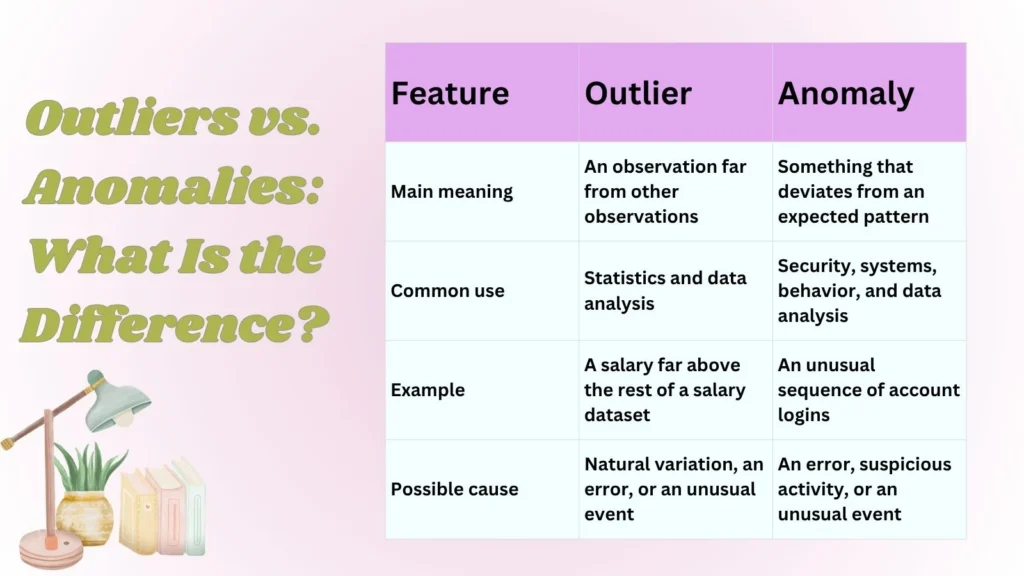
The words outlier and anomaly are related, and their meanings sometimes overlap. However, they are not always used in exactly the same way.
An outlier is an observation that differs substantially from the other values in a dataset.
| Feature | Outlier | Anomaly |
|---|---|---|
| Main meaning | An observation far from other observations | Something that deviates from an expected pattern |
| Common use | Statistics and data analysis | Security, systems, behavior, and data analysis |
| Example | A salary far above the rest of a salary dataset | An unusual sequence of account logins |
| Possible cause | Natural variation, an error, or an unusual event | An error, suspicious activity, or an unusual event |
For example, an unusually high payment may be an outlier in a transaction dataset. If that payment also breaks a pattern of normal account behavior, it may be investigated as an anomaly.
The terms can overlap, but being statistically unusual does not automatically mean something is suspicious or harmful.
What Does Outliers Mean in Business and Data Analysis?
In business, outliers can reveal both opportunities and problems.
A company might examine sales figures, customer behavior, website traffic, product prices, or employee performance to understand why some observations differ from the norm.
Positive Outliers
A positive outlier is an observation that is unusually high or favorable relative to the comparison group.
Examples include:
- A marketing campaign that produces far more sales than expected.
- A product that receives substantially more customer interest than similar products.
- A branch that achieves unusually high customer satisfaction.
- A website page that attracts much more traffic than other pages.
Investigating positive outliers can help businesses discover successful strategies and decide whether those strategies can be repeated.
Negative Outliers
A negative outlier is an observation that is unusually low or unfavorable.
Examples include:
- A store that experiences a sudden drop in sales.
- A product with an unusually high return rate.
- A website page that receives very little traffic compared with similar pages.
- A manufacturing batch with an unusually high defect rate.
These observations may point to technical problems, changing customer preferences, quality issues, or other factors worth investigating.
It is important to understand the reasons behind an outlier before making business decisions. A single unusually good result may be temporary, and a single poor result may reflect circumstances that are unlikely to recur.
Outliers Meaning in Psychology and Human Behavior
In psychology and discussions of human behavior, an outlier is someone or something that differs substantially from the typical pattern observed in a group.
For example, a person may demonstrate unusually strong memory skills, an uncommon response to a particular situation, or a pattern of behavior that differs from the wider group.
However, unusual behavior does not automatically indicate a psychological disorder or a problem. People vary naturally in their abilities, preferences, experiences, and responses.
Psychologists consider context, measurement methods, relevant research, and other information before drawing conclusions about an individual’s behavior.
Similarly, an unusual test score alone does not establish a diagnosis. It may indicate a need for additional assessment, or it may simply reflect a person’s distinctive strengths or circumstances.
Outliers Meaning in Research and Science
Outliers play an important role in scientific research because they can reveal unexpected results.
Researchers often collect observations from experiments, surveys, laboratory tests, and field studies. Some observations may differ considerably from the majority.
An unusual result might occur because of measurement error, an uncontrolled variable, a rare event, or a genuine scientific discovery.
For example, if researchers measure plant growth under similar conditions and one plant grows much taller than the others, that result may warrant further investigation.
Scientists do not necessarily discard the observation. Instead, they may repeat the experiment, inspect the equipment, review the procedure, or investigate whether the plant has a distinctive characteristic.
This approach helps prevent misleading conclusions and allows researchers to distinguish errors from meaningful findings.
Synonyms of Outliers
Several words have meanings similar to outliers, but the best substitute depends on the context.
| Synonym | Meaning | Example |
|---|---|---|
| Exceptions | Cases that differ from a rule or usual pattern | There were two exceptions to the general rule. |
| Anomalies | Deviations from an expected pattern | The report revealed several anomalies. |
| Irregularities | Things that do not follow the normal pattern | Investigators reviewed the irregularities. |
| Extremes | Values at the high or low ends | The analysis included the extreme values. |
| Deviations | Differences from a standard or expected value | The researcher examined the deviations. |
| Oddities | Unusual or unexpected things | The collection contained several oddities. |
| Unusual cases | Situations that are not typical | The doctor reviewed the unusual cases. |
These synonyms are not always interchangeable. For instance, extreme values may refer specifically to values near the ends of a distribution, while anomalies often suggests a deviation from an expected pattern.
Antonyms of Outliers
There is no single perfect antonym for outliers, but several terms express the opposite idea.
- Typical values: Values that represent what is usual in a dataset.
- Average observations: Observations that are near the average, although not necessarily equal to it.
- Norms: Standards or patterns that are commonly observed.
- Common cases: Situations that occur frequently or follow the usual pattern.
- Typical examples: Examples that represent the ordinary characteristics of a group.
For example, if a dataset contains several outliers and many typical observations, the typical observations follow the general pattern more closely.
Remember that an observation does not have to equal the mean or median to be typical. A value can differ from the average without being an outlier.
Common Mistakes When Using the Word Outliers

Learning the meaning of outliers also involves understanding what the word does not necessarily imply.
1. Assuming Every Unusual Value Is an Outlier
A value that looks different may not be statistically unusual when the entire dataset is considered.
For example, a score of 90 may seem high in one class but perfectly ordinary in another.
Better approach: Compare the value with the distribution and context of the data before labeling it an outlier.
2. Assuming Outliers Are Always Errors
An outlier may result from a data-entry mistake, but it can also be a valid observation.
For example, an unusually high sale might reflect a genuine large order rather than an error.
Better approach: Investigate the observation before deciding whether to correct or remove it.
3. Confusing Outliers With Anomalies in Every Context
The two terms overlap, but their meanings can differ depending on the field.
Better approach: Use outlier when emphasizing a value’s difference from other observations and anomaly when emphasizing a departure from an expected pattern.
4. Believing All Outliers Should Be Removed
Removing unusual observations without investigation can distort the results and hide important information.
Better approach: Determine why the observation is unusual and whether it should remain in the analysis.
5. Using Outlier as a Synonym for Failure
An outlier is not necessarily bad. It may represent exceptional success, a valuable discovery, or a rare but legitimate event.
Better approach: Describe the observation neutrally until you understand what caused the difference.
FAQs:
1. What does outliers mean in simple words?
Outliers are people, things, or data values that differ significantly from the rest of a group. They stand out because they do not follow the usual pattern.
2. What is the singular form of outliers?
The singular form is outlier. For example, “One outlier affected the dataset” refers to a single unusual observation, while “Several outliers affected the dataset” refers to more than one.
3. What does outliers mean in statistics?
In statistics, outliers are observations that lie unusually far from other values in a dataset. They may affect calculations and can represent errors, natural variation, or important unusual events.
4. What is an example of an outlier?
If five people earn $30,000, $32,000, $34,000, $35,000, and $200,000 annually, the $200,000 salary may be an outlier compared with the other salaries. Whether it qualifies statistically depends on the full dataset and the method used.
5. Are outliers always bad?
No. Outliers can be positive, negative, or neutral. An unusually successful business campaign is a positive example, while an unusually high product defect rate may be a negative example.
6. What is the difference between an outlier and an anomaly?
An outlier is a value that differs substantially from other observations. An anomaly is something that deviates from an expected pattern or behavior. The terms sometimes overlap, particularly in data analysis.
7. What is the opposite of outliers?
Possible contrasting terms include typical values, common cases, and ordinary observations. The best choice depends on whether you are discussing statistics, behavior, or everyday situations.
8. How do you identify outliers?
Outliers can be identified using graphs, the interquartile range method, z-scores, or subject-specific knowledge. The appropriate method depends on the dataset and the purpose of the analysis.
9. What does outlier mean when describing a person?
When describing a person, outlier means someone whose abilities, achievements, experiences, or behavior differ significantly from those of a comparable group.
10. Can an outlier affect the average?
Yes. An unusually high or low value can pull the mean toward it. The median is generally less sensitive to extreme observations, which is why analysts may examine both measures.
Conclusion:
The word outliers refers to people, observations, or values that differ significantly from the rest of a group. In statistics, outliers are unusual data points that may affect calculations or reveal important information. In everyday English, the term can describe exceptional individuals, unusual events, or results that do not follow the typical pattern.
Outliers are not always errors or negative findings. They can represent exceptional performance, natural variation, rare events, or meaningful discoveries. Their importance depends on the context and the reason they differ from other observations.
The key takeaway is simple: an outlier is something that stands apart from what is typical. By understanding the context, examining the evidence, and investigating unusual observations carefully, you can use the term more accurately in statistics, business, research, and everyday conversations.

I am Henry James and i am a passionate writer and language enthusiast behind PunPalace, a platform dedicated to exploring meanings, word origins, and simple explanations. My aims to make learning vocabulary easy, engaging, and accessible for everyone.