People do not always agree. Sometimes a small disagreement turns into an argument, emotions become stronger, and two or more people start speaking angrily to each other. This is where the word quarreling comes in.
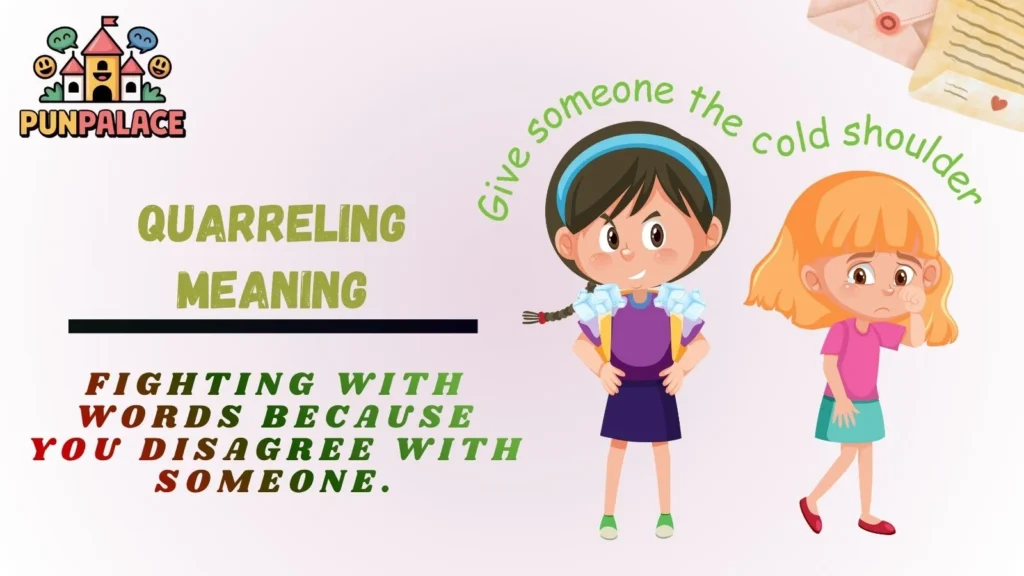
The quarreling meaning is simple: it refers to arguing or fighting verbally with someone, usually because of a disagreement. It can describe anything from a minor argument between friends to repeated conflicts between family members, coworkers, or partners.
For example, if two friends are angry with each other and keep arguing about what happened, you can say, “They are quarreling.”
But what exactly does quarreling mean? Is it always serious? How is it different from arguing, fighting, debating, or disagreeing? Let’s explore the word in detail.
What Does Quarreling Mean?
Quarreling means having an argument or disagreement with another person, especially in an angry or unpleasant way.
In simple English, quarreling means fighting with words because you disagree with someone.
The word usually suggests that the disagreement has become emotional or unfriendly. Two people might raise their voices, accuse each other, complain, or refuse to agree.
Quarreling means arguing angrily or repeatedly with someone over a disagreement.
For example:
- “The children were quarreling over a toy.”
- “The couple was quarreling about money.”
- “The neighbors are constantly quarreling.”
In each sentence, the people involved are having a disagreement that has developed into an argument or conflict.
Quarreling Meaning in Simple English
If you want the easiest explanation, think of quarreling as arguing with someone in an angry or unpleasant way.
Imagine two siblings both want to use the same television. One wants to watch a movie, while the other wants to watch a sports game. They start complaining, shouting, and blaming each other.
You could say:
“The siblings were quarreling over what to watch.”
Quarreling does not necessarily mean physical fighting. Most often, it refers to verbal conflict.
Quarreling Definition
The word quarreling is the present participle form of the verb quarrel. To quarrel means to argue or disagree angrily with someone.
| Word | Meaning | Example |
|---|---|---|
| Quarrel | An argument or angry disagreement | They had a quarrel. |
| Quarrel | To argue angrily | They often quarrel. |
| Quarreling | The act of arguing or disagreeing | They are quarreling. |
| Quarreled | Past form of quarrel | They quarreled yesterday. |
So, quarreling describes the action that is happening.
What Is an Example of Quarreling?
A simple example of quarreling is when two people have a disagreement and begin arguing angrily.
For instance, imagine two coworkers disagreeing about who was responsible for a mistake. Instead of calmly discussing the issue, they start blaming one another and speaking angrily.
You could say:
“The two coworkers were quarreling over who made the mistake.”
Other examples include:
- Children quarreling over a toy.
- Friends quarreling about a misunderstanding.
- Neighbors quarreling about noise.
- Family members quarreling over an inheritance.
- Partners quarreling about household responsibilities.
- Students quarreling over whose turn it is.
The common idea is a disagreement that becomes an argument.
Quarreling in a Relationship
When people talk about quarreling in a relationship, they usually mean repeated arguments or conflicts between romantic partners.
Couples can quarrel about many everyday issues, such as:
- Money
- Household chores
- Communication
- Time spent together
- Family disagreements
- Plans and responsibilities
- Jealousy or misunderstandings
For example:
“They have been quarreling about their finances lately.”
Here, quarreling does not automatically mean that the relationship is ending. It simply describes an ongoing argument or disagreement.
The seriousness depends on the situation, the frequency of the arguments, and how the people involved communicate with each other.
Quarreling Between Friends
Friends can also quarrel when they disagree or misunderstand one another.
For example, one friend might feel ignored because another friend canceled plans. If the issue turns into an angry argument, the friends may be described as quarreling.
You might hear:
“They stopped talking after quarreling over a misunderstanding.”
In casual situations, the word may sound somewhat more formal than simply saying “They were arguing.”
Quarreling Between Family Members
Family members can quarrel over both small and serious matters.
For example:
- “The brothers were quarreling over the car.”
- “The children were quarreling about who should go first.”
- “The relatives have been quarreling over the property.”
The word is particularly useful when the disagreement continues for some time.
Someone might say:
“The family has spent years quarreling over the issue.”
This suggests that the conflict is not just a one-time disagreement.
Quarreling vs Fighting
Another common confusion is between quarreling and fighting.
Quarreling usually refers to verbal conflict. Fighting can refer to verbal conflict, but it can also mean physical conflict.
For example:
- “The couple was quarreling about money.”
- “The two men were fighting.”
The first sentence strongly suggests an argument. The second sentence could mean an argument or a physical fight depending on context.
Therefore, calling something a quarrel does not automatically mean that anyone became physically violent.
Quarreling vs Disagreeing
Disagreeing is much broader and often less emotional than quarreling.
People can disagree politely without arguing.
For example:
“I disagree with your opinion, but I understand your point.”
This is a disagreement, but it is not necessarily a quarrel.
When disagreement becomes angry, personal, or hostile, quarreling becomes a more appropriate description.
Quarreling Synonyms
Several words can have a similar meaning to quarreling, although each has its own shade of meaning.
- Arguing — disagreeing verbally.
- Fighting — engaging in conflict, verbally or physically.
- Disputing — disagreeing about an issue.
- Feuding — having a prolonged conflict.
- Clashing — strongly disagreeing or conflicting.
- Bickering — arguing about small or unimportant things.
- Squabbling — arguing over minor matters.
- Wrangling — engaging in a difficult dispute or argument.
- Fussing — complaining or arguing, often about something relatively minor.
Bickering and squabbling are especially useful when the argument is petty or repetitive.
Quarreling vs Arguing
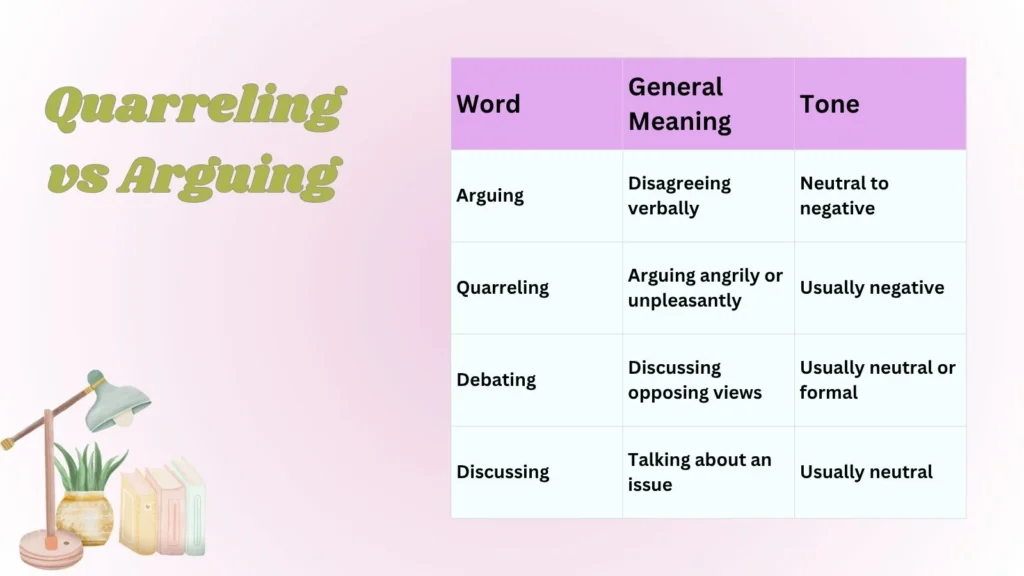
Quarreling and arguing are closely related, but they can have slightly different tones.
Arguing is a broad word. It can describe a disagreement between people, and it does not always sound extremely hostile.
Quarreling often suggests a more personal, emotional, or unpleasant disagreement.
| Word | General Meaning | Tone |
|---|---|---|
| Arguing | Disagreeing verbally | Neutral to negative |
| Quarreling | Arguing angrily or unpleasantly | Usually negative |
| Debating | Discussing opposing views | Usually neutral or formal |
| Discussing | Talking about an issue | Usually neutral |
For example, two politicians may debate a policy, while two neighbors may be quarreling about a fence.
Quarreling Antonyms
Words with opposite meanings can include:
- Agreeing
- Cooperating
- Compromising
- Harmonizing
- Peace
- Reconciling
- Understanding
For example, if two people stop quarreling and reach an agreement, they may be described as reconciling or making peace.
Quarreling in a Sentence
Here are several natural sentence examples showing how the word works in different contexts.
- The children were quarreling over the last piece of cake.
- Why are you two always quarreling?
- The neighbors were quarreling about the loud music.
- They spent the afternoon quarreling about money.
- The siblings were quarreling over who would use the computer first.
- She dislikes quarreling with her friends.
- The couple stopped quarreling after they talked things through.
- The employees were quarreling over the schedule.
- The two teams were quarreling about the decision.
- Constant quarreling can make communication difficult.
What Does “Stop Quarreling” Mean?
The phrase “stop quarreling” means to stop arguing or fighting verbally.
For example:
“Please stop quarreling and try to solve the problem calmly.”
A parent might say this to children who are arguing over a toy. A teacher might use it when students are having a heated disagreement.
The phrase usually communicates a request for peaceful communication.
What Does “Constantly Quarreling” Mean?
“Constantly quarreling” means arguing very frequently or repeatedly.
For example:
“The two brothers are constantly quarreling.”
This means the brothers argue so often that it has become a noticeable pattern.
The phrase can be used for couples, families, friends, coworkers, neighbors, or even groups and organizations.
What Does “Quarreling Over” Mean?
The phrase “quarreling over” identifies the subject of an argument.
For example:
- Quarreling over money
- Quarreling over property
- Quarreling over a toy
- Quarreling over a decision
- Quarreling over responsibilities
So, if someone says, “They are quarreling over the house,” it means they are arguing about the house or something related to it.
Is Quarreling a Negative Word?
Yes, quarreling usually has a negative meaning because it suggests an unpleasant argument or conflict.
However, the word itself does not tell you exactly how serious the situation is.
Two children may quarrel over a game for five minutes and then become friends again. On the other hand, adults may quarrel over a serious issue for years.
Context determines the seriousness.
Can Quarreling Be Playful?
Sometimes, yes. People can use language associated with quarreling in a playful or exaggerated way.
For example, two close friends might jokingly argue about which movie is better.
“We spent ten minutes quarreling over which superhero was the best.”
Here, quarreling may be used humorously rather than to describe a serious conflict.
The surrounding context and tone tell you whether the disagreement is genuinely hostile or simply playful.
Quarreling in Literature and Writing
The word quarreling is common in stories and descriptive writing because it can create a clear picture of conflict between characters.
A writer might say:
“The siblings spent the morning quarreling over their father’s old car.”
This tells readers more than simply saying “They talked.” It suggests tension, disagreement, and emotional conflict.
Writers can also use the word to describe groups that have ongoing disputes:
“The two families had been quarreling for generations.”
This creates a sense of a long-running feud.
Quarreling in Everyday Conversation
Although quarrel and quarreling are common English words, they can sometimes sound slightly more formal or literary than argue and arguing.
In everyday conversation, someone is more likely to say:
“Why are you arguing?”
rather than:
“Why are you quarreling?”
However, quarreling is completely natural English and is often used when describing repeated or unpleasant conflicts.
Quarreling Meaning in Texting and Social Media
Quarreling is not a special texting abbreviation or internet slang term. If someone uses the word in a text message, it generally keeps its standard English meaning: arguing or having a disagreement.
For example:
- “Why are you guys quarreling again?”
- “I’m tired of quarreling with everyone.”
- “They were quarreling all night.”
On social media, the word can also be used humorously to describe people arguing in comments.
For example:
“Everyone in the comments is quarreling about which phone is better.”
Here, the word simply describes the online disagreement.
Quarreling vs Bickering
Bickering and quarreling are similar, but bickering often suggests arguments about small, repetitive issues.
| Word | Typical Meaning | Example |
|---|---|---|
| Quarreling | Arguing angrily or unpleasantly | They were quarreling about money. |
| Bickering | Arguing repeatedly about small things | The children were bickering over the game. |
| Feuding | Maintaining a long-term conflict | The families have been feuding for years. |
Therefore, bickering often sounds less serious than a major quarrel, although both words describe conflict.
Why Do People Quarrel?
People can quarrel for countless reasons. Sometimes the issue is important, while other times the argument begins because of a small misunderstanding.
Common causes include:
- Miscommunication
- Different opinions
- Money disagreements
- Jealousy
- Competition
- Unmet expectations
- Personal boundaries
- Household responsibilities
- Stress
- Misunderstandings
Sometimes the original problem is small, but frustration from previous disagreements makes the quarrel more intense.
How to Understand Quarreling From Context
If you encounter the word quarreling in a sentence and are unsure what it means, look at the words around it.
Words such as angry, disagreement, fight, argument, blame, shouting, conflict, over, and again can provide clues.
For example:
“The neighbors were quarreling over the noise.”
The phrase “over the noise” tells you what caused the disagreement.
Similarly:
“The children stopped quarreling after their mother intervened.”
The phrase “stopped” indicates that an argument had been happening.
Common Mistakes With Quarreling
Confusing Quarreling With Physical Fighting
Quarreling usually refers to an argument or verbal disagreement. It does not automatically mean physical violence.
Thinking Quarreling Means Any Disagreement
Not every disagreement is a quarrel. People can disagree politely. Quarreling generally suggests a more heated, angry, or unpleasant interaction.
Confusing Quarreling With Debating
A debate can involve opposing opinions without personal hostility. Quarreling usually carries a stronger sense of conflict.
Using Quarreling When You Mean Bickering
Both words can describe arguments, but bickering often refers to repeated arguments about relatively minor matters.
Assuming Quarreling Always Means a Serious Relationship Problem
People can quarrel over something small and resolve the issue quickly. The word alone does not tell you whether a relationship is seriously damaged.
Forgetting the Correct Spelling
The correct spelling is quarreling. In British English, quarrelling with a double “l” is also commonly used. The spelling difference follows broader American and British spelling conventions.
Frequently Asked Questions About Quarreling Meaning
What is the simple meaning of quarreling?
Quarreling means arguing or having an angry disagreement with someone. It usually refers to verbal conflict.
Is quarreling the same as arguing?
They are very similar. Arguing is a broader term, while quarreling often suggests a more emotional, unpleasant, or personal disagreement.
What does quarreling with someone mean?
“Quarreling with someone” means arguing or having a conflict with that person, usually because you disagree about something.
What does quarreling over something mean?
“Quarreling over something” means arguing about a particular subject, such as money, property, responsibilities, or a decision.
Is quarreling a negative word?
Yes. Quarreling generally has a negative tone because it suggests an unpleasant disagreement or argument.
What is another word for quarreling?
Common alternatives include arguing, bickering, squabbling, disputing, clashing, feuding, and wrangling. The best choice depends on the situation.
What is the difference between quarreling and fighting?
Quarreling generally describes verbal disagreement, while fighting can refer to verbal arguments or physical conflict depending on context.
Can friends be quarreling?
Yes. Friends can quarrel when they have disagreements, misunderstandings, or conflicts. The word does not imply that they will necessarily stop being friends.
Final Thoughts:
The quarreling meaning is straightforward: it describes arguing or having an angry disagreement with someone. It can happen between friends, family members, couples, coworkers, neighbors, or other groups.
The word is closely related to arguing, bickering, squabbling, disputing, and fighting, but each term has a slightly different tone. In most situations, quarreling suggests that a disagreement has become unpleasant or emotional.
Understanding the context is the key to understanding the word correctly. A small disagreement between children and a long-running dispute between families can both involve quarreling, but the seriousness may be very different.
In short, when people are quarreling, they are not simply exchanging different opinions. They are generally engaged in some form of argument or conflict.

I am Henry James and i am a passionate writer and language enthusiast behind PunPalace, a platform dedicated to exploring meanings, word origins, and simple explanations. My aims to make learning vocabulary easy, engaging, and accessible for everyone.