
Have you ever wondered how scientists describe a process where the outcome involves randomness and probability? The word stochastic is commonly used for exactly this kind of situation.
The stochastic meaning refers to something that involves a random or probabilistic element. Instead of having one completely predictable outcome, a stochastic process can produce different outcomes depending on chance.
You may encounter the word in mathematics, statistics, science, economics, finance, computer science, engineering, and everyday discussions about uncertainty. Although it sounds technical, its basic idea is quite simple.
In this guide, we will explain what stochastic means, where the word is used, how it differs from deterministic, and how to understand stochastic examples in simple English.
What Does Stochastic Mean?
Stochastic describes something that involves randomness, probability, or outcomes that cannot be predicted with complete certainty.
In simple terms, if a process is stochastic, chance plays a role in what happens next.
Simple definition: Stochastic means involving random behavior or probability, where future outcomes cannot be known with complete certainty.
For example, the exact result of rolling a fair die cannot be predicted before the roll. You know the possible outcomes, but you do not know which number will appear.
That is the basic idea behind stochastic behavior.
Stochastic Meaning in Simple English

If you want to understand the word without technical language, think of “random but governed by probability.”
A stochastic situation does not mean that absolutely anything can happen. Instead, there are usually known possible outcomes and probabilities associated with them.
- Stochastic = involving chance
- Stochastic = probabilistic
- Stochastic = partly random
- Stochastic = uncertain in outcome
For example, weather forecasting is not perfectly predictable. Scientists can estimate probabilities, but they cannot guarantee exactly what the weather will be at every moment far into the future.
Stochastic Definition
The formal stochastic definition depends slightly on the field, but the central idea remains the same: a stochastic system or process incorporates random variables or probabilistic behavior.
In mathematics and statistics, stochastic models use probability to represent uncertainty.
Instead of saying:
“This exact result will definitely happen.”
a stochastic model might say:
“These outcomes are possible, and each has a certain probability.”
This makes stochastic methods useful whenever uncertainty is an important part of a problem.
Stochastic Meaning in Statistics
In statistics, the word stochastic is connected to uncertainty and random variation.
Many real-world datasets contain variation that cannot be explained perfectly by a simple fixed rule. Statistical models can use random variables and probability distributions to represent that uncertainty.
For example, suppose you want to estimate how many customers will visit a store tomorrow.
You might know:
- The store’s average number of daily customers
- Typical busy periods
- Seasonal patterns
- Past customer data
Yet you still cannot know the exact number of visitors in advance.
A stochastic model can represent this uncertainty and estimate the probabilities of different customer counts.
Stochastic Meaning in Mathematics
In mathematics, stochastic usually refers to systems, variables, or processes involving probability.
Stochastic mathematics is particularly useful when randomness is part of the problem rather than something that can simply be ignored.
Common mathematical concepts include:
- Random variables
- Probability distributions
- Stochastic processes
- Markov processes
- Random walks
- Brownian motion
These concepts allow mathematicians to study systems where uncertainty plays a central role.
Stochastic Meaning in Finance
The word stochastic is especially common in finance.
Financial markets contain many uncertain factors. The future price of a stock, for example, cannot be known with certainty.
Financial researchers may therefore use stochastic models to represent possible changes in prices, interest rates, volatility, or other financial variables.
A stochastic financial model does not necessarily say:
“The stock will be exactly $100 tomorrow.”
Instead, it can describe a range of possible outcomes and assign probabilities or distributions to those outcomes.
This approach helps analysts study risk and uncertainty.
Stochastic Meaning in Economics
Economists also use stochastic models because economic systems involve uncertainty.
Factors such as consumer behavior, inflation, employment, investment, and market conditions can change unpredictably.
A stochastic economic model can therefore include random variables to represent uncertainty.
For example, economists might model how changes in interest rates could affect investment while accounting for uncertain future conditions.
This allows researchers to examine different possible scenarios rather than assuming that every variable will follow one perfectly predictable path.
Stochastic Meaning in Science
Scientists often encounter stochastic behavior in natural systems.
At microscopic scales, for example, some physical phenomena are naturally described using probability.
Stochastic models can also be used to study:
- Particle motion
- Biological populations
- Genetic variation
- Chemical reactions
- Epidemic models
- Environmental systems
In these situations, probability provides a useful way to represent uncertainty and variation.
Stochastic Meaning in Computer Science
In computer science, stochastic can describe algorithms, systems, or models that use randomness or probability.
A stochastic algorithm may deliberately introduce random choices as part of its operation.
Randomized algorithms can be useful because randomness may help solve certain problems efficiently or avoid predictable behavior.
Stochastic methods are also important in areas such as:
- Artificial intelligence
- Machine learning
- Optimization
- Simulation
- Robotics
- Data science
Stochastic Meaning in Machine Learning
The term stochastic appears frequently in machine learning.
One familiar example is stochastic gradient descent, commonly abbreviated as SGD.
Instead of calculating an update using an entire training dataset at every step, stochastic or mini-batch approaches use smaller samples to update model parameters.
The randomness introduced by selecting individual examples or batches can make the optimization process more dynamic and efficient.
Therefore, when you see the word “stochastic” in machine learning, it often points toward random sampling, probabilistic behavior, or uncertainty.
Stochastic vs Deterministic
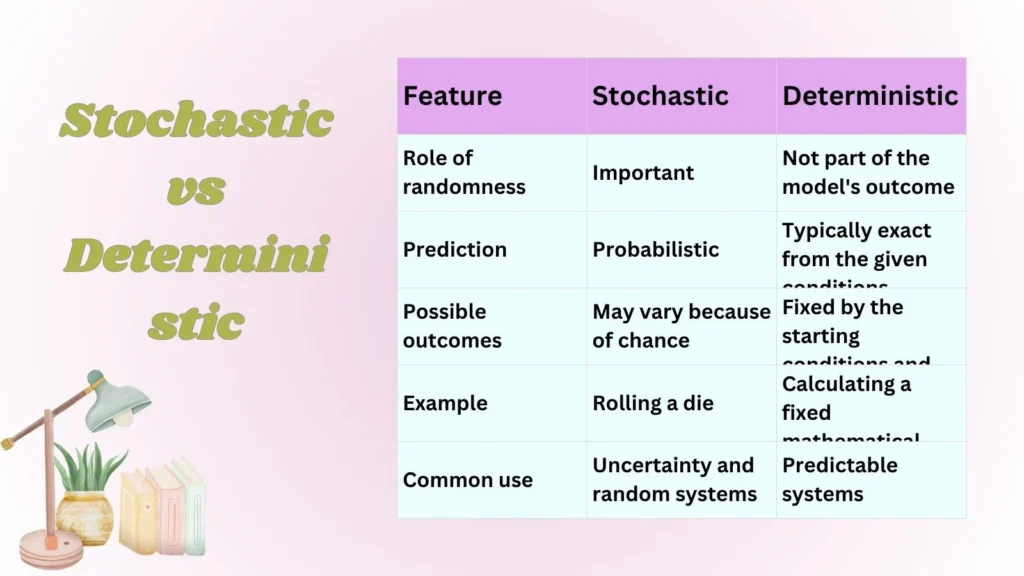
One of the easiest ways to understand stochastic is to compare it with deterministic.
| Feature | Stochastic | Deterministic |
|---|---|---|
| Role of randomness | Important | Not part of the model’s outcome |
| Prediction | Probabilistic | Typically exact from the given conditions |
| Possible outcomes | May vary because of chance | Fixed by the starting conditions and rules |
| Example | Rolling a die | Calculating a fixed mathematical expression |
| Common use | Uncertainty and random systems | Predictable systems |
For example, if you know that 2 + 2 = 4, there is no random element involved. That is deterministic.
If you roll a die, you know the possible results but cannot know the exact result beforehand. That is stochastic.
What Is a Stochastic Process?
A stochastic process is a mathematical model used to represent a system that changes over time while involving randomness.
Instead of studying only one fixed value, researchers examine a sequence or collection of random variables that represents how a system develops.
Examples can include models of:
- Stock prices
- Weather patterns
- Population changes
- Queueing systems
- Particle movement
- Financial markets
- Communication systems
The purpose is not necessarily to predict one exact future outcome. Instead, a stochastic model helps researchers understand possible outcomes and their probabilities.
Stochastic Examples in Everyday Life
You do not need to be a mathematician to understand stochastic behavior. Many everyday situations involve uncertainty.
Rolling a Die
You know that a standard die has six possible results, but you cannot know which number will appear before rolling it.
Traffic
You can estimate how long a journey usually takes, but unexpected traffic can change the actual travel time.
Customer Arrivals
A restaurant can estimate its average number of customers, but the exact number arriving each hour can vary.
Weather
Weather forecasts use probabilities because future atmospheric conditions contain uncertainty.
Financial Prices
Investors can analyze historical patterns, but future market prices remain uncertain.
These examples demonstrate the central idea behind the stochastic meaning: the future has uncertainty, and probability can help describe it.
Stochastic Example in a Sentence
Here are several natural examples showing how to use the word stochastic correctly:
- The researchers developed a stochastic model to study population growth.
- The financial analyst used a stochastic process to represent market uncertainty.
- Weather systems can be modeled using stochastic methods.
- The algorithm uses a stochastic approach to explore possible solutions.
- The study examined the stochastic variation in the data.
In each sentence, the word relates to randomness, probability, or uncertainty.
Stochastic Synonyms
There is no perfect synonym for stochastic in every technical context, but several words have related meanings.
- Random
- Probabilistic
- Uncertain
- Chance-based
- Variable
- Unpredictable
However, technical writing often uses “stochastic” because it conveys a more specific mathematical idea than simply saying something is random.
Stochastic vs Random
Stochastic and random are closely related, but they are not always interchangeable.
“Random” is a broad everyday word. It can describe anything that seems unpredictable or selected without a clear pattern.
“Stochastic” is more technical. It usually refers to a process, model, or system where probability and random variation are formally considered.
For example, saying “a random event” is common everyday language. Saying “a stochastic process” usually indicates a mathematical or scientific context.
Stochastic vs Probabilistic
Probabilistic and stochastic are also closely connected.
Probabilistic generally emphasizes the use of probabilities or probability distributions.
Stochastic often emphasizes a system or process that contains random variation over time or across outcomes.
In some contexts, the two words can be used similarly, but they are not always exact substitutes.
Is Stochastic a Positive or Negative Word?
Stochastic is neither inherently positive nor negative.
It is a descriptive technical term.
For example, a stochastic model can be useful when studying a complicated system. Randomness is not necessarily a flaw; sometimes it is simply a natural property of the system being studied.
The meaning depends on the context in which the word appears.
Why Is the Concept of Stochasticity Important?
Real life is rarely perfectly predictable.
People, markets, weather, biological systems, traffic, and many other systems contain uncertainty. A model that ignores randomness may sometimes provide an unrealistic picture of how a system behaves.
Stochastic methods allow researchers to ask useful questions such as:
- What outcomes are possible?
- How likely is each outcome?
- How much uncertainty exists?
- What happens over many repeated trials?
- How does randomness affect the system?
This makes stochastic thinking valuable across many scientific and practical fields.
Common Mistakes When Using Stochastic

Thinking Stochastic Means Completely Unpredictable
A stochastic process can still have patterns and probabilities. Randomness does not mean that absolutely anything can happen.
Assuming Stochastic Means Random Without Rules
Stochastic models often have well-defined probability distributions, rules, and structures.
Using Stochastic for Every Uncertain Situation
Not every uncertain situation is automatically a stochastic model. The term is most appropriate when probability or random variation is part of the system being described.
Confusing Stochastic With Deterministic
A deterministic system follows fixed rules from its starting conditions, while a stochastic system incorporates randomness or probabilistic variation.
Assuming Stochastic Has a Negative Meaning
Stochastic simply describes uncertainty or random behavior. It does not automatically mean something is bad, unreliable, or incorrect.
FAQs:
What does stochastic mean in simple English?
Stochastic means involving randomness or probability. A stochastic outcome cannot usually be predicted with complete certainty, although possible outcomes and their probabilities may be understood.
What is a stochastic process?
A stochastic process is a mathematical model for a system that changes over time while involving random variation or probability.
What is the opposite of stochastic?
In many contexts, deterministic is treated as the opposite or contrasting concept. A deterministic system has outcomes determined by its starting conditions and rules rather than random variation.
Is stochastic the same as random?
They are closely related, but stochastic is usually more technical. It often describes a process or model that formally incorporates randomness and probability.
Where is the word stochastic used?
The term is widely used in mathematics, statistics, finance, economics, physics, biology, engineering, computer science, machine learning, and other fields that deal with uncertainty.
Final Thoughts:
The stochastic meaning is easier to understand when you remember one simple idea: stochastic describes processes or systems in which randomness and probability play a role.
It does not mean that the outcome is completely chaotic or that nothing can be predicted. Instead, stochastic models often help us understand the range of possible outcomes and how likely they are.
From financial markets and weather systems to statistics, machine learning, and everyday events such as rolling a die, stochastic thinking helps explain situations where certainty is impossible.

I am Henry James and i am a passionate writer and language enthusiast behind PunPalace, a platform dedicated to exploring meanings, word origins, and simple explanations. My aims to make learning vocabulary easy, engaging, and accessible for everyone.