Have you ever heard someone say “the biggest,” “the fastest,” “the smartest,” or “the most beautiful”? These words are examples of the superlative form in English grammar. Understanding the superlative meaning can make it much easier to compare people, places, objects, experiences, and ideas.
In simple English, a superlative describes something as having the highest or lowest degree of a particular quality within a group. For example, in the sentence “Sara is the tallest student in the class,” the word tallest tells us that Sara has the greatest height among the students being compared.
The word can also have a broader meaning outside grammar. If someone calls something “superlative,” they may mean that it is extremely excellent, impressive, or outstanding. ⭐
What Does Superlative Mean?
The word superlative has two closely related meanings.
In grammar, a superlative is a form of an adjective or adverb used to show the highest or lowest degree of a quality among three or more people or things.
For example:
- small → smaller → smallest
- fast → faster → fastest
- beautiful → more beautiful → most beautiful
In general English, superlative can describe something that is exceptionally good or outstanding.
The superlative form shows that something has the greatest or least amount of a particular quality compared with others in a group.
Superlative Meaning in Simple English

If you want the easiest possible definition, think of superlative as meaning “the most” or “the least.”
For example:
- big → biggest = the most big in size
- small → smallest = the least big in size
- fast → fastest = faster than everyone or everything else in the comparison
- interesting → most interesting = having the highest level of interest
Usually, a superlative compares one person or thing with at least two others.
For example, if three restaurants are being compared, you might say:
“This is the best restaurant in the area.”
Here, best is a superlative because it identifies the restaurant with the highest level of quality within the comparison.
Superlative Definition at a Glance
| Term | Meaning | Example |
|---|---|---|
| Positive | Basic form of an adjective | tall |
| Comparative | Compares two things | taller |
| Superlative | Shows the highest or lowest degree in a group | tallest |
This three-level pattern is one of the most important ideas to remember when learning English adjectives.
What Is a Superlative in Grammar?
In English grammar, a superlative adjective describes a person or thing that has more of a quality than all the others in a particular group.
Consider these three sentences:
- Ali is tall.
- Ali is taller than Ahmed.
- Ali is the tallest student in the class.
The first sentence simply describes Ali. The second compares Ali with one other person. The third places Ali at the highest level of height within a group.
That final form is the superlative.
Comparative vs Superlative Meaning
A common source of confusion is the difference between comparative and superlative adjectives.
A comparative normally compares two people or things. A superlative normally identifies the highest or lowest degree among three or more.
| Form | Purpose | Example |
|---|---|---|
| Positive | Describes a quality | “This car is fast.” |
| Comparative | Compares two things | “This car is faster than that car.” |
| Superlative | Compares a group | “This is the fastest car here.” |
A simple memory trick is:
Comparative = compare.
Superlative = highest or lowest in a group.
How to Form Superlative Adjectives
English uses several patterns to form superlatives. The correct pattern often depends on the length and spelling of the adjective.
Short Adjectives
For many short adjectives, add -est.
- tall → tallest
- short → shortest
- fast → fastest
- long → longest
- small → smallest
These are common examples of one-syllable adjectives.
Adjectives Ending in E
If an adjective already ends in e, the usual form adds -st.
- large → largest
- nice → nicest
- wide → widest
- safe → safest
Adjectives Ending in Y
For adjectives ending in a consonant followed by y, the y commonly changes to i before adding -est.
- happy → happiest
- easy → easiest
- busy → busiest
- funny → funniest
Longer Adjectives
Longer adjectives commonly use most or least rather than adding -est.
- beautiful → most beautiful
- interesting → most interesting
- expensive → most expensive
- comfortable → most comfortable
For the opposite degree, use least.
- least expensive
- least interesting
- least comfortable
Superlative Examples in Sentences
The best way to understand superlative meaning is to see how these forms work in real sentences.
- “Mount Everest is one of the highest mountains in the world.”
- “She is the fastest runner on the team.”
- “This is the best movie I have seen this year.”
- “That was the most exciting match of the season.”
- “He chose the cheapest option available.”
- “Today is the hottest day of the week.”
- “This is the most comfortable chair in the room.”
- “She gave the funniest answer.”
- “That was the worst mistake in the entire project.”
- “This road is the longest route to the village.”
Notice that the superlative identifies an extreme position within a group or comparison.
Why Is “The” Often Used With Superlatives?
One important grammar rule is that superlative adjectives are often used with the article the.
For example:
- She is the tallest girl in the class.
- This is the most expensive phone here.
- He is the fastest player on the team.
The word the helps identify a specific person or thing as having the highest or lowest degree within the relevant group.
However, there are contexts where a superlative can appear without the, especially in certain fixed expressions or when the adjective functions differently. Therefore, “always use the” is a useful beginner rule, but not an absolute rule for every English sentence.
Irregular Superlative Forms
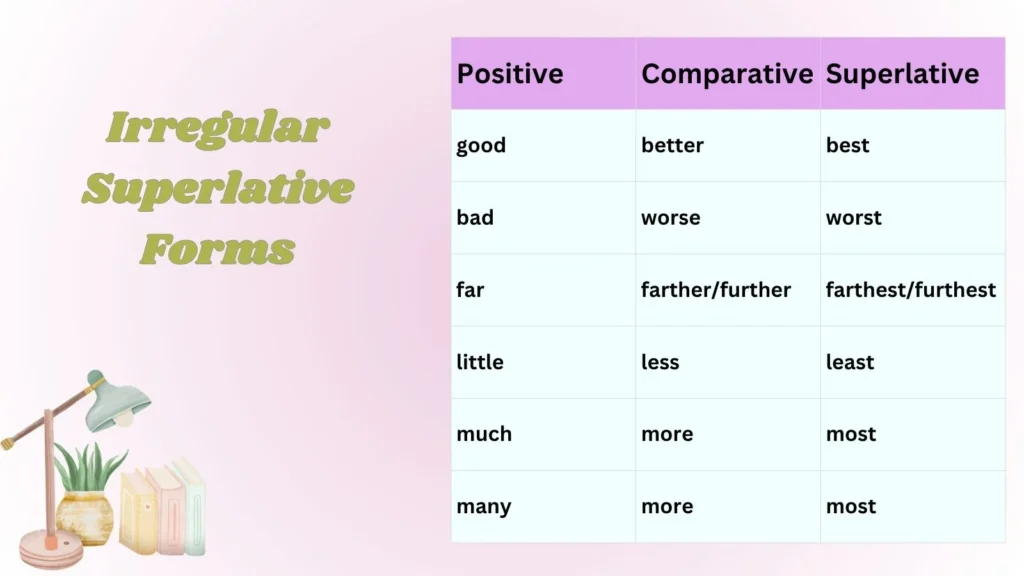
Some common adjectives do not follow the normal -est or most pattern. These are called irregular forms.
| Positive | Comparative | Superlative |
|---|---|---|
| good | better | best |
| bad | worse | worst |
| far | farther/further | farthest/furthest |
| little | less | least |
| much | more | most |
| many | more | most |
These forms are especially important because they cannot always be predicted simply by applying a standard ending.
Superlative Meaning With “Most” and “Least”
Many longer adjectives form their superlatives with most.
For example:
- beautiful → most beautiful
- important → most important
- successful → most successful
- dangerous → most dangerous
- popular → most popular
To express the lowest degree, use least:
- least important
- least expensive
- least popular
- least difficult
For example:
“This was the most interesting chapter in the book.”
Here, most interesting means it had the highest level of interest compared with the other chapters being considered.
Superlative Meaning in Everyday English
Superlatives are extremely common in everyday conversations.
People use them when talking about food, travel, sports, shopping, school, entertainment, weather, work, and personal experiences.
For example:
- “That was the best meal I’ve ever had.”
- “This is the cheapest store nearby.”
- “Friday was the busiest day at work.”
- “She is the kindest person I know.”
- “That is the most beautiful place I’ve visited.”
These expressions make comparisons clear and natural.
Superlative Meaning in Writing
Superlatives are also common in writing, especially when authors want to emphasize an extreme quality.
They appear in:
- News writing
- Reviews
- Advertisements
- Academic writing
- Personal essays
- Travel descriptions
- Product descriptions
- Sports reporting
For example, a product description might say:
“This model offers one of the most advanced features in its category.”
A review might say:
“The final scene was the most memorable part of the film.”
In both cases, the superlative creates a clear sense of comparison.
Superlative as a General English Word
Not every use of superlative is about grammar.
Outside grammatical terminology, superlative can mean something that is exceptionally good, excellent, or impressive.
For example:
“The chef received superlative reviews for the new restaurant.”
In this sentence, superlative means extremely favorable or outstanding.
This meaning is related to the grammatical meaning because both ideas involve being at an extreme or exceptionally high level.
Superlative Meaning in Reviews and Compliments
You may encounter the word superlative in formal reviews or descriptions.
For example:
- “The hotel received superlative praise.”
- “Her performance was superlative.”
- “The restaurant is known for its superlative service.”
Here, the word is being used as an adjective meaning excellent or outstanding.
This use is less common in casual conversation than grammatical uses such as best, biggest, or fastest.
Superlative Synonyms
The best synonym depends on how the word is being used.
When Superlative Refers to Grammar
- Highest degree
- Extreme form
- Maximum degree
- Highest comparison
When Superlative Means Excellent
- Outstanding
- Exceptional
- Excellent
- Remarkable
- Superior
- Extraordinary
Remember that these words are not perfect substitutes in every sentence.
Superlative vs Excellent
Superlative and excellent can sometimes have similar meanings, but they are not identical.
Excellent simply means very good or high in quality. Superlative can mean exceptionally excellent, but it also has a specific grammatical meaning.
For example:
“She gave an excellent performance.”
This means her performance was very good.
“She gave the best performance of the evening.”
This is a superlative comparison because her performance is being identified as the highest among the performances considered.
Superlative vs Comparative vs Positive Examples
Here is a quick reference that makes the three forms easier to remember:
| Positive | Comparative | Superlative |
|---|---|---|
| cold | colder | coldest |
| bright | brighter | brightest |
| small | smaller | smallest |
| happy | happier | happiest |
| beautiful | more beautiful | most beautiful |
| important | more important | most important |
| good | better | best |
| bad | worse | worst |
Common Mistakes With Superlatives

1. Using a Comparative Instead of a Superlative
Do not use a comparative form when you are identifying the highest degree within a group.
Incorrect: “She is the taller student in the class.”
Better: “She is the tallest student in the class.”
2. Using “Most” and “-est” Together
In standard English, avoid unnecessary combinations such as “most fastest” or “most tallest.”
Use:
- fastest, not most fastest
- tallest, not most tallest
- most beautiful, not beautifulest
3. Forgetting the Comparison Group
A superlative often makes the most sense when the relevant group is clear.
For example, “She is the tallest” may be grammatically understandable, but “She is the tallest student in the class” gives the reader clearer information.
4. Confusing “Best” With “Better”
Better is generally comparative, while best is superlative.
Example:
- “This phone is better than my old phone.”
- “This is the best phone in the group.”
5. Assuming Every Adjective Uses -Est
Long adjectives usually require most rather than -est.
For example, use most interesting, not “interestingest.”
How to Remember the Superlative Meaning
A simple memory trick can make the concept much easier:
Positive = describes.
Comparative = compares.
Superlative = selects the highest or lowest.
Imagine three runners:
- Runner A is fast.
- Runner B is faster than Runner A.
- Runner C is the fastest of the three.
The word fastest is the superlative because it identifies the highest level of speed in that group.
FAQs:
What does superlative mean in simple English?
Superlative means the highest or lowest degree of a quality when comparing something with others. Words such as biggest, fastest, best, and most beautiful are common superlative forms.
What is a superlative example?
“Maria is the tallest student in the class” is a superlative example. The word tallest shows that Maria has the greatest height within the group.
What is the difference between comparative and superlative?
A comparative generally compares two things, such as faster. A superlative identifies the highest or lowest degree within a group, such as fastest.
What are common superlative words?
Common examples include best, worst, biggest, smallest, fastest, slowest, happiest, easiest, most beautiful, and most important.
Can superlative mean excellent?
Yes. Outside grammar, superlative can mean exceptionally good, excellent, or outstanding. The exact meaning depends on the context.
Final Thoughts:
The superlative meaning is easy to understand once you remember that it expresses an extreme degree of a quality. In grammar, superlatives are used to identify the highest or lowest level among a group, with examples such as best, biggest, fastest, smallest, and most interesting.
The key difference is simple: the positive form describes, the comparative form compares, and the superlative form identifies the highest or lowest degree.
Outside grammar, superlative can also describe something exceptionally excellent or outstanding. So, whenever you encounter this word, look at the context to determine which meaning is intended.

I am Henry James and i am a passionate writer and language enthusiast behind PunPalace, a platform dedicated to exploring meanings, word origins, and simple explanations. My aims to make learning vocabulary easy, engaging, and accessible for everyone.