Have you ever wondered how skilled professionals from other countries get the opportunity to work in the United States? One of the most common answers is the H1B visa. This visa allows eligible U.S. employers to hire foreign professionals for certain jobs that require specialized knowledge.
Understanding the H1B visa meaning can help you learn how the U.S. work visa system operates, who qualifies, and what steps are involved in applying. Whether you are a student, a software engineer, a healthcare professional, or someone planning an international career, knowing the basics can help you make informed decisions.
In this guide, you will discover what an H1B visa is, its eligibility requirements, benefits, limitations, application process, and frequently asked questions. Let’s explore everything in simple English. 🇺🇸
What Is the H1B Visa Meaning?
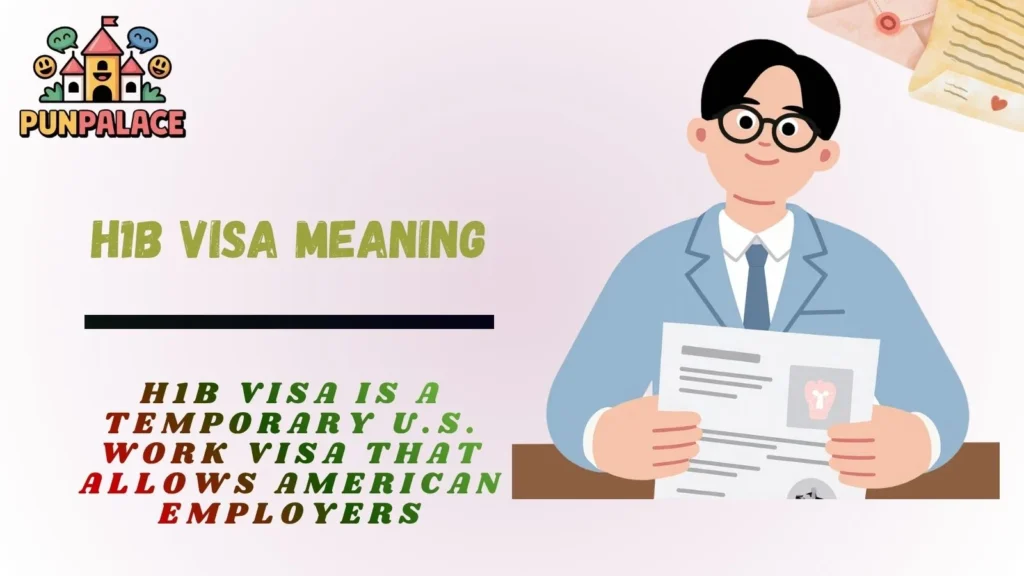
The H1B visa is a temporary U.S. work visa that allows American employers to employ qualified foreign workers in specialty occupations. These jobs generally require specialized knowledge and at least a bachelor’s degree or its equivalent in a directly related field.
For example, a U.S. technology company may want to hire a software engineer who has the education and skills required for a specialized position. If the job and worker meet the applicable requirements, the employer may be able to sponsor the worker for an H1B visa.
The H1B visa is not a general work permit that allows someone to accept any job in the United States. It is connected to an approved employment arrangement and specific immigration requirements.
Here is a simple explanation:
- H1B: A category of U.S. nonimmigrant work visa.
- Visa purpose: Employment in a qualifying specialty occupation.
- Employer involvement: A qualifying U.S. employer generally files the petition.
- Worker qualification: The applicant must meet the education, experience, licensing, and other requirements applicable to the position.
- Temporary status: The visa is generally temporary, although extensions and certain exceptions may apply.
In simple words, the H1B visa gives eligible professionals an opportunity to work in the United States for a qualifying employer under specific immigration rules.
What Does H1B Stand For?

H1B is the name of a U.S. nonimmigrant visa classification. The term does not represent an ordinary English phrase or a degree.
The letter and number identify a particular category within U.S. immigration law. The category is commonly associated with specialty occupations, including certain positions in technology, engineering, scientific research, finance, and other professional fields.
People also write it as H-1B, with a hyphen. Both H1B and H-1B commonly refer to the same visa category.
You may see these terms online:
- H1B visa
- H-1B work visa
- H1B work permit
- H1B sponsorship
- H1B visa lottery
- H1B visa petition
Although these expressions are related, they do not all mean the same thing. For example, H1B sponsorship refers to an employer’s role in the immigration process, while the H1B lottery refers to a selection process used when applicable registration demand exceeds the available cap.
Why Is the H1B Visa Important?
The H1B visa is important because it creates a legal route for eligible U.S. employers to recruit specialized professionals from other countries.
Many employers need workers with specific technical skills, advanced training, or professional expertise. When they cannot fill a qualifying position through their existing workforce, hiring an international professional may be an option.
The program can also provide career opportunities for foreign workers who want international experience.
Here are some reasons people pay attention to the H1B visa:
- Career opportunities: Eligible professionals may work for qualifying employers in the United States.
- Professional development: Workers may gain experience in international workplaces.
- Specialized employment: Employers can recruit workers with relevant expertise.
- Family possibilities: Certain spouses and unmarried children under 21 may qualify for H-4 dependent status.
- Potential long-term options: Some H1B workers may later pursue employment-based permanent residence if they and their employers qualify.
However, approval is not guaranteed. Applicants must meet the relevant legal requirements, and employers must follow the required procedures.
Who Is Eligible for an H1B Visa?
H1B eligibility depends on several factors, including the job, the applicant’s qualifications, the employer’s petition, and the applicable immigration rules.
A person does not qualify simply because they have a college degree or want to work in America.
1. You Must Have a Qualifying Job Offer
In most cases, you need a job offer from a U.S. employer willing and legally able to file an H1B petition on your behalf.
The position must meet the requirements for a specialty occupation. A general job offer is not enough if the actual position does not qualify.
2. The Job Must Be a Specialty Occupation
A specialty occupation generally requires the theoretical and practical application of specialized knowledge and a bachelor’s degree or higher in a directly related specific specialty, or its equivalent, as the minimum entry requirement under the applicable rules.
The job duties and educational requirements matter. A job title alone does not determine eligibility.
3. You Must Meet the Position’s Qualifications
You must possess the relevant qualifications for the job. Depending on the position, these may include:
- A bachelor’s degree or higher in a related specialty.
- A foreign degree equivalent to a qualifying U.S. degree.
- A combination of education and specialized experience that legally qualifies as equivalent.
- A required professional license, where applicable.
- Relevant skills or experience that match the position.
Not every applicant needs a degree from a U.S. university. Foreign qualifications may be accepted if they meet the applicable equivalency requirements.
4. Your Employer Must Complete the Required Process
The employer generally must complete the required Labor Condition Application process with the U.S. Department of Labor and file the H1B petition with U.S. Citizenship and Immigration Services, or USCIS.
The employer must meet the relevant wage and workplace obligations.
5. You Must Meet Applicable Immigration Requirements
Applicants must satisfy the requirements that apply to their individual circumstances. Depending on the case, this may involve consular visa processing, documentation, and admissibility requirements.
Meeting the basic education and job criteria does not automatically guarantee approval.
What Jobs Qualify for an H1B Visa?
H1B visas are commonly associated with professional positions that require specialized knowledge. However, eligibility depends on the actual duties and requirements of the position rather than simply the occupation’s name.
Some fields in which qualifying positions may exist include:
| Career field | Examples of possible positions |
|---|---|
| Information technology | Software engineer, systems analyst, certain cybersecurity specialists |
| Engineering | Electrical engineer, mechanical engineer, civil engineer |
| Healthcare | Certain specialized professional roles, subject to licensing and occupation requirements |
| Science | Research scientist, certain laboratory research positions |
| Finance | Certain financial analysts, quantitative specialists, and related professional roles |
| Education | Certain qualified teachers, researchers, and university positions |
| Business | Certain specialized business analysts and other qualifying professional roles |
| Architecture | Architect or related professional positions when the requirements are met |
Important: These are examples, not a guaranteed list of qualifying jobs. USCIS evaluates the particular position, its duties, its educational requirements, and the evidence submitted.
A position with a prestigious title may still fail to qualify if its actual requirements do not meet the specialty-occupation standard.
What Are the H1B Visa Requirements?
The H1B visa process involves requirements for both the employer and the worker. The precise documents and procedures can vary depending on the circumstances.
Employer Requirements
A sponsoring employer generally needs to:
- Offer a qualifying specialty-occupation position.
- Complete the applicable Labor Condition Application with the Department of Labor.
- Agree to comply with applicable wage and working-condition requirements.
- File the required H1B petition with USCIS.
- Provide evidence supporting the position and the worker’s qualifications.
- Pay the fees that the law requires the employer to pay.
Employers may have additional obligations depending on the type of organization, the worker’s situation, and current regulations.
Applicant Requirements
An applicant may need to provide:
- A valid passport.
- Educational certificates and transcripts.
- Degree equivalency documentation, when needed.
- Relevant professional licenses, if required.
- A résumé or curriculum vitae.
- Evidence of relevant work experience, where applicable.
- A copy of the job offer or employment information.
- The approved petition information needed for visa processing.
- Additional documents requested by the consulate or immigration authorities.
Not every applicant will need every document listed above. The appropriate checklist depends on the case.
Labor Condition Application
The Labor Condition Application, often called the LCA, is a key part of the process for many H1B petitions.
The employer submits it to the U.S. Department of Labor and makes required attestations concerning wages and working conditions. The process is intended to protect both U.S. workers and H1B employees.
An approved LCA is not the same as an approved H1B petition. The employer must still complete the applicable USCIS filing process.
How Does the H1B Visa Application Process Work?
The H1B application process usually involves several stages. The exact steps depend on whether the case is subject to the annual cap, whether an employer is cap-exempt, and whether the worker is applying for a visa abroad or changing status inside the United States.
Step 1: Find a Qualifying U.S. Employer
The first step is to find a U.S. employer that offers a suitable position and is willing to sponsor an H1B petition.
You can search for jobs in your field, review employer requirements, and prepare a professional résumé. Employers may consider your education, skills, experience, and ability to perform the role.
Remember that not every company sponsors H1B workers, and not every position qualifies.
Step 2: The Employer Evaluates Your Qualifications
The employer determines whether the position and your qualifications meet the relevant requirements.
The employer may review your degree, work experience, certifications, and other supporting information.
If your degree was awarded outside the United States, an equivalency evaluation may be helpful or necessary depending on the circumstances.
Step 3: The Employer Files the Labor Condition Application
For many H1B cases, the employer must submit an LCA to the Department of Labor.
The LCA addresses specified employment conditions, including the applicable wage obligations and other required attestations.
The employer must follow the rules associated with the LCA and the subsequent petition.
Step 4: Complete Registration if Required
Many H1B petitions that are subject to the annual cap require an electronic registration process before the employer can file a petition.
When registrations exceed the available cap, USCIS uses the applicable selection process. Selection generally allows an employer to proceed with filing; it does not guarantee that the petition will be approved.
Some petitions, including qualifying cap-exempt cases, may follow different procedures.
Step 5: The Employer Files the H1B Petition
After completing the required preliminary steps, the employer files the H1B petition with USCIS.
The petition includes information about the job, the employer, and the worker’s qualifications, along with the required forms, supporting evidence, and fees.
USCIS reviews the petition and may approve it, deny it, or request additional evidence.
Step 6: Complete Visa Processing if Needed
If you are outside the United States and need an H1B visa to travel for employment, you generally must complete the applicable U.S. consular visa application process after the petition is approved.
This may include completing the required application form, paying the applicable fee, attending an interview when required, and providing supporting documents.
If you are already in the United States, the case may instead involve a change of status or extension of status, depending on your circumstances.
Step 7: Begin Employment Under the Approved Conditions
After the required approval and immigration processing, you may begin or continue employment as authorized.
You must follow the conditions of your H1B status, including the rules governing your employment and any required updates if your work situation changes.
Remember: A job offer, registration selection, petition approval, visa issuance, and permission to remain in the United States are different things. Each has its own legal significance.
What Is the H1B Visa Lottery?
The H1B visa lottery is a common name for the selection process used when registrations for cap-subject H1B petitions exceed the available annual limit.
The regular annual cap is generally 65,000, with an additional 20,000 places for qualifying beneficiaries who hold a U.S. master’s degree or higher from an eligible institution. Certain petitions are exempt from these numerical caps.
These limits are subject to applicable law and policy. The number of registrations, selection procedures, and filing rules may change between fiscal years.
How Does the Lottery Work?
The process generally follows these steps:
- Employers submit registrations during the designated registration period when required.
- USCIS determines whether selection is necessary.
- If applicable, USCIS conducts the selection process under the rules for that fiscal year.
- Selected employers may file petitions during the designated filing period.
- USCIS evaluates the filed petitions and makes decisions.
Selection does not mean the worker has already received an H1B visa. The employer must still file a qualifying petition, and USCIS must adjudicate it.
Is Everyone Required to Enter the Lottery?
No. Certain employers and petitions may qualify for cap-exempt treatment. Examples can include qualifying institutions of higher education and certain related or nonprofit research organizations, depending on the applicable legal criteria.
Eligibility for an exemption depends on the specific employer and petition. Working in a particular field alone does not automatically make a petition cap-exempt.
What Is the Difference Between an H1B Visa and a Green Card?
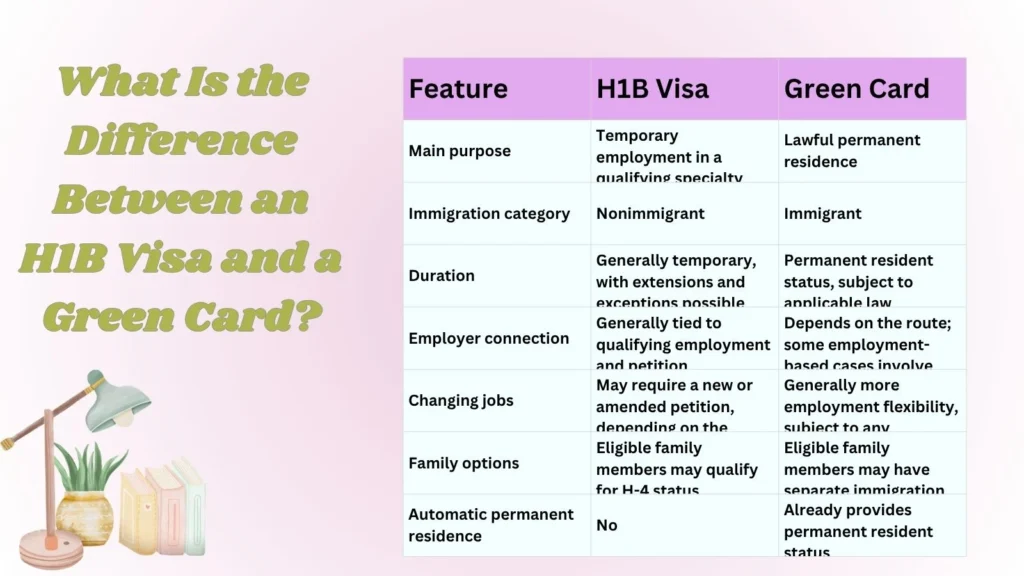
An H1B visa and a green card serve different purposes under U.S. immigration law.
The H1B visa is a temporary nonimmigrant work visa, while a green card provides lawful permanent resident status.
| Feature | H1B Visa | Green Card |
|---|---|---|
| Main purpose | Temporary employment in a qualifying specialty occupation | Lawful permanent residence |
| Immigration category | Nonimmigrant | Immigrant |
| Duration | Generally temporary, with extensions and exceptions possible | Permanent resident status, subject to applicable law |
| Employer connection | Generally tied to qualifying employment and petition requirements | Depends on the route; some employment-based cases involve employer sponsorship |
| Changing jobs | May require a new or amended petition, depending on the situation | Generally more employment flexibility, subject to any applicable conditions |
| Family options | Eligible family members may qualify for H-4 status | Eligible family members may have separate immigration options |
| Automatic permanent residence | No | Already provides permanent resident status |
An H1B worker may qualify to pursue a green card, but the processes are separate. Eligibility and timing depend on the particular immigration category and circumstances.
What Are the Benefits of an H1B Visa?
The H1B visa can provide important opportunities for eligible professionals. However, its benefits depend on the worker’s job, immigration status, employer, and individual circumstances.
1. Opportunity to Work in the United States
The main benefit is the opportunity to work legally in the United States in an approved qualifying position.
This can allow professionals to use their education and expertise in an international work environment.
2. Professional Growth
Working for a U.S. employer may provide experience with new technologies, professional standards, research, and international teams.
The value of this experience depends on the role and employer.
3. Potential Career Advancement
Some H1B workers may progress to more advanced positions or explore other qualifying employment opportunities.
However, a job change generally requires the appropriate immigration steps. Workers should not assume that they can move to any employer without considering the relevant rules.
4. Possibility of Bringing Eligible Family Members
Certain spouses and unmarried children under 21 may qualify for H-4 dependent status.
The family members’ status and options depend on the principal worker’s circumstances and the applicable immigration rules. Some H-4 spouses may qualify for employment authorization, but it is not automatic for every spouse.
5. Potential Path to Permanent Residence
The H1B visa is a nonimmigrant classification, but some H1B workers may pursue employment-based permanent residence through a separate process.
Eligibility depends on the relevant immigration category, employer sponsorship where required, and other legal conditions.
An H1B visa does not automatically lead to a green card.
What Are the Disadvantages of an H1B Visa?
Although the H1B visa can create valuable opportunities, it also has limitations.
1. Dependence on Employment and Sponsorship
The visa is associated with qualifying employment. Losing a job or changing employers can create immigration issues that require timely attention.
Certain workers may have a discretionary grace period of up to 60 consecutive days after employment ends, or until the end of their authorized validity period, whichever is shorter. This is not an unconditional extension of employment authorization, and the applicable rules and circumstances matter.
2. Annual Cap and Selection Uncertainty
Many H1B petitions are subject to an annual numerical cap and a registration selection process.
Even a qualified applicant may not be selected in a cap-subject cycle. Selection also does not guarantee petition approval.
3. Costs and Paperwork
The application process requires documentation, fees, and employer compliance. Some cases may also involve legal or professional assistance.
Employers and workers should understand which costs each party is legally required to pay.
4. Limited Flexibility
An H1B worker generally cannot treat the visa as an unrestricted authorization to work for any employer in any job.
A new job, material change in employment, or other significant change may require an amended or new petition, depending on the circumstances.
5. Temporary Immigration Status
The H1B visa is temporary. Although extensions and certain exceptions may be available, the worker must maintain appropriate immigration status and comply with the applicable time limits.
These limitations do not mean the visa is unsuitable. They mean that applicants should understand the rules before making major career or relocation decisions.
How Long Is an H1B Visa Valid?
H1B status is commonly granted for an initial period of up to three years. It is generally possible to extend it to a total of six years, subject to the applicable rules.
Certain exceptions can allow additional time, particularly in some employment-based permanent residence situations. The requirements for these exceptions are specific, so not every worker qualifies.
It is important to distinguish between:
- Visa stamp validity: The period during which a visa may be used to request entry, subject to its terms.
- Authorized stay or status: The period for which a person is authorized to remain in the United States under the applicable immigration rules.
- Employment authorization: The authorization to work under the relevant status and conditions.
These periods are not necessarily identical. A visa stamp’s expiration date does not, by itself, determine the authorized period of stay for someone already admitted to the United States.
Workers should check their immigration documents and seek qualified guidance when their status or travel plans are unclear.
Can You Change Employers on an H1B Visa?
Yes, an H1B worker may be able to change employers, but the process must comply with the applicable immigration rules.
In many cases, a new employer must file a new H1B petition. Certain eligible H1B workers can begin working for the new employer once the new petition is properly filed, if the statutory portability requirements are met.
This is commonly known as H1B portability.
The ability to change jobs depends on factors such as the worker’s current status, prior employment history, and whether the new position qualifies.
Before resigning from an existing job or starting a new one, it is wise to confirm the timing and filing requirements with the new employer’s immigration team or a qualified immigration attorney.
Can H1B Visa Holders Bring Their Families?
Eligible H1B workers may be able to bring certain family members to the United States under the H-4 dependent classification.
Eligible family members generally include:
- A qualifying spouse.
- Unmarried children under the age of 21.
H-4 status does not automatically provide employment authorization.
Certain H-4 spouses may apply for employment authorization if they meet specific conditions, such as qualifying circumstances connected to the H1B worker’s employment-based permanent residence process.
What Is the Difference Between an H1B Visa and an H-2B Visa?
Children generally do not receive work authorization simply because they hold H-4 status.
Family members must meet the relevant application and eligibility requirements. Their ability to remain in the United States also depends on the principal H1B worker’s status and the applicable rules.
The H1B and H-2B visas are both U.S. nonimmigrant employment classifications, but they serve different purposes.
The H1B category is generally for qualifying specialty occupations. The H-2B category is for eligible temporary nonagricultural work.
| Feature | H1B Visa | H-2B Visa |
|---|---|---|
| Main purpose | Specialty-occupation employment | Temporary nonagricultural employment |
| Typical requirement | Specialized knowledge and qualifying degree or equivalent | A qualifying temporary labor need and other program requirements |
| Job type | Professional or specialized positions that meet the legal standard | Eligible temporary nonagricultural jobs |
| Employer petition | Required in the ordinary process | Required in the applicable process |
| Annual limits | Generally subject to the H1B cap unless exempt | Subject to separate H-2B numerical limits and rules |
Neither category is a general authorization to take any job in the United States. The right option depends on the actual position and the applicable legal requirements.
How Much Does an H1B Visa Cost?
The cost of an H1B case varies according to the employer, petition type, applicable government fees, and the circumstances of the applicant.
Potential expenses can include:
- Employer petition filing fees.
- Applicable training or program fees.
- Fraud prevention and detection fees, where required.
- Additional fees that apply to certain employers or filings.
- Visa application fees, where applicable.
- Legal or professional service fees.
- Costs associated with obtaining or evaluating educational documents.
The amount payable and the party responsible for paying it depend on the fee rules in effect and the specific case.
Do not rely on one fixed online price for every H1B application. Government fees and applicable requirements can change. Employers and applicants should confirm the current fee schedule and the legal responsibility for each cost before filing.
Workers should also be cautious if an employer or recruiter demands payments that may legally be the employer’s responsibility.
H1B Visa Meaning for Indian Applicants
The H1B visa is frequently discussed among Indian students and professionals because it can offer a route to qualifying employment in the United States.
Indian applicants follow the same basic H1B eligibility framework as other foreign nationals. Their education, professional experience, job offer, employer petition, and applicable immigration rules determine whether they qualify.
A few points are especially important:
- An Indian passport does not automatically qualify or disqualify someone for H1B status.
- A U.S. job offer alone does not guarantee selection or approval.
- Many cap-subject cases require registration and selection.
- Some petitions may qualify for cap-exempt treatment.
- Visa appointment availability and processing times can vary.
- H1B status does not automatically provide permanent residence.
Indian applicants should evaluate employers carefully, verify job offers, and understand the relevant immigration process before paying recruiters or making major relocation decisions.
The same general principles apply to eligible applicants from Pakistan and other countries.
Common Mistakes About the H1B Visa

People often misunderstand the H1B visa because online explanations may use terms such as sponsorship, selection, approval, and visa issuance interchangeably.
Here are two common mistakes to avoid.
Mistake 1: Thinking H1B Lottery Selection Means Visa Approval
Being selected in the H1B registration process does not mean that the applicant has received a visa.
Selection generally gives the employer an opportunity to file a petition during the applicable period. USCIS must still review the petition and determine whether the legal requirements are satisfied.
Correct understanding: Selection is one stage of the process, not a guarantee of approval.
Mistake 2: Assuming an H1B Visa Allows Any Type of Work
H1B status is not an unrestricted work permit. It is connected to qualifying employment and the applicable petition and immigration conditions.
Changing jobs or making significant employment changes may require additional immigration filings.
Correct understanding: Always check whether a proposed job or employment change complies with the rules that apply to your H1B status.
FAQs:
1. What Is the H1B Visa Meaning in Simple Words?
The H1B visa is a temporary U.S. work visa that allows eligible foreign professionals to work for qualifying U.S. employers in specialty occupations. The position and the applicant must meet the applicable legal requirements.
2. Is the H1B Visa a Permanent Visa?
No. The H1B is a nonimmigrant visa classification intended for temporary employment. Some H1B workers may pursue permanent residence through a separate process if they qualify.
3. Can I Apply for an H1B Visa Without a Job Offer?
Generally, no. The ordinary H1B process requires a qualifying U.S. employer to file a petition on behalf of the worker. It is not a general self-sponsored work permit.
4. Is an H1B Visa Difficult to Get?
It can be challenging because applicants must meet the eligibility requirements, find a qualifying employer, and complete the required process. Cap-subject cases may also involve selection uncertainty. The difficulty varies from case to case.
5. How Long Can I Stay in the United States on an H1B Visa?
H1B status is commonly granted for up to three years initially and may generally be extended to a total of six years, subject to the applicable rules. Certain exceptions can permit additional time.
Final Thoughts :
Understanding the H1B visa meaning is an important first step if you are considering a professional career in the United States. This visa provides a route for eligible foreign professionals to work in qualifying specialty occupations through an appropriate U.S. employer.
The process involves more than finding a job. You must meet the relevant qualifications, the position must satisfy the specialty-occupation requirements, and the employer must complete the required immigration procedures. Selection, petition approval, visa issuance, and permission to remain in the United States are separate matters.
The H1B visa can offer professional opportunities and may allow eligible family members to accompany the worker. However, it is temporary, comes with employment-related conditions, and does not automatically lead to a green card.
If you are planning to apply, take time to understand the current requirements, evaluate potential employers carefully, and seek qualified immigration advice when needed.

I am Henry James and i am a passionate writer and language enthusiast behind PunPalace, a platform dedicated to exploring meanings, word origins, and simple explanations. My aims to make learning vocabulary easy, engaging, and accessible for everyone.