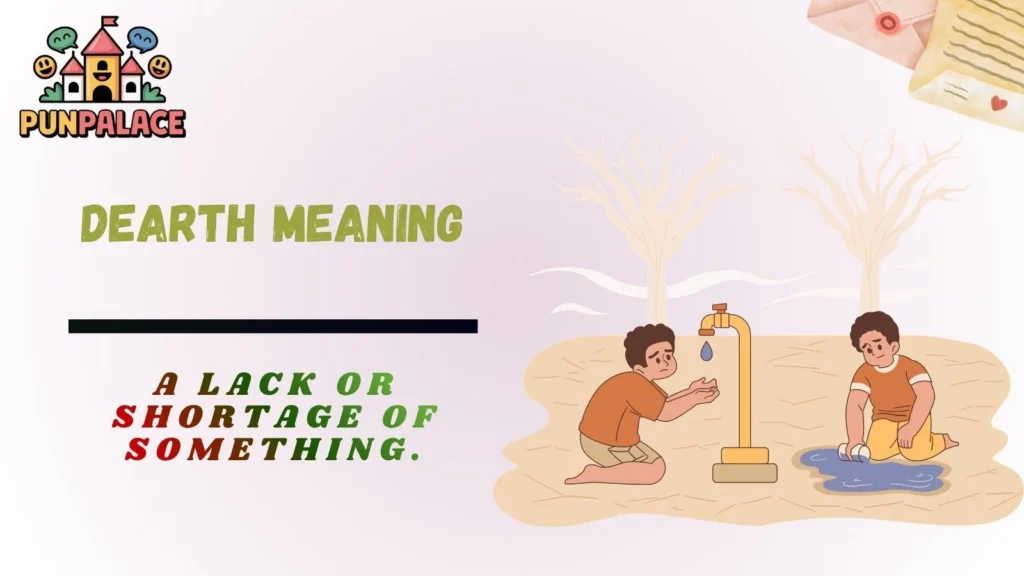
The word dearth means a shortage, lack, or insufficient supply of something. When there is not enough of something that is needed or expected, you can describe the situation as a dearth.
In simple English, dearth means “not enough” or “a serious lack of something.” For example, if a town does not have enough clean water, you could say there is a dearth of clean water.
The word often appears in formal, academic, journalistic, and professional writing. It can describe a shortage of physical things, such as food or workers, as well as abstract things, such as opportunities, information, evidence, or ideas.
Simple definition: Dearth = a lack or shortage of something.
For example:
- There is a dearth of affordable housing in the city.
- The project suffered from a dearth of reliable information.
- A dearth of rain caused problems for farmers.
What Is the Origin of the Word Dearth?
Dearth is an old English word with a long history. It is related to the Old English word “dēore”, which was associated with something being dear, costly, or valuable.
Over time, the word developed a connection with scarcity and high cost. When something becomes scarce, it can become more valuable or expensive. This historical connection helped dearth develop its modern sense of a shortage or lack.
The word has been used in English for centuries, especially when discussing food shortages, economic conditions, and difficult circumstances.
Today, its meaning is broader. You can use it for physical resources and abstract things alike.
Dearth Meaning in Simple English
If you are wondering about the dearth meaning in simple English, think of the words shortage, scarcity, lack, or insufficiency.
When something is in short supply, there is a dearth of it.
| Word | Simple Meaning | Example |
|---|---|---|
| Dearth | A serious lack or shortage | A dearth of jobs |
| Shortage | Not enough of something | A shortage of food |
| Scarcity | Limited availability | Water scarcity |
| Lack | Absence or insufficient amount | A lack of evidence |
| Abundance | A large amount | An abundance of resources |
One important point is that dearth usually suggests more than simply having a little less than expected. It often describes a noticeable or significant shortage.
Dearth Definition and Core Meaning
The standard definition of dearth is a scarcity or inadequate amount of something. It is usually followed by “of” and the thing that is lacking.
The most common structure is:
dearth + of + noun
- dearth of food
- dearth of workers
- dearth of opportunities
- dearth of evidence
- dearth of information
- dearth of resources
For example, the sentence “There is a dearth of qualified teachers” means that there are not enough qualified teachers available.
Likewise, “The report contains a dearth of useful information” means the report contains very little useful information or does not provide enough of it.
How Do You Pronounce Dearth?
Dearth is commonly pronounced like “durth” or approximately /dɜːrθ/ in many varieties of English.
The beginning sounds similar to the word “dear”, while the ending contains the “th” sound found in words such as “earth.”
Because the spelling can look unusual, some English learners may hesitate when they first encounter the word.
Dearth Examples in Sentences
The best way to understand dearth meaning is to see how the word works in real sentences.
- There is a dearth of affordable homes in the area.
- The company is facing a dearth of skilled employees.
- A dearth of rainfall damaged the crops.
- The research field has a dearth of reliable data.
- The village experienced a dearth of clean drinking water.
- The school has a dearth of modern equipment.
- There was a dearth of volunteers for the event.
- The article suffers from a dearth of supporting evidence.
- The industry is experiencing a dearth of new talent.
- The library has a dearth of books on this subject.
In each example, dearth communicates the idea that something is insufficient or unusually limited.
Dearth of Meaning
The phrase “dearth of” is one of the most common ways to use this word.
“A dearth of” means “a shortage or lack of.”
For example:
- A dearth of jobs = not enough jobs
- A dearth of food = not enough food
- A dearth of information = not enough information
- A dearth of evidence = insufficient evidence
- A dearth of opportunities = too few opportunities
- A dearth of funding = insufficient funding
This construction is particularly common in formal writing because it provides a concise way to describe a shortage.
Dearth vs Shortage
Dearth and shortage have very similar meanings, but they are not identical in style.
Shortage is a common everyday word. Dearth sounds more formal and literary.
| Dearth | Shortage |
|---|---|
| More formal | More common in everyday speech |
| Often used in formal writing | Used in ordinary conversation and writing |
| Means a lack or scarcity | Means not enough of something |
| A dearth of evidence | A shortage of evidence |
For example, a newspaper might write, “The industry faces a dearth of skilled workers.” In everyday conversation, someone might simply say, “There aren’t enough skilled workers.”
Both communicate essentially the same idea, but dearth has a more formal tone.
Dearth vs Scarcity
Dearth and scarcity are also close in meaning. Both can describe situations where something is difficult to find or available in limited quantities.
However, scarcity often emphasizes limited availability, while dearth emphasizes a noticeable lack or insufficient supply.
- Water scarcity refers to limited availability of water.
- A dearth of water emphasizes that there is not enough water.
- Resource scarcity describes limited resources.
- A dearth of resources highlights the shortage.
In many sentences, these words can be used interchangeably, but the exact choice depends on tone and context.
Dearth Synonyms
There are many useful dearth synonyms. The best synonym depends on the situation.
- Shortage
- Lack
- Scarcity
- Deficiency
- Insufficiency
- Absence
- Famine
- Want
- Inadequacy
- Paucity
Some of these words are stronger or more specific than others. For example, famine specifically refers to an extreme shortage of food, while paucity usually refers to a small or insufficient amount, especially in formal writing.
Dearth Antonyms
If dearth means a shortage, its opposite is a situation where something exists in a large or sufficient amount.
Common antonyms include:
- Abundance
- Plenty
- Surplus
- Excess
- Profusion
- Ample supply
- Wealth
For example:
“The region once suffered from a dearth of food, but now it has an abundance of crops.”
This sentence clearly shows the contrast between dearth and abundance.
Dearth in Academic and Professional Writing
The word dearth is especially common in academic and professional contexts. Writers use it to describe missing evidence, limited research, insufficient funding, or a shortage of qualified people.
For example:
- There is a dearth of research on the subject.
- The study identifies a dearth of reliable evidence.
- The organization faces a dearth of financial resources.
- The industry has experienced a dearth of experienced professionals.
- The report highlights a dearth of reliable statistics.
In these examples, dearth gives the sentence a formal and analytical tone.
It is useful when the writer wants to emphasize that something is not merely uncommon but insufficient for the situation.
Dearth in News and Journalism
Journalists often use dearth when discussing economic, social, environmental, or political conditions.
For example, news writing may refer to:
- a dearth of affordable housing
- a dearth of workers
- a dearth of rainfall
- a dearth of investment
- a dearth of medical supplies
- a dearth of evidence
- a dearth of public transportation
The word is useful because it summarizes the idea of insufficient supply in a single formal term.
If you see the word in a newspaper or report, replacing it mentally with “shortage” will usually make the sentence easier to understand.
Dearth vs Lack: What’s the Difference?
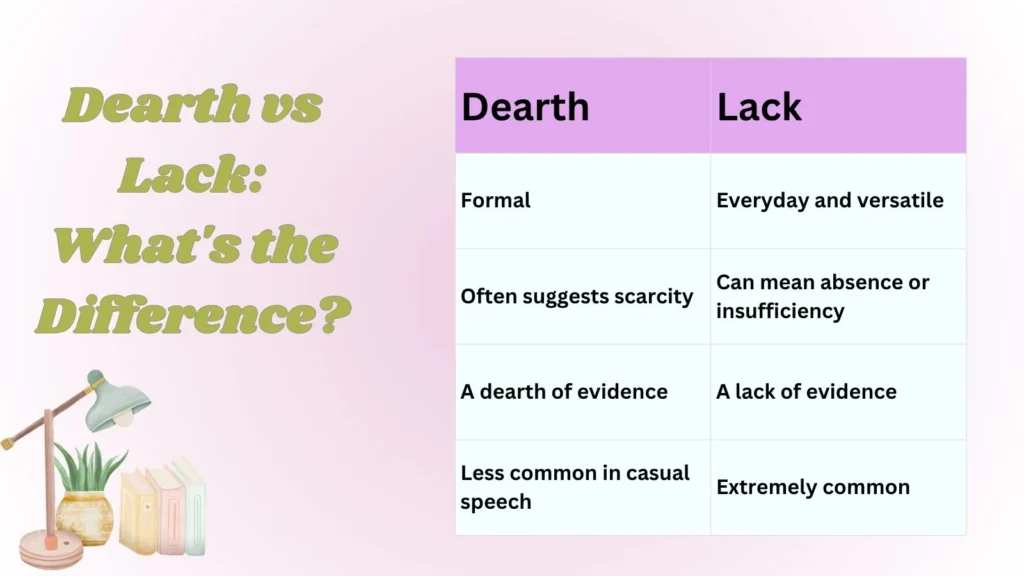
Lack is one of the simplest and most common words for expressing absence or insufficiency. Dearth is more formal and often suggests a significant shortage.
| Dearth | Lack |
|---|---|
| Formal | Everyday and versatile |
| Often suggests scarcity | Can mean absence or insufficiency |
| A dearth of evidence | A lack of evidence |
| Less common in casual speech | Extremely common |
For example, “There is a lack of communication” is very natural. “There is a dearth of communication” is grammatically possible, but it sounds more formal and may not fit every context.
Can Dearth Be Used for Abstract Things?
Yes. One of the most useful features of dearth is that it can describe both physical and abstract things.
You can have a dearth of:
- Food
- Water
- Money
- Workers
- Information
- Evidence
- Ideas
- Opportunities
- Resources
- Research
- Confidence
- Creativity
For instance, “There is a dearth of fresh ideas” does not mean that physical objects called ideas are missing. It means that there are too few new or creative ideas.
Dearth Meaning in Everyday Conversation
Although dearth is a perfectly normal English word, it is more common in formal writing than casual conversation.
In everyday speech, people are more likely to say:
- There isn’t enough.
- We’re running short of it.
- There’s a shortage.
- We don’t have much.
- There aren’t enough available.
Someone might say, “There’s a dearth of parking spaces downtown,” but “There aren’t enough parking spaces downtown” sounds more natural in casual conversation.
Therefore, dearth is useful to know even if you rarely use it yourself. You are likely to encounter it in articles, books, reports, essays, and news stories.
Dearth in Different Contexts
Dearth of Food
A dearth of food means there is not enough food available to meet people’s needs.
Example: “The drought resulted in a dearth of food.”
Dearth of Water
A dearth of water describes an insufficient supply of water.
Example: “The region is experiencing a dearth of fresh water.”
Dearth of Jobs
A dearth of jobs means there are too few employment opportunities.
Example: “Young graduates are struggling because of a dearth of suitable jobs.”
Dearth of Information
A dearth of information means that not enough useful information is available.
Example: “A dearth of information made the decision difficult.”
Dearth of Evidence
A dearth of evidence means there is insufficient evidence to support a conclusion or claim.
Example: “The researchers noted a dearth of evidence on the subject.”
Is Dearth a Negative Word?
Dearth is generally associated with a negative or unfavorable situation because it describes something being insufficient or unavailable.
However, the word itself is not offensive or insulting. Its emotional effect depends on what is missing.
For example:
- Dearth of food sounds serious because food is essential.
- Dearth of jobs suggests economic difficulty.
- Dearth of evidence may simply describe a research limitation.
- Dearth of entertainment options may describe a minor inconvenience.
So, dearth describes a lack, but the seriousness of that lack depends on the context.
Dearth vs Paucity
Paucity is another formal synonym of dearth. Both words describe a small or insufficient amount.
There is a slight difference in emphasis. Dearth commonly highlights a shortage, while paucity often emphasizes the small quantity itself.
For example:
“There is a dearth of qualified candidates.”
This strongly suggests that qualified candidates are difficult to find in sufficient numbers.
“There is a paucity of data.”
This emphasizes that the available amount of data is very small.
Both words are formal and are especially common in academic writing.
Common Phrases With Dearth
Learning common combinations can make the word much easier to recognize.
- A dearth of information
- A dearth of evidence
- A dearth of resources
- A dearth of opportunities
- A dearth of talent
- A dearth of workers
- A dearth of jobs
- A dearth of funding
- A dearth of research
- A dearth of ideas
- A dearth of rainfall
- A dearth of affordable housing
When you see “dearth of”, you can usually replace it with “shortage of” to understand the basic meaning.
How to Use Dearth Correctly
The most natural grammatical pattern is “a dearth of + noun.”
Examples:
- A dearth of opportunities
- A dearth of resources
- A dearth of evidence
- A dearth of qualified applicants
Because dearth is normally treated as a singular noun, you will often see “a dearth of” when introducing the shortage.
Correct: “There is a dearth of qualified doctors.”
Less natural: “There are dearth of qualified doctors.”
The second sentence is incorrect because dearth is singular in that construction and requires “is” when used with a.
Dearth Meaning in Literature and Writing
Writers often choose dearth because it has a formal, slightly literary quality. It can make a description of scarcity sound more precise or polished.
For example:
“The village endured a dearth of rain for several months.”
This sounds more literary than:
“The village didn’t get enough rain for several months.”
Neither sentence is inherently better. The choice depends on the intended style.
For essays, reports, articles, and formal writing, dearth can be useful when you want to avoid repeating the word shortage.
Dearth Meaning in Texting and Social Media
If you encountered dearth in a text message, social media post, caption, or online discussion, its meaning is generally the same: a lack or shortage of something.
Unlike internet abbreviations such as “LOL” or “BRB,” dearth is a standard English vocabulary word. It does not have a special texting meaning.
For example:
“There is a dearth of good movies lately.”
This means:
“There aren’t enough good movies lately.”
Someone might use the word online to sound humorous, dramatic, formal, or literary, but the basic definition remains unchanged.
Why Do Writers Use the Word Dearth?
Writers use dearth because it communicates the idea of scarcity efficiently.
Compare these two sentences:
“There are not enough reliable sources available.”
“There is a dearth of reliable sources.”
The second sentence is shorter and more formal. It is particularly useful when writing about research, economics, education, science, business, or public issues.
However, simple language is often better for general audiences. If your readers may not know the word, “shortage” or “lack” may be clearer.
Dearth Meaning: Quick Comparison
| Term | Meaning | Tone |
|---|---|---|
| Dearth | A shortage or serious lack | Formal |
| Shortage | Not enough of something | Neutral |
| Scarcity | Limited availability | Formal/neutral |
| Lack | Absence or insufficient amount | Everyday |
| Paucity | A small or insufficient amount | Very formal |
| Abundance | A large amount | Positive/opposite |
Common Mistakes With Dearth

1. Thinking Dearth Means “Expensive”
Because of the word’s historical connection with value and scarcity, learners may assume dearth directly means expensive. In modern English, it means shortage or lack, not simply high price.
2. Confusing Dearth With Death
The spelling of dearth may look somewhat similar to death, but the meanings are completely different.
Dearth = shortage or lack.
Death = the end of life.
3. Forgetting “Of”
The most common pattern is “a dearth of something.”
Example: “There is a dearth of reliable information.”
4. Using Dearth in Every Casual Sentence
Although grammatically correct, dearth can sound formal in ordinary conversation. Words such as lack and shortage are often more natural.
5. Assuming Dearth Always Means an Extreme Crisis
Dearth indicates insufficient supply, but the seriousness depends on context. A dearth of food can be severe, while a dearth of entertainment options may be relatively minor.
FAQs:
What does dearth mean in simple words?
Dearth means a shortage, lack, or insufficient amount of something. In simple terms, it means there is not enough of something.
What is an example of dearth?
An example is: “The region is experiencing a dearth of clean water.” This means the region does not have enough clean water.
Is dearth a synonym for shortage?
Yes. Shortage is one of the closest synonyms of dearth. The main difference is that dearth sounds more formal.
What is the opposite of dearth?
The opposite of dearth is generally abundance, plenty, surplus, or ample supply.
Is dearth a formal word?
Yes. Dearth is generally more formal than “lack” or “shortage.” It is common in academic, professional, journalistic, and literary writing.
Final Thoughts:
The dearth meaning is simple once you connect it with the words shortage, scarcity, and lack. A dearth occurs when there is not enough of something available.
You can use the word for physical resources such as food, water, money, and supplies. You can also use it for abstract things such as information, evidence, opportunities, research, ideas, and talent.
The most common structure is “a dearth of”, as in “a dearth of opportunities” or “a dearth of evidence.”
Although the word sounds somewhat formal, understanding it can make reading articles, academic papers, reports, and professional writing much easier. When you encounter dearth, simply think: “There is not enough of something.” 📚✨

I am Henry James and i am a passionate writer and language enthusiast behind PunPalace, a platform dedicated to exploring meanings, word origins, and simple explanations. My aims to make learning vocabulary easy, engaging, and accessible for everyone.