Have you ever heard someone say, “The whole thing was a charade”, and wondered what they meant? The word charade can be confusing because it has both a playful connection to a guessing game and a figurative meaning that is much more critical.
The most common charade meaning in everyday English is a situation or performance that appears genuine but is actually fake, misleading, or designed to hide the truth. For example, if two people pretend to be friends in public even though they strongly dislike each other, someone might describe their behavior as a charade.
However, charade can also refer to the popular game of charades, in which players act out words or phrases without speaking while others try to guess them.
In this guide, we will explore the meaning of charade, its simple definition, origin, examples, synonyms, figurative use, connection with the guessing game, common phrases, and common mistakes.
What Does Charade Mean?
The word charade has two closely related uses.
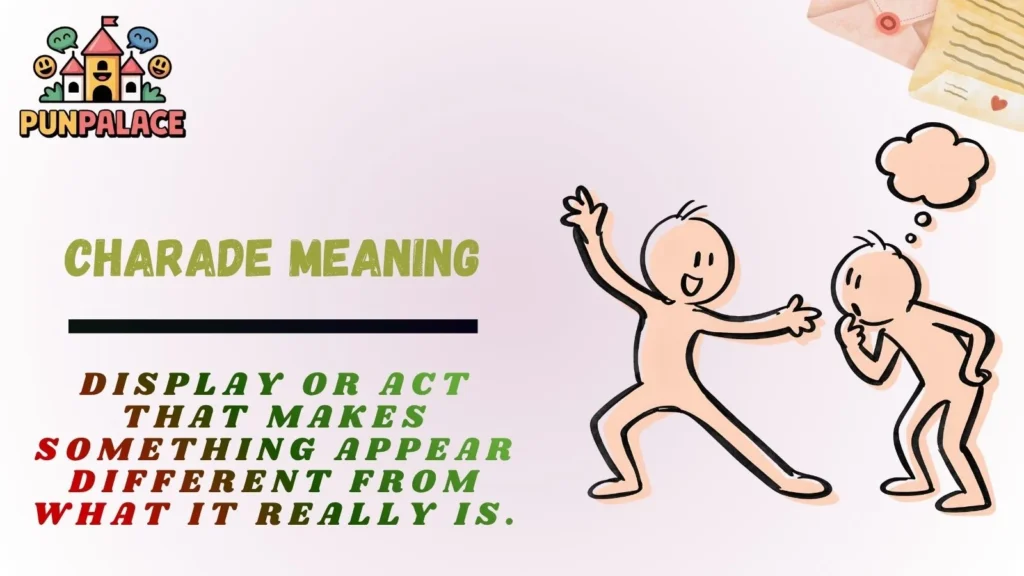
First, in its figurative sense, a charade is a false display or act that makes something appear different from what it really is.
Second, charades is a guessing game in which players communicate words or phrases through gestures and actions rather than speaking.
| Meaning | Simple Explanation | Example |
|---|---|---|
| Figurative meaning | A fake performance or pretense | “Their agreement was just a charade.” |
| Game | A guessing game using actions | “We played charades at the party.” |
The context usually makes it clear which meaning is intended.
Charade Meaning in Simple English

In simple English, a charade can mean “a fake show” or “pretending that something is true when it is not.”
Imagine a person smiling and acting happy while secretly being extremely upset. If the person deliberately creates a false impression for others, their behavior could be described as a charade.
Another example would be a company pretending that everything is operating normally when its leaders already know that a major problem exists.
In both cases, the important idea is appearance versus reality.
Charade as a Fake Performance
The figurative meaning of charade often suggests that someone is putting on an act.
It does not necessarily mean that every detail is completely false. Instead, the overall presentation may be misleading because people are pretending that a situation is different from reality.
For example:
- “Their happy marriage was a charade.”
- “The meeting became a charade.”
- “Everyone knew the apology was a charade.”
- “The investigation was criticized as a charade.”
- “His confidence was partly a charade.”
Each example suggests that the visible behavior does not accurately represent the underlying reality.
What Is a Charade in Everyday Conversation?
In everyday conversation, calling something a charade is usually critical.
If someone says, “This is all a charade,” they are normally suggesting that people are pretending or creating a false appearance.
For example, imagine two business partners who have secretly decided to end their partnership. They continue smiling and acting as if everything is normal during a public event. Someone who knows the situation might say:
“Their friendly behavior is just a charade.”
The word therefore has a stronger meaning than simply saying something is “an act.” It often suggests deception, pretense, or an attempt to create a misleading impression.
Charade Meaning in a Sentence
Here are several examples that show how the word can be used naturally.
- “The entire argument was a charade designed to attract attention.”
- “Everyone knew that their friendship was a charade.”
- “She finally stopped pretending that everything was fine and ended the charade.”
- “The public apology looked like a charade.”
- “They maintained the charade for several months.”
- “The supposed competition was merely a charade.”
- “He could no longer continue the charade.”
- “The meeting felt like a complete charade.”
Notice that the word often appears with expressions such as “a charade,” “the charade,” and “continue the charade.”
What Does “It Was All a Charade” Mean?
The phrase “It was all a charade” means that the situation was largely an act or pretense.
For example:
“They acted like they were negotiating seriously, but it was all a charade.”
This means that the apparent negotiation was not genuine. The people involved were putting on a performance for others.
Similarly:
“Their relationship was all a charade.”
This suggests that the relationship looked real from the outside but was not what it appeared to be.
What Does “End the Charade” Mean?
“End the charade” means to stop pretending or stop maintaining a false appearance.
For example:
“They had hidden the disagreement for years, but eventually decided to end the charade.”
In this sentence, ending the charade means finally acknowledging the truth instead of continuing to pretend everything is normal.
The expression is commonly used when a false situation has continued for a long time.
What Does “Continue the Charade” Mean?
“Continue the charade” means to keep pretending that something is true or genuine when it is not.
For example:
“Everyone knew the project was failing, but management continued the charade that everything was under control.”
The phrase emphasizes that the people involved are knowingly maintaining the appearance of normality or success.
Charade vs Deception
Deception means deliberately causing someone to believe something that is not true.
A charade can involve deception, but the word focuses more strongly on the performance or appearance being presented.
For example:
Deception: A person secretly changes information to make someone believe a false fact.
Charade: A group publicly behaves as though everything is fine even though everyone knows there is a serious problem.
The two concepts overlap, but they are not exact synonyms.
Charade vs Farce
Charade and farce can sometimes describe situations that are not genuine, but their meanings are different.
A farce can describe an absurd or ridiculous situation. It can also refer to a type of comedy based on exaggerated and unlikely events.
A charade emphasizes pretense or false appearance.
For example:
- “The whole process was a charade.” — It was presented as genuine but was not.
- “The meeting turned into a farce.” — The meeting became ridiculous or chaotic.
Charade vs Ruse
A ruse is a trick or strategy used to deceive someone.
A charade is more about maintaining an appearance or putting on a performance.
For example, someone might use a ruse to distract another person. Meanwhile, a group might maintain a charade by pretending that they agree with each other.
Both words can involve deception, but the focus is different.
Synonyms for Charade
Depending on the context, useful synonyms for the figurative meaning of charade include:
- Pretense
- Act
- Sham
- Facade
- Show
- Performance
- Ruse
- Deception
- Hoax
- Fake display
These words are not interchangeable in every sentence. The best choice depends on whether you want to emphasize pretending, deception, appearance, or trickery.
Antonyms of Charade
Words that can express the opposite idea include:
- Truth
- Honesty
- Sincerity
- Authenticity
- Genuineness
- Reality
- Transparency
For example, if a person’s behavior is genuine rather than a charade, you might describe it as sincere or authentic.
Charade vs Pretending
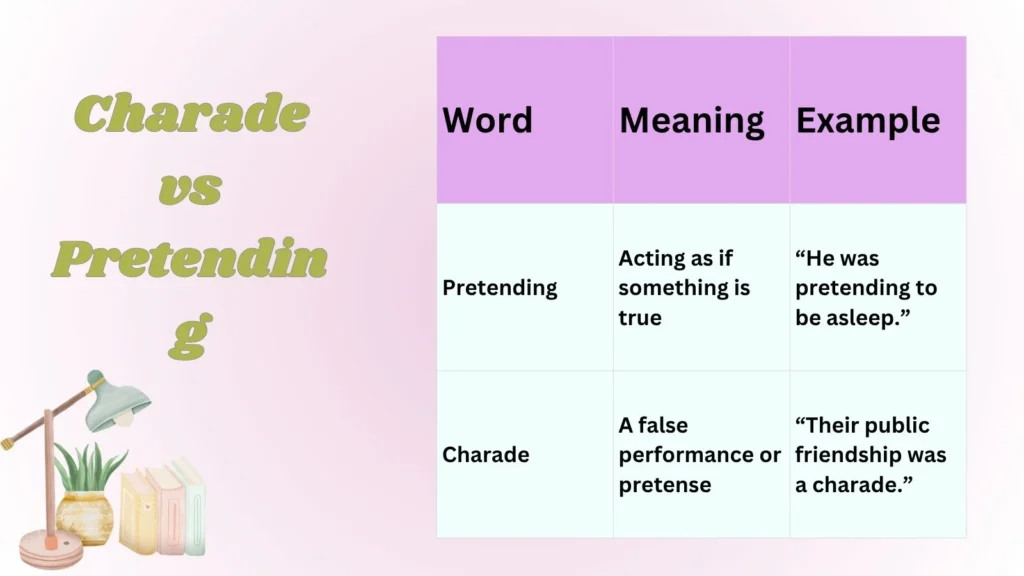
Pretending is a broad word that simply means acting as if something is true when it is not.
A charade is more specific. It often refers to an organized, noticeable, or sustained performance that creates a false impression.
| Word | Meaning | Example |
|---|---|---|
| Pretending | Acting as if something is true | “He was pretending to be asleep.” |
| Charade | A false performance or pretense | “Their public friendship was a charade.” |
Therefore, every charade involves some form of pretense, but not every act of pretending would normally be called a charade.
Charade Meaning in Literature and Writing
Writers often use the word charade when they want to show a contrast between what people see and what is actually happening.
A character might maintain a charade to protect a secret, avoid embarrassment, preserve a relationship, or influence other people.
For example, a novel could describe a wealthy family maintaining a public image of perfect happiness while privately dealing with serious problems.
Calling the family’s public behavior a charade tells the reader that the appearance is misleading.
The word can therefore be useful in fiction, journalism, essays, reviews, and commentary when discussing appearances versus reality.
Charade Meaning in Movies and TV
The concept of a charade appears frequently in movies and television.
A character may pretend to be someone else, hide their feelings, or maintain a false relationship. Viewers may later discover that the apparent situation was not genuine.
When describing such a storyline, someone might say:
“Their perfect family life was a charade.”
This immediately communicates that the public image was very different from reality.
What Is the Charades Game?
The word charades is also associated with a popular guessing game.
In the game, one person acts out a word, phrase, title, movie, book, or other concept without speaking. The other players try to guess what is being acted out.
For example, if the answer is “swimming,” a player might imitate swimming motions without saying the word.
The other players then try to guess the answer.
How Do You Play Charades?
Traditional charades can be played with two or more people, although larger groups are often more entertaining.
A simple version works like this:
- Write words or phrases on separate pieces of paper.
- Place them in a container.
- One player chooses a paper without showing it to others.
- The player acts out the word or phrase without speaking.
- The other players guess the answer.
- Set a time limit if desired.
- Award a point when the team guesses correctly.
The game can be adapted for children, families, classrooms, parties, and team-building activities.
Why Is the Game Called Charades?
The game is connected historically with a form of word-guessing entertainment in which clues were acted out.
The English word charade ultimately comes through French, and its history is connected with an older type of riddle or word puzzle.
Over time, the term became associated with the familiar game in which words and phrases are represented through gestures.
The modern figurative meaning of charade developed around the idea of an acted or artificial performance, which helps explain the connection between the two uses.
Charade Meaning and Its French Origin
The word charade entered English from French. Its history is associated with a type of word puzzle in which different parts of a word could be represented or guessed.
The exact historical development of the word is more complicated than simply translating it as “fake.” The modern English figurative sense developed from the idea of something being acted or presented as a performance.
This history helps explain why charade can refer both to an acting game and to a figurative performance that is not genuine.
Can Charade Be a Verb?
In modern standard English, charade is primarily used as a noun.
You normally say:
- “It was a charade.”
- “They maintained the charade.”
- “The whole thing was a charade.”
You would generally not use charade as an ordinary verb in place of words such as “pretend,” “deceive,” or “act.”
Is Charade Always Negative?
When charade is used in its figurative sense, it usually has a negative or critical tone.
If someone describes a situation as a charade, they are normally suggesting that the situation is fake, misleading, or unnecessarily performative.
However, charades as a game is completely different. In that context, the word has a fun and playful meaning.
Context is therefore extremely important.
Charade Meaning in Social Media
On social media, people may use charade when criticizing what they believe is a fake online image.
For example, someone might write:
“The perfect-life posts are just a charade.”
Here, the speaker is suggesting that the person’s public online image does not accurately reflect their real life.
The word may also appear in discussions about fake friendships, staged content, exaggerated lifestyles, or public performances.
Because social media often emphasizes carefully presented images, charade can be a useful word for describing a perceived difference between online appearance and reality.
Charade Meaning in Relationships
In relationship contexts, charade often describes pretending that a relationship is healthy, happy, or genuine when it is not.
For example:
“They continued the charade for years.”
This suggests that they maintained the appearance of a normal relationship despite knowing that serious problems existed.
The word can also describe pretending to like someone, pretending to agree, or hiding conflict from friends and family.
Charade Meaning in Business
In business writing, charade can be used when someone believes a formal process is merely a performance.
For example:
“Employees felt that the consultation process was a charade because the decision had already been made.”
Here, the word suggests that the consultation appeared genuine but was perceived as lacking genuine influence.
Because charade is strongly evaluative, writers should use it carefully when describing real-world situations, especially in formal communication.
Charade Meaning in Politics and Public Discussions
The word can also appear in political commentary when someone describes a public process as insincere or merely performative.
For example, a commentator might call a debate, negotiation, or public event a charade if they believe the participants are only pretending to negotiate.
However, because the word expresses a judgment about whether something is genuine, it is important to distinguish an opinion or accusation from an established fact when using it in serious writing.
How to Remember the Meaning of Charade
A simple way to remember the figurative meaning is to connect charade with the word “act.”
When something is a charade, people are essentially putting on an act to create a particular impression.
Think:
Charade = a performance that hides reality.
For the game, think:
Charades = acting without speaking so others can guess.
These two ideas are easy to distinguish once you focus on context.
Common Mistakes With the Word Charade

Confusing Charade With Charades
Charade can refer to a false performance, while charades commonly refers to the guessing game.
Thinking Charade Always Means a Game
In everyday writing, “a charade” often means a fake or misleading performance rather than the game.
Using Charade as a Simple Synonym for Lie
A lie is a false statement. A charade is broader and often involves maintaining an appearance or performance.
Assuming Every Performance Is a Charade
A performance is not automatically fake. The figurative meaning of charade suggests that the performance is misleading or not genuine.
Ignoring the Tone
Calling something a charade usually communicates criticism. Use the word carefully when you are describing real people or serious situations.
FAQs:
What does charade mean in simple English?
Charade can mean a fake performance or pretense in which something is presented as genuine when it is not. Charades can also refer to a guessing game based on acting.
What does “the whole thing was a charade” mean?
It means that the entire situation was viewed as an act, pretense, or misleading performance rather than something genuine.
Is a charade the same as a lie?
Not exactly. A lie is usually a false statement, while a charade is a broader performance or pretense that creates a false impression.
What is the difference between charade and charades?
Charade is commonly used for a fake or misleading performance. Charades usually refers to the guessing game where people act out words or phrases without speaking.
Is charade a negative word?
When used to mean a false performance, charade usually has a negative or critical tone. When referring to the game of charades, it has a playful meaning.
Final Thoughts:
The charade meaning is easiest to understand when you focus on the idea of appearance versus reality. In its figurative sense, a charade is a false performance or pretense that makes something appear genuine when it is not.
For example, if people pretend that everything is fine despite knowing that a serious problem exists, someone might describe their behavior as a charade. Expressions such as “end the charade,” “continue the charade,” and “it was all a charade” are common ways to use the word.
The word also connects to charades, the popular guessing game where players act out words or phrases without speaking. Although the two uses are related historically, context tells you which meaning is intended.

I am Henry James and i am a passionate writer and language enthusiast behind PunPalace, a platform dedicated to exploring meanings, word origins, and simple explanations. My aims to make learning vocabulary easy, engaging, and accessible for everyone.