Have you ever walked through a crowded market, busy street, airport, or train station where people were moving quickly in every direction? That lively combination of activity, movement, noise, and excitement can be described with one useful English word: bustle.
The bustle meaning is generally connected with a place or situation full of energetic activity and movement. You might hear someone say, “The city was filled with bustle,” to describe a busy environment where people are constantly coming and going.
However, bustle has more than one meaning. It can be used as a noun to describe busy activity, as a verb meaning to move or work energetically, and in historical fashion, it can refer to a structure worn under a woman’s skirt to make the back of the dress project outward.
In this guide, you will learn the bustle definition, its meanings, examples, synonyms, antonyms, pronunciation, origin, common phrases, and how to use the word naturally in different contexts.
What Is the Bustle Meaning?
Bustle means a state of energetic and often noisy activity, especially when many people are moving around or doing things at the same time.
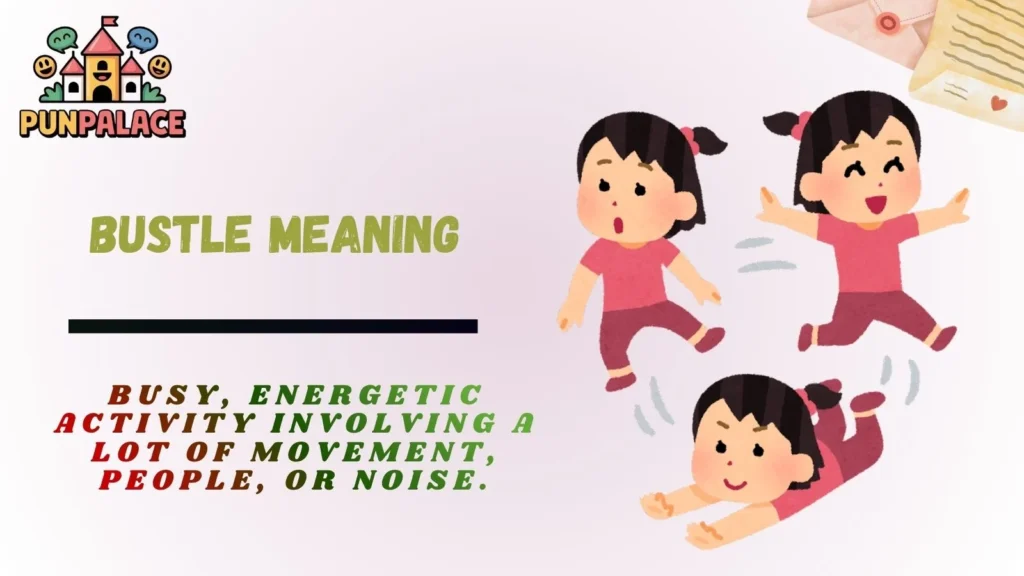
Simple definition: Bustle means busy, energetic activity involving a lot of movement, people, or noise.
For example:
- The bustle of the city continued late into the night.
- We enjoyed the bustle of the crowded market.
- The station was full of activity and bustle.
The word often creates a picture of a place that feels alive, active, crowded, and energetic.
Bustle Meaning in Simple English
In simple English, bustle means a lot of busy activity.
Imagine walking into a busy shopping street. People are talking, cars are moving, shopkeepers are serving customers, and pedestrians are rushing from one place to another. That lively scene has bustle.
| Word | Simple Meaning | Example |
|---|---|---|
| Bustle | Busy and energetic activity | The market was full of bustle. |
| Bustle as a verb | To move or work energetically | Everyone bustled around the kitchen. |
| Bustle in fashion | A support worn under a skirt | The dress had a large bustle. |
The first meaning is by far the most common in general English, but the other uses are important to recognize when reading older literature or learning about historical fashion.
What Does Bustle Mean?
What does bustle mean? It usually means a state of energetic activity, especially in a busy place where people are moving around quickly.
For example, if someone says, “I love the bustle of downtown,” they mean they enjoy the busy atmosphere, movement, sounds, and activity of the city center.
The word can also be a verb. If someone says, “People were bustling around,” it means they were moving around or working actively and energetically.
There is also a historical meaning related to clothing. A bustle was a framework or padded support worn beneath a skirt, especially during the 19th century, to make the back of the dress stick out.
Bustle as a Noun
When bustle is used as a noun, it commonly refers to energetic activity and movement.
Examples include:
- The morning bustle of the city was already beginning.
- I enjoy the bustle of a busy café.
- The airport was filled with the bustle of travelers.
- The market’s bustle made the neighborhood feel lively.
- After the festival ended, the streets became quiet instead of bustling.
In these examples, bustle is a noun because it names a condition or atmosphere of busy activity.
Bustle as a Verb
Bustle can also be used as a verb. As a verb, it means to move, work, or act energetically.
For example:
- Everyone bustled around preparing for the party.
- She bustled into the room with several bags.
- The workers bustled about getting everything ready.
- People were bustling through the station.
The verb often suggests quick or energetic movement. It does not necessarily mean that someone is running. A person can bustle while walking quickly, working actively, or moving from one task to another.
Bustle Meaning in Fashion
There is another interesting bustle meaning related to historical clothing.
A bustle was a framework, pad, or other support worn beneath the back of a woman’s skirt to create a fuller, projecting shape at the rear of the dress.
Bustles became particularly associated with Western women’s fashion during the 19th century. Different styles and shapes were used depending on the period.
For example:
“The Victorian dress was designed to be worn with a bustle.”
Here, bustle has nothing to do with a crowded or busy place. It refers to a piece of clothing or an undergarment structure.
This meaning is especially useful when reading historical novels, fashion history articles, museum descriptions, or literature set in the Victorian era.
Bustle Meaning in a Sentence
Here are examples showing the most common ways to use bustle in English.
Busy Activity
“The bustle of the city made the area feel exciting.”
Busy Place
“We walked through the bustle of the crowded market.”
Energetic Movement
“The staff bustled around the restaurant before dinner.”
Preparation
“Everyone was bustling about before the guests arrived.”
Historical Fashion
“The elaborate gown included a bustle at the back.”
These examples demonstrate why context is important when understanding the word.
Bustle vs Hustle
Bustle and hustle are easy to confuse because both can describe energetic activity.
Bustle usually emphasizes a lively environment or energetic movement.
Hustle can emphasize hurried movement, energetic effort, or aggressively pursuing something. In modern informal English, hustle can also refer to working hard or finding ways to earn money.
Compare:
- The bustle of the marketplace — the lively activity of the marketplace.
- The hustle of the marketplace — the hurried, energetic activity and movement.
They overlap, but the exact meaning depends on the context.
Bustle vs Commotion
Commotion generally suggests noisy, confused, or disorderly activity, while bustle can simply describe a lively and busy environment.
For example:
“The bustle of the city was exciting.”
This sounds positive or neutral.
“The commotion outside made it difficult to concentrate.”
This suggests that the activity was disruptive or confusing.
Therefore, bustle does not automatically imply disorder.
Bustle vs Busy
Busy is a general adjective, while bustle is usually a noun describing the atmosphere or activity of a place.
For example:
- “The street is busy.”
- “The street is filled with bustle.”
Both sentences describe an active environment, but the second creates a stronger sense of movement and lively activity.
Bustle Antonyms
Words with meanings opposite to bustle include:
- Quiet
- Calm
- Stillness
- Peace
- Silence
- Tranquility
- Inactivity
- Idleness
For example, if a busy marketplace is full of bustle during the afternoon, it may become quiet and peaceful after the shops close.
Common Phrases With Bustle
Learning common expressions can make the bustle meaning easier to recognize in real writing.
- The bustle of the city — the busy activity of urban life.
- The bustle of the market — lively activity in a marketplace.
- In the bustle of everyday life — amid the busy activities of daily life.
- Bustle around — move around energetically.
- Bustle about — move or work actively.
- Bustle into a room — enter energetically or quickly.
- City bustle — busy urban activity.
One particularly useful expression is “the bustle of everyday life.” It refers to the constant activities, responsibilities, movement, and demands that make daily life feel busy.
Bustle Synonyms
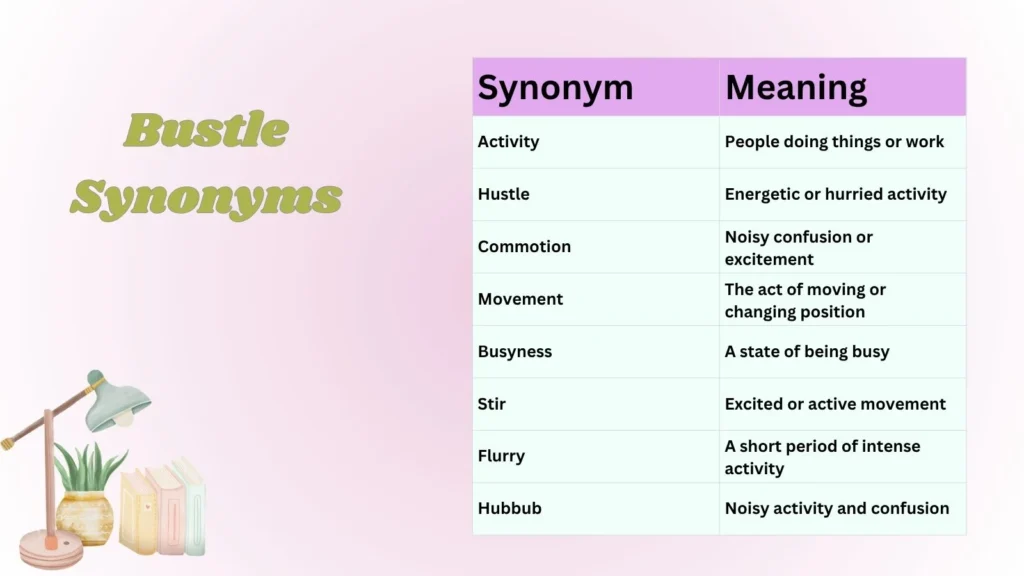
Several words can have a similar meaning to bustle, especially when it refers to busy activity.
| Synonym | Meaning |
|---|---|
| Activity | People doing things or work |
| Hustle | Energetic or hurried activity |
| Commotion | Noisy confusion or excitement |
| Movement | The act of moving or changing position |
| Busyness | A state of being busy |
| Stir | Excited or active movement |
| Flurry | A short period of intense activity |
| Hubbub | Noisy activity and confusion |
These synonyms are related but do not always have exactly the same emotional tone. Bustle can describe energetic activity without suggesting that the situation is chaotic or unpleasant.
Bustle in Everyday Life
The word bustle is often used to describe environments that naturally have a lot of activity.
For example, you might describe:
- A crowded shopping mall
- A busy train station
- A large airport
- A popular street market
- A city center during rush hour
- A restaurant before dinner service
- A kitchen preparing food for a large event
- A school hallway between classes
- A festival filled with visitors
- A workplace preparing for an important event
In each case, the word highlights the energy and movement of the environment.
Bustle in Literature and Writing
Writers often use bustle because it creates a vivid picture of an active environment without having to describe every individual movement.
For example, a writer might describe a city as being filled with the bustle of morning life. Readers can imagine people traveling to work, shops opening, vehicles moving, and streets filling with activity.
The word can also create a contrast between busy and quiet places.
For example:
“After the bustle of the marketplace, the quiet garden felt peaceful.”
This contrast makes both environments easier to visualize.
Bustle Meaning in Social and Modern Contexts
In modern writing, bustle is often used to describe city life, tourism, shopping, events, restaurants, transportation, and busy routines.
For example:
- “Visitors enjoyed the bustle of downtown.”
- “The café was alive with bustle on Saturday morning.”
- “She escaped the bustle of the city for a quiet weekend.”
These uses are generally neutral or positive. Bustle can suggest excitement and energy rather than simply stress.
Is Bustle a Positive or Negative Word?
Bustle can be positive, neutral, or slightly negative depending on the context.
When someone enjoys the energy of a busy city, bustle may have a positive meaning.
For example:
“I love the bustle of downtown.”
Here, bustle suggests excitement and liveliness.
But someone who wants peace and quiet might describe the bustle of the city as tiring or overwhelming.
For example:
“I needed a break from the constant bustle of the city.”
Here, the word describes activity that has become exhausting.
How to Pronounce Bustle
Bustle is pronounced approximately as BUH-suhl.
It has two syllables and rhymes closely with words such as hustle.
Remember that the spelling may look slightly unusual because the final e is silent.
Bustle Word Forms
The word can appear in several grammatical forms.
| Form | Example |
|---|---|
| Bustle | The bustle of the city was exciting. |
| Bustles | The city bustles with activity. |
| Bustled | She bustled around the kitchen. |
| Bustling | They walked along a bustling street. |
Bustling is especially common as an adjective.
For example:
- A bustling city
- A bustling market
- A bustling street
- A bustling restaurant
- A bustling neighborhood
In each case, bustling means full of busy activity.
How to Use Bustle Correctly
When using bustle as a noun, it is commonly paired with of.
For example:
“The bustle of the city.”
“The bustle of the marketplace.”
“The bustle of everyday life.”
When using bustle as a verb, you may see phrases such as:
- Bustle around
- Bustle about
- Bustle into
- Bustle through
For example, “She bustled around the house” means she moved around actively while doing things.
Why Is Bustle a Useful Word?
Bustle is useful because it communicates more than simply saying that a place is “busy.” It can suggest movement, energy, people, noise, excitement, and constant activity all at once.
Compare these two descriptions:
“The market was busy.”
“The market was full of bustle.”
The second sentence gives a stronger sense of an energetic atmosphere. You can almost imagine people moving through the market, talking, shopping, and working.
Common Mistakes With Bustle
Confusing Bustle With Hustle
Although the words sound similar, they are not always interchangeable. Bustle commonly describes lively activity, while hustle can suggest hurried movement, energetic effort, or other meanings in modern English.
Assuming Bustle Always Means Noise
Bustle can involve noise, but noise is not required. A busy office or crowded station can be bustling even if it is not extremely loud.
Using Bustle Only for People
The word is strongly associated with human activity, but the surrounding environment can also be described as bustling. For example, a bustling city refers to the overall active atmosphere.
Forgetting the Fashion Meaning
When reading historical texts, remember that bustle can refer to a clothing support worn under a skirt. Context determines the meaning.
Thinking Bustle Is Always Negative
Bustle can describe an exciting and lively atmosphere. Its emotional meaning depends on how the writer or speaker views the activity.
FAQs:
What is the simple meaning of bustle?
The simple bustle meaning is busy, energetic activity involving movement, people, and often noise. It can describe a lively place or environment.
What does bustle mean as a verb?
As a verb, bustle means to move, work, or act energetically. For example, “Everyone bustled around the kitchen” means everyone was moving and working actively.
What is a synonym for bustle?
Common synonyms include activity, hustle, commotion, movement, busyness, stir, flurry, and hubbub. The best synonym depends on the context.
Is bustle a positive or negative word?
Bustle can be positive, neutral, or slightly negative. It may describe the exciting energy of a city, or it may describe activity that someone finds tiring or overwhelming.
What does bustle mean in fashion?
In historical fashion, a bustle was a framework, pad, or support worn beneath the back of a woman’s skirt to create a fuller, projecting shape.
Conclusion:
The bustle meaning is mainly connected with busy, energetic activity and movement. It is often used to describe crowded streets, markets, cities, airports, restaurants, workplaces, and other lively environments.
As a verb, bustle means to move or work energetically. The word can also have a historical fashion meaning, referring to a structure worn under a skirt to create a fuller shape at the back.
The easiest way to remember the common meaning is: bustle = lively and energetic activity. If you see the word in a phrase such as “the bustle of the city,” think of people moving, working, talking, shopping, and creating a lively atmosphere.
Once you understand the context, bustle becomes a simple and useful word for describing the energy and movement of everyday life.

I am Henry James and i am a passionate writer and language enthusiast behind PunPalace, a platform dedicated to exploring meanings, word origins, and simple explanations. My aims to make learning vocabulary easy, engaging, and accessible for everyone.