Have you ever heard someone describe a project as a complete waste of time or money? They might call it a boondoggle. This unusual English word is often used when a project costs too much, achieves very little, or seems unnecessary.
The boondoggle meaning is a wasteful or unnecessary project, activity, or piece of work that uses time, money, or effort without providing much value. It is especially common when people criticize government projects, business plans, or complicated activities that do not produce useful results.
For example, if a company spends thousands of dollars on a project that never delivers anything useful, an employee might say, “This whole project is a boondoggle.”
In this guide, you will learn the meaning of boondoggle in simple English, how to use it in conversations, its synonyms, examples in sentences, and common mistakes to avoid. Let’s make this interesting word easy to understand! 😊
What Is the Boondoggle Meaning in English?
A boondoggle is a project, activity, or undertaking that wastes time, money, or resources, often because it is poorly planned, unnecessary, or unlikely to produce worthwhile results.
The word usually expresses criticism. When someone calls something a boondoggle, they are suggesting that the activity is wasteful or does not justify its cost.
For example:
- A government spends millions on a project that delivers little public benefit.
- A company organizes endless meetings without making any real progress.
- A team develops an expensive product that nobody wants to use.
- An organization continues funding a project despite repeated failures.
In these situations, people may use the word boondoggle to express frustration about wasted resources.
The word is commonly used as a noun.
Simple definition: A boondoggle is a wasteful project or activity that consumes resources without delivering enough value.
It does not necessarily mean that someone has committed a crime or deliberately wasted money. Sometimes, a project becomes a boondoggle because of poor planning, unrealistic expectations, or unexpected problems.
Boondoggle Meaning in Simple Words
In simple English, boondoggle means a pointless or wasteful project.
Imagine that your school spends a lot of money creating a new computer room. However, the computers never work properly, students cannot access the room, and nobody benefits from the investment.
Someone might describe the project as a boondoggle because it cost a lot but accomplished very little.
Here are some easy examples:
| Situation | Why It Could Be Called a Boondoggle |
|---|---|
| A company spends money on an unused software system | The investment provides little value |
| A team holds meetings without making decisions | Time is wasted without meaningful progress |
| A public project becomes extremely expensive with few benefits | The cost may not justify the results |
| A person spends hours organizing unnecessary paperwork | Effort is spent on an unproductive activity |
| An organization funds a project that never achieves its goals | Resources are consumed without useful results |
The important idea is waste without sufficient benefit.
However, calling something a boondoggle is often an opinion. One person may consider a project wasteful, while another may believe it provides long-term benefits.
What Does Boondoggle Mean in a Sentence?
The easiest way to understand a new word is to see how people use it in everyday situations.
Here are examples of boondoggle in complete sentences:
- “The expensive project turned out to be a boondoggle.”
- “Taxpayers criticized the construction plan as a boondoggle.”
- “Our manager canceled the boondoggle after reviewing its costs.”
- “The new software system became a corporate boondoggle.”
- “Some employees thought the conference was a complete boondoggle.”
- “The investigation revealed that the project had wasted valuable resources.”
- “We should avoid turning this simple task into another boondoggle.”
- “Critics called the proposal a government boondoggle.”
- “The company invested heavily in what eventually became a boondoggle.”
- “He refused to spend more money on the failing project because he considered it a boondoggle.”
In each example, the word describes an activity or project that is viewed as wasteful or unproductive.
Boondoggle Meaning in Text and Chat
In text messages and online conversations, boondoggle usually means a pointless, wasteful, or unnecessarily complicated activity.
It is not a standard texting abbreviation. It is a regular English word that people sometimes use humorously or critically when discussing something that seems like a waste of time or money.
For example:
Friend 1: How was the meeting?
Friend 2: A total boondoggle. Three hours and no decisions!
In this conversation, the second person means the meeting consumed time without producing anything useful.
More examples include:
- “This assignment is such a boondoggle.” This suggests the assignment feels unnecessary or wasteful.
- “That whole event was a boondoggle.” This means the event seemed like a poor use of time or money.
- “Our new system is turning into a boondoggle.” This suggests the system is becoming costly or unproductive.
- “Let’s not make this project a boondoggle.” This means the speaker wants to avoid unnecessary complications and wasted resources.
The word may sound formal or humorous depending on the situation. It is especially useful when you want to criticize a project without using a longer explanation.
Is Boondoggle a Slang Word?
Boondoggle is sometimes used informally, but it is not merely internet slang. It is an established English word that appears in journalism, political discussions, business writing, and everyday conversation.
People often use it when they want to criticize an activity that appears wasteful.
For example:
- “The proposed plan is a boondoggle.”
- “The company wasted its budget on a marketing boondoggle.”
- “Critics described the new facility as an expensive boondoggle.”
The word can be humorous, sarcastic, or serious. Its tone depends on the speaker and the situation.
In a formal report, you might choose a more neutral expression such as inefficient project or wasteful expenditure. In an opinion article or casual conversation, boondoggle can be more expressive.
Where Did the Word Boondoggle Come From?
The word boondoggle has an interesting history.
It became widely known in the United States during the 1930s. The term was associated with craftwork and activities organized for young people, including the creation of simple braided or woven items. During the Great Depression, the word also became associated with certain work-relief activities and was sometimes used dismissively by critics who considered those activities wasteful.
Over time, the word developed a broader meaning. Today, it commonly refers to a project or undertaking that wastes money, time, or effort.
The history helps explain why the word can sometimes sound humorous or dismissive. It has been used in discussions about whether a particular activity is genuinely useful or simply consumes resources.
Although the word’s historical uses varied, its modern meaning most often focuses on a wasteful or pointless project.
What Are the Different Uses of Boondoggle?
The word can describe different types of wasteful activities. The context usually tells you what kind of boondoggle someone means.
1. Government Boondoggle
A government boondoggle is a public project that critics believe wastes taxpayer money or provides insufficient public benefits.
For example, a construction project may experience repeated delays and cost increases while delivering little of its intended value.
Example: “Opposition leaders described the expensive public works plan as a government boondoggle.”
The phrase is common in political debates, news commentary, and discussions about public spending.
However, the label is often subjective. A project criticized as wasteful by one group may be defended by another group as necessary or beneficial.
2. Business Boondoggle
A business boondoggle is a company project, investment, or activity that consumes significant resources without producing worthwhile results.
For example, a business might spend months developing a complicated internal platform that employees rarely use.
Example: “The software upgrade became a corporate boondoggle after repeated delays and cost overruns.”
The term can describe failed investments, unnecessary procedures, expensive experiments, or projects with little practical value.
3. Workplace Boondoggle
A workplace boondoggle is an activity that employees consider unnecessary, unproductive, or excessively complicated.
It could be a meeting that produces no decisions, a report nobody reads, or a procedure that adds work without improving results.
Example: “The new approval process is a boondoggle that slows down every department.”
This use is informal and often expresses frustration.
4. Financial Boondoggle
A financial boondoggle refers to an investment or spending project that appears to waste money.
For example, an organization might continue spending on a failing initiative even after evidence suggests that it is unlikely to succeed.
Example: “Investors worried that the expansion plan would become a financial boondoggle.”
The word does not automatically imply fraud or illegal activity. It simply suggests that the money may not be producing enough value.
5. Personal Boondoggle
People can also use boondoggle for personal activities they consider pointless or unnecessarily complicated.
Example: “Planning this simple weekend trip has become a complete boondoggle.”
Here, the speaker means that the planning process has become more complicated and time-consuming than necessary.
Boondoggle Synonyms and Similar Words
A synonym is a word with a similar meaning. The best synonym for boondoggle depends on the situation and how strongly you want to criticize it.
| Synonym | Meaning | Example |
|---|---|---|
| Waste | Something that uses resources without sufficient benefit | The project was a waste of money. |
| White elephant | Something expensive to maintain that provides little value | The unused building became a white elephant. |
| Fiasco | A complete failure or embarrassing disaster | The launch turned into a fiasco. |
| Misadventure | An unfortunate or unsuccessful undertaking | The expensive experiment became a misadventure. |
| Folly | An unwise action or decision | The investment was a costly folly. |
| Futile exercise | An activity unlikely to achieve a useful result | The repeated paperwork became a futile exercise. |
| Money pit | Something that continually consumes money | The old property became a money pit. |
| Time-waster | Something that wastes time | The unnecessary meeting was a time-waster. |
| Wasteful project | An undertaking that uses resources inefficiently | The proposal was criticized as a wasteful project. |
| Bureaucratic mess | An inefficient or complicated administrative process | The approval system became a bureaucratic mess. |
These words are related, but they are not exact replacements in every sentence.
For example, fiasco emphasizes failure, while boondoggle emphasizes waste. A project can be expensive and wasteful without being a complete disaster.
Boondoggle Antonyms
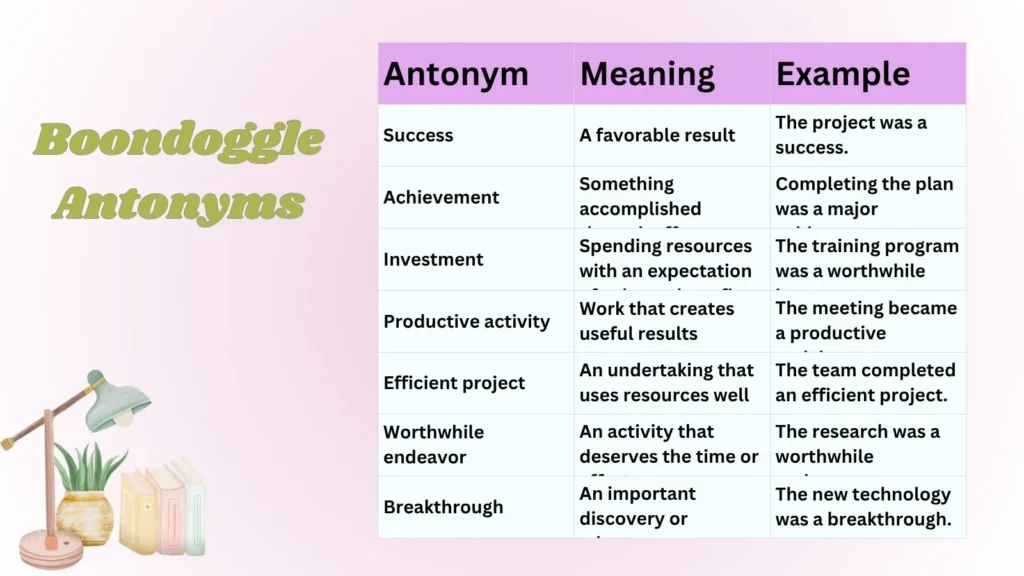
An antonym is a word with the opposite meaning.
Since a boondoggle is a wasteful or unproductive undertaking, suitable opposites include words that suggest usefulness, efficiency, or success.
| Antonym | Meaning | Example |
|---|---|---|
| Success | A favorable result | The project was a success. |
| Achievement | Something accomplished through effort | Completing the plan was a major achievement. |
| Investment | Spending resources with an expectation of value or benefit | The training program was a worthwhile investment. |
| Productive activity | Work that creates useful results | The meeting became a productive activity. |
| Efficient project | An undertaking that uses resources well | The team completed an efficient project. |
| Worthwhile endeavor | An activity that deserves the time or effort | The research was a worthwhile endeavor. |
| Breakthrough | An important discovery or advance | The new technology was a breakthrough. |
For example, instead of describing a project as a boondoggle, you might call it a worthwhile investment if it delivers meaningful benefits.
How to Use Boondoggle Correctly
Understanding the word’s grammatical role will help you use it naturally.
Boondoggle as a Noun
In modern everyday English, boondoggle is primarily used as a noun.
It can refer to a specific project, event, undertaking, or activity that someone considers wasteful.
Examples:
- “The conference was a boondoggle.”
- “The government faced criticism over the boondoggle.”
- “We don’t want another expensive boondoggle.”
- “The project became a boondoggle after its budget doubled.”
You can also use it with adjectives:
- An expensive boondoggle
- A pointless boondoggle
- A government boondoggle
- A corporate boondoggle
- A costly boondoggle
Boondoggle as a Verb
Boondoggle can also be used as a verb, although this use is less common in everyday conversation.
As a verb, it can mean to engage in pointless or wasteful activity, or to spend time on work that appears unproductive.
Examples:
- “The team spent the afternoon boondoggling instead of finishing the report.”
- “Critics argued that officials were boondoggling with public funds.”
In most ordinary situations, the noun form is more familiar and natural.
Common Sentence Patterns
Here are some useful structures:
- A boondoggle: “The new project is a boondoggle.”
- A complete boondoggle: “The expensive event was a complete boondoggle.”
- Turn into a boondoggle: “The simple renovation turned into a boondoggle.”
- Wasteful boondoggle: “The proposal was criticized as a wasteful boondoggle.”
- Government boondoggle: “The article discussed a controversial government boondoggle.”
These expressions can help you use the word confidently in writing and conversation.
Real-Life Examples of Boondoggle
The following scenarios show how the word might be used in everyday situations.
Example 1: At Work
A company introduces a new reporting system. Employees must enter the same information into three different platforms, but management receives no additional useful information.
An employee says, “This reporting system is a boondoggle.”
The employee believes the system wastes time without improving productivity.
Example 2: In Government
A public construction project experiences repeated delays and significant cost increases. Residents question whether the finished project will provide enough benefit to justify the expense.
A newspaper columnist calls it “an expensive government boondoggle.”
The phrase expresses the columnist’s criticism of the project’s cost and value.
Example 3: At School
Students spend several weeks preparing a presentation that is canceled shortly before it is due. They feel that much of their work was unnecessary.
One student says, “All that preparation was a boondoggle.”
The student is expressing frustration about wasted effort.
Example 4: In Business
A company spends a large amount of money developing an app. After launch, very few customers use it, and the company cannot recover its investment.
A manager describes the failed initiative as “a costly boondoggle.”
The word emphasizes the gap between the resources spent and the results achieved.
Example 5: In Everyday Life
Someone spends an entire afternoon filling out unnecessary forms to complete a simple task.
They might say, “The whole process was a boondoggle.”
In this example, the word describes a frustrating activity that took more time and effort than it should have.
Boondoggle vs. White Elephant
Boondoggle and white elephant are similar expressions because both can describe something wasteful or burdensome. However, their meanings are slightly different.
A boondoggle usually emphasizes an unnecessary or wasteful project or activity.
A white elephant usually refers to something expensive to maintain or manage that provides little benefit relative to its cost.
| Feature | Boondoggle | White Elephant |
|---|---|---|
| Main meaning | A wasteful or pointless project | Something costly and burdensome to maintain |
| Common context | Projects, spending, activities, and plans | Buildings, equipment, assets, or expensive possessions |
| Main emphasis | Wasted effort, time, or money | High costs compared with practical value |
| Example | The unnecessary project was a boondoggle. | The unused stadium became a white elephant. |
The expressions sometimes overlap. A public project that wastes money during construction might be called a boondoggle, while the expensive facility it creates might later be called a white elephant.
Boondoggle vs. Fiasco
These words can both describe something negative, but they focus on different problems.
A boondoggle is an activity or project considered wasteful or pointless.
A fiasco is a complete failure or a situation that goes badly in an embarrassing or chaotic way.
For example:
- “The expensive training program was a boondoggle because nobody benefited from it.”
- “The product launch was a fiasco because the website crashed and customers could not place orders.”
A project can be both a boondoggle and a fiasco if it wastes resources and ends in a major failure. However, the words emphasize different aspects of the situation.
Common Mistakes When Using Boondoggle
Although boondoggle is a useful word, there are a few common misunderstandings to avoid.
Mistake 1: Thinking Boondoggle Always Means Fraud
A boondoggle does not automatically involve fraud, corruption, or illegal activity.
It generally means a project or activity that is considered wasteful or unnecessary. A project may become a boondoggle because of poor planning, changing requirements, or disappointing results.
Correct understanding: “The project was a boondoggle” means the speaker considers it wasteful. It does not prove that anyone broke the law.
Mistake 2: Using Boondoggle for Every Failure
Not every unsuccessful activity is a boondoggle.
A difficult project may fail despite careful planning and responsible use of resources. In that situation, failure, setback, or fiasco might be more appropriate, depending on what happened.
Correct understanding: Use boondoggle when you want to emphasize wasted time, money, effort, or resources.
FAQs:
1. What Does Boondoggle Mean in Simple English?
Boondoggle means a wasteful or unnecessary project or activity that consumes time, money, or effort without producing enough useful results. For example, an expensive project that achieves very little may be called a boondoggle.
2. Is Boondoggle a Negative Word?
Yes, it usually has a negative or critical meaning. Calling something a boondoggle suggests that it is wasteful, pointless, or not worth the resources spent on it.
3. Is Boondoggle a Slang Word?
Boondoggle is an established English word, not just internet slang. It is often used informally in conversations, but it also appears in political commentary, journalism, and business discussions.
4. What Is Another Word for Boondoggle?
Common alternatives include waste, folly, fiasco, money pit, and futile exercise. The best synonym depends on whether you want to emphasize wasted resources, poor judgment, or complete failure.
5. Can You Use Boondoggle in a Sentence?
Yes. For example, “The company canceled the expensive project because it had become a boondoggle.” This means the project was considered wasteful and was no longer worth continuing.
Conclusion:
The boondoggle meaning is a wasteful, unnecessary, or unproductive project or activity that uses time, money, or effort without providing enough value.
People commonly use the word when discussing government spending, business investments, workplace procedures, and activities that seem unnecessarily complicated. It usually carries a critical tone, but it does not automatically mean that fraud or illegal activity has occurred.
Remember that boondoggle focuses on wasted resources, while related words such as fiasco emphasize failure and white elephant emphasizes the burden of maintaining something expensive.
Now that you understand the definition, examples, synonyms, and common expressions, you can recognize and use this word more confidently in everyday English. 📚

I am Henry James and i am a passionate writer and language enthusiast behind PunPalace, a platform dedicated to exploring meanings, word origins, and simple explanations. My aims to make learning vocabulary easy, engaging, and accessible for everyone.