Have you ever seen someone smile in a way that did not feel friendly? Perhaps they looked at another person with a raised lip, a mocking expression, or an attitude that seemed to say they were better than everyone else. That expression is often called a sneer.
The word sneer means to show disrespect, contempt, or disapproval through a mocking facial expression, tone of voice, or remark. It usually communicates that someone considers another person or their ideas foolish, inferior, or unworthy of respect.
For example, imagine someone shares an idea during a meeting, and another person responds with a mocking smile and says, “That’s your best idea?” That reaction can be described as a sneer.
The word can be used as both a noun and a verb. As a noun, it describes the mocking expression itself. As a verb, it describes the act of making that expression or speaking in a contemptuous way.
In this guide, we will explore the sneer meaning, pronunciation, origin, examples, synonyms, antonyms, and differences between sneering, smirking, and smiling.
1. Sneer Meaning in Simple Words
Sneer means to show that you think someone or something is foolish, inferior, or deserving of disrespect.
In simple words, it means to make a mocking or disrespectful facial expression or comment.
For example:
- Someone sneers at another person’s clothes.
- A student sneers at a classmate’s answer.
- A person sneers when they hear an idea they consider ridiculous.
- Someone makes a sneering comment to insult another person.
Simple Definition
A sneer is a facial expression, remark, or way of speaking that shows contempt, disrespect, or mocking disapproval.
Quick Meaning Table
| Word | Meaning |
|---|---|
| Sneer | To show contempt through an expression or remark |
| Sneering | Making a mocking or disrespectful expression |
| Sneered | The past tense of sneer |
| Sneeringly | In a mocking or contemptuous manner |
| Sneerer | A person who sneers |
The main idea behind the word is disrespect expressed through facial expressions, words, or tone.
2. Sneer Definition and Pronunciation
Sneer is a common English word used to describe an expression or behavior that communicates contempt.
Pronunciation: SNEER
Phonetic spelling: /snɪər/
Part of speech: Noun and verb
As a Noun
As a noun, sneer refers to a mocking or contemptuous facial expression or remark.
Example: “He gave me a sneer when I suggested the idea.”
Here, sneer describes the expression on his face.
As a Verb
As a verb, sneer means to make a contemptuous expression or speak in a mocking way.
Example: “She sneered at his suggestion.”
Here, sneered describes the action of showing disrespect.
3. Origin and History of the Word Sneer
The word sneer has an interesting history. It appeared in English around the sixteenth century and developed as a word describing a facial expression associated with contempt or scorn.
Its precise historical origins are uncertain, but it became established in English as a term for expressing mockery or disdain.
Over time, its meaning expanded beyond facial expressions. Today, sneer can also describe words, comments, and tones of voice that communicate disrespect.
For example, a person can sneer without making an obvious facial expression. Their words alone may carry a mocking or contemptuous attitude.
The word is commonly found in novels, conversations, journalism, and descriptions of people’s behavior.
4. Sneer Examples in Everyday Life
Understanding examples makes it easier to recognize how sneer is used in different situations.
Here are some common examples.
Example 1: Sneering at Someone’s Appearance
Someone looks at another person’s clothes and makes a mocking facial expression.
Sentence: “The rude teenager sneered at his classmate’s old shoes.”
Example 2: Sneering at an Idea
A person responds to someone’s suggestion with contempt.
Sentence: “He sneered at the proposal instead of considering it seriously.”
Example 3: Sneering During an Argument
Someone uses a mocking expression to make another person feel foolish.
Sentence: “She gave him a sneer during the argument.”
Example 4: Sneering at Someone’s Achievement
A person dismisses another individual’s success.
Sentence: “Instead of congratulating her, he sneered at her achievement.”
Example 5: Sneering in the Workplace
A colleague reacts disrespectfully to another employee’s suggestion.
Sentence: “The manager sneered when the new employee offered an unusual solution.”
Example 6: Sneering in a Conversation
Someone makes a sarcastic comment with a contemptuous tone.
Sentence: “He sneered, ‘You really think that will work?'”
These examples show that sneering often involves disrespect, mockery, or a feeling of superiority.
5. What Does a Sneer Look Like?
A sneer is usually recognized through facial expressions that communicate contempt or mockery.
It may include:
- One corner of the mouth lifting.
- The upper lip curling slightly.
- A mocking or dismissive smile.
- A raised eyebrow combined with a contemptuous expression.
- A look that suggests disrespect or superiority.
However, not every crooked smile or raised eyebrow is a sneer. Facial expressions depend on context, and the same expression can communicate different emotions in different situations.
Sneer vs. Normal Smile
| Sneer | Normal Smile |
|---|---|
| Often communicates contempt | Usually communicates friendliness or happiness |
| Can appear mocking | Usually appears welcoming |
| May make someone feel insulted | Often makes someone feel comfortable |
| Can show superiority | Can show warmth or appreciation |
| Often has a negative tone | Usually has a positive or neutral tone |
A sneer is not simply a smile. It carries an attitude of disrespect or mockery.
6. Sneer Meaning in Different Situations
The word sneer can be used in several contexts, including relationships, school, workplaces, literature, and everyday communication.
A. Sneer Meaning in Relationships
In relationships, a sneer can communicate disrespect, frustration, or contempt toward a partner.
For example:
“He sneered at her suggestion instead of listening.”
This describes a dismissive reaction that may make the other person feel unimportant.
Repeated contemptuous behavior can damage communication and trust in relationships.
B. Sneer Meaning at School
Students may use sneering expressions to mock classmates or dismiss their opinions.
For example:
“The student sneered when his classmate gave the wrong answer.”
This suggests a mocking or disrespectful reaction.
C. Sneer Meaning in the Workplace
In professional settings, sneering can make communication uncomfortable and discourage people from sharing ideas.
For example:
“The employee sneered at the proposal during the meeting.”
This means the employee reacted with contempt rather than offering constructive feedback.
D. Sneer Meaning in Literature
Writers often use the word sneer to describe characters who are arrogant, cruel, sarcastic, or dismissive.
For example:
“The villain wore a cold sneer as he entered the room.”
This description helps readers imagine the character’s unpleasant attitude.
E. Sneer Meaning in Everyday Conversation
In daily conversations, sneer can describe both facial expressions and disrespectful remarks.
Example:
“Don’t sneer at people just because they have different opinions.”
Here, sneer means to mock or show contempt toward others.
7. Sneer Synonyms
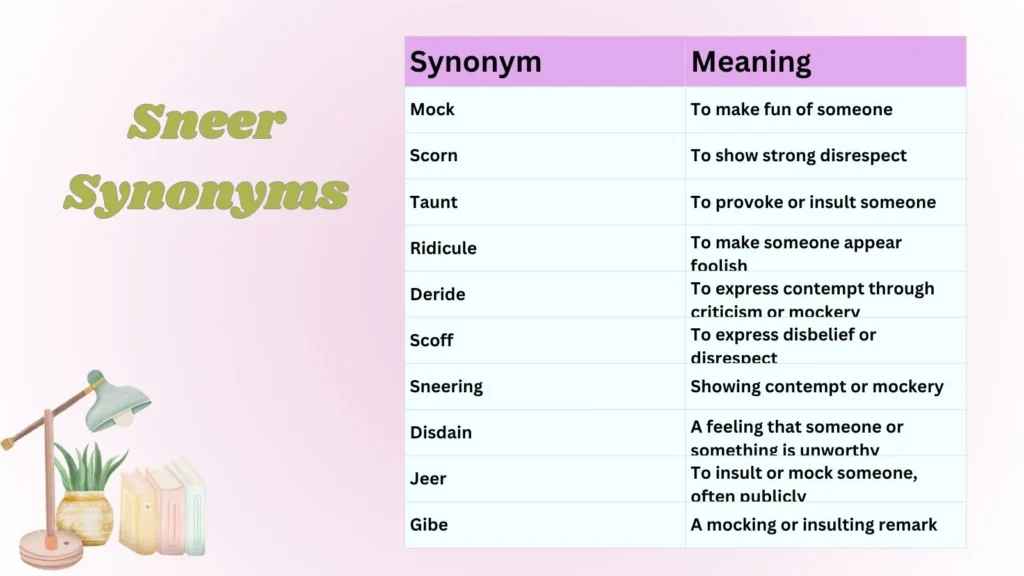
Synonyms are words that have similar meanings. Learning the synonyms of sneer can help you understand the word more deeply and improve your vocabulary.
| Synonym | Meaning |
|---|---|
| Mock | To make fun of someone |
| Scorn | To show strong disrespect |
| Taunt | To provoke or insult someone |
| Ridicule | To make someone appear foolish |
| Deride | To express contempt through criticism or mockery |
| Scoff | To express disbelief or disrespect |
| Sneering | Showing contempt or mockery |
| Disdain | A feeling that someone or something is unworthy |
| Jeer | To insult or mock someone, often publicly |
| Gibe | A mocking or insulting remark |
Which Synonym Is Best for Sneer?
The best synonym depends on the situation.
- Use mock when someone makes fun of another person.
- Use scorn when expressing strong disrespect.
- Use ridicule when making someone look foolish.
- Use scoff when showing disbelief or contempt.
- Use taunt when deliberately provoking someone.
- Use deride when criticizing someone in a mocking way.
For example, “He sneered at the suggestion” could also be expressed as “He scoffed at the suggestion.”
8. Antonyms of Sneer
Antonyms are words that have opposite meanings.
Since sneer communicates contempt or disrespect, its antonyms generally express kindness, admiration, friendliness, or respect.
| Antonym | Meaning |
|---|---|
| Smile | To show happiness or friendliness |
| Praise | To express approval or admiration |
| Respect | To treat someone with consideration |
| Admire | To regard someone positively |
| Compliment | To say something positive about someone |
| Appreciate | To recognize someone’s value |
| Encourage | To give someone confidence or support |
| Approve | To accept or express agreement |
| Applaud | To show approval or appreciation |
| Welcome | To greet someone warmly |
Example:
- Sneer: “She sneered at his efforts.”
- Opposite idea: “She praised his efforts.”
9. Sneer vs. Smirk: What’s the Difference?
Sneer and smirk are sometimes confused because both can involve an unusual or slightly crooked smile.
However, they communicate different attitudes.
Sneer usually expresses contempt, disrespect, or mockery.
Smirk usually describes a small, self-satisfied smile that may suggest confidence, amusement, or smugness.
Comparison Table
| Sneer | Smirk |
|---|---|
| Shows contempt or disrespect | Shows self-satisfaction or amusement |
| Often has a mocking quality | Often has a smug quality |
| Can be openly insulting | May be subtle or knowing |
| Usually has a negative meaning | Can be negative, playful, or neutral depending on context |
| May communicate superiority | May communicate confidence or satisfaction |
Examples of Sneer
“He sneered at her question.”
This means he showed disrespect or contempt.
Examples of Smirk
“He smirked after winning the game.”
This means he gave a small, self-satisfied smile.
Easy trick: A sneer often says, “I think you’re beneath me.” A smirk often says, “I’m pleased with myself.”
10. Sneer vs. Scoff: What’s the Difference?
Sneer and scoff are closely related, but they describe different ways of expressing contempt.
Sneer usually involves a facial expression or a contemptuous way of speaking.
Scoff means to express disbelief, ridicule, or disrespect, often through words or a dismissive sound.
| Sneer | Scoff |
|---|---|
| Often involves a contemptuous facial expression | Often involves a dismissive reaction |
| Can be silent | Can involve words, laughter, or sounds |
| Shows disdain or mockery | Shows disbelief or contempt |
| “He sneered at the idea.” | “He scoffed at the idea.” |
Both words can describe disrespectful reactions, but sneer focuses more on the expression or manner, while scoff often emphasizes the dismissive response.
11. Common Expressions and Phrases With Sneer
Sneer appears in several useful English expressions.
1. Give Someone a Sneer
Means to make a contemptuous or mocking facial expression toward someone.
Example: “She gave him a sneer when he entered the room.”
2. Sneer at Someone
Means to show disrespect or contempt toward a person.
Example: “You should never sneer at someone because of their appearance.”
3. Sneer at an Idea
Means to dismiss an idea with mockery or contempt.
Example: “The committee sneered at the suggestion.”
4. Sneer With Disdain
Means to make a contemptuous expression showing strong disrespect.
Example: “He sneered with disdain when he heard the excuse.”
5. A Sneering Comment
A remark that expresses mockery, disrespect, or contempt.
Example: “Her sneering comment made the conversation uncomfortable.”
6. A Cold Sneer
A facial expression that communicates a lack of warmth, sympathy, or respect.
Example: “He answered with a cold sneer.”
12. Sneer Meaning in Text Messages and Social Media
Although sneer is not a common texting abbreviation, people use the word in online conversations to describe mocking or disrespectful behavior.
For example:
- “Why did you sneer at my idea?”
- “I don’t appreciate your sneering comments.”
- “He responded with a sneer instead of answering.”
- “Stop sneering at people who are trying their best.”
On social media, sneer may describe a mocking reaction, a contemptuous comment, or a facial expression shown in a picture or video.
Can an Emoji Represent a Sneer?
Some emojis can communicate smugness, sarcasm, or mockery, but none has exactly the same meaning in every context.
For example, the smirking face emoji may sometimes suggest a smug or teasing attitude. However, a sneer specifically communicates contempt or disrespect.
13. How to Use Sneer Correctly in a Sentence
Sneer can function as both a noun and a verb. Understanding its grammatical use will help you use it correctly.
Sneer as a Noun
Use sneer when referring to the expression or mocking remark itself.
Examples:
- “He gave me a sneer.”
- “There was a sneer on her face.”
- “His sneer showed his disappointment.”
- “I ignored the rude sneer.”
Sneer as a Verb
Use sneer when describing the action of expressing contempt.
Examples:
- “They sneer at people who disagree with them.”
- “She sneered at his suggestion.”
- “He began to sneer during the conversation.”
- “The audience sneered at the ridiculous performance.”
Common Sentence Structure
| Structure | Example |
|---|---|
| Sneer at + person | “He sneered at his opponent.” |
| Sneer at + idea | “She sneered at the proposal.” |
| Give + someone + a sneer | “He gave me a sneer.” |
| Sneer with + emotion | “She sneered with contempt.” |
| Sneering + noun | “His sneering expression was unpleasant.” |
14. Common Mistakes When Using the Word Sneer
Although sneer is easy to understand, people sometimes confuse it with other expressions or use it incorrectly.
Mistake 1: Confusing Sneer With a Friendly Smile
Incorrect understanding: “A sneer is just another word for smiling.”
Correct understanding: A sneer usually communicates contempt, mockery, or disrespect. A friendly smile generally communicates warmth or happiness.
Mistake 2: Confusing Sneer With Smirk
Incorrect understanding: “Sneer and smirk always mean the same thing.”
Correct understanding: A sneer expresses contempt, while a smirk often expresses smugness or self-satisfaction.
Mistake 3: Thinking Sneer Is Only a Noun
Incorrect understanding: “Sneer can only describe a facial expression.”
Correct understanding: Sneer can be both a noun and a verb.
Examples:
- Noun: “He gave a sneer.”
- Verb: “He sneered at me.”
Mistake 4: Using Sneer When You Mean Whisper
Incorrect: “She sneered something quietly.”
Better: “She whispered something quietly.”
Correct understanding: Whisper describes speaking softly, while sneer describes expressing contempt or mockery.
Mistake 5: Assuming Every Unusual Facial Expression Is a Sneer
Incorrect understanding: “Any crooked smile means someone is sneering.”
Correct understanding: A sneer involves contempt or mockery. Facial expressions should be understood in their conversational context.
15. More Examples of Sneer in Sentences
Here are 15 additional sentences to help you understand how sneer works in everyday English.
- “The arrogant man sneered at everyone around him.”
- “She noticed the sneer on his face.”
- “He gave a sneering reply to the simple question.”
- “The teacher told the students not to sneer at their classmates.”
- “His face twisted into a cruel sneer.”
- “The actor delivered the line with a sarcastic sneer.”
- “She sneered when someone challenged her opinion.”
- “The politician responded with a sneer instead of an explanation.”
- “I could hear the sneer in his voice.”
- “He tried to hide his sneer during the meeting.”
- “The character’s sneer made him seem arrogant.”
- “Never sneer at someone who is learning something new.”
- “She looked at the broken chair with a sneer.”
- “His sneering attitude upset the entire team.”
- “The audience reacted negatively to his sneering remarks.”
These sentences show that sneer can describe expressions, attitudes, comments, and actions.
FAQs:
1. What does sneer mean in simple words?
Sneer means to show disrespect, contempt, or mockery through a facial expression, tone of voice, or remark. It often involves a mocking or unpleasant smile.
2. Is sneer a positive or negative word?
Sneer is generally a negative word because it describes contemptuous, mocking, or disrespectful behavior.
3. What is another word for sneer?
Common synonyms include mock, scoff, scorn, ridicule, deride, taunt, and jeer. The best synonym depends on the context.
4. What does it mean to sneer at someone?
To sneer at someone means to show contempt or disrespect toward them through a facial expression, tone, or mocking remark.
5. What is the difference between sneer and smirk?
A sneer communicates contempt or disrespect, while a smirk is a small, self-satisfied smile that may suggest smugness, amusement, or confidence.
6. What does a sneer look like?
A sneer may involve a raised corner of the mouth, a curled upper lip, or a mocking facial expression. It often communicates contempt or superiority.
7. What is the opposite of sneer?
Opposite words include smile, praise, respect, admire, appreciate, encourage, and compliment.
8. Can sneer be used as a verb?
Yes. Sneer is both a noun and a verb. For example, “He gave a sneer” uses it as a noun, while “He sneered at the suggestion” uses it as a verb.
9. What does sneering mean?
Sneering means expressing contempt, disrespect, or mockery through facial expressions, words, or tone of voice.
10. What does a sneer mean in literature?
In literature, a sneer often describes a character’s contemptuous expression or arrogant attitude. Writers use it to show hostility, superiority, mockery, or disrespect.
Conclusion:
The sneer meaning refers to showing contempt, disrespect, or mockery through a facial expression, tone of voice, or remark. It can be used as both a noun and a verb, making it useful when describing people’s expressions and behavior.
A sneer is different from a normal smile because it usually carries a negative attitude. It is also different from a smirk, which often communicates smugness or self-satisfaction rather than direct contempt.
Whether you encounter the word in a novel, conversation, workplace discussion, or social media post, remember its central meaning: a sneer is an expression or remark that shows disrespect or scorn.
Understanding this word will help you recognize its use in everyday English and communicate more clearly and confidently.

I am Henry James and i am a passionate writer and language enthusiast behind PunPalace, a platform dedicated to exploring meanings, word origins, and simple explanations. My aims to make learning vocabulary easy, engaging, and accessible for everyone.