
Have you ever wondered why we say to eat, to sleep, or to learn instead of simply using eat, sleep, or learn in certain sentences? These forms are called infinitives, and they play an important role in English grammar.
The infinitive meaning refers to the basic form of a verb, commonly written with the word to before it. For example, to read, to write, and to speak are infinitives. However, an infinitive can also appear without to, as in can swim or let him go.
Understanding infinitives helps you build grammatically correct sentences, express purposes, describe plans, and communicate more clearly in English.
In this guide, you will learn the definition of an infinitive, its types, grammar rules, common mistakes, and easy examples you can use in everyday conversations. 📚
What Is the Meaning of Infinitive?
An infinitive is the basic form of a verb that can function in different ways within a sentence. It commonly appears as to followed by a base verb.
Examples include:
- To eat
- To sleep
- To study
- To play
- To write
- To travel
- To understand
In these examples, eat, sleep, study, and the other words are base verbs. Adding to creates the common to-infinitive form.
Consider this sentence:
I want to learn English.
Here, to learn is an infinitive that completes the meaning of the verb want.
Another example is:
She went to the library to study.
In this sentence, to study explains the purpose of going to the library.
An infinitive does not show tense by itself in the same way a finite verb does. Instead, its role and meaning depend on the sentence in which it appears.
Infinitive Meaning in Simple English

In simple English, an infinitive is a verb in its basic form, often used with the word to.
For example:
- To run
- To dance
- To cook
- To sing
- To learn
You can use infinitives to talk about things you want to do, need to do, plan to do, or hope to do.
Examples:
- I want to travel.
- He needs to rest.
- We plan to visit our grandparents.
- She hopes to win the competition.
The bold words are infinitives.
Think of an infinitive as a verb form that allows you to express an action as an idea, goal, plan, or purpose.
Types of Infinitives in English Grammar
English grammar commonly distinguishes between the to-infinitive and the bare infinitive. More advanced grammar also describes perfect, continuous, passive, and perfect continuous infinitives.
Let’s explore the main types with examples.
1. To-Infinitive
A to-infinitive consists of to followed by the base form of a verb.
Structure: To + base verb
Examples:
- To read
- To write
- To eat
- To learn
- To exercise
Example sentences:
- I want to read this book.
- She decided to leave early.
- They hope to win the match.
- He needs to finish his homework.
The to-infinitive commonly appears after verbs such as want, hope, decide, plan, and need.
2. Bare Infinitive
A bare infinitive is the base form of a verb used without to.
Examples:
- Eat
- Go
- Come
- Speak
- Dance
Bare infinitives commonly follow modal verbs such as can, could, may, might, must, should, and will.
Example sentences:
- I can swim.
- She should study.
- They must leave now.
- We will visit tomorrow.
Notice that we do not say I can to swim or she should to study in standard English.
Bare infinitives also appear after certain verbs, including let and make, in constructions such as:
- Let him go.
- The teacher made us rewrite the answer.
3. Perfect Infinitive
A perfect infinitive is formed with to have followed by a past participle.
Structure: To have + past participle
Examples:
- To have finished
- To have arrived
- To have forgotten
- To have completed
Example sentences:
- She seems to have forgotten my message.
- He claims to have completed the work.
- They appear to have left early.
The perfect infinitive often refers to an action that happened before the time of the main verb.
4. Continuous Infinitive
A continuous infinitive describes an action as ongoing.
Structure: To be + verb ending in -ing
Examples:
- To be working
- To be studying
- To be sleeping
- To be waiting
Example sentences:
- She seems to be working late.
- He appears to be sleeping.
- They are happy to be living here.
The continuous infinitive emphasizes an activity in progress.
5. Passive Infinitive
A passive infinitive focuses on an action being done to someone or something.
Structure: To be + past participle
Examples:
- To be invited
- To be selected
- To be informed
- To be respected
Example sentences:
- I hope to be selected for the team.
- She wants to be invited to the event.
- The documents need to be signed.
The person or thing receiving the action is the focus.
6. Perfect Continuous Infinitive
A perfect continuous infinitive combines the perfect and continuous forms.
Structure: To have been + verb ending in -ing
Examples:
- To have been working
- To have been studying
- To have been waiting
Example sentences:
- He seems to have been working all night.
- She claims to have been studying for hours.
- They appear to have been waiting for a long time.
This form often emphasizes the duration of an activity that began earlier.
How to Use Infinitives in a Sentence
Infinitives can perform several functions in English sentences. They can express purpose, complete the meaning of another verb, describe nouns, or act as subjects and complements.
1. Infinitive as the Subject
An infinitive phrase can function as the subject of a sentence.
Examples:
- To exercise regularly is beneficial.
- To learn a new language takes time.
- To help others is a kind act.
In each sentence, the infinitive phrase identifies the activity being discussed.
In everyday English, a sentence with it as the subject is often more natural:
- It is beneficial to exercise regularly.
- It takes time to learn a new language.
Both patterns are grammatically acceptable.
2. Infinitive as the Object of a Verb
An infinitive can follow a verb and complete its meaning.
Examples:
- I want to sleep.
- She decided to study.
- We hope to succeed.
- He promised to help.
In these sentences, the infinitive tells us what the person wants, decides, hopes, or promises.
Common verbs followed by to-infinitives include:
- Want
- Need
- Hope
- Decide
- Plan
- Promise
- Agree
- Refuse
- Learn
- Expect
Example: “They agreed to participate.”
3. Infinitive to Show Purpose
One of the most common uses of an infinitive is to explain why someone does something.
Examples:
- I went outside to get some fresh air.
- She studies hard to pass the exam.
- He called me to ask a question.
- We saved money to buy a car.
In these sentences, the infinitive answers the question why?
For example:
“Why did she study hard?”
“She studied hard to pass the exam.”
The infinitive phrase explains the purpose of the action.
4. Infinitive After an Adjective
Infinitives often follow adjectives to complete their meaning.
Examples:
- I am happy to help.
- She is ready to leave.
- He was surprised to hear the news.
- They are eager to learn.
- This book is easy to understand.
The infinitive tells us what causes the feeling or what action is possible or necessary.
5. Infinitive After a Noun
An infinitive can describe or provide more information about a noun.
Examples:
- I have a lot of work to do.
- She needs a place to stay.
- He has a story to tell.
- We need something to eat.
In “I have a lot of work to do,” the phrase to do explains what kind of work is meant.
6. Infinitive After Question Words
Infinitives can follow question words such as what, where, when, how, and who.
Examples:
- I don’t know what to say.
- She explained how to solve the problem.
- We need to decide where to go.
- He showed me how to use the computer.
- They discussed when to begin.
These constructions are useful when discussing choices, instructions, or decisions.
Infinitive Rules You Should Know
Learning a few essential rules will help you use infinitives correctly.
Rule 1: Use the Base Form After To
In a standard to-infinitive, use the base form of the verb.
Correct:
- I want to go.
- She needs to work.
- They plan to travel.
Incorrect:
- I want to goes.
- She needs to worked.
- They plan to traveling.
Remember that to is followed by the base form in a standard to-infinitive.
Rule 2: Use Bare Infinitives After Modal Verbs
Modal verbs generally take the bare infinitive.
Correct:
- He can drive.
- You should listen.
- We must leave.
Incorrect:
- He can to drive.
- You should to listen.
- We must to leave.
Rule 3: Some Verbs Take an Infinitive
Certain verbs are commonly followed by to-infinitives.
Examples:
- I decided to stay.
- She wants to learn.
- He promised to call.
- They hope to win.
However, not every verb follows the same pattern. Some verbs take gerunds, while others can take both forms with different or similar meanings.
Rule 4: Use an Infinitive to Explain Purpose
When explaining why someone does something, a to-infinitive is often appropriate.
Examples:
- I went to the shop to buy milk.
- She called to ask for help.
- He opened the window to let in fresh air.
Rule 5: Do Not Confuse Infinitive To With Prepositional To
This is an especially important rule.
In a to-infinitive, to is followed by the base form of a verb:
- I want to learn.
- She plans to travel.
However, to can also be a preposition. When it functions as a preposition, it can be followed by a noun or a verb ending in -ing.
Examples:
- I look forward to meeting you.
- She is committed to improving her skills.
- He is accustomed to waking up early.
In these examples, to meeting, to improving, and to waking are not to-infinitives. The word to is a preposition.
Infinitive vs. Gerund
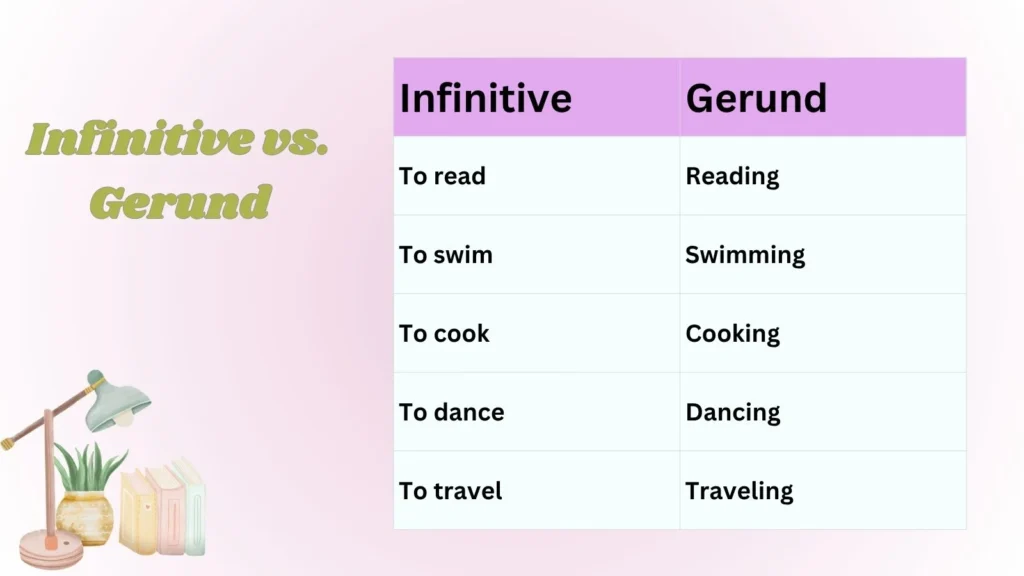
An infinitive and a gerund both involve verbs, but they have different forms.
An infinitive commonly uses to followed by the base verb, while a gerund uses the -ing form as a noun-like element.
| Infinitive | Gerund |
|---|---|
| To read | Reading |
| To swim | Swimming |
| To cook | Cooking |
| To dance | Dancing |
| To travel | Traveling |
Examples:
- I like to read before bed.
- I enjoy reading before bed.
Both sentences are correct, although some verbs change meaning or emphasis depending on which form follows them.
Verbs Followed by Infinitives
Common examples include:
- Want to go
- Decide to leave
- Hope to win
- Plan to study
- Promise to help
Example: “She decided to join the club.”
Verbs Followed by Gerunds
Common examples include:
- Enjoy reading
- Avoid making
- Finish working
- Suggest going
- Consider moving
Example: “She enjoys reading novels.”
Verbs That Can Take Both Forms
Some verbs can be followed by either a gerund or an infinitive.
For example:
- I like to swim.
- I like swimming.
Other verbs, such as stop, can change meaning depending on the form:
- He stopped smoking means he quit smoking.
- He stopped to smoke means he paused another activity in order to smoke.
Understanding these patterns helps you create more accurate and natural sentences.
Infinitive vs. Finite Verb
A finite verb shows grammatical information such as tense or agreement with the subject. An infinitive is a non-finite verb form.
Compare these examples:
Finite verb: She works every day.
Infinitive: She wants to work every day.
In the first sentence, works is the finite verb. It agrees with the subject she in the present tense.
In the second sentence, wants is finite, while to work is an infinitive.
Here are more examples:
| Sentence | Finite Verb | Infinitive |
|---|---|---|
| I want to eat. | Want | To eat |
| He hopes to win. | Hopes | To win |
| They plan to travel. | Plan | To travel |
| She decided to leave. | Decided | To leave |
This distinction is useful when learning more advanced English grammar.
Infinitive Phrases and Their Examples
An infinitive phrase consists of an infinitive and any words that complete or modify it.
Examples:
- To finish the assignment
- To buy a new phone
- To help her younger brother
- To learn English quickly
- To complete the project on time
Consider this sentence:
“She wants to finish the assignment before dinner.”
The infinitive phrase is to finish the assignment before dinner. It includes the infinitive to finish and additional words that complete its meaning.
More examples:
- To learn English fluently is my goal.
- He went to the market to buy fresh vegetables.
- They need to complete the report today.
- She is excited to meet her favorite author.
Infinitive phrases allow you to communicate ideas with more detail.
Common Infinitive Examples in Everyday English
You can find infinitives in everyday conversations, schoolwork, professional communication, and written English.
Here are 20 useful examples.
- I want to eat something.
- She needs to sleep early.
- We plan to visit our cousins.
- He hopes to become a doctor.
- They decided to move abroad.
- I forgot to lock the door.
- She promised to help me.
- He learned to drive last year.
- We went outside to play.
- I am happy to see you.
- They are ready to begin.
- She has a letter to write.
- I don’t know what to do.
- He asked me to wait.
- We need to leave now.
- She wants to improve her English.
- I called him to explain the situation.
- They hope to finish the work soon.
- He seems to understand the lesson.
- I would like to order a cup of tea.
These examples demonstrate how infinitives express desires, plans, purposes, and actions.
Common Mistakes When Using Infinitives
Even English learners who understand infinitives sometimes make mistakes with verb forms and sentence structure.
1. Adding the Wrong Verb Form After To
Incorrect: She wants to goes home.
Correct: She wants to go home.
Use the base form after the infinitive marker to.
2. Using To After a Modal Verb
Incorrect: He can to swim.
Correct: He can swim.
Modal verbs such as can, should, and must generally take the bare infinitive.
3. Confusing Infinitives With Gerunds
Incorrect: I enjoy to read books.
Correct: I enjoy reading books.
The verb enjoy is followed by a gerund, not a to-infinitive.
4. Forgetting the Infinitive After Certain Adjectives
Incorrect: I am happy see you.
Correct: I am happy to see you.
The adjective happy can be followed by a to-infinitive in this construction.
5. Using an Infinitive After Every Verb
Not every verb takes an infinitive. For example, avoid is generally followed by a gerund.
Incorrect: She avoided to answer the question.
Correct: She avoided answering the question.
Learning which verbs take infinitives and which take gerunds will help you avoid this mistake.
FAQs:
1. What Is the Meaning of Infinitive in English Grammar?
An infinitive is a non-finite verb form, commonly made with to plus the base verb, such as to eat or to learn. It can express an action, purpose, plan, or idea.
2. What Are Five Examples of Infinitives?
Five examples are to read, to write, to play, to learn, and to travel. Each consists of to followed by the base form of a verb.
3. What Are the Two Main Types of Infinitives?
The two commonly taught forms are the to-infinitive, such as to speak, and the bare infinitive, such as speak after a modal verb in “I can speak.”
4. What Is a Bare Infinitive?
A bare infinitive is a verb in its base form without to. For example, go in “You should go now” is a bare infinitive.
5. What Is the Difference Between an Infinitive and a Gerund?
An infinitive commonly uses to plus a base verb, as in to swim. A gerund uses the -ing form in a noun-like role, as in swimming.
6. Can an Infinitive Be the Subject of a Sentence?
Yes. For example, “To exercise regularly is important.” The infinitive phrase to exercise regularly acts as the subject.
7. Why Do We Use Infinitives?
Infinitives help express goals, intentions, purposes, plans, and actions. For example, “I study hard to pass my exam” uses an infinitive to explain the purpose of studying.
8. Is the Word To Always Part of an Infinitive?
No. Sometimes to is a preposition, as in “I look forward to meeting you.” Here, meeting is a gerund, not an infinitive.
Conclusion:
The infinitive meaning is simple once you understand how infinitives work. An infinitive is a non-finite form of a verb, commonly written as to plus the base verb, such as to eat, to study, or to travel. It can also appear without to, as in can swim or let him go.
Infinitives are useful for expressing purposes, plans, intentions, and actions. Learning their types, rules, and differences from gerunds will help you improve your English grammar and write more natural sentences.
Start by identifying infinitives in everyday sentences and practicing a few examples each day. With regular practice, you will become more confident using infinitives in both speaking and writing.

I am Henry James and i am a passionate writer and language enthusiast behind PunPalace, a platform dedicated to exploring meanings, word origins, and simple explanations. My aims to make learning vocabulary easy, engaging, and accessible for everyone.