
Noticing a change in vaginal discharge can naturally make you wonder whether something is wrong. The good news is that creamy discharge is often a normal part of vaginal health, particularly when it is white or off-white, mild-smelling, and occurs without itching, burning, pain, or other unusual symptoms.
The creamy discharge meaning can vary depending on where you are in your menstrual cycle, hormonal changes, pregnancy, sexual activity, and other factors. Discharge can naturally change in color, texture, and amount throughout the month.
However, creamy discharge can sometimes occur alongside an infection or another condition. That is why the appearance of discharge alone cannot provide a definite diagnosis.
In this guide, we will explain what creamy discharge can mean, why it happens, how it may change during the menstrual cycle, and which symptoms suggest that you should speak with a healthcare professional.
What Does Creamy Discharge Mean?
Creamy discharge generally describes vaginal fluid that has a smooth, lotion-like, or creamy consistency.
For many people, this type of discharge is completely normal. The vagina naturally produces fluid and mucus that help maintain moisture and protect the vaginal environment.
Simple meaning: Creamy discharge is vaginal fluid with a smooth or creamy texture, and it can be a normal result of hormonal changes.
The important point is that texture alone does not tell you whether discharge is normal or abnormal. You should also consider its color, smell, amount, and whether you have symptoms such as itching, irritation, pain, or burning.
Is Creamy Discharge Normal?

In many cases, yes.
Normal vaginal discharge can be clear, white, or off-white and can have different textures at different points in the menstrual cycle.
It may sometimes look:
- Thin and watery
- Sticky
- Slippery
- Creamy
- Milky
- Slightly thick
A mild or barely noticeable smell can also be normal.
If creamy discharge occurs without concerning symptoms and follows a person’s usual pattern, it is often not a reason for alarm.
Creamy Discharge and the Menstrual Cycle
Hormones can cause vaginal discharge to change throughout the menstrual cycle.
After menstruation, discharge may initially be relatively dry or sticky for some people. As estrogen rises, cervical mucus can become wetter, clearer, or more slippery around the fertile part of the cycle.
At other times, particularly after ovulation, discharge may become thicker or creamier because of hormonal changes.
This means that seeing creamy discharge at a particular point in your cycle does not automatically indicate a problem.
| Cycle Stage | Possible Discharge Pattern | What It May Reflect |
|---|---|---|
| After period | Less discharge or sticky fluid | Normal hormonal changes |
| Before ovulation | Increasingly moist or creamy | Rising estrogen |
| Around ovulation | Often wetter or slippery | Fertile cervical mucus |
| After ovulation | Often thicker or creamier | Hormonal changes |
| Before next period | May become thicker or more noticeable | Changing hormone levels |
These patterns are general. Everyone’s discharge pattern is different, and not everyone experiences the same changes.
What Causes Creamy Discharge?
Several normal factors can contribute to creamy vaginal discharge.
Hormonal Changes
Changes in estrogen and progesterone can affect cervical mucus and vaginal secretions. This is one of the most common reasons discharge changes throughout the menstrual cycle.
Ovulation
The days around ovulation can bring noticeable changes in cervical mucus. Although fertile mucus is often described as clear and stretchy, discharge can also vary in appearance before and after ovulation.
Before Your Period
Hormonal changes before menstruation may make discharge appear thicker, creamier, or more noticeable.
Pregnancy
Pregnancy can increase vaginal discharge because of hormonal and blood-flow changes. This normal pregnancy-related discharge is often called leukorrhea and is generally thin or milky white.
However, creamy discharge by itself cannot confirm pregnancy. If pregnancy is possible, a pregnancy test is a more appropriate way to check.
Birth Control and Hormones
Hormonal contraception can alter cervical mucus and vaginal discharge. A change after starting, stopping, or changing hormonal birth control may therefore be related to those hormonal effects.
White Creamy Discharge Meaning
White creamy discharge can be completely normal, especially when it does not have a strong unpleasant smell and is not accompanied by irritation or pain.
Normal discharge can appear white or slightly off-white and may become more visible after drying on underwear.
However, white discharge can also occur with certain vaginal infections. Therefore, color alone is not enough to determine the cause.
Pay attention to additional signs such as:
- Strong or unusual odor
- Persistent itching
- Burning
- Redness or swelling
- Pain during urination
- Pelvic pain
- Unusual bleeding
- A sudden major change from your normal discharge
If these symptoms occur, consider speaking with a healthcare professional rather than trying to diagnose the cause from discharge appearance alone.
Thick Creamy Discharge Meaning
Thick creamy discharge can sometimes be part of normal hormonal changes.
For example, discharge may become thicker after ovulation or at other points in the menstrual cycle.
However, very thick discharge accompanied by intense itching, irritation, redness, or discomfort may occur with a yeast infection.
A yeast infection commonly causes itching and irritation and may produce thick, white discharge. Still, other conditions can cause similar symptoms, so testing or professional evaluation may be necessary for an accurate diagnosis.
Creamy Discharge Before Your Period
Some people notice creamy discharge in the days leading up to their period.
This can happen because hormone levels change after ovulation and continue changing as the body approaches menstruation.
If the discharge is similar to what you normally experience and there are no concerning symptoms, it may simply reflect your normal cycle.
However, if the discharge suddenly becomes very different from your usual pattern, develops a strong unpleasant odor, or comes with pain or irritation, it is worth getting medical advice.
Creamy Discharge After Ovulation
After ovulation, progesterone becomes more prominent and cervical mucus may become thicker, stickier, or creamier.
For this reason, creamy discharge after ovulation can be a normal cycle-related change.
It is important not to use discharge texture alone to determine whether ovulation definitely occurred. Menstrual cycles can vary, and mucus patterns are not a guaranteed way to identify ovulation.
Creamy Discharge During Pregnancy
Pregnancy can cause an increase in normal vaginal discharge. This is sometimes called leukorrhea.
Pregnancy-related discharge is commonly thin, milky, or white and generally does not have a strong unpleasant odor.
But creamy discharge alone is not a reliable pregnancy test.
If you have had unprotected sex or another situation where pregnancy is possible and your period is late, taking an appropriate pregnancy test is a much better way to find out.
If you are pregnant and notice discharge accompanied by bleeding, significant pain, a strong unpleasant odor, fever, or other concerning symptoms, contact a healthcare professional promptly.
Creamy Discharge vs Yeast Infection
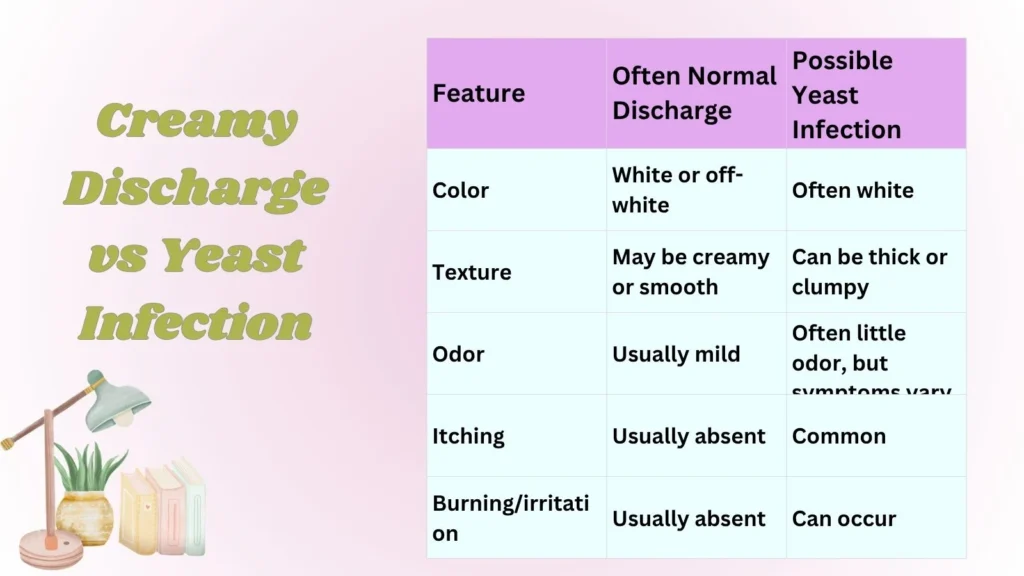
One common misconception is that all thick white or creamy discharge means a yeast infection. That is not necessarily true.
| Feature | Often Normal Discharge | Possible Yeast Infection |
|---|---|---|
| Color | White or off-white | Often white |
| Texture | May be creamy or smooth | Can be thick or clumpy |
| Odor | Usually mild | Often little odor, but symptoms vary |
| Itching | Usually absent | Common |
| Burning/irritation | Usually absent | Can occur |
This comparison is only a general guide. Symptoms can overlap, and several different conditions can cause similar discharge changes.
Creamy Discharge vs Normal Cervical Mucus
Cervical mucus is produced by glands in and around the cervix. Its texture changes as hormone levels change.
At some points in the cycle, it can be creamy and opaque. At other points, it may become clearer, wetter, and more slippery.
These changes are part of the body’s reproductive system and can occur without any illness.
Therefore, creamy cervical mucus does not automatically mean something is wrong.
Does Creamy Discharge Mean Ovulation?
Not necessarily.
Creamy discharge can occur around different stages of the menstrual cycle. Fertile cervical mucus is often wetter, clearer, and more slippery as ovulation approaches.
Because discharge patterns differ between individuals, you should not assume that creamy discharge proves that ovulation is happening.
If you are tracking ovulation for fertility purposes, consider using a more reliable fertility-awareness method or discussing appropriate tracking methods with a qualified healthcare professional.
Does Creamy Discharge Mean Pregnancy?
No, creamy discharge alone does not mean you are pregnant.
Hormonal changes during pregnancy can increase vaginal discharge, but similar discharge can occur during a normal menstrual cycle.
If you think you might be pregnant, consider taking a pregnancy test according to its instructions. If you receive an unexpected result or have questions about timing, a healthcare professional can provide guidance.
When Is Creamy Discharge Concerning?
Creamy discharge deserves more attention when it is accompanied by symptoms that are unusual for you.
Contact a healthcare professional if you experience discharge along with:
- Strong or unpleasant odor
- Persistent itching
- Burning or significant irritation
- Pelvic or lower abdominal pain
- Pain during sex
- Pain or burning when urinating
- Unusual vaginal bleeding
- Green, gray, or otherwise unusual discharge
- Fever or feeling unwell
These symptoms can occur with infections or other conditions that require proper assessment.
Can Creamy Discharge Be an STI?
Certain sexually transmitted infections can cause changes in vaginal discharge, but discharge alone cannot identify an STI.
Some STIs may cause unusual discharge, odor, pelvic discomfort, pain when urinating, bleeding, or no symptoms at all.
If you have had sexual contact that could have exposed you to an STI, testing is the most reliable way to determine your status.
Do not assume that normal-looking discharge means an STI is impossible. Some infections can be present without obvious symptoms.
How to Take Care of Vaginal Health
Good everyday habits can support normal vaginal health.
- Wash the external genital area gently with water or a mild, unscented cleanser.
- Avoid douching because it can disturb the natural vaginal environment.
- Avoid heavily fragranced products around the genital area.
- Change out of damp clothing when practical.
- Wear breathable underwear if it feels comfortable for you.
- Pay attention to changes from your normal discharge pattern.
- Seek professional advice when unusual symptoms persist.
The vagina has its own natural balance, so aggressive cleaning is generally unnecessary.
Common Mistakes About Creamy Discharge

Assuming Creamy Discharge Always Means Pregnancy
Pregnancy can increase discharge, but creamy discharge also occurs during ordinary hormonal changes. It cannot confirm pregnancy.
Assuming Every White Discharge Is an Infection
White or creamy discharge can be normal. Symptoms such as itching, burning, unusual odor, and pain provide more useful information.
Diagnosing a Yeast Infection From Texture Alone
Thick discharge can occur with yeast infections, but other conditions can look similar. Self-diagnosis can therefore lead to the wrong treatment.
Ignoring a Strong Odor
A significant change in odor, particularly when accompanied by other symptoms, should not automatically be dismissed as normal.
Using Harsh Products to Remove Discharge
Strong soaps, fragrances, and douching can irritate the genital area and disturb its natural environment.
Assuming Discharge Must Look the Same Every Day
Vaginal discharge naturally changes throughout the menstrual cycle. A variation in texture or amount does not automatically indicate a health problem.
FAQs:
What does creamy discharge mean?
Creamy discharge means vaginal fluid has a smooth, lotion-like, or creamy texture. It can be a normal result of hormonal changes, especially during certain stages of the menstrual cycle.
Is creamy white discharge normal?
It can be normal, particularly when it is white or off-white, has little odor, and occurs without itching, burning, pain, or irritation.
Does creamy discharge mean pregnancy?
Not necessarily. Pregnancy can increase normal vaginal discharge, but creamy discharge also occurs during ordinary menstrual-cycle changes. A pregnancy test is a more reliable way to check for pregnancy.
Does creamy discharge mean ovulation?
Not always. Cervical mucus can become creamy at different points in the menstrual cycle. Creamy discharge alone cannot reliably confirm ovulation.
When should I worry about creamy discharge?
Seek medical advice if creamy discharge is accompanied by a strong unpleasant odor, persistent itching, burning, pelvic pain, pain during urination or sex, unusual bleeding, fever, or a major change from your normal pattern.
Final Thoughts :
The creamy discharge meaning is not automatically something negative. Vaginal discharge naturally changes throughout the menstrual cycle, and creamy or white discharge can be a normal part of those hormonal changes.
At the same time, the texture of discharge should not be used by itself to diagnose pregnancy, ovulation, yeast infections, or sexually transmitted infections.

I am Henry James and i am a passionate writer and language enthusiast behind PunPalace, a platform dedicated to exploring meanings, word origins, and simple explanations. My aims to make learning vocabulary easy, engaging, and accessible for everyone.