The word new is one of the most common words in the English language. We use it when talking about things we have recently bought, experiences we have never had, people we have recently met, or situations that have recently changed. However, the new meaning can change slightly depending on the context.
In simple English, new usually describes something that has recently been made, discovered, obtained, introduced, or experienced. It can also describe something that is different from what existed before.
For example, if someone says, “I bought a new phone,” they usually mean the phone is recently purchased or has not been used by them before. If someone says, “She is the new manager,” it means she has recently taken the position.
This guide explains the new meaning in simple English, along with its different uses, examples, synonyms, antonyms, origin, grammatical forms, and common mistakes.
What Does New Mean?
New generally means something that is recently made, recently acquired, recently introduced, or different from something that came before it.
The exact meaning depends on the context.
For example:
“I have a new laptop.”
Here, new means the laptop has recently been obtained or is not previously owned by the speaker.
Now consider:
“We have a new teacher this year.”
In this sentence, new means the teacher has recently joined the school or started teaching the class.
New Meaning in Simple English

In very simple English, new means recently made, recently obtained, or different from before.
It can describe objects, people, ideas, experiences, places, situations, methods, and many other things.
| Use | Simple Meaning | Example |
|---|---|---|
| Recently made | Made not long ago | This is a new car. |
| Recently obtained | Recently bought or received | I have a new phone. |
| Recently arrived | Someone who has just joined | She is the new employee. |
| Different | Not the same as before | We need a new plan. |
| Unfamiliar | Not previously known or experienced | This is a new idea for me. |
New Meaning in English
In English, new is primarily an adjective. It modifies a noun to describe something recently created, obtained, introduced, or different.
For example:
- A new house
- A new job
- A new student
- A new idea
- A new book
- A new opportunity
The word can also appear in many common expressions, such as new beginning, new experience, new generation, and new technology.
New Meaning in Text
When you see new in a text message or online conversation, its meaning is usually straightforward. It often means something recently purchased, recently discovered, recently introduced, or unfamiliar.
For example:
“Check out my new shoes!”
This means the person recently bought or received the shoes.
Another example is:
“I have a new idea.”
Here, new means the idea has recently occurred to the person or has not been discussed before.
Unlike many slang words or abbreviations, new normally keeps its standard dictionary meaning in texting.
New Meaning in a Sentence
Here are some simple examples showing how new is commonly used:
- “I bought a new pair of shoes.”
- “She started a new job last month.”
- “We moved into a new house.”
- “He has a new computer.”
- “The company introduced a new product.”
- “I met some new friends at college.”
- “This is a new experience for me.”
- “They developed a new method.”
- “The school has a new principal.”
- “Let’s try a new restaurant tonight.”
In each sentence, new communicates the idea of something recent, different, unfamiliar, or newly introduced.
New Meaning When Talking About Objects
One of the most common uses of new is to describe objects.
When someone says an object is new, they may mean it was recently manufactured, recently purchased, or has not been used before.
For example:
“She bought a new dress for the wedding.”
This usually means the dress was recently purchased. However, “new” does not always guarantee that an object was manufactured recently. A person can buy an older item and still call it new to them.
That distinction is important because new can mean “recently acquired” rather than literally “recently manufactured.”
New Meaning for People
The word new can also describe people who have recently joined a group, organization, workplace, school, or community.
For example:
- “She is the new teacher.”
- “Meet our new employee.”
- “He is the new captain of the team.”
- “We have a new neighbor.”
In these sentences, new does not mean that the person was recently born. Instead, it means they have recently taken a particular role or become part of a group.
New Meaning for Ideas and Information
New can describe ideas, information, discoveries, methods, and knowledge.
For example:
“Scientists discovered new evidence.”
Here, new evidence means evidence that has recently become available or was not previously known.
Similarly:
“The team created a new strategy.”
This means the strategy is different from the previous approach.
This use is especially common in education, science, business, technology, and journalism.
New Meaning as Different or Changed
Sometimes new does not mean something was recently created. Instead, it means something has changed from its previous form.
For example:
“The company has a new policy.”
The policy may not be physically new. It is called new because it has replaced the previous policy.
Similarly:
“We need a new approach.”
This means the existing approach is no longer suitable, so a different one is needed.
New vs Old
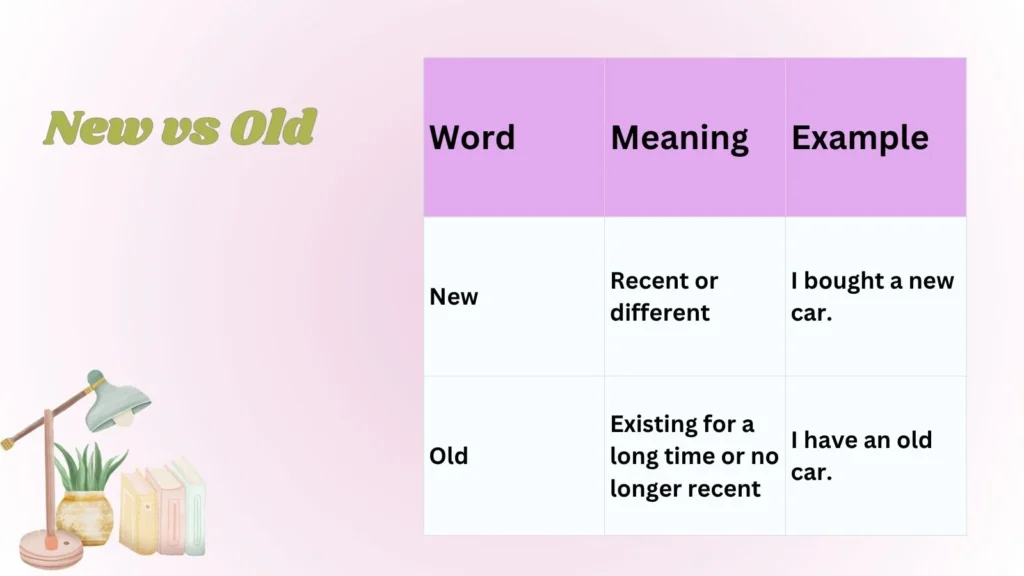
The most direct opposite of new is old.
New generally refers to something recent or different, while old refers to something that has existed for a long time or is no longer recent.
| Word | Meaning | Example |
|---|---|---|
| New | Recent or different | I bought a new car. |
| Old | Existing for a long time or no longer recent | I have an old car. |
However, “old” can also describe something familiar or previously known, while “new” can describe something unfamiliar or recently introduced.
New vs Modern
New and modern are related but not identical.
New usually focuses on time, recent creation, acquisition, or change. Modern usually refers to something associated with the present age or contemporary styles and ideas.
For example, an old building can have a modern design. Similarly, a newly built building does not necessarily have a modern design.
So, something can be new without being modern, and something can be modern without being new.
New vs Recent
New and recent are sometimes interchangeable, but there is a small difference.
Recent specifically emphasizes that something happened or appeared not long ago.
New can mean recent, but it can also mean unfamiliar, different, or newly acquired.
For example:
“This is a new idea for me.”
The idea may have existed for years. It is simply new to the speaker.
New Synonyms
The best synonym for new depends on the context.
Common synonyms and related words include:
- Recent – happening or appearing not long ago
- Fresh – recently made, obtained, or experienced
- Novel – new or unusual
- Modern – associated with the present time
- Original – not copied or previously existing in the same form
- Innovative – introducing new ideas or methods
- Unused – not previously used
- Different – unlike what existed before
Not every synonym works in every sentence, so context remains important.
New Antonyms
The main antonym of new is old.
Other contrasting words may include:
- Old
- Used
- Ancient
- Former
- Outdated
- Traditional
- Established
- Familiar
Again, the appropriate opposite depends on what “new” means in the sentence.
New Meaning in Different Contexts
The meaning of new becomes clearer when we examine different situations.
| Context | Meaning of New | Example |
|---|---|---|
| Shopping | Recently purchased or unused | I bought a new jacket. |
| Work | Recently hired or appointed | She is our new manager. |
| Education | Recently introduced or unfamiliar | This is a new subject. |
| Technology | Recently developed or released | The company launched a new device. |
| Relationships | Recently started or met | He has a new friend. |
| Ideas | Recently created or different | She suggested a new solution. |
| Life | Different from a previous situation | He started a new life abroad. |
New Beginning Meaning
The phrase new beginning is a common expression that means starting something different after an earlier period has ended.
For example:
“Moving to a new city gave her a new beginning.”
Here, new beginning suggests a fresh start, often with a sense of hope, change, or opportunity.
This expression is frequently used when discussing relationships, careers, personal growth, education, and major life changes.
New Experience Meaning
A new experience is something a person has not experienced before.
For example:
“Traveling alone was a new experience for him.”
The experience does not have to be recently created. It is “new” because it is unfamiliar to the person.
This shows another important meaning of new: something can be new to you even if it is not new to everyone else.
New Generation Meaning
New generation usually refers to a newer group of people, products, technology, or systems that follow an earlier generation.
For example:
“The new generation of smartphones offers improved features.”
Here, new generation means a newer version or group that has developed after an earlier one.
This phrase is common in technology, business, entertainment, education, and discussions about society.
Origin and History of the Word New
The word new is extremely old and has existed in various forms throughout the history of the English language.
It can be traced back to Old English nīwe, with related forms appearing in other Germanic languages. The word has retained its central idea of something recent, fresh, or not previously known for centuries.
Because the concept of “new” is fundamental to everyday communication, the word has remained one of the most frequently used adjectives in English.
Grammar and Forms of New
New is primarily an adjective.
Examples include:
- “A new book”
- “A new student”
- “A new opportunity”
- “A new idea”
It also has comparative and superlative forms in certain contexts:
- Newer – more recent or more modern
- Newest – most recent
For example:
“This phone is newer than my old one.”
And:
“This is the newest model available.”
Why Is the Word New So Important?
The word new is important because it helps us describe change, progress, discovery, and unfamiliar experiences.
We use it when talking about everyday things such as clothes and phones, but also for major concepts such as new opportunities, new ideas, new technology, and new beginnings.
It can even carry an emotional meaning. A new beginning can suggest hope, while a new opportunity can suggest possibility and growth.
Because of this flexibility, new is much more than a simple opposite of “old.” It is a key word for describing change in everyday English.
Common Mistakes With the Word New
Although new is an easy word, learners sometimes misunderstand how it works in different contexts.
Thinking New Always Means Recently Manufactured
Something can be new to you without being recently made. For example, an old book can be new to someone who has never read it before.
Confusing New With Modern
New means recent or unfamiliar, while modern usually describes something associated with the present age or contemporary styles.
Assuming New Always Means Unused
A person may describe something as new because they recently bought it, even if it was previously used. The exact meaning depends on context.
Using New When Recent Is More Precise
When you specifically want to emphasize that something happened not long ago, recent may be more precise.
Forgetting the Meaning of New to Someone
The phrase new to me means unfamiliar to the speaker. It does not necessarily mean that the thing itself is newly created.
FAQs:
What is the simple meaning of new?
New generally means recently made, recently obtained, recently introduced, unfamiliar, or different from what existed before.
What does new mean in text?
In texting, new usually has its normal meaning. It can describe something recently bought, discovered, introduced, or unfamiliar.
What is the opposite of new?
The most common opposite of new is old. Depending on the context, other opposites can include used, former, outdated, or familiar.
What is a synonym for new?
Common synonyms include recent, fresh, novel, modern, original, innovative, and unused, although the best choice depends on context.
What does new to me mean?
New to me means something is unfamiliar to the speaker or something they have not experienced, seen, or learned about before.
Final Thoughts:
The new meaning is centered on the ideas of recentness, difference, freshness, and unfamiliarity. It can describe something recently created, recently purchased, newly introduced, or simply unfamiliar to a particular person.
Whether you are talking about a new job, a new phone, a new idea, a new friend, or a new beginning, the word helps communicate that something has changed or is different from what came before.
Understanding context is the key to understanding exactly what new means in any sentence. Once you recognize whether it refers to time, experience, change, or introduction, its meaning becomes easy to understand.

I am Henry James and i am a passionate writer and language enthusiast behind PunPalace, a platform dedicated to exploring meanings, word origins, and simple explanations. My aims to make learning vocabulary easy, engaging, and accessible for everyone.


