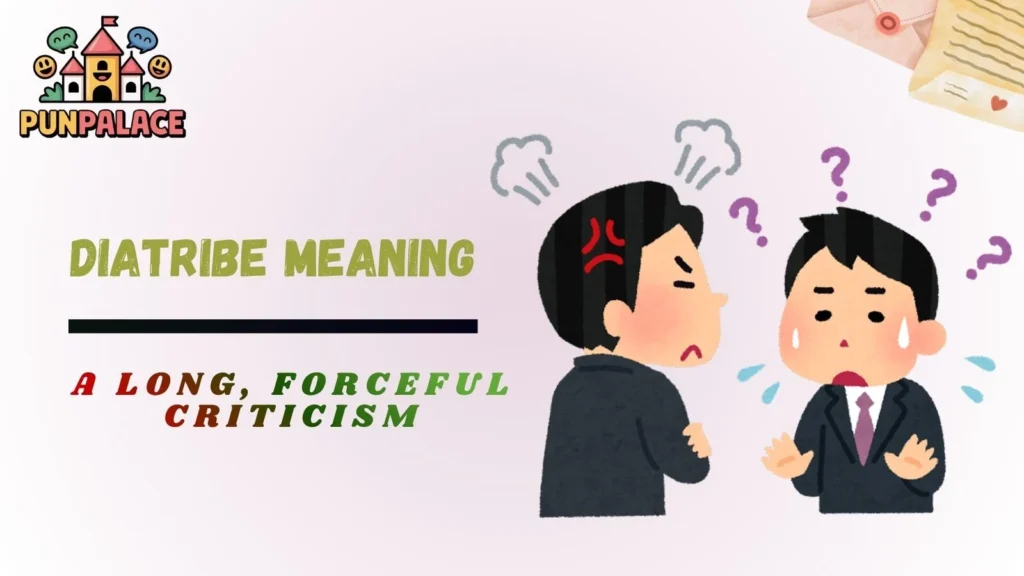
Have you ever listened to someone speak angrily for several minutes about a person, topic, or situation? If the speech is filled with strong criticism and emotional language, you may have heard a diatribe. The word often appears in news articles, books, debates, reviews, and everyday conversations.
The diatribe meaning is a long and forceful speech or piece of writing that strongly criticizes someone or something. It usually expresses anger, disapproval, or intense opposition.
In this guide, we will explain what does diatribe mean in simple English, look at its origin, examples, synonyms, tone, and common uses, and show you how to use the word correctly.
What Does Diatribe Mean?
Diatribe is a noun that means a long, angry, or strongly critical speech or piece of writing.
When someone goes on a diatribe, they usually spend a significant amount of time expressing strong negative opinions about a particular subject.
For example:
“The politician launched into a diatribe against corruption.”
In this sentence, the politician gave a lengthy and strongly worded criticism of corruption.
| Word | Meaning | Typical Tone |
|---|---|---|
| Diatribe | A long, forceful criticism | Angry or hostile |
| Diatribe | An extended verbal attack | Strongly negative |
| Diatribe | A lengthy piece of writing expressing intense disapproval | Critical |
Diatribe Meaning in Simple English

In simple English, a diatribe is a long and angry criticism of someone or something.
Imagine someone becoming extremely frustrated about a subject and continuing to complain about it with strong language. That extended angry speech could be called a diatribe.
For example:
“He went on a diatribe about how badly the company was managed.”
This means he spoke at length and very critically about the company’s management.
The important ideas behind the word are length, strong criticism, and emotion.
Diatribe Meaning in English
In English, diatribe generally refers to a forceful verbal or written attack directed toward a person, organization, idea, policy, or situation.
It is stronger than simply saying that someone complained.
A complaint might be short and calm:
“The customer complained about the delayed delivery.”
A diatribe would be much more extensive and emotionally charged:
“The customer launched into a lengthy diatribe about the company’s terrible service.”
Therefore, the word suggests more than disagreement. It often suggests an extended and passionate expression of anger or criticism.
Diatribe Meaning in a Sentence
Here are several examples that show how diatribe can be used naturally:
- “The manager went on a diatribe about employees arriving late.”
- “His speech turned into a diatribe against the new policy.”
- “She posted a long diatribe criticizing the company.”
- “The article contained a harsh diatribe against social media.”
- “After the meeting, he launched into a diatribe about the decision.”
- “Her diatribe lasted nearly twenty minutes.”
In each example, the word describes an extended and strongly critical expression.
What Is an Example of a Diatribe?
Suppose a person is extremely unhappy with a restaurant. Instead of simply saying, “The service was slow,” they spend ten minutes explaining how terrible the restaurant is, criticizing the staff, management, prices, food, and overall experience.
That lengthy and emotionally charged criticism could be described as a diatribe.
Another example might be a public speaker who spends a long portion of a speech attacking a particular government policy with passionate and negative language.
The key point is that a diatribe is usually more intense and extensive than an ordinary complaint.
Is a Diatribe Always Angry?
A diatribe is usually associated with anger, hostility, or intense criticism, although the speaker does not necessarily have to be shouting.
Someone can deliver a calm-sounding but extremely negative written diatribe.
For example, a newspaper article could contain a detailed and forceful attack on a political decision. Even if the writing is grammatically polished and controlled, it may still be described as a diatribe because of its strongly hostile criticism.
Therefore, anger is common but emotional shouting is not required.
Diatribe vs Complaint
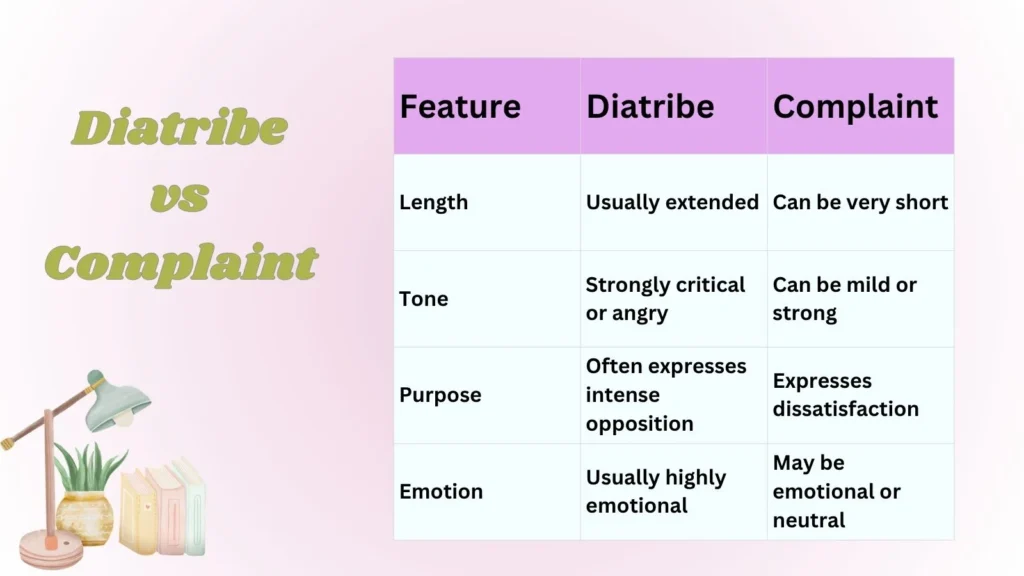
These words are related, but they are not identical.
| Feature | Diatribe | Complaint |
|---|---|---|
| Length | Usually extended | Can be very short |
| Tone | Strongly critical or angry | Can be mild or strong |
| Purpose | Often expresses intense opposition | Expresses dissatisfaction |
| Emotion | Usually highly emotional | May be emotional or neutral |
For example, saying “I’m unhappy with the service” is a complaint. Spending a long time angrily attacking every aspect of the service could become a diatribe.
Diatribe vs Rant
Diatribe and rant are close in meaning, and they are sometimes used interchangeably.
A rant is an extended, emotional expression of anger or frustration. A diatribe is also an extended criticism, but the word often emphasizes a verbal or written attack against a particular target.
For example:
“He went on a rant about traffic.”
“He launched into a diatribe against the city’s transportation policies.”
Both sentences describe strong criticism, but diatribe can sound more formal and literary.
Diatribe vs Tirade
Another word frequently compared with diatribe is tirade.
A tirade is generally a long, angry speech or outburst. A diatribe specifically emphasizes strong criticism or verbal attack.
| Word | General Meaning | Common Impression |
|---|---|---|
| Diatribe | Extended, forceful criticism | Critical and hostile |
| Tirade | Long, angry outburst | Emotional and aggressive |
| Rant | Extended angry complaint | Informal and emotional |
There is some overlap among these words, but their emphasis can differ depending on the sentence.
Diatribe Synonyms
There are several diatribe synonyms that can be used depending on the context.
- Rant — an emotional and often angry speech.
- Tirade — a long, angry verbal attack.
- Harangue — a lengthy and forceful speech, often critical.
- Denunciation — a strong public condemnation.
- Criticism — an expression of disapproval.
- Attack — a forceful criticism of a person or idea.
- Outburst — a sudden expression of strong emotion.
- Jeremiad — a long complaint or prediction of trouble, often with a moralizing tone.
Not every synonym has exactly the same meaning. Diatribe specifically suggests an extended and strongly critical expression.
Antonyms of Diatribe
Words with meanings opposite or contrasting to diatribe include:
- Praise
- Compliment
- Approval
- Applause
- Commendation
- Endorsement
- Appreciation
For example, a diatribe attacks or condemns something, while a commendation expresses strong approval.
Origin and History of the Word Diatribe
The word diatribe has an interesting history. It comes from the Greek word diatribē, which was connected with the idea of spending time or engaging in discussion.
In ancient usage, the term could refer to a philosophical discourse or lecture. Over time, its meaning developed in English toward the modern sense of a long and forceful criticism.
This change is a useful reminder that word meanings can evolve significantly over centuries.
How Is Diatribe Used in Everyday English?
Although diatribe is not one of the most common casual words, it appears frequently in journalism, literature, commentary, political discussions, and formal writing.
You may encounter phrases such as:
- “A political diatribe”
- “A lengthy diatribe”
- “An angry diatribe”
- “A bitter diatribe”
- “A public diatribe”
- “A diatribe against the government”
- “A diatribe about modern society”
These expressions usually describe an extended criticism directed toward a specific subject.
How to Use Diatribe Correctly
Diatribe is a noun, so it is commonly used with verbs such as launch, deliver, begin, start, write, or go on.
Examples include:
- “He launched into a diatribe about the rules.”
- “She delivered a diatribe against the proposal.”
- “The writer wrote a diatribe criticizing the policy.”
- “His speech became a diatribe against his opponents.”
The phrase “launch into a diatribe” is especially common because it conveys the idea of suddenly beginning a lengthy, forceful criticism.
Why Do People Use the Word Diatribe?
Calling something a diatribe does more than say that it is criticism. It can also suggest that the criticism is excessive, emotional, or overly lengthy.
For example, describing an article as “a detailed criticism” sounds relatively neutral. Calling it “a diatribe” suggests that the writer’s criticism is unusually forceful and possibly excessive.
As a result, the word can itself carry a slightly negative judgment about how the criticism was expressed.
Diatribe in Writing and Journalism
Writers and journalists may use the word diatribe when describing an especially aggressive piece of commentary.
For example:
“The columnist’s latest article was less an analysis and more a diatribe against the proposal.”
This sentence suggests that the article focused heavily on attacking the proposal rather than providing balanced analysis.
Because of this, calling someone’s writing a diatribe can itself be a form of criticism.
Common Mistakes With the Word Diatribe

Mistake 1: Thinking Every Complaint Is a Diatribe
A short complaint is not necessarily a diatribe. The word usually implies lengthy and forceful criticism.
Mistake 2: Assuming a Diatribe Must Involve Shouting
A diatribe can be written or spoken and does not have to involve loud or dramatic behavior. Strongly critical content is more important than volume.
Mistake 3: Using Diatribe as a Synonym for Any Speech
A normal speech, presentation, or lecture is not a diatribe. The word specifically carries the idea of strong criticism or condemnation.
Mistake 4: Confusing Diatribe With Debate
A debate involves opposing arguments and discussion. A diatribe is generally one-sided and strongly critical.
Mistake 5: Thinking Diatribe Is Always Spoken
A diatribe can be written or spoken. An angry article, social media post, essay, or public statement can all potentially be described as a diatribe.
FAQs:
What does diatribe mean in simple English?
Diatribe means a long and strongly critical speech or piece of writing, usually expressing anger, hostility, or intense disapproval.
What is an example of a diatribe?
If someone spends a long time angrily criticizing a company’s policies, management, and decisions, their speech could be described as a diatribe.
Is a diatribe always negative?
Yes, the word generally describes strongly negative criticism or condemnation. It is not normally used for praise or neutral discussion.
What are common synonyms for diatribe?
Common synonyms include rant, tirade, harangue, denunciation, criticism, and attack. The exact synonym depends on the context.
What is the difference between a diatribe and a rant?
Both can describe lengthy emotional criticism. However, diatribe often sounds more formal and emphasizes a forceful attack against a particular subject, while rant is more informal.
Final Thoughts:
The diatribe meaning is a long, forceful, and strongly critical speech or piece of writing. It usually expresses anger, frustration, hostility, or intense disapproval toward a particular person, idea, policy, or situation.
Although diatribe is related to words such as rant and tirade, it often sounds more formal and is commonly found in journalism, literature, political commentary, and serious discussions.
When you see someone described as going on a diatribe, think of a lengthy and passionate attack or criticism rather than an ordinary complaint.

I am Henry James and i am a passionate writer and language enthusiast behind PunPalace, a platform dedicated to exploring meanings, word origins, and simple explanations. My aims to make learning vocabulary easy, engaging, and accessible for everyone.