IEP stands for Individualized Education Program. In school settings, an IEP is a written plan designed to provide specialized educational support for a student who qualifies for special education services.
The IEP meaning in school is important because it describes a plan built around a student’s individual learning needs. Instead of using exactly the same educational approach for every student, an IEP can outline specific goals, accommodations, services, and support.
Simple definition: An IEP is an individualized school plan that explains a qualifying student’s educational needs, goals, supports, and services.
An IEP can help a school provide appropriate educational support to a student with a qualifying disability. The goal is not simply to give a student easier work. Instead, the plan identifies the specific support the student needs to participate and make progress in education.
For example, a student might need extra time for tests, specialized instruction, speech-language services, assistive technology, or another educational support.
The appropriate services depend on the student’s individual needs.
IEP Meaning at a Glance 📖
Term
Meaning
IEP
Individualized Education Program
Purpose
To provide individualized educational support
Used In
School and special education settings
Focus
Student needs, goals, services, and accommodations
Format
Written educational plan
What Is an Individualized Education Program? 📝
An Individualized Education Program is a formal educational document created for an eligible student. It describes the student’s current educational performance, learning goals, and the special education services and supports the school will provide.
The plan is intended to be individualized. That means it should reflect the student’s particular strengths, needs, challenges, and educational goals.
Depending on the student, an IEP may address areas such as:
Academic skills
Reading and writing
Mathematics
Communication
Behavior
Social skills
Physical or developmental needs
Independent living skills
What Is Included in an IEP? 📚
An IEP can contain several important parts. The exact requirements depend on the applicable education rules and the student’s circumstances.
IEP Component
What It Describes
Present Levels
The student’s current academic and functional performance
Annual Goals
Measurable educational goals for the student
Special Education Services
Specialized instruction and educational support
Accommodations
Changes that help the student access learning
Progress Monitoring
How progress toward goals will be measured
Placement
Information about the educational setting and services
IEP Goals Explained 🎯
One of the most important parts of an IEP is the student’s annual goals. These goals describe what the student is expected to work toward during the relevant period.
Strong educational goals are specific and measurable. For example, instead of simply saying:
“Improve reading.”
A goal might describe a particular reading skill and how progress will be measured.
This gives teachers and families a clearer way to understand whether the student is making progress.
IEP Accommodations vs Modifications 🔍
Accommodations and modifications are not always the same thing.
An accommodation generally changes how a student accesses or demonstrates learning without necessarily changing the learning expectation itself.
A modification, by contrast, can change what a student is expected to learn or demonstrate. Whether an IEP includes modifications depends on the student’s needs and educational plan.
Who Is Involved in an IEP? 👥
An IEP is developed through collaboration among people involved in the student’s education. The specific team can vary, but it commonly includes:
Parents or guardians
Teachers
Special education professionals
School representatives
Related-service professionals, when appropriate
The student, when appropriate
Working together allows the team to consider different perspectives and create a plan that addresses the student’s educational needs.
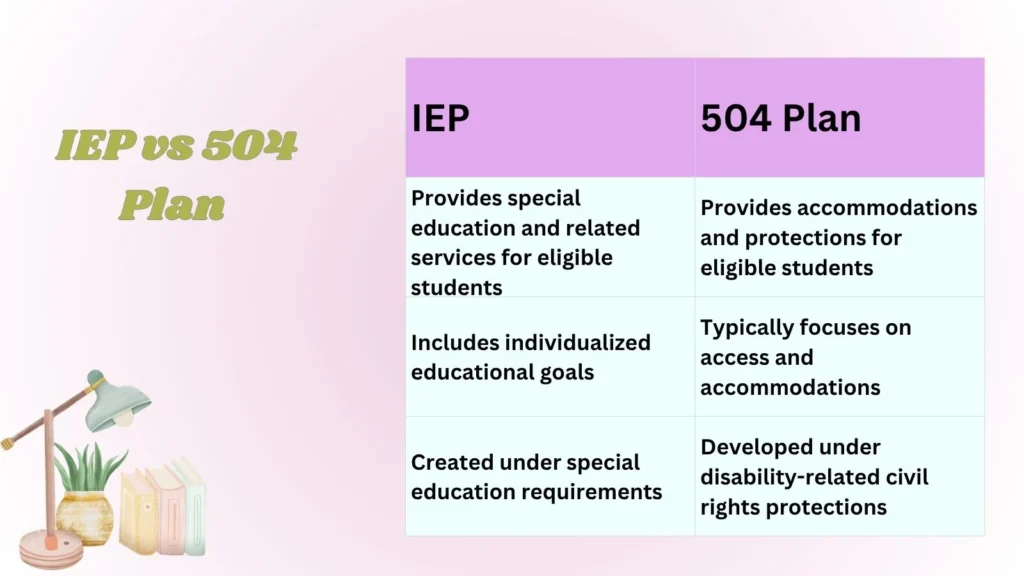
IEP vs 504 Plan 🔄
People sometimes confuse an IEP with a 504 plan. Although both can provide support to students with disabilities, they are not the same type of plan.
IEP
504 Plan
Provides special education and related services for eligible students
Provides accommodations and protections for eligible students
Includes individualized educational goals
Typically focuses on access and accommodations
Created under special education requirements
Developed under disability-related civil rights protections
Eligibility and services can vary depending on the student’s circumstances and applicable rules.
IEP Meaning in a School Conversation 💬
You may hear teachers, parents, counselors, or administrators use IEP in everyday school conversations.
For example:
“The student’s IEP meeting is next week.”
“Please review the accommodations listed in the IEP.”
“The teacher is collecting data for the student’s IEP goals.”
“The IEP team discussed the student’s progress.”
In each case, IEP refers to the student’s Individualized Education Program.
IEP Meeting Meaning 👨👩👧👦
An IEP meeting is a meeting where the relevant team discusses a student’s educational plan. Depending on the situation, the team may review the student’s progress, discuss current needs, update goals, and determine appropriate services or accommodations.
Families can use these meetings to ask questions and share information about the student’s educational experience.
The purpose is to make sure the student’s educational plan continues to reflect their needs.
Common Examples of IEP Support 💡
IEP support is individualized, so there is no single list that applies to every student. Depending on the student’s needs, support may include:
Specialized reading instruction
Specialized mathematics instruction
Speech and language services
Occupational therapy when appropriate
Assistive technology
Classroom accommodations
Behavioral support
Support with organization or executive functioning
The specific services should be based on the student’s educational needs rather than a generic checklist.
IEP and Student Progress 📈
An IEP is not simply a document that is written once and forgotten. Student progress can be reviewed over time.
Teachers and other members of the educational team may collect information about academic performance, classroom participation, behavior, or progress toward individual goals.
This information can help the team determine whether the student’s current supports are working or whether changes may be needed.
Common Mistakes About IEP Meaning ❌
Thinking IEP Means Every Student Gets Special Treatment
An IEP is designed for students who meet the applicable eligibility requirements for special education services. It is not simply a general plan available to every student.
Thinking an IEP Is Only About Grades
An IEP can address academic needs as well as functional, communication, behavioral, developmental, or other educational needs, depending on the student.
Confusing an IEP With a 504 Plan
IEPs and 504 plans can both provide support, but they serve different purposes and operate under different legal frameworks.
Thinking Every IEP Looks the Same
The word individualized is important. An IEP is created around the particular needs and goals of the student.
Assuming an IEP Never Changes
Student needs and progress can change. IEPs may therefore be reviewed and updated according to applicable requirements and the student’s circumstances.
FAQs:
What does IEP stand for in school?
IEP stands for Individualized Education Program. It is a written educational plan for an eligible student who needs special education and related services.
What is the purpose of an IEP?
The purpose of an IEP is to identify a student’s individual educational needs, goals, services, accommodations, and supports and provide a framework for addressing those needs.
Who gets an IEP?
Students who meet the applicable requirements for special education eligibility may receive an IEP. Eligibility is determined through the appropriate educational evaluation and process.
What is the difference between an IEP and a 504 plan?
An IEP provides special education and related services to eligible students, while a 504 plan generally focuses on accommodations and equal access for eligible students with disabilities.
Can an IEP change?
Yes. An IEP can be reviewed and updated as appropriate to reflect a student’s progress, changing needs, goals, and educational circumstances.
Final Thoughts:
The IEP meaning in school is Individualized Education Program. It is a written plan designed to address the educational needs of an eligible student who requires special education and related services.
An IEP can include measurable goals, specialized instruction, accommodations, related services, progress information, and other individualized supports. Most importantly, the plan is designed around the individual student, rather than using exactly the same approach for everyone.
Understanding what IEP means can make school conversations much easier for students, parents, and educators. 🎓
I am Henry James and i am a passionate writer and language enthusiast behind PunPalace, a platform dedicated to exploring meanings, word origins, and simple explanations. My aims to make learning vocabulary easy, engaging, and accessible for everyone.