
If you’re writing a medical, nursing, pharmacy, or healthcare research paper, understanding AMA in text citation is essential.
Correct citations improve credibility, help readers locate your sources, and maintain academic integrity. While the AMA Citation Style may seem confusing at first, it becomes much easier once you understand the numbering system and formatting rules.
This guide explains everything you need to know about AMA in text citation in simple language. You’ll learn how it works, where to place citation numbers, common formatting rules, practical examples, and mistakes to avoid. Whether you’re a student or a researcher, this guide will help you cite sources with confidence.
What Is AMA In Text Citation? 📚
AMA in text citation is the citation method used in the American Medical Association (AMA) citation style. Instead of using the author’s name and publication year inside the text, AMA assigns each source a unique number.
The first source you cite becomes 1, the second becomes 2, and so on. Every time you use the same source again, you reuse its original number instead of assigning a new one.
This numbering system keeps academic writing clean, organized, and easy to read.
Quick Overview of AMA Citation Style 📖
| Feature | Details |
|---|---|
| Citation Method | Numbered references |
| In-Text Format | Superscript or regular Arabic numbers |
| Reference Order | Listed in the order sources first appear |
| Reuse of Sources | Use the same citation number every time |
| Common Fields | Medicine, Nursing, Pharmacy, Public Health |
Why Is AMA In Text Citation Important? 🎯

Proper citation is more than simply following formatting rules. It demonstrates honesty, professionalism, and respect for intellectual work. Accurate citations also allow readers to verify facts and locate original research.
- Prevents accidental plagiarism.
- Improves the credibility of academic writing.
- Makes research easier to verify.
- Creates consistency throughout your paper.
- Meets university and journal requirements.
How Does AMA In Text Citation Work? ✍️
The numbering process is straightforward.
- Cite your first source as 1.
- The second unique source becomes 2.
- The third unique source becomes 3.
- If you mention source 1 again later, continue using 1.
The numbering never changes, even if another source appears between repeated citations.
Examples of AMA In Text Citation 💡
Single Source
Regular exercise improves cardiovascular health.1
Multiple Sources
Several studies support this conclusion.2,3,5
Repeated Source
The same study also reported additional findings.1
Where Should Citation Numbers Be Placed? 📍
AMA citation numbers are usually placed immediately after the information they support. Consistent placement makes your writing easier to follow and prevents confusion.
| Situation | Example |
|---|---|
| After a sentence | The treatment was effective.1 |
| After a quotation | “Accurate diagnosis improves outcomes.”2 |
| Repeated evidence | Further analysis confirmed the results.1 |
AMA vs APA vs MLA 📊
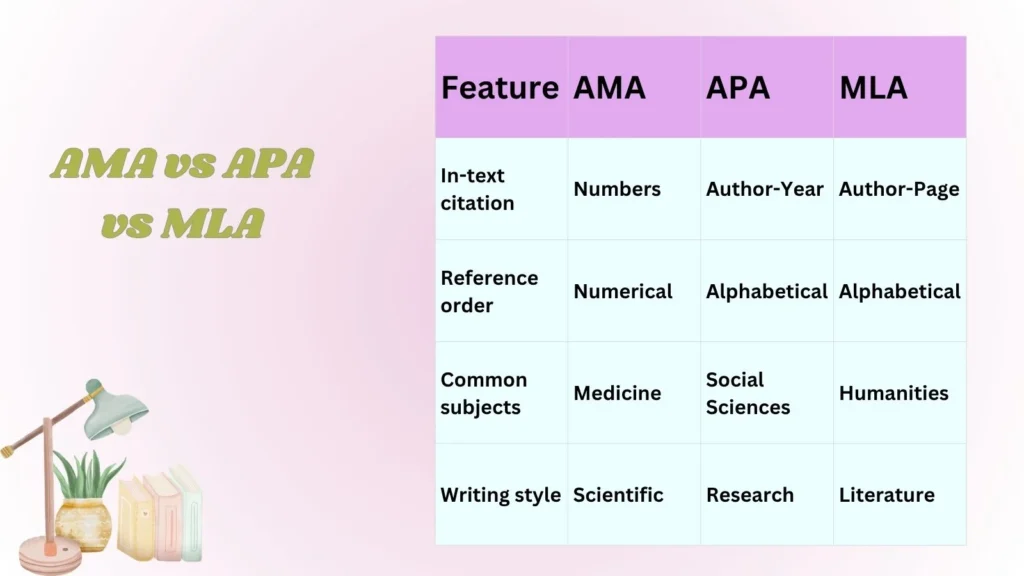
| Feature | AMA | APA | MLA |
|---|---|---|---|
| In-text citation | Numbers | Author-Year | Author-Page |
| Reference order | Numerical | Alphabetical | Alphabetical |
| Common subjects | Medicine | Social Sciences | Humanities |
| Writing style | Scientific | Research | Literature |
Benefits of Using AMA Citation Style ⭐
- Simple numbering system.
- Easy to follow in long research papers.
- Reduces clutter inside paragraphs.
- Widely accepted in medical publishing.
- Provides a professional appearance.
How to Create an AMA Reference List 📑
Every AMA in text citation must match a complete entry in the reference list. Unlike some citation styles that arrange references alphabetically, AMA organizes references in the order they first appear in your document.
For example, if a journal article is the first source mentioned in your paper, it will be listed as reference number 1. If a book is the second source you cite, it becomes reference number 2.
This numbering remains the same throughout your document, even if you cite the same source multiple times.
| Reference Number | Source Type |
|---|---|
| 1 | Journal Article |
| 2 | Book |
| 3 | Website |
| 4 | Government Report |
AMA Citation Examples for Different Source Types 📚
Although every source follows specific formatting rules, the general structure remains consistent. Here are simplified examples to help you understand how different references are organized.
Journal Article Example
Include the author’s name, article title, journal title, publication year, volume, issue, and page numbers.
Book Example
Include the author’s name, book title, edition if applicable, publisher, and publication year.
Website Example
Include the organization or author, webpage title, publication or update date if available, and the access date when required.
Government Publication Example
List the government agency as the author followed by the report title and publication details.
When Should You Use AMA Citation Style? 🏥
AMA style is commonly required in healthcare and scientific writing. Universities, medical schools, and professional journals often recommend or require this citation format.
- Medical research papers
- Nursing assignments
- Pharmacy reports
- Public health projects
- Clinical case studies
- Biomedical research
Common Mistakes When Using AMA In Text Citation ❌

Changing Citation Numbers
One of the biggest mistakes is assigning a new number to a source that has already been cited. Every source keeps its original number throughout the paper.
Citing Sources Out of Order
Reference numbers should always follow the order in which sources first appear in the document.
Using Different Formats Together
Avoid mixing AMA with APA, MLA, or Chicago formatting within the same document.
Incorrect Reference Matching
Each citation number must match the correct source in the reference list.
Skipping Citation Numbers
Do not leave gaps in numbering. Every new source should receive the next available number.
FAQs:
Does AMA use author names in the text?
No. AMA primarily uses numbered citations instead of author-date formatting.
Can I reuse the same citation number?
Yes. If you cite the same source again later, simply use its original reference number.
Is AMA only used in medicine?
Although it is most common in medicine and healthcare, AMA style is also used in related scientific and biomedical fields.
Should references be alphabetical?
No. AMA reference lists are arranged according to the order in which sources first appear in the document.
Final Thoughts:
Learning AMA in text citation may seem challenging at first, but the numbering system quickly becomes easy with practice.
By assigning each source a unique number, reusing existing numbers correctly, and maintaining a well-organized reference list, you can create professional and credible academic writing.
Whether you are preparing a research paper, medical assignment, nursing project, or scientific report, following AMA guidelines improves clarity and demonstrates academic integrity.
Taking a few extra minutes to review your citations before submission can help you avoid common formatting mistakes.

I am Henry James and i am a passionate writer and language enthusiast behind PunPalace, a platform dedicated to exploring meanings, word origins, and simple explanations. My aims to make learning vocabulary easy, engaging, and accessible for everyone.