The most common NP meaning in text is “No Problem.” People use it to politely respond to a thank you, show that something wasn’t an inconvenience, or reassure someone that everything is okay.
Although this is the most popular meaning, NP can occasionally represent something different depending on the conversation and platform.
In this guide, you’ll learn what does NP mean in text, where it came from, how people use it, examples of real conversations, and the common mistakes to avoid.
What Does NP Mean in Text? 💬
In texting and online chats, NP most commonly stands for “No Problem.” It is a friendly response used after someone says “thank you” or apologizes for something.
Instead of typing the full phrase, people shorten it to NP because it saves time while keeping conversations casual and natural.
Friend: Thanks for helping me today!
You: NP! 😊
In this example, NP simply means “You’re welcome” or “It was no problem.”
Quick Meaning Table 📖
| Abbreviation | Meaning | Common Usage |
|---|---|---|
| NP | No Problem | Replying to thanks |
| NP | No Pressure | Casual conversations |
| NP | Not Possible | Less common usage |
Origin of NP in Texting 🌐
The abbreviation NP became popular during the early days of internet chat rooms, instant messaging, and online gaming. Since people wanted to type quickly, they shortened common phrases into simple abbreviations.
Over time, NP spread across text messaging, social media platforms, gaming communities, and workplace chats. Today, it remains one of the most commonly used internet abbreviations.
How Is NP Used in Text Messages? 📱
People use NP in many everyday situations. Here are some of the most common examples.
Replying to Thanks 🙌
Friend: Thank you for picking me up.
You: NP!
Responding to an Apology 😊
Friend: Sorry I’m late.
You: NP. It happens.
Offering Reassurance ❤️
Friend: I hope I didn’t bother you.
You: NP at all!
Different Meanings of NP Depending on Context 🔍
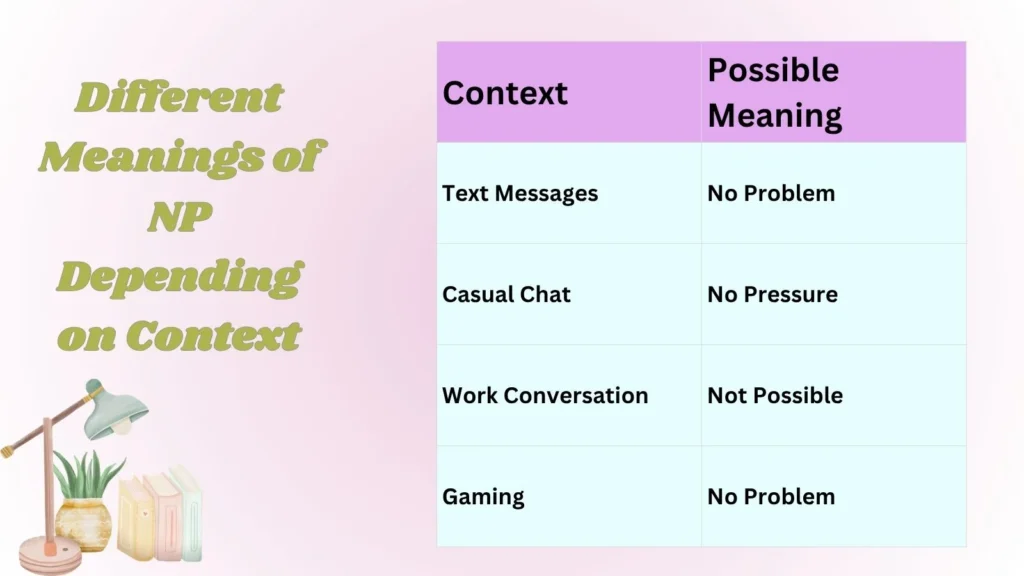
Although “No Problem” is the most common meaning, context always matters.
| Context | Possible Meaning |
|---|---|
| Text Messages | No Problem |
| Casual Chat | No Pressure |
| Work Conversation | Not Possible |
| Gaming | No Problem |
Always read the surrounding conversation before deciding which meaning fits best.
Examples of NP in Real Conversations 💡
Example 1
Alex: Thanks for sharing your notes.
Emma: NP!
Example 2
Ryan: Sorry for replying late.
Olivia: NP. I was busy too.
Example 3
Chris: Can we meet tomorrow instead?
Sophia: NP. Tomorrow works for me.
When Should You Use NP? ✅
- Text messages
- Social media chats
- Online gaming
- Messaging apps
- Casual conversations with friends
NP is best used in informal conversations where short, friendly replies are appropriate.
When Should You Avoid NP? ⚠️
Although NP is widely accepted in casual conversations, it isn’t suitable everywhere.
- Business emails
- Professional reports
- Academic writing
- Formal customer communication
- Official documents
In formal situations, writing “You’re welcome” or “No problem” in full appears more professional.
Common Mistakes When Using NP ❌
Assuming NP Always Means “No Problem”
While “No Problem” is the most common meaning, NP can represent other phrases depending on the conversation. Always consider the context before interpreting it.
Using NP in Professional Communication
NP is internet slang and should generally be avoided in formal emails, academic papers, or business correspondence where complete words create a better impression.
FAQs:
What does NP mean in text?
In most text messages, NP means “No Problem.” It is commonly used as a polite response after someone says thank you or apologizes.
Can NP have other meanings?
Yes. Depending on the conversation, NP can also mean “No Pressure” or “Not Possible.” However, these meanings are much less common than “No Problem.”
Is NP considered rude?
No. NP is generally viewed as a friendly and polite response in casual conversations. However, some formal situations may call for writing the complete phrase instead.
Can I use NP in business emails?
It is better to avoid internet abbreviations in professional communication. Writing “You’re welcome” or “No problem” in full creates a more polished impression.
Final Thoughts:
Understanding what does NP mean in text makes online communication easier and more natural.
In most situations, NP simply means “No Problem,” making it a quick and friendly way to respond to thanks or apologies.
Although the abbreviation is widely accepted in texting, social media, and gaming, it should be used carefully in professional or academic settings.
Always consider the context to make sure your message is clear and appropriate.

I am Henry James and i am a passionate writer and language enthusiast behind PunPalace, a platform dedicated to exploring meanings, word origins, and simple explanations. My aims to make learning vocabulary easy, engaging, and accessible for everyone.