Imagine someone living an ordinary life, going to work, spending time with friends, and following a normal daily routine. Nobody suspects anything unusual about them. However, behind this ordinary appearance, they are secretly waiting for a specific signal or instruction to begin a hidden mission.
This mysterious idea is what makes the term sleeper agent so fascinating.
The phrase is commonly used in spy stories, action movies, political discussions, books, and news reports. It describes someone who secretly lives in a particular environment while remaining inactive until they receive instructions to carry out an assigned mission.
Understanding the sleeper agent meaning helps you recognize how the expression is used in intelligence, espionage, popular culture, and everyday conversations.
In this guide, you will discover its definition, origin, examples, characteristics, differences from other intelligence terms, and common mistakes people make when using it.
What Is the Meaning of Sleeper Agent?
A sleeper agent is a person who secretly lives in a particular country, community, or organization while appearing to lead an ordinary life. They remain inactive or maintain a low profile until they receive instructions to perform a specific task.
The term is especially associated with espionage and intelligence operations.
Unlike an active spy who regularly gathers information or performs assignments, a sleeper agent may wait for months or even years before being activated.
For example, imagine a fictional intelligence agent who moves to another country, establishes a normal-looking identity, gets a job, and builds relationships. The person does not immediately perform any spying activities. Instead, they wait for instructions from a hidden organization.
That fictional character would be described as a sleeper agent.
The word sleeper suggests inactivity or waiting, while agent refers to someone working on behalf of another person or organization.
Sleeper Agent Definition in Simple Words
In simple words, a sleeper agent is a secret operative who stays inactive or unnoticed until they are instructed to carry out a mission.
Think of someone who is waiting for the right moment to act while keeping their true purpose hidden.
Here is an easy way to understand the phrase:
- Sleeper: Someone or something that remains inactive.
- Agent: A person who acts for or represents another person or organization.
- Sleeper agent: A hidden operative who waits for activation before performing an assigned task.
The expression is mostly used in intelligence and espionage, but it can also appear metaphorically in movies, books, and casual conversations.
Origin and History of the Term Sleeper Agent
The expression sleeper agent developed from the language of espionage and intelligence operations.
The word sleeper has long been used to describe something inactive that may become active later. When combined with agent, it describes an operative who remains hidden or dormant until needed.
The concept became particularly familiar through discussions of Cold War espionage, when intelligence organizations from rival countries attempted to establish secret networks and collect information abroad.
Stories about undercover operatives living under assumed identities helped make the expression popular in books, newspapers, television, and films.
Today, sleeper agents are common characters in spy thrillers, political dramas, action movies, and fictional conspiracy stories.
How Does a Sleeper Agent Work?
In fictional espionage stories and historical discussions, a sleeper agent is usually portrayed as someone who maintains a hidden identity while waiting for instructions.
The general concept can be understood through several stages:
1. Establishing a Hidden Identity
A sleeper agent may be portrayed as living under an assumed identity or maintaining a carefully constructed public background.
The purpose is to avoid attracting attention and appear like an ordinary member of society.
2. Living an Ordinary Life
The person may have a job, social relationships, hobbies, and everyday responsibilities.
Their ordinary appearance helps explain why the term is associated with secrecy and long periods of inactivity.
3. Remaining Dormant
During this period, the agent does not carry out the main assignment.
They may simply wait for a message, event, or instruction that signals a change in their role.
4. Receiving Activation Instructions
In fictional stories, activation may happen through a coded message, a secret communication, or a specific event.
This moment changes the character from an apparently ordinary person into an active operative.
5. Carrying Out an Assignment
Once activated, the sleeper agent may perform the mission described in the story, which could involve gathering information or supporting an intelligence operation.
Not every sleeper agent scenario follows the same pattern. These stages describe a general fictional and conceptual model rather than a universal real-world procedure.
Examples of Sleeper Agent in Everyday Language
The best way to understand a phrase is to see how it works in different sentences.
Here are some examples of sleeper agent used in context:
Example 1: The spy movie revealed that the friendly neighbor was actually a sleeper agent.
Example 2: The detective suspected that the mysterious character had been living under a secret identity for years.
Example 3: In the novel, the sleeper agent waited decades before receiving the message that activated the mission.
Example 4: The television series follows a sleeper agent struggling to balance an ordinary family life with a secret assignment.
Example 5: The intelligence agency investigated reports of a possible sleeper agent operating under a false identity.
Example 6: The audience was shocked when the seemingly harmless character turned out to be a sleeper agent.
These sentences show that the term is generally associated with secrecy, hidden identities, and delayed action.
Characteristics of a Sleeper Agent
Sleeper agents are often portrayed with several recognizable characteristics in fiction and espionage discussions.
1. A Hidden Identity
A sleeper agent may use a false identity to conceal their real background or purpose.
2. A Normal Appearance
They often appear to have ordinary lives, making them difficult to distinguish from other people in a fictional setting.
3. Long-Term Inactivity
One of the defining ideas is that the agent remains inactive for an extended period.
4. A Secret Assignment
The person is associated with a hidden mission or responsibility.
5. Delayed Activation
A sleeper agent does not necessarily act immediately. The assignment may begin only after a particular instruction or event.
6. Secrecy
The character’s true purpose is generally unknown to the people around them.
These characteristics explain why sleeper agents are popular subjects in suspense stories and spy fiction.
Sleeper Agent vs. Spy: What Is the Difference?
The expressions sleeper agent and spy are related, but they do not have exactly the same meaning.
A spy is someone who secretly gathers information, often for a government, organization, or another interested party.
A sleeper agent is a more specific type of operative who remains inactive or hidden until a particular moment.
| Feature | Sleeper Agent | Spy |
|---|---|---|
| Meaning | An inactive or hidden operative waiting for instructions | Someone who secretly gathers information |
| Activity | May remain inactive for a long time | Often actively gathers information |
| Main idea | Dormancy and delayed activation | Secrecy and intelligence gathering |
| Identity | May maintain a concealed identity | May work openly or secretly under different identities |
| Example | A fictional operative waiting years for a signal | An operative collecting confidential information |
Important: A sleeper agent may also be a spy, but not every spy is a sleeper agent.
Sleeper Agent Meaning in Movies and TV Shows
Sleeper agents are especially popular in entertainment because they create mystery, suspense, and unexpected plot twists.
A character may appear trustworthy throughout a story, only for the audience to discover that they have a secret identity or hidden mission.
This concept is frequently used in:
- Spy thrillers: Stories involving intelligence organizations and secret missions.
- Action movies: Films featuring undercover characters and unexpected betrayals.
- Political dramas: Stories about government secrets and international conflicts.
- Science fiction: Fictional plots involving programmed identities or hidden instructions.
- Psychological thrillers: Stories exploring identity, memory, loyalty, and deception.
One well-known example is the television series The Americans, which explores undercover Soviet intelligence officers living as an ordinary American family during the Cold War.
Another example is The Manchurian Candidate, a political thriller that explores the idea of a person being manipulated into carrying out hidden actions.
These fictional stories have helped make the sleeper agent concept familiar to audiences worldwide.
Sleeper Agent vs. Double Agent
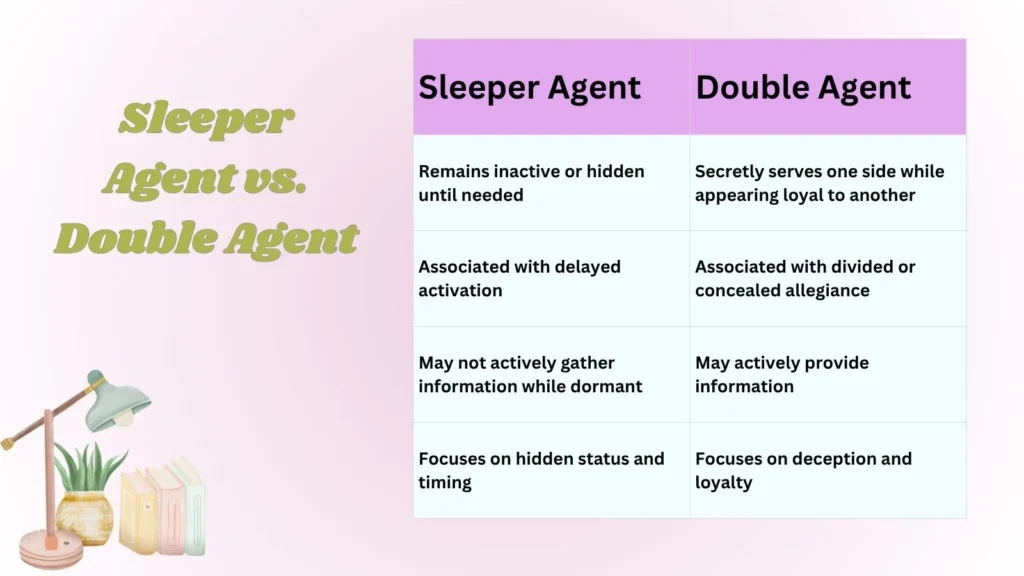
The difference is mainly related to their role and loyalty.
| Sleeper Agent | Double Agent |
|---|---|
| Remains inactive or hidden until needed | Secretly serves one side while appearing loyal to another |
| Associated with delayed activation | Associated with divided or concealed allegiance |
| May not actively gather information while dormant | May actively provide information |
| Focuses on hidden status and timing | Focuses on deception and loyalty |
The two concepts can overlap in a fictional or intelligence setting, but they describe different roles.
Sleeper Agent vs. Sleeper Cell
A sleeper agent and a sleeper cell are closely related expressions, but they refer to different things.
A sleeper agent is an individual who remains inactive or hidden until instructed to act.
A sleeper cell refers to a small, concealed group of individuals who remain inactive until they are directed to carry out an assignment.
For example, a thriller might feature one undercover character as a sleeper agent, while a group of hidden operatives is described as a sleeper cell.
| Term | Meaning |
|---|---|
| Sleeper Agent | One hidden or dormant operative |
| Sleeper Cell | A concealed group of operatives |
| Spy | A person who secretly gathers information |
| Double Agent | Someone secretly working for one side while appearing to serve another |
Sleeper Agent Meaning in Modern Conversations
Although the phrase comes from espionage-related language, people sometimes use it metaphorically in everyday conversations.
For example, someone might call a person a sleeper agent as a joke when they suddenly reveal an unexpected ability, personality, or hidden talent.
Consider these examples:
Example 1: He was quiet throughout the competition, but he turned into a sleeper agent when the final round started.
Example 2: My friend seemed uninterested in sports, but he was a sleeper agent on the basketball court.
Example 3: That quiet student was a sleeper agent in the debate competition. Nobody expected such an impressive performance.
In these situations, the phrase is not being used literally. It humorously describes someone who appears inactive or ordinary but unexpectedly becomes impressive or influential.
However, context matters. In serious discussions, the expression usually refers to espionage or covert operations.
Is a Sleeper Agent Real or Just Fiction?
Sleeper agents are not exclusively fictional. The broader concept of intelligence operatives living under concealed identities and remaining inactive for extended periods has appeared in real-world espionage history.
One frequently discussed historical example is the group of Russian intelligence operatives arrested in the United States in 2010. They had lived under assumed identities for years and were associated with an intelligence network often discussed in connection with the idea of illegals and sleeper operatives.
However, popular movies sometimes exaggerate the concept. Fiction may portray agents as instantly activated through dramatic phrases or mysterious signals, while real intelligence work is generally more complicated.
It is important to distinguish documented historical cases from fictional storylines and unsupported claims.
Why Are Sleeper Agents Interesting?
Sleeper agents attract attention because they challenge the way people think about identity and trust.
A person who appears completely ordinary may have a hidden purpose that nobody around them understands.
Several elements make this concept interesting:
- Mystery: The audience does not know who the person really is.
- Suspense: A hidden mission may begin at any moment.
- Surprise: An apparently harmless character may reveal an unexpected role.
- Psychological conflict: Characters may struggle between their public identities and secret responsibilities.
- Trust: The concept raises questions about loyalty, deception, and relationships.
These themes make sleeper agents powerful characters in novels, films, and television series.
Common Mistakes When Using Sleeper Agent
Although the phrase is easy to understand, some people use it incorrectly. Here are two common mistakes to avoid.
1. Confusing Every Spy With a Sleeper Agent
Not every spy is a sleeper agent. A regular spy may actively collect confidential information, while a sleeper agent is generally associated with remaining inactive until receiving instructions. The distinction is important when discussing intelligence or fictional characters.
2. Thinking a Sleeper Agent Must Literally Be Sleeping
The word sleeper does not mean the person spends their time asleep. It refers to inactivity or remaining dormant. A sleeper agent may continue living an ordinary daily life while waiting for a particular assignment or activation.
FAQs:
1. What Does Sleeper Agent Mean in Simple Words?
A sleeper agent is a secret operative who remains inactive or hidden until receiving instructions to carry out a mission.
2. What Is Another Word for Sleeper Agent?
Depending on the context, similar expressions include dormant operative, undercover operative, and inactive intelligence agent. However, these terms do not always have exactly the same meaning.
3. Is a Sleeper Agent the Same as a Spy?
No. A spy generally gathers information secretly, while a sleeper agent is an operative who remains dormant or hidden until needed. A sleeper agent may also perform spying activities after activation.
4. What Is a Sleeper Cell?
A sleeper cell is a concealed group of individuals who remain inactive until they are instructed to carry out an assignment.
5. How Long Can a Sleeper Agent Remain Inactive?
There is no fixed period. In fictional stories and historical discussions, sleeper operatives may remain inactive for months or even years before becoming active.
6. What Does It Mean to Activate a Sleeper Agent?
Activating a sleeper agent means giving the previously inactive operative instructions or a signal to begin carrying out an assigned mission.
7. Are Sleeper Agents Real?
The broader concept has real historical associations with espionage operations. However, many dramatic portrayals in movies and television are fictional or exaggerated.
8. What Is the Opposite of a Sleeper Agent?
There is no exact opposite, but an active operative or active spy is a useful contrast because they are already carrying out intelligence-related activities rather than waiting in a dormant state.
9. Can Sleeper Agent Be Used as a Joke?
Yes. In casual conversations, people sometimes use it humorously to describe someone who appears quiet or ordinary but unexpectedly reveals impressive skills or abilities.
10. Why Is the Term Sleeper Agent Popular in Movies?
The concept creates suspense and unexpected plot twists. It allows filmmakers to build mysterious characters whose true identities and intentions are revealed later in the story.
Conclusion:
The sleeper agent meaning describes a secret operative who remains inactive or hidden while waiting for instructions to carry out an assigned mission. The expression is closely connected to espionage, intelligence operations, and undercover identities.
Although sleeper agents are frequently featured in spy movies and television shows, the broader concept also has connections to real-world intelligence history.
Remember that a sleeper agent is not simply someone who sleeps or an ordinary spy. The defining idea is remaining dormant until a particular moment or instruction.
Once you understand this distinction, you can easily recognize the phrase in books, films, news discussions, and everyday conversations.

Noah Wilson is a witty wordsmith with a passion for puns and playful humor. At PunPalace.com, he shares clever jokes and pun-filled content that keeps readers laughing. When he’s not crafting puns, Noah enjoys exploring language and turning everyday moments into funny, memorable stories.