
Have you ever watched a live event on television while someone else listened to the same event on the radio or watched it through an online streaming platform? If the same program is being broadcast across multiple platforms at the same time, it is known as a simulcast.
The word simulcast is commonly used in television, radio, sports, entertainment, online streaming, and digital media. You may come across it when looking for a live sports match, a concert, a television show, or even an anime episode.
Understanding the simulcast meaning helps you recognize how modern broadcasting works and why the same content can appear on different platforms simultaneously.
In this article, we will explain what simulcast means in simple English, explore its origin, provide everyday examples, and discuss how it differs from related broadcasting terms.
What Does Simulcast Mean?
Simulcast means broadcasting or transmitting the same program, event, or content through two or more platforms or channels at the same time.
The word combines two ideas:
- Simultaneous: Happening at the same time.
- Broadcast: Sending audio or video content to an audience.
In simple words, a simulcast happens when the same content is shared with different audiences through multiple broadcasting methods simultaneously.
For example, if a football match is shown live on television, streamed on a website, and broadcast on the radio at the same time, it can be described as a simulcast.
Simple definition: Simulcast means showing or broadcasting the same content on multiple platforms at the same time.
Simulcast Meaning in Simple Words
The easiest way to understand simulcast is to think of watching one live event through different channels.

Imagine a popular music concert. The organizers decide to broadcast it:
- On a television channel.
- Through an online streaming service.
- On a radio station.
- On a mobile application.
If these broadcasts happen at the same time, the event is being simulcast.
The important point is that the content is shared simultaneously. It does not necessarily mean that every platform uses exactly the same format. For example, television may show video while radio broadcasts the concert’s audio.
What Is the Origin of the Word Simulcast?
The word simulcast originated as a combination of the words simultaneous and broadcast.
It developed during the growth of radio and television broadcasting, when media companies began transmitting the same programs through more than one medium.
As broadcasting technology improved, simulcasting became increasingly useful. It allowed broadcasters to reach larger audiences without requiring people to use only one particular platform.
Today, the term is widely used in traditional media as well as internet-based broadcasting.
How Does a Simulcast Work?
A simulcast works by distributing the same live or scheduled content to multiple platforms at the same time.
Although the technical process can vary, the general steps are straightforward.
- Content is created: A television program, sporting event, concert, or other broadcast is produced.
- The broadcast is prepared: Audio and video signals are prepared for distribution.
- Multiple platforms receive the content: The broadcast is sent to television networks, radio stations, websites, or streaming services.
- Audiences watch or listen: People can access the same event through different platforms at approximately the same time.
For example, a live awards ceremony might be shown on television while also being streamed through an official website.
The audience can choose whichever platform is most convenient.
Simulcast Examples in Everyday Life
Simulcasting is used in many areas of entertainment, communication, and broadcasting. Here are some common examples.
1. Sports Events
Sports broadcasting is one of the most familiar examples of simulcasting.
A cricket match might be broadcast live on a television channel, a sports website, and a mobile application simultaneously.
Fans can watch the same match using different devices.
2. Television Programs
A television network may show the same program on two different channels at the same time.
For instance, a special live interview could be broadcast on the network’s main channel and another affiliated channel.
3. Radio and Television
Sometimes, the same event is broadcast through both radio and television.
For example, a national announcement may be shown on television while its audio is transmitted through radio stations.
4. Online Live Streaming
Many organizations stream conferences, product launches, and public events across multiple online platforms.
A company might broadcast a product announcement on its website and social media channels simultaneously.
5. Anime and Entertainment
The term simulcast is especially common among anime fans.
When a new anime episode is released in one country and made available in other countries through a streaming service at nearly the same time, it is often called an anime simulcast.
This allows international viewers to follow a series without waiting weeks or months for a later release.
Simulcast Meaning in Broadcasting
In broadcasting, simulcast refers to transmitting the same program through multiple broadcast channels or platforms at the same time.
It helps television and radio networks expand their reach and make content accessible to more people.
For example, a major news announcement could be broadcast on several television channels and radio stations simultaneously.
Simulcasting can also involve different technologies. A program may be available through traditional television broadcasting and internet streaming at the same time.
The main purpose is to make the same content available to audiences using different methods of communication.
Simulcast Meaning in Anime
In anime, simulcast refers to releasing or streaming an episode in different regions at approximately the same time as its original Japanese broadcast.
For example, imagine a new anime episode airs in Japan on Saturday. An international streaming platform makes that episode available to viewers in other countries shortly afterward, often within hours.
Anime fans commonly use phrases such as:
- The anime is available on simulcast.
- The new episode will be simulcast this weekend.
- I watch this series through its official simulcast release.
Simulcasting helps international fans stay updated with ongoing anime series and reduces the waiting period between regional releases.
However, the exact release time may vary depending on licensing agreements, subtitles, regional restrictions, and streaming schedules.
Simulcast Meaning in TV and Radio
The meaning of simulcast in television and radio is closely connected to simultaneous broadcasting.
A television station and a radio station may transmit the same live event at the same time.
For example, during an important public event, viewers may watch the video coverage on television while listeners hear the audio version on the radio.
The content may be adapted slightly for each platform, but the event itself is being transmitted simultaneously.
This approach is useful because it reaches people who prefer different types of media.
Simulcast vs. Broadcast: What Is the Difference?
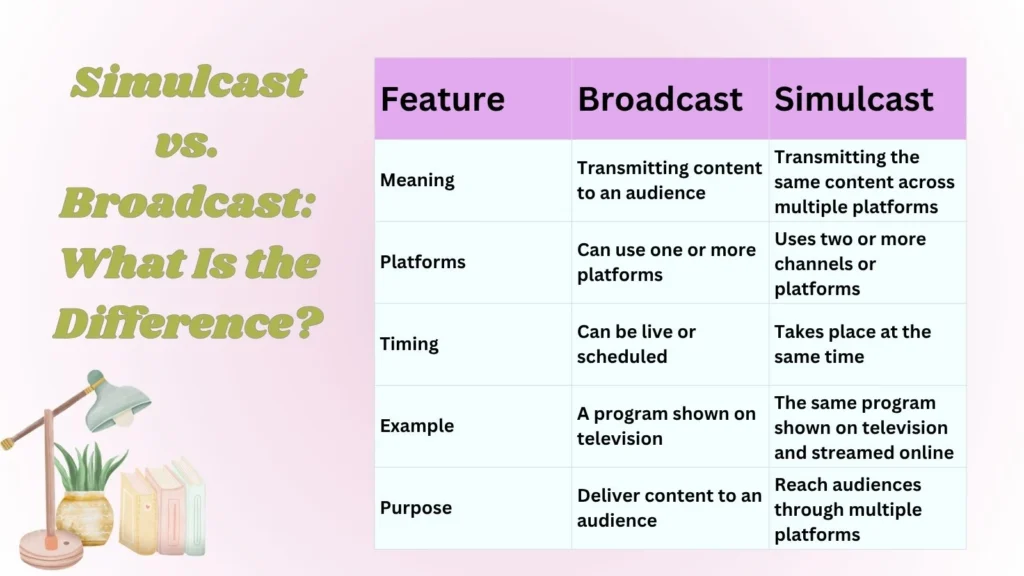
Although simulcast and broadcast are related, they do not mean exactly the same thing.
Broadcast is a general term for transmitting content to an audience. It can happen through television, radio, or other media.
Simulcast specifically describes broadcasting the same content through multiple platforms or channels at the same time.
| Feature | Broadcast | Simulcast |
|---|---|---|
| Meaning | Transmitting content to an audience | Transmitting the same content across multiple platforms simultaneously |
| Platforms | Can use one or more platforms | Uses two or more channels or platforms |
| Timing | Can be live or scheduled | Takes place at the same time |
| Example | A program shown on television | The same program shown on television and streamed online |
| Purpose | Deliver content to an audience | Reach audiences through multiple platforms |
Key difference: Every simulcast is a form of broadcasting, but not every broadcast is a simulcast.
Simulcast vs. Livestream: What Is the Difference?
Simulcast and livestream are often used together, but they describe different aspects of content distribution.
A livestream is a real-time transmission of audio or video over the internet.
A simulcast means the same content is transmitted through multiple channels or platforms at the same time.
For example, a concert streamed live on one website is a livestream. If the same concert is also being shown on television and another streaming platform simultaneously, it can be described as a simulcast.
| Feature | Simulcast | Livestream |
|---|---|---|
| Main idea | Same content on multiple platforms simultaneously | Real-time online audio or video |
| Internet required | Not always | Usually yes |
| Platforms | Multiple channels or platforms | Usually an online platform |
| Example | A match shown on TV and online together | A match streamed live on a website |
Common Places Where Simulcasting Is Used
Simulcasting is not limited to television or radio. It is used across several industries.
| Industry | Example of Simulcasting |
|---|---|
| Sports | Broadcasting a cricket match on TV and online |
| Entertainment | Showing a concert on television and streaming platforms |
| Anime | Releasing episodes internationally close to the Japanese broadcast |
| News | Sharing a live announcement through TV and radio |
| Education | Broadcasting a lecture through a website and campus television |
| Business | Streaming a product launch across several platforms |
| Government | Broadcasting a public announcement through different media |
These examples show how simulcasting makes information and entertainment available to wider audiences.
Benefits of Simulcasting
Simulcasting offers several advantages for broadcasters, organizations, and viewers.
1. Reaches a Larger Audience
One of the biggest benefits is the ability to reach people through multiple platforms.
Some people prefer television, while others use mobile phones, websites, or radio. Simulcasting makes it possible to serve these different audiences.
2. Improves Accessibility
People can choose the platform that best suits their needs.
Someone without access to a television may still be able to watch an event through an online streaming service.
3. Saves Time
Instead of distributing content separately at different times, organizations can transmit it simultaneously.
This is particularly useful for live events and important announcements.
4. Creates a Consistent Experience
When the same event is available across different platforms at the same time, audiences can follow the same major moments together.
5. Supports International Audiences
In entertainment, simulcasting helps viewers in different countries access new content without waiting for a traditional delayed release.
Disadvantages of Simulcasting
Although simulcasting is useful, it also comes with some challenges.
- Technical difficulties: A network or streaming problem can interrupt the broadcast.
- High production costs: Managing multiple platforms may require additional equipment, software, and staff.
- Licensing restrictions: Some content cannot legally be distributed in every region or on every platform.
- Timing differences: Small delays may occur because of internet speed, broadcasting technology, or platform processing.
- Different audience requirements: Each platform may need a slightly different presentation or format.
These challenges mean that successful simulcasting requires careful planning and reliable technology.
Is Simulcast the Same as Simultaneous Streaming?
Not exactly.
The terms are related, but they are not always interchangeable.
Simultaneous streaming generally means sending live content to multiple online platforms at the same time.
Simulcasting has a broader meaning. It can involve television, radio, internet streaming, and other broadcasting methods.
For example, streaming a live event on YouTube and Facebook simultaneously can be described as simulcasting. However, simulcasting can also involve traditional radio and television rather than only online services.
Common Mistakes When Understanding Simulcast

People sometimes misunderstand the term because it is used in several industries. Here are two important mistakes to avoid.
1. Confusing Simulcast With a Regular Broadcast
A regular broadcast does not necessarily involve multiple platforms. It may simply mean transmitting a program through one television or radio channel.
A simulcast specifically involves distributing the same content through multiple channels or platforms at the same time.
2. Assuming Simulcast Means Identical Release Times Everywhere
Simulcast generally refers to simultaneous broadcasting, but small technical delays or regional scheduling differences can occur.
In anime and international streaming, for example, an episode may become available shortly after its original broadcast rather than at the exact same second.
FAQs:
1. What does simulcast mean in simple words?
Simulcast means broadcasting the same program or event through two or more platforms at the same time.
2. What is an example of a simulcast?
A cricket match shown live on television, a sports website, and a mobile application simultaneously is an example of a simulcast.
3. What does simulcast mean in anime?
In anime, simulcast means releasing or streaming an episode internationally at approximately the same time as its original Japanese broadcast.
4. Is simulcast the same as livestream?
No. A livestream is a real-time online broadcast, while a simulcast involves distributing the same content through multiple platforms simultaneously.
5. What is the purpose of simulcasting?
The main purpose is to reach a larger audience by making the same content available through different broadcasting channels at the same time.
6. Can a radio program be simulcast?
Yes. A radio program can be simulcast when the same content is transmitted through another platform, such as a television channel or online streaming service.
7. Does simulcast mean live?
Not necessarily. Simulcast describes simultaneous distribution across multiple platforms. It is often used for live events, but the term can also apply to scheduled programming.
8. Why is simulcasting popular in anime?
It allows international fans to watch new episodes close to their original Japanese release, helping them stay updated with ongoing series.
9. What is the difference between simulcast and broadcast?
Broadcast is the general transmission of content to an audience. Simulcast specifically means transmitting the same content through multiple channels or platforms at the same time.
10. Is simulcasting available on streaming platforms?
Yes. Streaming platforms may simulcast live events or distribute programs simultaneously with television networks and other services.
Conclusion:
The simulcast meaning is simple: it refers to broadcasting the same content through multiple platforms or channels at the same time. It is widely used in television, radio, sports, anime, entertainment, and online streaming.
Whether you are watching a live cricket match, following an anime series, or attending an online event, simulcasting helps make the same content available to audiences through different platforms.

I am Henry James and i am a passionate writer and language enthusiast behind PunPalace, a platform dedicated to exploring meanings, word origins, and simple explanations. My aims to make learning vocabulary easy, engaging, and accessible for everyone.