The remote job meaning is simple: a remote job is work that an employee or freelancer performs away from a traditional office, usually by using the internet and digital communication tools.
Instead of commuting to a company office every day, a remote worker may work from home, a coworking space, a library, or another suitable location. 💻
Remote jobs have become increasingly common in industries such as technology, marketing, customer service, writing, design, education, finance, and administration. Some jobs are fully remote, while others allow employees to work remotely only on certain days.
In this guide, we will explain what a remote job is, how remote work operates, different types of remote jobs, examples, benefits, challenges, remote job requirements, and common mistakes people make when understanding the term.
What Does Remote Job Mean?
A remote job is a job that allows a person to perform their work outside the employer’s traditional physical workplace.
Communication and work are usually handled through digital tools such as email, messaging platforms, video meetings, project-management software, cloud documents, and other online systems.
Simple definition: A remote job is a job that can be performed away from the company’s physical office, often from home or another location with internet access.
For example:
“She has a remote job as a content writer.”
This means she can perform her work without regularly going into a company office.
Remote Work Meaning in Simple English
Remote work means working from somewhere other than the employer’s usual office.
In many cases, remote workers use a computer and internet connection to communicate with their employer and complete their responsibilities.
For example, a graphic designer living in one city might work for a company located in another country without moving to that company’s office.
The terms remote job and remote work are closely related, although “remote job” usually describes the position itself, while “remote work” describes the working arrangement.
How Does a Remote Job Work?
A remote job generally works through online communication and digital collaboration.
A typical remote employee may:
- Receive tasks through an online platform
- Communicate with coworkers through chat or email
- Attend video meetings
- Work on cloud-based documents
- Submit completed projects online
- Track deadlines digitally
- Use company software remotely
- Report progress to a manager
The exact process depends on the employer and type of job.
Some remote jobs require employees to be available during specific working hours, while others focus more on completing assigned tasks by certain deadlines.
What Is a Fully Remote Job?
A fully remote job is a position that can normally be performed remotely rather than requiring regular attendance at a company office.
An employee may work from home or another approved location.
For example:
“This position is fully remote and does not require office attendance.”
However, fully remote does not always mean that an employee can work from absolutely anywhere. Some companies may require workers to live in a specific country, state, region, or time zone.
What Is a Hybrid Job?
A hybrid job combines remote work with office work.
For example, an employee might work from home three days a week and attend the office two days a week.
Hybrid arrangements vary considerably between employers.
| Work Type | Typical Arrangement |
|---|---|
| Fully remote | Work is primarily performed away from the office |
| Hybrid | Combination of remote and office work |
| On-site | Work is primarily performed at the employer’s workplace |
Remote Job vs. Work From Home
Remote job and work from home are often used interchangeably, but they can have slightly different meanings.
A work-from-home arrangement specifically suggests that the person works from their home.
A remote job may allow work from home but could also allow an employee to work from another approved location.
For example:
“I work from home today.”
This describes the location.
“I have a remote job.”
This describes the overall employment arrangement.
Types of Remote Jobs
Remote work is available across many industries. Some common categories include:
- Software development
- Graphic design
- Content writing
- Digital marketing
- Customer support
- Virtual assistance
- Online teaching
- Accounting
- Data analysis
- Project management
- Sales
- Recruitment
- Translation
- Video editing
- Social media management
The availability of remote positions depends on the company, industry, role, and specific responsibilities.
Examples of Remote Jobs
Here are some common examples of positions that can often be performed remotely:
Remote Content Writer
A content writer creates articles, website copy, product descriptions, blogs, or other written material. Most communication and file sharing can happen online.
Remote Software Developer
A software developer can write, test, and maintain code from a remote location using digital development tools and communication platforms.
Remote Graphic Designer
A graphic designer can create logos, advertisements, social media graphics, presentations, and other visual content remotely.
Remote Customer Service Representative
A customer service representative may answer customer questions through phone, email, chat, or specialized support software.
Remote Virtual Assistant
A virtual assistant can handle administrative tasks such as scheduling, email management, research, data entry, and organization from a remote location.
Remote Job Meaning for Freelancers
Remote work is not limited to traditional employees.
Freelancers can also perform remote work for clients located in different cities or countries.
For example, a freelance writer in Pakistan might create website content for a client in the United States without physically meeting the client.
Freelancers usually work under project-based, hourly, or contract arrangements, depending on the agreement.
Benefits of Remote Jobs
Remote jobs can offer several advantages for both workers and employers.
Less Commuting
One major benefit is avoiding the daily commute to an office. This can save time and reduce transportation costs.
Flexible Environment
Some remote positions provide greater flexibility in where and sometimes when work is completed.
Access to Wider Opportunities
Remote work can allow people to apply for jobs with companies located far from their homes.
Potentially Lower Daily Expenses
Working remotely may reduce expenses related to commuting, meals outside the home, and professional clothing, although remote workers may have other costs.
More Control Over the Work Environment
Some people prefer working in a quiet home office rather than a busy workplace.
Remote Employee vs. Freelancer
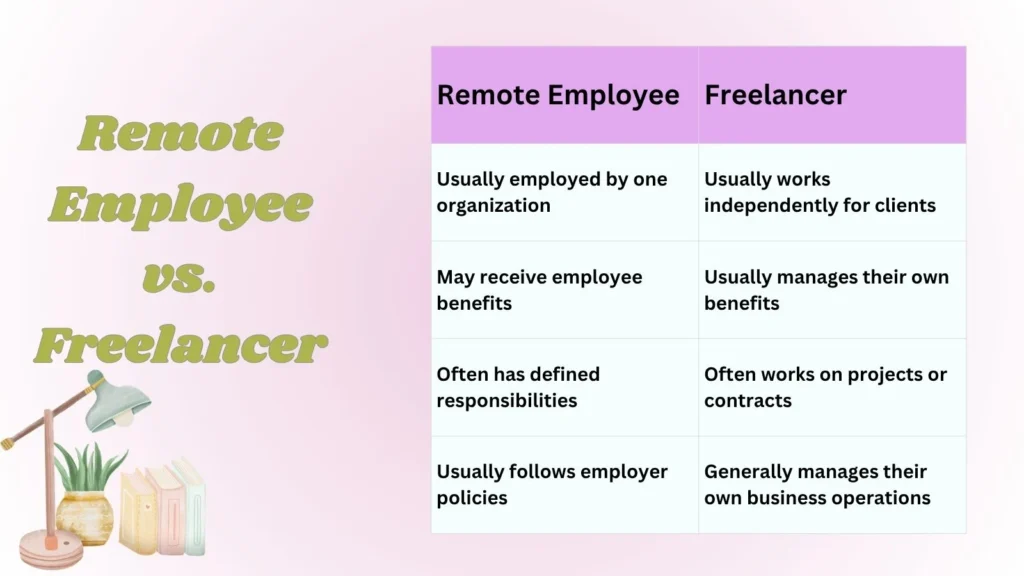
A remote employee and a freelancer can both work outside an office, but their employment relationships are different.
| Remote Employee | Freelancer |
|---|---|
| Usually employed by one organization | Usually works independently for clients |
| May receive employee benefits | Usually manages their own benefits |
| Often has defined responsibilities | Often works on projects or contracts |
| Usually follows employer policies | Generally manages their own business operations |
The exact legal and tax status of workers depends on the applicable laws and the employment agreement.
Challenges of Remote Jobs
Remote work also has disadvantages. It is not automatically easier than office work.
Common challenges include:
- Feeling isolated
- Communication difficulties
- Home distractions
- Internet problems
- Difficulty separating work and personal life
- Time-zone differences
- Less face-to-face interaction
- Need for strong self-discipline
Some people are highly productive remotely, while others prefer the structure and social environment of an office.
Skills Needed for a Remote Job
Remote workers often need both job-specific skills and strong independent working habits.
Important skills may include:
- Communication: Clearly communicating through digital channels.
- Time management: Organizing tasks and meeting deadlines.
- Self-discipline: Staying productive without constant supervision.
- Digital skills: Comfort with computers and online tools.
- Organization: Managing files, tasks, meetings, and deadlines.
- Problem-solving: Handling basic issues independently.
- Adaptability: Adjusting to changing tools and workflows.
What Do You Need for a Remote Job?
The requirements vary by job, but many remote positions require a reliable digital setup.
Common requirements include:
- A computer or laptop
- Reliable internet access
- A suitable workspace
- Email access
- Video-conferencing capability
- Relevant professional software
- Basic digital communication skills
Some employers provide equipment such as laptops, monitors, headsets, or other necessary tools.
Remote Job Meaning in Job Descriptions
When a job advertisement says “remote”, it generally means the position can be performed outside the company’s physical office.
However, applicants should carefully read the complete job description.
A remote position may specify:
- Remote within a particular country
- Remote within a particular state or region
- Specific time-zone requirements
- Occasional office visits
- Required travel
- Specific working hours
- Location restrictions
Therefore, remote does not always mean work from anywhere in the world.
What Does “Remote” Mean on LinkedIn?
When a job listing on a professional employment platform is labeled remote, it generally indicates that the employer does not require the employee to work regularly from a traditional office.
However, the employer may still have location, time-zone, tax, or travel requirements.
Applicants should always review the complete listing before assuming that a position can be performed from any country.
Remote Job Meaning in Texting
If someone says “I have a remote job” in a text message, they usually mean that they work for a company without regularly going to a physical office.
For example:
Person A: “Do you go to the office every day?”
Person B: “No, I have a remote job.”
Person B is explaining that their work is performed remotely, often from home or another approved location.
Remote Job Meaning for Students
Students may look for remote jobs because they can sometimes fit more easily around classes and other responsibilities.
Examples can include:
- Online tutoring
- Content writing
- Virtual assistance
- Graphic design
- Social media work
- Customer support
- Freelance services
However, students should check the required working hours and make sure the position is compatible with their studies.
Remote Jobs and International Work
One common misconception is that every remote job allows international workers.
This is not necessarily true.
An employer may restrict remote employees to a particular country because of employment laws, payroll systems, taxes, data regulations, time zones, or other business requirements.
Therefore, a listing that says remote may still have geographical restrictions.
Remote Work and Productivity
Remote work can be productive when employees have clear goals, effective communication, appropriate tools, and a suitable work environment.
Good remote-work practices can include:
- Setting clear daily priorities
- Maintaining a consistent schedule
- Using task-management tools
- Keeping communication clear
- Taking regular breaks
- Creating boundaries between work and personal time
Productivity ultimately depends on the person, job, management style, and working environment.
Remote Job vs. Office Job
The biggest difference is where the work is performed and how employees interact with the organization.
| Remote Job | Office Job |
|---|---|
| Work is primarily performed away from the office | Work is primarily performed at the office |
| Heavy use of digital communication | More face-to-face interaction |
| Usually little or no daily commute | Usually requires commuting |
| May offer location flexibility | Usually tied to a physical workplace |
| Requires independent organization | Often provides a structured workplace environment |
Remote Job vs. Freelance Job
These terms describe different things.
Remote describes where or how work is performed.
Freelance describes the type of working relationship.
A person can therefore be:
- A remote employee
- A freelance remote worker
- A freelance worker who works on-site
- An employee working in an office
For example, a freelance web designer can work remotely for several clients, while a remote software developer may be a full-time employee of one company.
Common Remote Job Terms
When searching for remote employment, you may encounter several related terms.
- Fully remote: Work is primarily performed remotely.
- Hybrid: Combination of remote and office work.
- Work from home: Work performed from the employee’s home.
- Distributed team: A team whose members work from different locations.
- Remote-first: An organization designed to support remote work as a major working model.
- Location independent: Work designed to allow substantial geographic flexibility, subject to applicable restrictions.
How to Find a Remote Job
Finding a remote job usually starts with identifying suitable roles and employers that genuinely support remote work.
A practical approach includes:
- Choose a specific skill or career area.
- Prepare a professional resume.
- Create a strong online professional profile.
- Build a portfolio when relevant.
- Search specifically for remote positions.
- Check the location requirements carefully.
- Research the employer before applying.
- Prepare for online interviews.
Applicants should also be cautious of job scams that promise unusually high earnings for little work or request money from applicants.
Common Mistakes About Remote Job Meaning
Thinking Remote Means “Work Anywhere”
A remote job may still have geographic restrictions. Always check whether the employer accepts workers from your country or region.
Thinking Remote Means No Fixed Schedule
Many remote employees still have specific working hours, meetings, deadlines, and availability requirements.
Thinking Remote Work Means Easy Work
Remote work still requires professional skills, responsibility, communication, and performance.
Confusing Remote With Freelance
Remote describes the work location or arrangement, while freelance describes an independent working relationship. They are not the same thing.
Assuming Every Remote Job Is Work From Home
Some remote employees can work from coworking spaces or other approved locations. The exact arrangement depends on the employer.
Ignoring Time-Zone Requirements
A remote company may require employees to work during specific hours so that they can collaborate with the rest of the team.
FAQs:
What does remote job mean?
A remote job is a job that allows a person to perform their work away from a traditional company office, often from home or another approved location.
Does a remote job mean working from home?
Not always. Many remote employees work from home, but some may work from coworking spaces or other approved locations.
What is the difference between remote and hybrid work?
Remote work is primarily performed away from the office, while hybrid work combines remote work with regular or scheduled office attendance.
Can remote jobs be full-time?
Yes. Remote jobs can be full-time, part-time, temporary, contract, or freelance positions depending on the employer and role.
Does remote mean you can work from any country?
No. Some remote jobs have specific country, region, tax, legal, or time-zone requirements.
Conclusion:
The remote job meaning refers to a job that allows a person to work away from a traditional office, often using a computer, internet connection, and digital communication tools.
Remote jobs can be found in many fields, including technology, writing, marketing, customer service, design, education, finance, and administration. They can be full-time, part-time, freelance, or contract positions.
The biggest advantages may include less commuting, greater location flexibility, and access to opportunities outside a person’s local area. At the same time, remote work requires communication, organization, self-discipline, and the ability to work effectively without constant in-person supervision.

I am Henry James and i am a passionate writer and language enthusiast behind PunPalace, a platform dedicated to exploring meanings, word origins, and simple explanations. My aims to make learning vocabulary easy, engaging, and accessible for everyone.