Have you ever wondered how someone can understand a machine, software program, device, or product without having access to the original design process? That is where reverse engineering comes in.
The reverse engineering meaning is the process of examining an existing product, system, device, or piece of software to understand how it works, how it was designed, or how its different parts fit together.
Instead of starting with an idea and building something from scratch, reverse engineering starts with something that already exists and works backward to discover its structure and function.
Reverse engineering is used in software development, cybersecurity, manufacturing, engineering, electronics, automotive technology, research, and many other fields. 🔍
In this guide, we will explain what reverse engineering means, how the process works, where it is used, common examples, its advantages and limitations, and how it differs from related concepts.
What Does Reverse Engineering Mean?
Reverse engineering means analyzing an existing system, product, device, or software to understand its design, components, operation, or underlying principles.
The word “reverse” is important because the normal engineering process usually moves from a design or idea toward a finished product. Reverse engineering moves in the opposite direction: from the finished product back toward an understanding of its design.
Simple definition: Reverse engineering is the process of taking an existing product or system apart, analyzing it, and figuring out how it works.
The process does not always involve physically taking something apart. Software, for example, can be analyzed by examining its code, behavior, files, memory, or compiled instructions.
Reverse Engineering Meaning in Simple English
In simple English, reverse engineering means working backward from a finished thing to understand how it was made or how it works.
Imagine finding an unfamiliar machine. You do not have its original blueprint. You carefully examine its parts, observe what happens when it operates, and determine how the pieces work together.
That is essentially reverse engineering.
For software, the process might involve examining a program to understand what it does and how its internal components interact.
For a physical product, engineers might inspect its materials, dimensions, components, and manufacturing methods.
Why Is It Called Reverse Engineering?
It is called reverse engineering because it reverses the usual direction of the engineering process.
Traditional engineering often follows a path like this:
- Idea
- Requirements
- Design
- Prototype
- Testing
- Finished product
Reverse engineering begins with the finished product or existing system and works backward.
- Existing product
- Observation
- Analysis
- Identification of components
- Understanding relationships
- Reconstruction of design or functionality
This reversal is the key idea behind the term.
How Does Reverse Engineering Work?
The exact process varies depending on what is being analyzed. Reverse engineering a car is very different from reverse engineering an application.
However, many reverse engineering projects follow a similar general process.
1. Identify the Objective
The first step is deciding what you want to understand.
For example, an engineer might want to discover:
- How a product works
- Why a device fails
- How software behaves
- How components interact
- What materials were used
- How an older system can be maintained
A clear objective helps determine what information needs to be collected.
2. Collect Information
The analyst gathers available information about the product or system.
This might include documentation, specifications, observable behavior, measurements, files, physical components, or test results.
3. Examine the Components
The system is examined in greater detail. Physical products may be opened or measured, while software may be analyzed through its files, behavior, architecture, or compiled instructions.
4. Analyze Relationships
Researchers determine how different parts interact with one another.
Understanding individual components is useful, but understanding how those components work together is often the most important part.
5. Reconstruct the Design
The collected information can then be used to create diagrams, documentation, models, or other representations of the original system.
6. Test the Understanding
The reconstructed understanding is compared with the behavior of the original system.
If the explanation does not match what the original system does, researchers refine their model and continue investigating.
Reverse Engineering Examples
Reverse engineering is easier to understand when you see practical examples.
Example 1: Software
A developer may analyze an old software application to understand how it functions because the original source code or documentation is no longer available.
The goal may be to maintain the system, migrate its functionality, or make it work with newer technology.
Example 2: Automobile
An automotive engineer can examine a vehicle’s components and construction to understand how certain systems operate.
This may help with maintenance, compatibility, research, or product development.
Example 3: Electronic Device
An engineer may examine a circuit board to identify its components and understand how signals move through the system.
Example 4: Mechanical Part
If an older machine has a broken component and its original engineering drawings are unavailable, an engineer may measure the existing part and create a new digital model.
Example 5: Security Research
A cybersecurity researcher may analyze software to understand how it behaves and identify security weaknesses.
This type of research must be performed responsibly and within applicable laws and authorization.
Reverse Engineering in Software
Software reverse engineering involves studying an existing software program to understand its structure, behavior, algorithms, or functionality.
Software developers may encounter situations where they need to understand an application without having access to its original source code.
Depending on the situation, researchers may examine:
- Program files
- Compiled code
- Program behavior
- Data structures
- File formats
- Dependencies
- Communication patterns
- System interactions
The purpose can range from maintaining legacy software to conducting authorized security research.
Source Code vs. Reverse Engineering
If you have the original source code, you can directly examine how the program was written.
Reverse engineering is often necessary when the original source code is unavailable or when researchers need to understand the behavior of an existing compiled program or system.
Reverse Engineering in Cybersecurity
Reverse engineering plays an important role in cybersecurity research.
Security researchers can analyze suspicious or potentially malicious software to understand what it does, how it operates, and what systems it interacts with.
Security analysis can help researchers identify:
- Suspicious behavior
- Security vulnerabilities
- Unexpected network activity
- Hidden functionality
- Potential attack techniques
- Indicators that can assist defensive monitoring
Reverse engineering can therefore support defensive security work, incident analysis, malware research, and vulnerability investigation.
Because software analysis can also be misused, authorized and lawful testing is an important part of responsible cybersecurity research.
Reverse Engineering in Manufacturing
In manufacturing, reverse engineering can help companies understand existing physical products.
For example, engineers can measure an existing component and create a digital model of it.
This is particularly useful when:
- Original drawings are unavailable.
- A component is obsolete.
- Replacement parts are needed.
- An older machine needs modernization.
- Engineers need to document an existing design.
- A product needs to be analyzed for improvement.
Modern measurement tools and 3D scanning can make this process significantly more efficient.
Reverse Engineering and 3D Scanning
3D scanning is commonly associated with reverse engineering physical objects.
A scanner can capture the shape and dimensions of an existing object and convert the collected measurements into digital information.
Engineers can then use that information to create or refine a computer-aided design model.
The general workflow may look like:
- Scan the physical object.
- Collect geometric data.
- Clean and process the data.
- Create a digital model.
- Compare the model with the physical object.
- Use the model for engineering or manufacturing purposes.
This is one example of how modern technology supports reverse engineering.
Reverse Engineering in Electronics
Electronic products can also be reverse engineered.
An engineer may examine a circuit board to determine which components are present and how they are connected.
Analysis may involve components such as:
- Processors
- Memory chips
- Resistors
- Capacitors
- Integrated circuits
- Connectors
- Sensors
- Power-management components
Understanding the relationships between these components can help researchers document an existing device or troubleshoot engineering problems.
Reverse Engineering in Automotive Technology
The automotive industry provides many examples of reverse engineering.
Engineers may study existing vehicles to understand components, manufacturing techniques, dimensions, performance characteristics, or system integration.
Reverse engineering can also be useful when supporting older vehicles for which original documentation is incomplete.
However, analyzing a competitor’s product does not automatically grant legal permission to copy protected designs, software, trademarks, or patented inventions.
Reverse Engineering vs. Forward Engineering
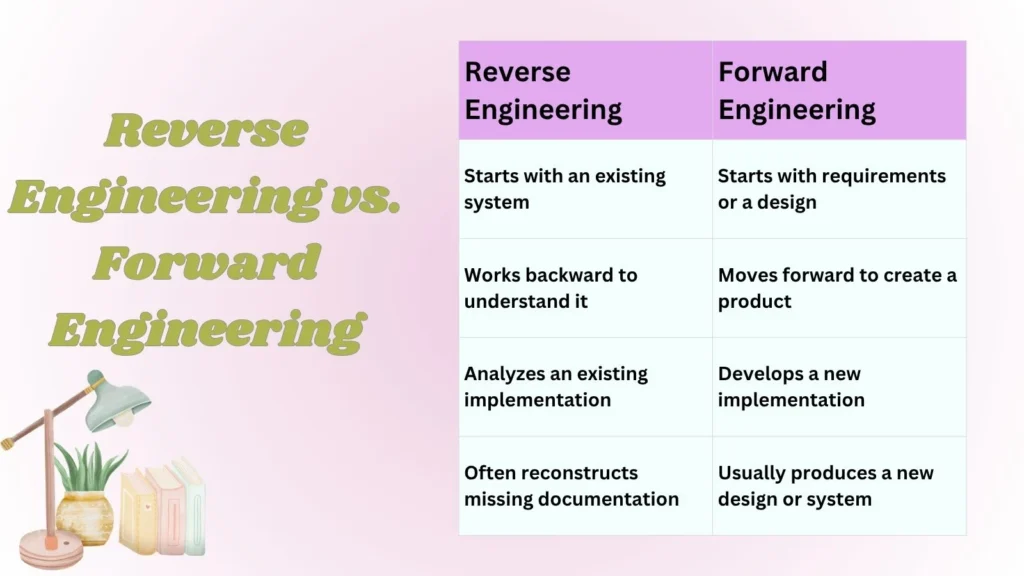
One of the easiest ways to understand reverse engineering is to compare it with forward engineering.
| Reverse Engineering | Forward Engineering |
|---|---|
| Starts with an existing system | Starts with requirements or a design |
| Works backward to understand it | Moves forward to create a product |
| Analyzes an existing implementation | Develops a new implementation |
| Often reconstructs missing documentation | Usually produces a new design or system |
In simple terms, forward engineering builds something, while reverse engineering studies something that already exists.
Reverse Engineering vs. Decompiling
These terms are related but should not be treated as exact synonyms.
Decompiling refers to converting compiled software into a higher-level representation that is easier for humans to understand.
Reverse engineering is much broader. It can include analyzing software behavior, architecture, files, communications, and other characteristics.
Decompilation can therefore be one technique used during software reverse engineering.
Reverse Engineering vs. Copying
Another common misunderstanding is that reverse engineering simply means copying an existing product.
That is not necessarily true.
Reverse engineering is primarily about understanding an existing system. The resulting knowledge may be used for maintenance, compatibility, research, troubleshooting, education, security analysis, or other purposes.
Whether a particular use is legally permitted depends on factors such as intellectual-property rights, licenses, contracts, jurisdiction, and purpose.
Why Do Engineers Use Reverse Engineering?
There are many legitimate reasons to reverse engineer a system.
Understanding Legacy Systems
Older software and machines may remain important long after their original designers have moved on. Reverse engineering can help engineers understand systems that lack complete documentation.
Repair and Maintenance
Understanding how a component works can help technicians diagnose problems or create compatible replacements.
Compatibility
Researchers may study an existing system to understand how another product can communicate or work with it.
Security Research
Authorized security researchers may analyze software and hardware to identify vulnerabilities or understand suspicious behavior.
Research and Education
Students and engineers can use reverse engineering to learn how real-world systems are designed and implemented.
Product Improvement
Studying an existing design can reveal opportunities for performance, reliability, manufacturing, or usability improvements.
Benefits of Reverse Engineering
Reverse engineering can provide several practical benefits when performed appropriately.
- Better understanding: It reveals how an existing system works.
- Documentation: It can help recreate missing technical documentation.
- Maintenance: It can support older products and systems.
- Compatibility: It can help engineers understand interfaces and interactions.
- Security: It can support authorized vulnerability and malware analysis.
- Innovation: Studying existing designs can provide technical insights.
- Problem solving: It can help identify why a product or system behaves in a particular way.
Limitations of Reverse Engineering
Reverse engineering can also be difficult and time-consuming.
Some systems are extremely complex, and understanding every component may require specialized knowledge.
Common challenges include:
- Incomplete information
- Complex architecture
- Obfuscated software
- Limited documentation
- Specialized hardware
- Difficulty reproducing original conditions
- Time and cost
- Legal or contractual restrictions
A reverse-engineered model may also fail to capture every detail of the original design if some information cannot be observed directly.
Is Reverse Engineering Legal?
There is no single worldwide answer to whether reverse engineering is legal. The legal position depends on the jurisdiction, purpose, product, license terms, intellectual-property rights, and specific circumstances.
Some forms of reverse engineering may be permitted for purposes such as interoperability, security research, education, or maintenance under certain laws or exceptions. Other activities may violate copyright, patent, trade-secret, contract, or software-license restrictions.
Therefore, the fact that something can technically be reverse engineered does not automatically mean that every possible use is legally allowed.
When dealing with commercial software, proprietary hardware, or confidential information, it is important to review the applicable license, contract, and law.
Reverse Engineering in Everyday Technology
Although the term sounds highly technical, the underlying idea is easy to recognize in everyday life.
Imagine receiving an unfamiliar electronic device. You inspect its buttons, connections, internal components, and behavior until you understand what each part does.
You are essentially applying the basic logic of reverse engineering.
Professional reverse engineering simply uses more advanced methods, specialized tools, measurements, documentation techniques, and technical knowledge.
Skills Needed for Reverse Engineering
People working in reverse engineering often develop knowledge across several technical areas.
Depending on the field, useful skills may include:
- Problem-solving
- Logical reasoning
- Programming
- Computer architecture
- Electronics
- Mechanical engineering
- Digital modeling
- Debugging
- Data analysis
- Technical documentation
Cybersecurity-focused reverse engineers may also study operating systems, assembly languages, executable formats, networking, and defensive security techniques.
Common Tools Used in Reverse Engineering
The tools depend heavily on the type of object being analyzed.
Software researchers may use tools for:
- Debugging
- Disassembly
- Decompilation
- File analysis
- Memory analysis
- Behavior monitoring
Physical-product engineers may use:
- Calipers and precision measurement tools
- 3D scanners
- CAD software
- Microscopes
- Imaging equipment
- Material-analysis tools
The important point is that reverse engineering is a methodology, not one particular tool.
Reverse Engineering and Innovation
Reverse engineering can contribute to innovation by helping engineers understand how existing systems solve particular technical problems.
For example, an engineer studying an older mechanical design may discover a clever way of reducing vibration. That knowledge can inspire a new design.
However, learning from an existing product is different from unlawfully reproducing protected intellectual property.
Good engineering uses analysis as a source of understanding while respecting applicable legal and ethical boundaries.
Reverse Engineering Meaning in Business
Businesses may use reverse engineering for maintenance, compatibility, product research, quality analysis, and understanding older systems.
For example, a manufacturer may need to replace a discontinued component. If original technical drawings are unavailable, engineers can examine an existing component and create measurements or a digital model.
Similarly, a software company maintaining a legacy application may need to understand undocumented behavior before replacing or modernizing the system.
Reverse Engineering and Product Design
Product designers can use reverse engineering to study existing products and identify technical characteristics.
They may examine:
- Dimensions
- Materials
- Component placement
- Manufacturing methods
- Mechanical movement
- Electrical connections
- User interaction
This information can support research and development, provided that the resulting work respects relevant legal and contractual restrictions.
Reverse Engineering and Legacy Technology
Legacy technology is one of the areas where reverse engineering can be especially valuable.
A system may still be operational even though:
- The original engineers are unavailable.
- Documentation has been lost.
- The original manufacturer no longer supports it.
- Some components are obsolete.
- The original source code is unavailable.
Reverse engineering can help organizations understand these systems before modifying, repairing, replacing, or integrating them with newer technology.
Reverse Engineering vs. Reengineering
These terms sound similar but describe different activities.
Reverse engineering focuses on understanding an existing system.
Reengineering generally involves changing, redesigning, restructuring, or rebuilding an existing system to improve it or adapt it to new requirements.
Reverse engineering may therefore happen before reengineering.
An organization might first analyze an old system to understand how it works and then redesign it using modern technology.
Common Phrases With Reverse Engineering
You may encounter reverse engineering in phrases such as:
- Reverse engineering software
- Reverse engineering a product
- Reverse engineering technology
- Reverse engineering process
- Reverse engineering tools
- Reverse engineering analysis
- Reverse engineering techniques
- Reverse engineering design
- Software reverse engineering
- Hardware reverse engineering
How to Use Reverse Engineering in a Sentence
Here are some simple examples showing how the phrase is used.
- Example 1: The engineers used reverse engineering to understand the old machine.
- Example 2: She studied software reverse engineering as part of her cybersecurity training.
- Example 3: The company used reverse engineering to document an obsolete component.
- Example 4: Reverse engineering helped the team understand the device’s internal architecture.
- Example 5: The researchers performed authorized reverse engineering for security analysis.
- Example 6: The engineers created a digital model through reverse engineering.
Reverse Engineering Meaning in Technology
In technology, reverse engineering generally means analyzing an existing technological system to understand its internal structure, behavior, design, or functionality.
The term can apply to software, hardware, embedded systems, electronic devices, communication systems, and more.
Technology professionals use reverse engineering for many reasons, including troubleshooting, interoperability, security research, maintenance, education, and documentation.
Common Mistakes About Reverse Engineering Meaning

Thinking Reverse Engineering Always Means Copying
Reverse engineering is about understanding an existing system. Copying a product may be one possible outcome of an analysis, but copying is not the definition of reverse engineering.
Assuming It Only Applies to Software
Reverse engineering is used in software, but it also applies to mechanical products, electronics, vehicles, manufacturing, and other physical systems.
Thinking It Always Requires Taking Something Apart
Physical disassembly can be useful, but reverse engineering can also involve observation, measurements, testing, software analysis, and other non-destructive methods.
Confusing Reverse Engineering With Reengineering
Reverse engineering focuses on understanding an existing system, while reengineering generally involves modifying or redesigning it.
Assuming Everything Can Be Reverse Engineered Easily
Some systems are extremely complex, undocumented, encrypted, protected, or difficult to access. Reverse engineering can require significant time and specialized expertise.
Assuming Reverse Engineering Is Always Legal
The legality depends on the circumstances and applicable law. Authorization, contracts, licenses, intellectual-property rights, and the purpose of the activity can all matter.
FAQs:
What does reverse engineering mean?
Reverse engineering means examining an existing product, system, device, or software to understand how it works, how it was designed, or how its components interact.
What is reverse engineering in simple words?
In simple words, reverse engineering means working backward from an existing product or system to figure out how it works.
What is an example of reverse engineering?
An example is analyzing an old machine when its original engineering drawings are unavailable. Engineers can measure its components and create a digital model to understand or reproduce necessary parts.
Is reverse engineering the same as copying?
No. Reverse engineering is the process of analyzing and understanding an existing system. Copying is a separate activity and may involve legal or intellectual-property issues.
Is reverse engineering used in cybersecurity?
Yes. Authorized reverse engineering is used in cybersecurity to analyze software, investigate suspicious programs, study vulnerabilities, and understand how systems behave.
Conclusion:
The reverse engineering meaning is the process of examining an existing product, system, device, or software to understand its design, structure, components, and behavior.
Instead of building something from an initial design, reverse engineering starts with something that already exists and works backward toward an understanding of how it was created or how it operates.
It is used across software development, cybersecurity, manufacturing, electronics, automotive engineering, product design, research, and legacy-system maintenance.
Reverse engineering is not automatically the same as copying, decompiling, or reengineering. Those activities can overlap with reverse engineering, but each has its own meaning and purpose.
Whether you are learning about software, hardware, engineering, or cybersecurity, understanding the basic idea is simple: reverse engineering means looking at the finished system and working backward to understand it.

I am Henry James and i am a passionate writer and language enthusiast behind PunPalace, a platform dedicated to exploring meanings, word origins, and simple explanations. My aims to make learning vocabulary easy, engaging, and accessible for everyone.