The common sense meaning refers to the ability to make sensible, practical decisions by using basic judgment and everyday experience. It means understanding what is reasonable or sensible in an ordinary situation without needing complicated knowledge.
For example, if it is raining heavily and you decide to take an umbrella before leaving home, that is an example of common sense. You are using simple knowledge about the situation to make a practical choice. ☔
Common sense is often connected with good judgment, practical thinking, reasonable behavior, and awareness of consequences.
Simple definition: Common sense is the ability to think and behave in a practical, reasonable way based on everyday knowledge and experience.
Common Sense Definition in Simple English
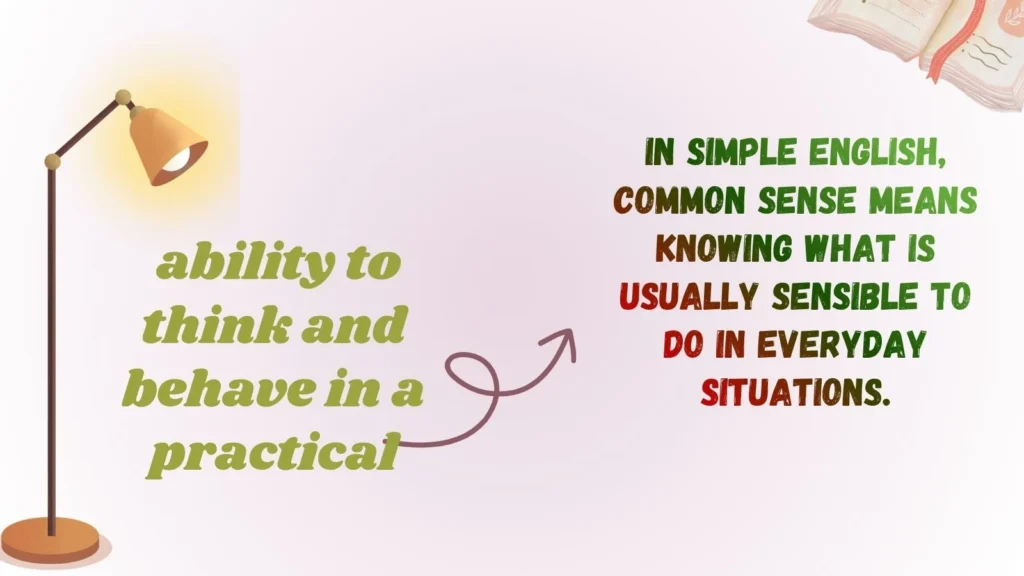
In simple English, common sense means knowing what is usually sensible to do in everyday situations.
It helps people make ordinary decisions without needing special training or complicated instructions.
- Looking both ways before crossing a road.
- Checking whether food is still safe before eating it.
- Wearing warm clothes when the weather is very cold.
- Saving important work before closing a computer program.
- Keeping valuable belongings in a safe place.
- Thinking about possible consequences before taking a risky action.
These examples involve basic practical judgment. That is the central idea behind the meaning of common sense.
What Does Common Sense Mean?
What does common sense mean? It means using practical judgment to deal with ordinary situations in a sensible way.
Common sense is not necessarily about being highly educated or knowing a large amount of information. Someone can have extensive academic knowledge and still make an impractical decision in a simple everyday situation.
Likewise, someone without advanced education can have excellent practical judgment.
For example, if a glass is placed close to the edge of a table, moving it farther away from the edge is common sense because it reduces the chance of the glass falling.
The decision is based on a simple understanding of cause and effect.
What Is an Example of Common Sense?
One simple example of common sense is bringing an umbrella when the weather forecast indicates heavy rain.
Other everyday examples include:
- Not touching a hot pan with your bare hand.
- Charging your phone before a long journey if you expect to need it.
- Reading instructions before using an unfamiliar product.
- Keeping a wallet or phone secure in a crowded place.
- Wearing appropriate shoes for a difficult hiking trail.
- Not sharing private information with an unknown person online.
In each case, a person considers the situation and chooses an action that is generally practical and reasonable.
Why Is Common Sense Important?
Common sense helps people navigate everyday life. It can support safer choices, better decisions, and more practical problem-solving.
It is especially useful when there is no detailed instruction telling you exactly what to do.
For example, imagine that you notice water leaking from a pipe in your home. You may not be a plumber, but common sense can tell you that allowing the water to continue flowing could cause more damage. Turning off the water supply and seeking appropriate help would be a practical response.
Common sense can help with:
- Safety: Recognizing obvious risks.
- Decision-making: Choosing practical options.
- Problem-solving: Finding reasonable solutions.
- Communication: Understanding ordinary social situations.
- Daily tasks: Handling routine problems effectively.
It does not solve every problem, but it provides a useful foundation for ordinary decisions.
Common Sense vs Intelligence
Common sense and intelligence are related but not identical.
Intelligence can involve learning, reasoning, problem-solving, memory, abstract thinking, and understanding complex ideas. Common sense is more specifically associated with practical judgment in everyday situations.
| Common Sense | Intelligence |
|---|---|
| Focuses on practical everyday judgment. | Can involve complex reasoning and learning. |
| Often develops through experience and observation. | Can involve many different cognitive abilities. |
| Helps with ordinary real-world decisions. | Can help solve complex theoretical or practical problems. |
| Does not require advanced academic knowledge. | May involve specialized knowledge or advanced reasoning. |
Someone can be very intelligent but occasionally make a decision that appears to lack common sense. Similarly, a person may have strong practical judgment without having advanced academic knowledge.
Common Sense vs Knowledge
Knowledge means information or understanding gained through education, study, observation, or experience. Common sense is the practical ability to use basic understanding when making everyday decisions.
For example, knowing that a particular chemical is dangerous is specific knowledge. Understanding that you should not randomly mix unknown chemicals is a practical safety judgment.
In everyday life, knowledge and common sense often work together.
Common Sense Examples in Everyday Life
Common sense appears in many ordinary situations, even when people do not specifically call it common sense. 🧠
At Home
- Turning off appliances when they are not needed.
- Cleaning up spilled water to prevent someone from slipping.
- Keeping sharp objects away from young children.
- Closing doors and windows when necessary.
At School
- Reading an assignment before submitting it.
- Bringing necessary materials to class.
- Asking for clarification when instructions are unclear.
- Checking your work before handing it in.
At Work
- Arriving prepared for an important meeting.
- Checking an email before sending it.
- Keeping important files backed up.
- Asking questions before making a decision when information is missing.
Online
- Being careful with suspicious links.
- Using strong passwords.
- Thinking before sharing private information.
- Checking information before believing or sharing it.
These actions demonstrate practical awareness of likely consequences.
What Does It Mean to Use Common Sense?
To use common sense means to stop, consider the situation, and choose an action that is reasonably practical.
For example, suppose you are carrying a cup of hot coffee while walking on a crowded staircase. Using common sense means recognizing that the situation has a risk of spilling and adjusting how you carry the cup or waiting until you are in a safer place.
It is essentially about asking:
- What is happening?
- What could go wrong?
- What is the practical thing to do?
- What are the likely consequences?
These questions can encourage better everyday judgment.
Can Common Sense Be Learned?
Many practical habits associated with common sense can be developed through experience, observation, education, and learning from mistakes.
People often become better at practical decision-making as they encounter more situations and understand their consequences.
For example, someone who once forgot to check the weather before leaving for an outdoor event may learn to check the forecast next time.
That experience can improve future decision-making.
Developing practical judgment can involve:
- Paying attention to consequences.
- Learning from mistakes.
- Listening to experienced people.
- Thinking before acting.
- Considering possible risks.
- Asking questions when something is unclear.
- Checking reliable information when assumptions may be wrong.
Common Phrases With Common Sense
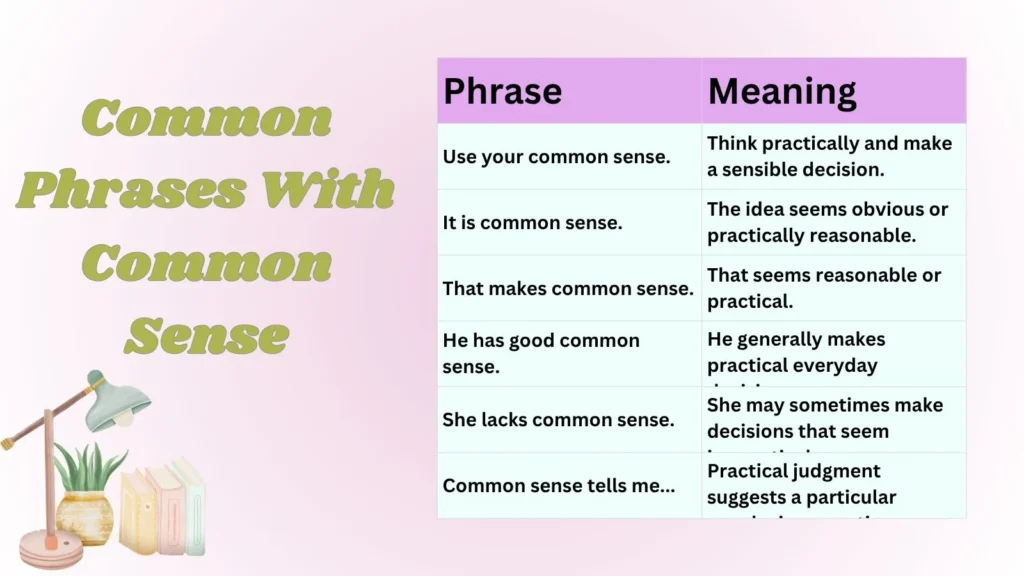
The expression appears in many common English phrases.
| Phrase | Meaning |
|---|---|
| Use your common sense. | Think practically and make a sensible decision. |
| It is common sense. | The idea seems obvious or practically reasonable. |
| That makes common sense. | That seems reasonable or practical. |
| He has good common sense. | He generally makes practical everyday decisions. |
| She lacks common sense. | She may sometimes make decisions that seem impractical. |
| Common sense tells me… | Practical judgment suggests a particular conclusion or action. |
Common Sense Meaning in a Conversation
In everyday conversation, people often use common sense to describe something they consider obvious or practical.
For example:
“Use common sense and don’t leave your phone unattended in a crowded place.”
Here, the speaker is referring to basic practical awareness.
Another example is:
“It is common sense to check the address before sending the package.”
This means the speaker believes checking the address is a simple and reasonable step.
However, the phrase can sometimes sound critical when directed at another person. Saying “Use your common sense” may imply that the speaker thinks the other person should have recognized something obvious.
Is Common Sense the Same for Everyone?
Not necessarily. What seems obvious or practical can sometimes depend on a person’s experience, culture, environment, education, and circumstances.
People may have different assumptions about what should be obvious because they have learned different things or lived in different situations.
For example, a task that seems completely familiar to someone with years of experience may not be obvious to a beginner.
This is why the phrase common sense can sometimes be subjective. An action that appears obvious to one person may not be obvious to another.
That does not necessarily mean one person is intelligent and the other is not. It may simply reflect differences in experience or expectations.
Common Sense in Problem-Solving
Common sense can be useful when solving simple problems because it encourages people to focus on practical solutions.
Suppose your phone is not charging. Instead of immediately assuming the phone is broken, you might first check whether the charger is properly connected, whether the outlet works, and whether the cable is damaged.
These are simple checks based on ordinary reasoning.
Common sense problem-solving often follows a basic pattern:
- Identify the problem.
- Look at the obvious possible causes.
- Consider the simplest reasonable solution.
- Check whether the solution works.
- Seek specialized help if the problem requires it.
Of course, common sense has limits. A complicated technical, legal, medical, or financial problem may require professional knowledge rather than relying only on everyday judgment.
Common Sense and Critical Thinking
Common sense and critical thinking can work together, but they are not identical.
Common sense often helps with practical everyday decisions. Critical thinking involves carefully evaluating information, evidence, assumptions, and reasoning.
For example, common sense might tell you not to immediately trust a suspicious online message. Critical thinking can take the next step by examining the sender, checking the claim, and looking for reliable evidence.
Both approaches can be valuable, especially when a situation is more complicated than it first appears.
Synonyms of Common Sense
There is no single perfect synonym for common sense, but several words and phrases can express similar ideas depending on context.
- Good judgment
- Practical judgment
- Practical wisdom
- Sound judgment
- Good sense
- Practical thinking
- Reasonableness
- Judgment
Good judgment is especially close in meaning because it refers to making sensible decisions after considering a situation.
Antonyms of Common Sense
There is not always one direct opposite of common sense, but the following expressions can describe the opposite idea:
- Poor judgment
- Foolishness
- Impractical thinking
- Recklessness
- Carelessness
- Irrational thinking
- Lack of judgment
The exact opposite depends on the situation and what kind of practical judgment is missing.
Common Sense Meaning in British and American English
Common sense is a widely used expression in both British and American English. Its basic meaning remains essentially the same: practical judgment based on ordinary experience and reasonable understanding.
You may hear it in casual conversations, workplace discussions, educational settings, news writing, books, and everyday advice.
Examples include:
- “It’s just common sense.”
- “You need to use some common sense.”
- “She has excellent common sense.”
- “That seems like common sense to me.”
Common Mistakes About Common Sense

1. Thinking Common Sense Means Intelligence
Common sense and intelligence are not identical. Common sense focuses mainly on practical everyday judgment, while intelligence is a broader concept involving different cognitive abilities.
2. Assuming Common Sense Is Always Universal
Different people can have different experiences and expectations. What seems obvious to one person may not be obvious to someone with a different background or level of experience.
3. Using Common Sense for Every Problem
Common sense is useful for everyday situations, but complicated problems may require specialized knowledge, professional advice, or reliable evidence.
4. Thinking Common Sense Means Never Making Mistakes
Everyone can make poor decisions. Having common sense does not mean a person will always choose correctly.
5. Confusing Common Sense With a Fact
Something being described as common sense does not automatically make it factually correct. Sometimes a claim that seems obvious still needs evidence or further investigation.
FAQs:
What does common sense mean in simple words?
Common sense means using practical judgment to make reasonable decisions in everyday situations.
What is an example of common sense?
Taking an umbrella when heavy rain is expected is a simple example of common sense because it is a practical response to a predictable situation.
Is common sense the same as intelligence?
No. Intelligence is a broader concept, while common sense mainly refers to practical judgment and sensible everyday decision-making.
What is another word for common sense?
Depending on the context, alternatives include good judgment, sound judgment, practical wisdom, good sense, and practical thinking.
Can common sense be learned?
Many practical habits associated with common sense can develop through experience, observation, education, and learning from previous mistakes.
Conclusion: Common:
The common sense meaning is centered on practical judgment, reasonable thinking, and sensible everyday behavior. It helps people recognize ordinary risks, consider consequences, and choose actions that are generally practical.
Common sense is not exactly the same as intelligence or knowledge. It is more closely connected with applying everyday understanding to real-life situations. It can also develop through experience and learning.
From checking the weather before leaving home to thinking carefully before making a risky decision, common sense appears in countless ordinary moments. In simple terms, it means using practical judgment to handle everyday situations sensibly.

I am Henry James and i am a passionate writer and language enthusiast behind PunPalace, a platform dedicated to exploring meanings, word origins, and simple explanations. My aims to make learning vocabulary easy, engaging, and accessible for everyone.