Have you come across the word bogie and wondered what it means? The word bogie meaning can be confusing because it has several different uses. You may see it when reading about trains, vehicles, engineering, golf, or even informal conversation.
In railway terminology, a bogie is a wheeled framework underneath a railway vehicle that supports the vehicle and allows it to move along the track. In golf, bogey is a different spelling and refers to a score of one over par on a hole.
The word can also appear in other specialized or informal contexts. That is why understanding the sentence around it is important.
In this guide, we will explain what does bogie mean in simple English, explore its major meanings, provide clear examples, and explain the difference between bogie and bogey.
What Is the Bogie Meaning?
The most common technical meaning of bogie refers to a small wheeled assembly that supports a railway vehicle.
A train carriage can be very long and heavy. Instead of placing all its wheels directly under the body in one simple arrangement, many railway vehicles use bogies. These assemblies contain wheels, axles, bearings, suspension components, and other mechanical parts.
In simple English, you can think of a bogie as a wheeled support system underneath a train or railway vehicle.
For example:
The railway carriage has two bogies underneath it.
Here, bogies are the wheeled structures supporting the carriage and helping it travel along the railway.
Bogie Meaning in Simple English
If you want a very simple definition, bogie means a wheeled frame or assembly that supports a railway vehicle.
It is located between the railway vehicle and the tracks. The bogie helps distribute the vehicle’s weight and allows the vehicle to negotiate curves more effectively.
A simplified way to remember it is:
Train body → bogie → wheels → railway track
Modern bogies can be complex mechanical systems. They may include suspension, braking equipment, traction components, steering features, and other systems depending on the type of railway vehicle.
Bogie Meaning in a Train
The bogie meaning in train is especially important in railway engineering.
A railway carriage or locomotive can use one or more bogies to support its body. A typical bogie has several wheels arranged around axles and is designed to move beneath the vehicle.
One important advantage of a bogie is that it allows the railway vehicle to handle curves while maintaining stability.
Imagine a long train carriage trying to travel around a bend. A rigid wheel arrangement attached directly to the entire length of the vehicle would make this much more difficult.
A bogie provides a movable support structure that can help the vehicle follow the curve of the track.
| Part | Basic Function |
|---|---|
| Bogie frame | Supports and connects major components |
| Wheels | Run on the railway track |
| Axles | Connect and support wheelsets |
| Suspension | Helps manage movement and vibration |
| Braking components | Help slow or stop the vehicle |
Why Do Trains Use Bogies?
Bogies serve several important purposes in railway vehicles.
- Weight distribution: They help distribute the weight of the vehicle over multiple wheelsets.
- Curve negotiation: They allow the vehicle to travel around railway curves more effectively.
- Stability: They contribute to the stability of the vehicle during movement.
- Ride quality: Suspension systems in bogies can reduce vibration and improve passenger comfort.
- Mechanical support: They carry important components required for railway operation.
- Braking: Many bogies incorporate braking equipment.
Because of these functions, the bogie is an important part of modern railway design.
Types of Railway Bogies
There are many different bogie designs because railway vehicles have different operating requirements.
Passenger trains, freight wagons, locomotives, metro systems, and high-speed trains may use different arrangements.
Some bogies are designed primarily for passenger comfort, while others are optimized for heavy loads or high speeds.
Common distinctions can include:
- Passenger bogies
- Freight bogies
- Locomotive bogies
- Powered bogies
- Non-powered bogies
- High-speed bogies
The exact construction depends on the railway system and vehicle design.
Bogie Meaning in a Sentence
Seeing the word in real sentences can make the definition easier to remember.
- The engineer inspected the train’s bogie.
- The damaged bogie was removed for repair.
- The passenger carriage uses two bogies.
- The maintenance team checked the bogie suspension.
- The new train has specially designed bogies for high-speed travel.
- The technician examined the wheels attached to the bogie.
- The carriage remained stable while the bogies moved through the curve.
In each of these examples, bogie refers to a mechanical railway component.
What Is a Bogie Made Of?
A railway bogie contains multiple components that work together.
The exact design differs from one vehicle to another, but a bogie may contain a frame, wheelsets, axles, suspension components, bearings, braking equipment, and other mechanical systems.
Powered bogies may also contain traction equipment that helps move the railway vehicle.
The bogie is therefore much more than simply a group of wheels. It is a carefully engineered system that connects the vehicle body with the railway track.
Bogie Meaning and Suspension
Suspension is an important part of many bogie designs.
Railway tracks are not perfectly smooth, and a moving train experiences vibration and movement. Suspension components help manage these forces.
Good suspension can contribute to:
- Passenger comfort
- Vehicle stability
- Reduced vibration
- Better wheel-track interaction
- Protection of mechanical components
Different railway vehicles use different suspension arrangements based on their design and operating conditions.
Bogie Meaning in Locomotives
Locomotives can also use bogies.
In a locomotive, the bogie can support some of the locomotive’s weight and contain wheels and other mechanical equipment. Powered bogies may include traction motors or related systems.
This allows the locomotive to transfer traction forces through its wheelsets while maintaining a suitable relationship with the track.
Because locomotives are heavy and powerful machines, their bogies must be designed to handle substantial mechanical loads.
Bogie Meaning in Freight Trains
Freight railway vehicles can use bogies designed to carry heavy loads.
Freight bogies must handle the weight of the wagon and its cargo while operating safely on the railway network.
The design can vary depending on the type of freight wagon, axle loading requirements, railway standards, and operating conditions.
This makes the bogie an important component in both passenger and freight railway systems.
Bogie Meaning in Metro and High-Speed Trains
Modern metro and high-speed railway vehicles also use sophisticated bogie designs.
Metro trains need bogies that work reliably during frequent acceleration, braking, and station stops.
High-speed trains place additional demands on bogie design because vehicles operate at much higher speeds.
Engineers therefore pay close attention to factors such as stability, vibration, wheel-track interaction, aerodynamics, suspension, and maintenance.
Is Bogie a Slang Word?
Bogie can have informal meanings in some varieties of English, but the meaning depends heavily on the context.
In some British English contexts, related spellings such as bogey can refer informally to a troublesome or feared person or thing. In other contexts, “bogey” has historical military meanings related to an unidentified aircraft or target.
These uses should not be confused with the railway term bogie.
If someone uses the word in a text message or casual conversation, look at the surrounding words before deciding what it means.
Bogie Meaning in Texting
Unlike common texting abbreviations such as “LOL” or “BRB,” bogie is not generally a standard texting abbreviation.
If you see “bogie” in a message, it may simply be a normal word referring to a train component, or it may be an informal term depending on the conversation.
For example, a person discussing railway travel might write:
The mechanic said the bogie needs to be repaired.
Here, the meaning is clearly related to trains.
Context is especially important because bogie and bogey are sometimes confused in casual writing.
Bogie Meaning vs Bogey Meaning
The spelling difference is small, but the meanings can be quite different.
Bogie most commonly refers to a railway wheel assembly.
Bogey can refer to a golf score, an informal term for something troublesome, or other context-specific meanings.
If you are writing about railway engineering, use bogie. If you are writing about a golf score, use bogey.
Bogie vs Bogey: What Is the Difference?
One of the biggest sources of confusion is the difference between bogie and bogey.
Although they look and sound similar, they commonly refer to different things.
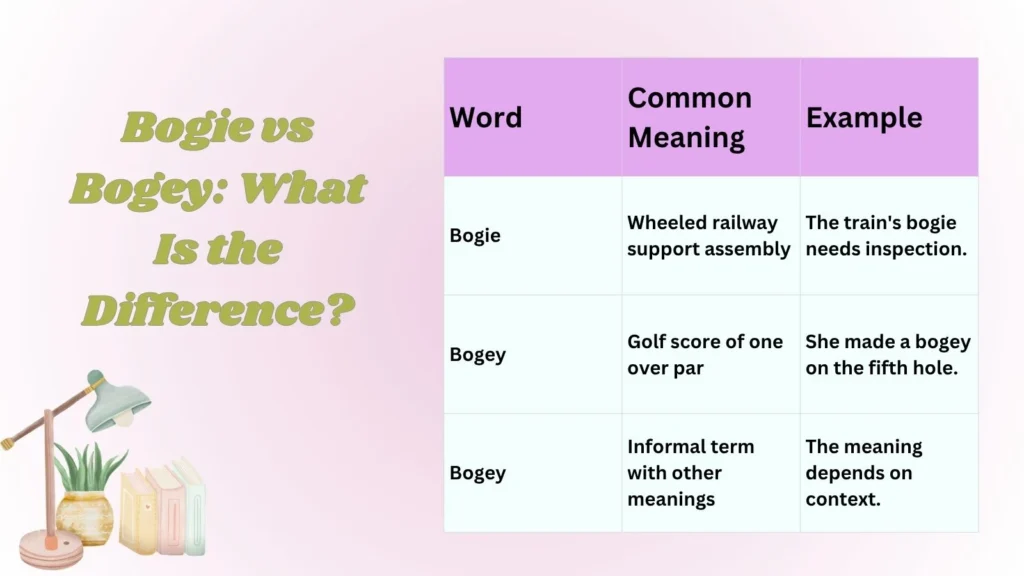
| Word | Common Meaning | Example |
|---|---|---|
| Bogie | Wheeled railway support assembly | The train’s bogie needs inspection. |
| Bogey | Golf score of one over par | She made a bogey on the fifth hole. |
| Bogey | Informal term with other meanings | The meaning depends on context. |
So, if you are talking about trains, bogie is generally the word you want. If you are talking about golf, the standard spelling is bogey.
Bogie Meaning in Golf
Here is where spelling becomes especially important.
In golf, the term is normally spelled bogey, not bogie. A bogey means a golfer takes one stroke more than the stated par for a hole.
For example, if a hole is a par 4 and a golfer completes it in 5 strokes, the golfer has made a bogey.
This is not normally the railway meaning of bogie.
Simple Golf Example
Suppose a hole is par 3.
- 3 strokes = par
- 4 strokes = bogey
- 5 strokes = double bogey
Therefore, if someone says, “I made a bogey on the seventh hole,” they are most likely talking about golf rather than trains.
Bogie Meaning in British English
Bogie is particularly common in British and international railway terminology.
Railway systems around the world use the concept of bogies, although the exact engineering design can vary between vehicles.
In everyday British English, however, other spellings and meanings may appear. This is another reason why context is important.
If you encounter the word in a railway article, technical manual, or discussion about trains, the railway meaning is usually the relevant one.
Bogie Meaning in Engineering
In engineering, a bogie is generally understood as a wheeled chassis or framework that supports a vehicle or equipment.
Railway bogies are the most familiar example, but the broader engineering concept involves a movable supporting assembly with wheels.
Engineers design bogies to balance several requirements, including:
- Weight capacity
- Stability
- Wheel and rail interaction
- Suspension performance
- Braking requirements
- Ride comfort
- Maintenance requirements
- Operating speed
High-speed trains require carefully engineered bogies because even small mechanical issues can affect ride quality and stability.
How to Remember the Meaning of Bogie
A simple memory trick can help.
Think of the “i” in bogie as standing for an important railway idea: the wheeled support underneath the train.
You can also remember the basic image:
Train carriage + wheels underneath = bogie
For golf, remember the alternative spelling:
Bogey = one over par
This simple distinction can prevent many spelling and meaning mistakes.
Synonyms and Related Terms for Bogie
There is not always a perfect synonym for bogie because it is a specific engineering term.
Depending on the context, related terms may include:
- Wheel assembly
- Wheeled frame
- Chassis
- Running gear
- Wheelset assembly
- Undercarriage
- Railway running gear
These words are not always exact substitutes. In technical railway writing, bogie is usually the more precise term.
Why Is the Bogie Important?
Without an appropriate wheel-support system, modern railway vehicles could not operate in the same way.
Bogies help railway vehicles carry their weight, travel along tracks, negotiate curves, manage vibration, and incorporate systems such as brakes and traction equipment.
They are therefore essential to railway vehicle design.
Although passengers rarely see the bogies while traveling, these mechanical assemblies play a major role underneath the vehicle.
Common Mistakes About Bogie Meaning

Confusing Bogie With Bogey
This is the most common mistake. Bogie is commonly used for railway equipment, while bogey is commonly used for a golf score of one over par.
Thinking a Bogie Is Just a Wheel
A bogie is not simply one wheel. It is a complete supporting assembly that can contain wheels, axles, suspension, braking equipment, and other components.
Assuming Bogie Always Means a Train
The railway meaning is the most common technical use, but related or informal meanings may appear depending on the variety of English and context.
Using Bogey for Railway Equipment
In standard railway terminology, bogie is the appropriate spelling for the wheeled support assembly.
Assuming Bogie Is a Texting Abbreviation
Bogie is not generally a standard texting abbreviation. If you see it in a message, examine the surrounding conversation to determine the intended meaning.
FAQs:
What does bogie mean?
Bogie commonly means a wheeled framework or assembly that supports a railway vehicle. It can contain wheels, axles, suspension, braking systems, and other components.
What is a bogie on a train?
A train bogie is the wheeled support structure located underneath a railway vehicle. It helps support the vehicle and allows it to travel along the track and negotiate curves.
What is the difference between bogie and bogey?
Bogie commonly refers to railway equipment, while bogey is commonly used in golf for a score of one over par on a hole. “Bogey” also has other context-specific meanings.
What does bogie mean in golf?
In golf, the standard spelling is generally bogey, not bogie. A bogey means completing a hole in one stroke over par.
Is bogie a slang word?
Bogie is primarily a technical railway term. Some related forms and spellings have informal meanings, but whether it is slang depends on the context and variety of English being used.
Final Thoughts:
The bogie meaning is easiest to understand when you consider the context. In railway terminology, a bogie is a wheeled supporting assembly located underneath a train, carriage, locomotive, or other railway vehicle.
Bogies help with weight distribution, stability, suspension, braking, and movement through curves. They are important mechanical systems even though passengers usually do not notice them.
The biggest language confusion comes from bogie vs bogey. In golf, the usual spelling is bogey, meaning one stroke over par on a hole. In railway engineering, bogie is the standard term for the wheeled support assembly.

I am Henry James and i am a passionate writer and language enthusiast behind PunPalace, a platform dedicated to exploring meanings, word origins, and simple explanations. My aims to make learning vocabulary easy, engaging, and accessible for everyone.